Exercise 11
(i)
Robot starts from the origin and traces a path by repeatedly moving units to the right and then units upward. Robot starts from the point and repeatedly moves unit to the right and then units upward. Will the paths traced by these two robots intersect and if so, where?
(ii)
Robot starts from and traces a path by repeatedly moving units to the right and then units upward. Robot starts from the point and repeatedly moves units to the right and then units downwards. Will the paths traced by these two robots intersect and if so, where?
Not cross-checked
This solution has not been cross-checked against the answer printed in NCERT.
A robot's corner points, after each full move, lie on a line with slope \(\displaystyle \text{rise}/\text{run}\).(i) Robot $\displaystyle 1$: through \(\displaystyle (0,0)\), slope \(\displaystyle \tfrac{4}{3}\). Robot $\displaystyle 2$: through \(\displaystyle (10,0)\), slope \(\displaystyle 2\).\[y=\tfrac{4}{3}x, \qquad y=2(x-10) \]\[\tfrac{4}{3}x=2x-20 \Rightarrow \tfrac{2}{3}x=20 \Rightarrow x=30, \quad y=40 \]Both robots stand at this corner, after $\displaystyle 10$ and $\displaystyle 20$ cycles.\[(3\cdot 10,\ 4\cdot 10)=(10+20,\ 2\cdot 20)=(30,40) \]The staircases first touch earlier, when Robot $\displaystyle 1$ ($\displaystyle 7$ cycles, then $\displaystyle 3$ right) meets Robot $\displaystyle 2$ ($\displaystyle 14$ cycles).\[(3\cdot 7+3,\ 4\cdot 7)=(10+14,\ 2\cdot 14)=(24,28) \](ii) Robot $\displaystyle 1$: through \(\displaystyle (3,0)\), slope \(\displaystyle 1\). Robot $\displaystyle 2$: through \(\displaystyle (7,0)\), slope \(\displaystyle -\tfrac{3}{5}\).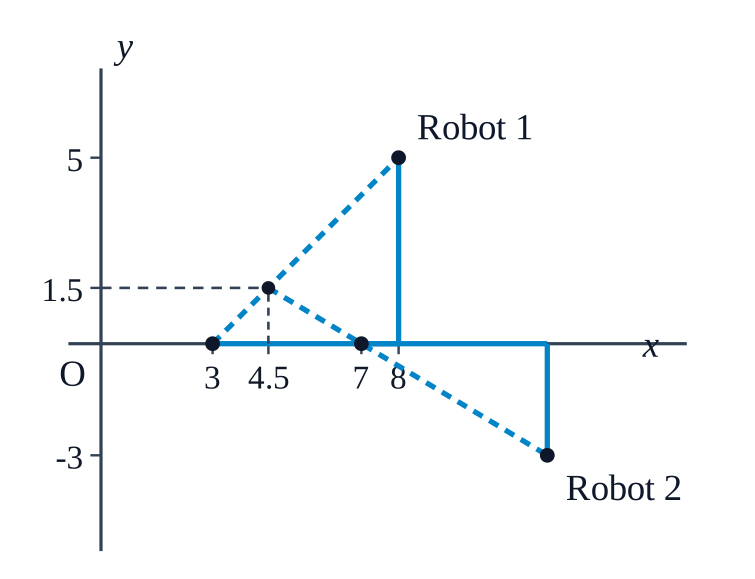 \[y=x-3, \qquad y=-\tfrac{3}{5}(x-7) \]\[5x-15=-3x+21 \Rightarrow x=\tfrac{9}{2}, \quad y=\tfrac{3}{2} \]This point lies behind Robot $\displaystyle 2$'s start \(\displaystyle (7,0)\), so Robot $\displaystyle 2$ never reaches it. The staircases share only the stretch \(\displaystyle (7,0)\) to \(\displaystyle (8,0)\) on the \(\displaystyle x\)-axis.Answer: (i) Yes: the paths first touch at \(\displaystyle (24,28)\); the lines meet at \(\displaystyle (30,40)\). (ii) Yes: along the \(\displaystyle x\)-axis from \(\displaystyle (7,0)\) to \(\displaystyle (8,0)\); the lines meet at \(\displaystyle (4.5,\,1.5)\), behind Robot $\displaystyle 2$'s start.
\[y=x-3, \qquad y=-\tfrac{3}{5}(x-7) \]\[5x-15=-3x+21 \Rightarrow x=\tfrac{9}{2}, \quad y=\tfrac{3}{2} \]This point lies behind Robot $\displaystyle 2$'s start \(\displaystyle (7,0)\), so Robot $\displaystyle 2$ never reaches it. The staircases share only the stretch \(\displaystyle (7,0)\) to \(\displaystyle (8,0)\) on the \(\displaystyle x\)-axis.Answer: (i) Yes: the paths first touch at \(\displaystyle (24,28)\); the lines meet at \(\displaystyle (30,40)\). (ii) Yes: along the \(\displaystyle x\)-axis from \(\displaystyle (7,0)\) to \(\displaystyle (8,0)\); the lines meet at \(\displaystyle (4.5,\,1.5)\), behind Robot $\displaystyle 2$'s start.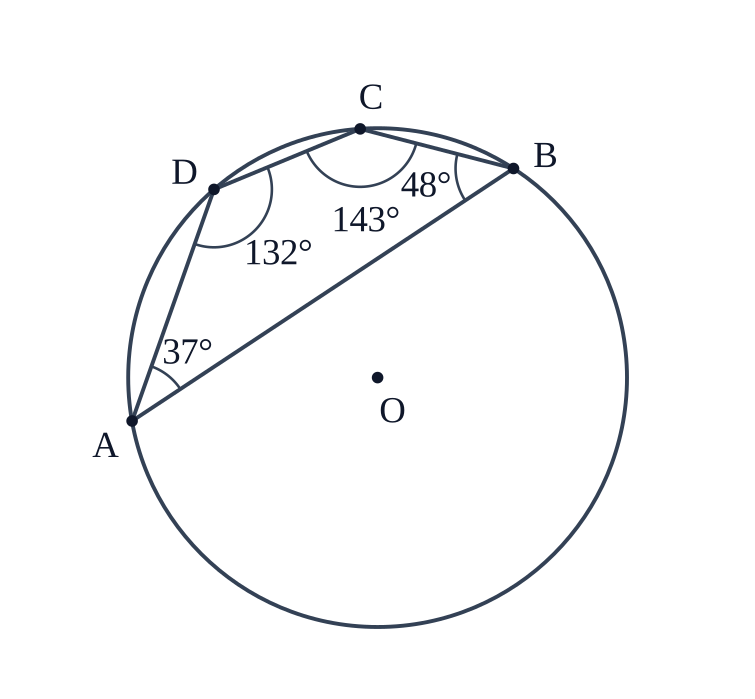 \[\angle A+\angle C=180^\circ \Rightarrow (x+7)+(3y+23)=180 \Rightarrow x+3y=150 \quad (1) \]\[\angle B+\angle D=180^\circ \Rightarrow (y+8)+(4x+12)=180 \Rightarrow 4x+y=160 \quad (2) \]\[(2) \Rightarrow y=160-4x \]\[(1) \Rightarrow x+3(160-4x)=150 \Rightarrow 480-11x=150 \Rightarrow x=30, \quad y=40 \]\[\angle A=37^\circ, \quad \angle B=48^\circ, \quad \angle C=143^\circ, \quad \angle D=132^\circ \]Check:\[37+143=180, \qquad 48+132=180 \]Answer: \(\displaystyle \angle A=37^\circ,\ \angle B=48^\circ,\ \angle C=143^\circ,\ \angle D=132^\circ\)