SolveIt is under development
SolveItClass 9 · NCERT

NCERT Solutions · Class 9 Mathematics Two Variables, One Line

42 questions · 42 still being checked

Exercise Set 13.3 1–4 (part 3 of 7)

  1. Exercise 1

    NCERT_Question_Class9_Maths_Ch13_Ex13-3_Q1 The following diagrams represent ski hills. Rank the hills in order of their steepness, from least to greatest.

    Not cross-checked

    This solution has not been cross-checked against the answer printed in NCERT.

    In each diagram the vertical side is the rise and the horizontal side is the run. A steeper hill has a greater slope.\[\text{A: } \frac{60}{70} = \frac{6}{7} \approx 0.857 \] \[\text{B: } \frac{60}{110} = \frac{6}{11} \approx 0.545 \] \[\text{C: } \frac{80}{100} = \frac{4}{5} = 0.8 \] \[\frac{6}{11} < \frac{4}{5} < \frac{6}{7} \]Answer: B, C, A (least to greatest steepness).
  2. Exercise 2

    The ramp at a loading dock rises 2.5\displaystyle 2.5 metres over a run of 4\displaystyle 4 metres. Find the slope of the ramp.

    Not cross-checked

    This solution has not been cross-checked against the answer printed in NCERT.

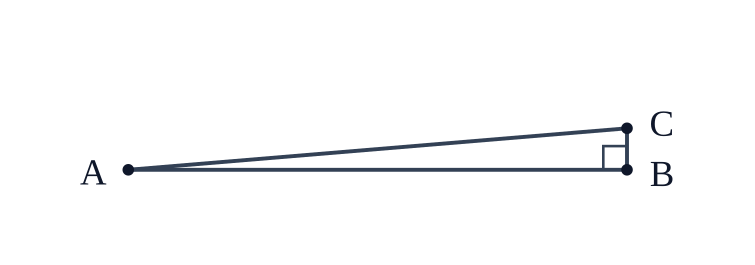
    The ramp is the slanting side AC of the right triangle in the figure.NCERT_Solution_Class9_Maths_Ch13_Ex13-3_Q2\[\text{Rise} = BC = 2.5 \text{ m}, \quad \text{Run} = AB = 4 \text{ m} \] \[\text{Slope} = \frac{\text{Rise}}{\text{Run}} = \frac{2.5}{4} = \frac{5}{8} = 0.625 \]Answer: slope \(\displaystyle = \dfrac{5}{8} = 0.625 \)
  3. Exercise 3

    Find the slope of the line l\displaystyle l in each of the following diagrams.
    (i)
    NCERT_Question_Class9_Maths_Ch13_Ex13-3_Q3_i
    (ii)
    NCERT_Question_Class9_Maths_Ch13_Ex13-3_Q3_ii
    (iii)
    NCERT_Question_Class9_Maths_Ch13_Ex13-3_Q3_iii
    (iv)
    NCERT_Question_Class9_Maths_Ch13_Ex13-3_Q3_iv

    Not cross-checked

    This solution has not been cross-checked against the answer printed in NCERT.

    (i) The line \(\displaystyle l\) is horizontal, so any two points on it have the same \(\displaystyle y\): rise \(\displaystyle = 0\). \[m = \frac{y_2 - y_1}{x_2 - x_1} = \frac{0}{x_2 - x_1} = 0 \](ii) The marked points are \(\displaystyle (-2, 2)\) and \(\displaystyle (2, -2)\). \[m = \frac{-2 - 2}{2 - (-2)} = \frac{-4}{4} = -1 \](iii) The marked points are \(\displaystyle (-2, -1)\) and \(\displaystyle (1, 1)\). \[m = \frac{1 - (-1)}{1 - (-2)} = \frac{2}{3} \](iv) The line \(\displaystyle l\) is vertical, so every point on it has the same \(\displaystyle x\): run \(\displaystyle = 0\). \[m = \frac{y_2 - y_1}{x_2 - x_1} = \frac{y_2 - y_1}{0} \quad \text{(division by 0)} \]Answer: (i) \(\displaystyle 0\); (ii) \(\displaystyle -1\); (iii) \(\displaystyle \dfrac{2}{3}\); (iv) undefined.
  4. Exercise 4

    An accessibility ramp for wheelchairs is to be made alongside the staircase. The guidelines given for the slope of the ramp is 1\displaystyle 1 cm vertical rise to 12\displaystyle 12 cm horizontal length. What should be the horizontal length of the ramp if the total height of the stairs is 18\displaystyle 18 cm?

    Not cross-checked

    This solution has not been cross-checked against the answer printed in NCERT.

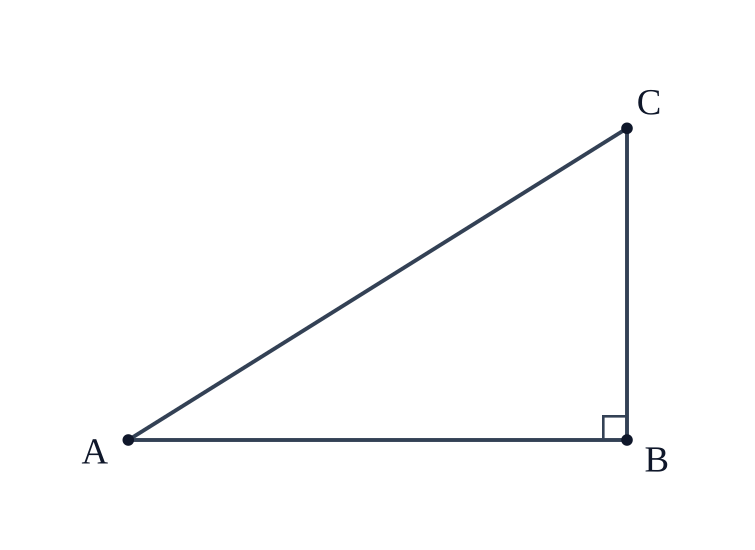
    The ramp and the stairs form a right triangle, as in the figure.NCERT_Solution_Class9_Maths_Ch13_Ex13-3_Q4\[\text{Slope} = \frac{\text{Rise}}{\text{Run}} = \frac{1}{12} \] \[\text{Rise} = BC = 18 \text{ cm}, \quad \text{Run} = AB = x \] \[\frac{18}{x} = \frac{1}{12} \] \[x = 18 \times 12 = 216 \text{ cm} \]Answer: horizontal length \(\displaystyle = 216\) cm (\(\displaystyle 2.16\) m)