Choose \(\displaystyle x\), find \(\displaystyle y\), and read the quadrant from the signs.
(i)
\[x=2:\ 10+3y=7 \Rightarrow y=-1 \]
\[x=-1:\ -5+3y=7 \Rightarrow y=4 \]
\(\displaystyle (2,-1)\) lies in quadrant IV; \(\displaystyle (-1,4)\) in quadrant II.
(ii)
\[x=2:\ 10-3y=7 \Rightarrow y=1 \]
\[x=-1:\ -5-3y=7 \Rightarrow y=-4 \]
\(\displaystyle (2,1)\) lies in quadrant I; \(\displaystyle (-1,-4)\) in quadrant III.
(iii)
\[x=1:\ -5+3y=7 \Rightarrow y=4 \]
\[x=-2:\ 10+3y=7 \Rightarrow y=-1 \]
\(\displaystyle (1,4)\) lies in quadrant I; \(\displaystyle (-2,-1)\) in quadrant III.
(iv)
\[x=-2:\ 10-3y=7 \Rightarrow y=1 \]
\[x=1:\ -5-3y=7 \Rightarrow y=-4 \]
\(\displaystyle (-2,1)\) lies in quadrant II; \(\displaystyle (1,-4)\) in quadrant IV.
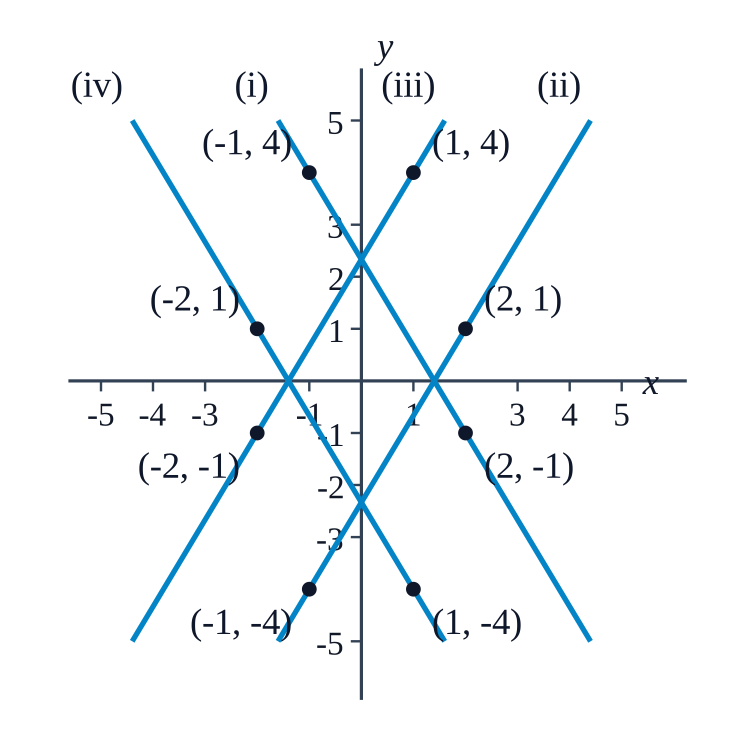
Any other two solutions in different quadrants are equally valid.
Answer: (i) \(\displaystyle (2,-1)\) IV, \(\displaystyle (-1,4)\) II; (ii) \(\displaystyle (2,1)\) I, \(\displaystyle (-1,-4)\) III; (iii) \(\displaystyle (1,4)\) I, \(\displaystyle (-2,-1)\) III; (iv) \(\displaystyle (-2,1)\) II, \(\displaystyle (1,-4)\) IV.
 Consider the graph of the equation