SolveItClass 12 · NCERT

NCERT Solutions · Class 12 Chemistry Coordination Compounds

31 questions · 26 still being checked

Exercises 5.11–5.20 (part 2 of 3)

  1. Exercise 5.11

    Draw all the isomers (geometrical and optical) of:
    (i)
    [CoCl2(en)2]+\displaystyle \mathrm{[CoCl_{2}(en)_{2}]^{+}}
    (ii)
    [Co(NH3)Cl(en)2]2+\displaystyle \mathrm{[Co(NH_{3})Cl(en)_{2}]^{2+}}
    (iii)
    [Co(NH3)2Cl2(en)]+\displaystyle \mathrm{[Co(NH_{3})_{2}Cl_{2}(en)]^{+}}

    Not cross-checked

    This solution has not been cross-checked against the answer printed in NCERT.
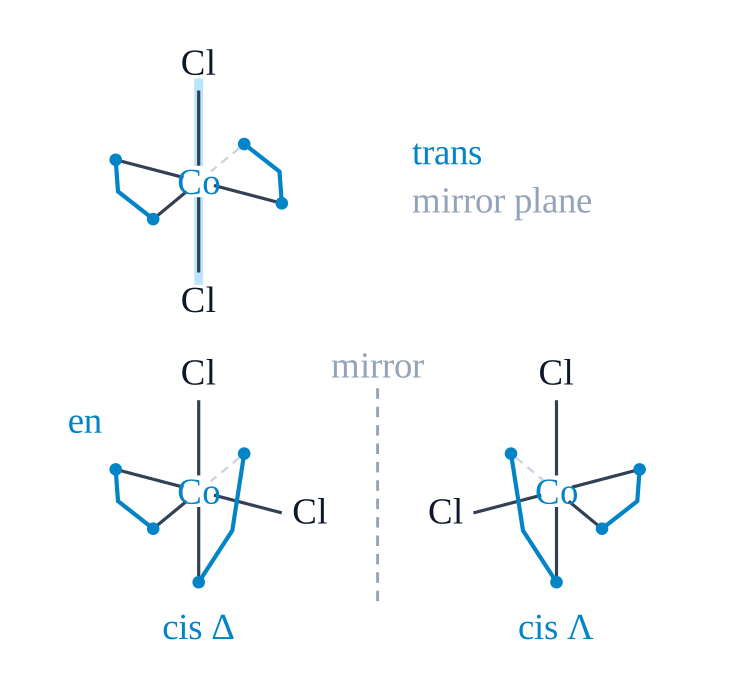
    Ethylenediamine (en) is a symmetric bidentate ligand with a bite angle of about $\displaystyle 90$° — it can only span two CIS positions of an octahedron, never two that are trans ($\displaystyle 180$°) to each other. Every isomer below follows from that single geometric fact, together with the two tests you need: a geometrical isomer comes from placing the same set of ligands cis ($\displaystyle 90$° apart) or trans ($\displaystyle 180$° apart); an optical isomer exists only when the mirror image of the structure cannot be rotated back onto the original (no internal mirror plane survives).(i) \(\displaystyle [CoCl_2(en)_2]^+\)Both en ligands must each straddle a cis pair of positions, leaving the two \(\displaystyle Cl\) ligands to occupy whatever two positions remain.
    trans-\(\displaystyle [CoCl_2(en)_2]^+\): the two \(\displaystyle Cl\) atoms sit at opposite (axial) corners of the octahedron, and the two en ligands share the four equatorial positions between them. A mirror plane runs through both \(\displaystyle Cl\) atoms and bisects the molecule, so this structure is identical to its own mirror image. It is optically inactive — there is only one trans form.
    cis-\(\displaystyle [CoCl_2(en)_2]^+\): the two \(\displaystyle Cl\) atoms are adjacent ($\displaystyle 90$° apart). No mirror plane survives this arrangement — the two chelate rings now twist around the cobalt with a definite handedness — so the mirror image is a genuinely different, non-superimposable structure. This is the step people skip: "cis" here does not mean one molecule, it means two — a right-handed twist (Δ-cis, historically d-cis) and a left-handed twist (Λ-cis, historically l-cis), which are non-superimposable mirror images of each other.
    \(\displaystyle [CoCl_2(en)_2]^+\) therefore has $\displaystyle 3$ isomers: $\displaystyle 1$ achiral trans form + a Δ/Λ (d/l) enantiomeric pair of the cis form.(ii) \(\displaystyle [Co(NH_3)Cl(en)_2]^{2+}\)Same skeleton as (i), with one \(\displaystyle Cl\) replaced by \(\displaystyle NH_3\); the same cis/trans argument now applies to the \(\displaystyle NH_3\)–\(\displaystyle Cl\) pair.
    trans-\(\displaystyle [Co(NH_3)Cl(en)_2]^{2+}\): \(\displaystyle NH_3\) and \(\displaystyle Cl\) occupy the two opposite axial positions, with the en ligands filling the equatorial girdle. A mirror plane runs through the \(\displaystyle NH_3\)–Co–\(\displaystyle Cl\) axis, making this form superimposable on its own mirror image — optically inactive.
    cis-\(\displaystyle [Co(NH_3)Cl(en)_2]^{2+}\): \(\displaystyle NH_3\) and \(\displaystyle Cl\) are adjacent. As in (i), no mirror plane survives, so this form is chiral and exists as a Δ (d) and a Λ (l) enantiomer, non-superimposable mirror images of each other.
    \(\displaystyle [Co(NH_3)Cl(en)_2]^{2+}\) therefore also has $\displaystyle 3$ isomers: $\displaystyle 1$ achiral trans form + a Δ/Λ enantiomeric pair of the cis form.(iii) \(\displaystyle [Co(NH_3)_2Cl_2(en)]^+\)The en ligand again occupies two cis positions, leaving four positions for two \(\displaystyle NH_3\) and two \(\displaystyle Cl\). Once the two \(\displaystyle Cl\) positions are chosen, the two \(\displaystyle NH_3\) are forced into whatever positions remain, so it is the \(\displaystyle Cl\)–\(\displaystyle Cl\) relationship that fixes the overall shape:
    trans-\(\displaystyle [Co(NH_3)_2Cl_2(en)]^+\): the two \(\displaystyle Cl\) atoms are directly opposite each other ($\displaystyle 180$°); the two \(\displaystyle NH_3\) ligands and the en then take up the remaining, symmetric set of cis positions. An internal mirror plane passes through the two \(\displaystyle Cl\) atoms, so this structure is superimposable on its mirror image — optically inactive.
    cis-\(\displaystyle [Co(NH_3)_2Cl_2(en)]^+\): the two \(\displaystyle Cl\) atoms are adjacent ($\displaystyle 90$° apart), which in turn puts the two \(\displaystyle NH_3\) ligands cis to each other as well. This destroys the mirror plane, so — exactly as in (i) and (ii) — the cis form is chiral and exists as a Δ (right-handed) and a Λ (left-handed) enantiomer, non-superimposable mirror images of one another.
    \(\displaystyle [Co(NH_3)_2Cl_2(en)]^+\) therefore has $\displaystyle 3$ isomers: $\displaystyle 1$ achiral trans form + a Δ/Λ enantiomeric pair of the cis form.The recurring trap in all three parts is treating "the cis isomer" as a single structure: because en's bite forces a fixed handedness onto whatever else is arranged cis to it, the cis arrangement is never one molecule — it is always a non-superimposable Δ/Λ (d/l) pair, while the trans arrangement, having a mirror plane, is always just one, optically inactive structure.Answer: Each of the three complexes shows both geometrical and optical isomerism, giving $\displaystyle 3$ stereoisomers apiece, in the same pattern — one achiral trans isomer and a chiral cis isomer that exists as a non-superimposable Δ/Λ (d/l) enantiomeric pair: (i) trans-\(\displaystyle [CoCl_2(en)_2]^+\) and Δ/Λ-cis-\(\displaystyle [CoCl_2(en)_2]^+\); (ii) trans-\(\displaystyle [Co(NH_3)Cl(en)_2]^{2+}\) and Δ/Λ-cis-\(\displaystyle [Co(NH_3)Cl(en)_2]^{2+}\); (iii) trans-\(\displaystyle [Co(NH_3)_2Cl_2(en)]^+\) and Δ/Λ-cis-\(\displaystyle [Co(NH_3)_2Cl_2(en)]^+\).
  2. Exercise 5.12

    Write all the geometrical isomers of [Pt(NH3)(Br)(Cl)(py)]\displaystyle \mathrm{[Pt(NH_{3})(Br)(Cl)(py)]} and how many of these will exhibit optical isomers?

    Not cross-checked

    This solution has not been cross-checked against the answer printed in NCERT.

    NCERT’s answer
    Three (two cis and one trans)
    In a square-planar complex, geometrical isomers differ only in which ligand sits trans (directly across the metal) from which — nothing else can change.The complex \(\displaystyle [\mathrm{Pt(NH_3)(Br)(Cl)(py)}] \) is square planar (four-coordinate \(\displaystyle \mathrm{Pt^{2+}} \), a \(\displaystyle d^8\) ion), and it carries four different monodentate ligands: \(\displaystyle \mathrm{NH_3} \), \(\displaystyle \mathrm{Br^-} \), \(\displaystyle \mathrm{Cl^-} \), and pyridine (py \(\displaystyle = \mathrm{C_5H_5N} \), bonded through N). This is the general type \(\displaystyle \mathrm{MABCD} \) — one distinct ligand at each corner of the square around the metal.Label the four corners of the square $\displaystyle 1$, $\displaystyle 2$, $\displaystyle 3$, $\displaystyle 4$ going around it, so that corners $\displaystyle 1$ and $\displaystyle 3$ are trans to each other, and so are $\displaystyle 2$ and 4. Once you fix which pair of ligands sits trans, the whole isomer is fixed — the other two ligands are automatically forced trans to each other in the two remaining corners. With four ligands \(\displaystyle A, B, C, D \), there are exactly three ways to split them into two trans pairs:\[(A\text{-}trans\text{-}B,\ C\text{-}trans\text{-}D), \qquad (A\text{-}trans\text{-}C,\ B\text{-}trans\text{-}D), \qquad (A\text{-}trans\text{-}D,\ B\text{-}trans\text{-}C) \]The step people skip: rotating the whole flat molecule in its own plane, or flipping it over, does not create a new isomer — it only changes which corner you happen to call "$\displaystyle 1$". So any arrangement you can draw collapses onto one of the three pairings above, giving exactly three distinct geometrical isomers:
    Isomer I — \(\displaystyle \mathrm{NH_3} \) trans to \(\displaystyle \mathrm{Br} \); \(\displaystyle \mathrm{Cl} \) trans to py
    Isomer II — \(\displaystyle \mathrm{NH_3} \) trans to \(\displaystyle \mathrm{Cl} \); \(\displaystyle \mathrm{Br} \) trans to py
    Isomer III — \(\displaystyle \mathrm{NH_3} \) trans to py; \(\displaystyle \mathrm{Br} \) trans to \(\displaystyle \mathrm{Cl} \)
    Now, optical isomerism. A molecule is optically active only if its mirror image cannot be superimposed back onto it — and square-planar complexes almost never manage this. In each isomer above, the metal and all four donor atoms lie in a single plane, and that plane is itself a plane of symmetry (\(\displaystyle \sigma_h \)) of the molecule: reflecting the entire structure through its own plane leaves every ligand sitting exactly where it started. A structure that possesses such an internal mirror plane is always superimposable on its own mirror image — it is achiral, not chiral.This holds for Isomer I, II, and III individually: none of them has a stereocentre held out of plane, so each one's "mirror image" is just the same molecule again. Hence none of the three geometrical isomers is optically active.Answer: $\displaystyle 3$ geometrical isomers exist — (NH₃/Br trans, Cl/py trans), (NH₃/Cl trans, Br/py trans), and (NH₃/py trans, Br/Cl trans); none of them ($\displaystyle 0$) shows optical isomerism, since the plane of the square-planar complex is itself a plane of symmetry.
  3. Exercise 5.13

    Aqueous copper sulphate solution (blue in colour) gives:
    (i)
    a green precipitate with aqueous potassium fluoride and
    (ii)
    a bright green solution with aqueous potassium chloride. Explain these experimental results.
    NCERT’s answer
    Aqueous \(\displaystyle CuSO_{4}\) solution exists as [Cu(\(\displaystyle H_{2}\)O)$\displaystyle 4$]\(\displaystyle SO_{4}\) which has blue colour due to [Cu(\(\displaystyle H_{2}\)O)$\displaystyle 4$]$\displaystyle 2$+ ions. (i) When KF is added, the weak \(\displaystyle H_{2}\)O ligands are replaced by \(\displaystyle F^{¯}\)ligands, forming [\(\displaystyle CuF_{4}\)]$\displaystyle 2$" ions which is a green precipitate. [Cu(\(\displaystyle H_{2}\)O)$\displaystyle 4$]$\displaystyle 2$+ + \(\displaystyle 4F^{-}\) → [\(\displaystyle CuF_{4}\)]$\displaystyle 2$- + \(\displaystyle 4H_{2}\)O (ii) When KCl is added, \(\displaystyle Cl^{¯}\)ligands replace the weak \(\displaystyle H_{2}\)O ligands forming [\(\displaystyle CuCl_{4}\))$\displaystyle 2$- ions which has bright green colour. [Cu(\(\displaystyle H_{2}\)O)$\displaystyle 4$]$\displaystyle 2$+ + \(\displaystyle 4Cl^{-}\) → [\(\displaystyle CuCl_{4}\)]$\displaystyle 2$- + \(\displaystyle 4H_{2}\)O
    The colour you see comes from which ligands sit on Cu²⁺ right now, not from Cu²⁺ by itself. Aqueous \(\displaystyle CuSO_4\) is blue because the copper exists as the hexaaquacopper(II) ion, \(\displaystyle [Cu(H_2O)_6]^{2+}\); its particular arrangement of ligands splits the d-orbitals by a certain amount \(\displaystyle \Delta_o\), and the wavelength of visible light absorbed to promote an electron across that gap is what leaves the transmitted blue colour behind. Change the ligands around Cu²⁺ and you change \(\displaystyle \Delta_o\) — so you change the colour, and you may also change how soluble the resulting salt is. That is the one idea both parts of this question turn on.(i) With aqueous KF — a green precipitateFluoride is a small, hard, weak-field ligand. When \(\displaystyle F^-\) is added, it displaces some — not all — of the water molecules bound to \(\displaystyle \mathrm{Cu^{2+}}\): \[[Cu(H_2O)_6]^{2+} + 4F^- \longrightarrow [CuF_4(H_2O)_2]^{2-} + 4H_2O \] The mixed complex \(\displaystyle [CuF_4(H_2O)_2]^{2-}\) has a different crystal field splitting from the pure aqua ion, so it absorbs a different part of the visible spectrum and appears green rather than blue. Its potassium salt, \(\displaystyle K_2[CuF_4(H_2O)_2]\), is only sparingly soluble in water, so as it forms it comes out of solution as a green precipitate instead of staying dissolved.(ii) With aqueous KCl — a bright green solutionChloride is a weaker-field ligand than water and a much larger, softer ion than fluoride, so it favours a different coordination number. Because KCl is added as a solution, \(\displaystyle Cl^-\) is present in large excess, and this excess drives the substitution all the way — every water ligand is displaced, not just some of them: \[[Cu(H_2O)_6]^{2+} + 4Cl^- \longrightarrow [CuCl_4]^{2-} + 6H_2O \] The product is the tetrahedral tetrachlorocuprate(II) ion, \(\displaystyle [CuCl_4]^{2-}\), which is green — but unlike the fluoro complex above, its potassium salt \(\displaystyle K_2[CuCl_4]\) is freely soluble in water. With nothing to precipitate, the green colour simply shows up as the colour of the solution itself.The step people get wrong: it's tempting to think "\(\displaystyle F^-\) is a stronger ligand than \(\displaystyle Cl^-\), so it should form the more complete complex." What actually decides full versus partial substitution here is the solubility of the product, not just ligand strength — the fluoro complex precipitates the moment enough of it forms (pulling the equilibrium to a partial, low-solubility composition), while the soluble chloro complex is free to go all the way to \(\displaystyle [CuCl_4]^{2-}\) once \(\displaystyle Cl^-\) is in excess. Colour change alone only tells you the ligand field around \(\displaystyle \mathrm{Cu^{2+}}\) has changed; whether that shows up as a precipitate or a coloured solution is a separate question of solubility.Answer: Both results come from ligand substitution at Cu²⁺, replacing some or all of the coordinated water. With KF, partial replacement gives the green, sparingly soluble \(\displaystyle [CuF_4(H_2O)_2]^{2-}\) salt, which precipitates. With KCl, excess \(\displaystyle Cl^-\) fully replaces the water to give the green, water-soluble \(\displaystyle [CuCl_4]^{2-}\) ion, which stays in solution as a bright green colour.
  4. Exercise 5.14

    What is the coordination entity formed when excess of aqueous KCN is added to an aqueous solution of copper sulphate? Why is it that no precipitate of copper sulphide is obtained when H2S(g)\displaystyle \mathrm{H_{2}S(g)} is passed through this solution?

    Not cross-checked

    This solution has not been cross-checked against the answer printed in NCERT.

    NCERT’s answer
    [Cu(\(\displaystyle H_{2}\)O)$\displaystyle 4$]$\displaystyle 2$+ + $\displaystyle 4$ \(\displaystyle CN^{-}\) → [Cu(CN)$\displaystyle 4$]$\displaystyle 2$- + \(\displaystyle 4H_{2}\)O As \(\displaystyle CN^{¯}\)is a strong ligand, it forms a highly stable complex with \(\displaystyle Cu^{2+}\) ion. On passing \(\displaystyle H_{2}\)S, free \(\displaystyle Cu^{2+}\) ions are not available to form the precipitate of CuS.
    Cyanide is not only a ligand here — towards \(\displaystyle \mathrm{Cu^{2+}} \) it is also a reducing agent. So the copper you start with as Cu(II) does not stay Cu(II); the entity that survives in excess \(\displaystyle \mathrm{KCN} \) is a copper(I) complex, \(\displaystyle [\mathrm{Cu(CN)_4}]^{3-} \). Getting this right is the whole first half of the question.Step $\displaystyle 1$ — what is in solution before you add anything. Copper sulphate in water is not bare \(\displaystyle \mathrm{Cu^{2+}} \); it is the aquated ion \(\displaystyle [\mathrm{Cu(H_2O)_4}]^{2+} \) (blue). \(\displaystyle \mathrm{KCN} \) supplies \(\displaystyle \mathrm{K^+} \) and the cyanide ligand \(\displaystyle \mathrm{CN^-} \), which binds through carbon and is a strong-field ligand.Step $\displaystyle 2$ — the first drops of \(\displaystyle \mathrm{KCN} \): a precipitate that does not last. With a small amount of cyanide you get cupric cyanide, \[\mathrm{Cu^{2+}} + 2\,\mathrm{CN^-} \longrightarrow \mathrm{Cu(CN)_2}\downarrow \] a yellowish-brown solid. This is unstable at room temperature and decomposes, the cyanide reducing the copper and being oxidised itself to cyanogen gas, \(\displaystyle \mathrm{(CN)_2} \): \[2\,\mathrm{Cu(CN)_2} \longrightarrow 2\,\mathrm{CuCN}\downarrow + \mathrm{(CN)_2}\uparrow \] This is the redox step people miss. \(\displaystyle \mathrm{CN^-} \) is oxidised (its carbon goes from \(\displaystyle +2\) to \(\displaystyle +3\)) and \(\displaystyle \mathrm{Cu^{2+}} \) is reduced to \(\displaystyle \mathrm{Cu^{+}} \). Copper(II) and cyanide simply cannot coexist in water.Step $\displaystyle 3$ — excess \(\displaystyle \mathrm{KCN} \): the precipitate redissolves as the complex. The white \(\displaystyle \mathrm{CuCN} \) dissolves in more cyanide to give the tetrahedral tetracyanidocuprate(I) ion: \[\mathrm{CuCN} + 3\,\mathrm{CN^-} \longrightarrow [\mathrm{Cu(CN)_4}]^{3-} \] Putting the three steps together, the balanced overall reaction is \[2\,\mathrm{CuSO_4} + 10\,\mathrm{KCN} \longrightarrow 2\,\mathrm{K_3[Cu(CN)_4]} + \mathrm{(CN)_2}\uparrow + 2\,\mathrm{K_2SO_4} \] Check it: $\displaystyle 2$ Cu, $\displaystyle 10$ K, $\displaystyle 10$ CN and $\displaystyle 2$ sulphate on each side. The solution you are left holding is colourless (Cu(I) is \(\displaystyle d^{10} \), so there are no \(\displaystyle d\!-\!d \) transitions to give colour) — the loss of the blue is itself the evidence that the copper is no longer Cu(II).The coordination entity: \(\displaystyle [\mathrm{Cu(CN)_4}]^{3-} \), tetracyanidocuprate(I), present as the salt \(\displaystyle \mathrm{K_3[Cu(CN)_4]} \). Coordination number $\displaystyle 4$, geometry tetrahedral, oxidation state of Cu \(\displaystyle = +1\) (check: \(\displaystyle x + 4(-1) = -3 \Rightarrow x = +1\)).Step $\displaystyle 4$ — why \(\displaystyle \mathrm{H_2S} \) gives no copper sulphide. A sulphide precipitates only when the ionic product of its ions exceeds its solubility product \(\displaystyle K_{sp} \). The copper in this solution is locked inside a complex of enormous stability, so the free copper-ion concentration is vanishingly small, and the ionic product never reaches \(\displaystyle K_{sp} \).Put numbers on it. The stability (formation) constant of the complex is \[\beta_4 = \frac{[\mathrm{Cu(CN)_4^{3-}}]}{[\mathrm{Cu^{+}}][\mathrm{CN^{-}}]^{4}} \approx 2 \times 10^{30} \] so, rearranging for the free ion with, say, \(\displaystyle [\mathrm{Cu(CN)_4^{3-}}] = 0.1\ \mathrm{mol\,L^{-1}} \) and leftover \(\displaystyle [\mathrm{CN^-}] = 0.1\ \mathrm{mol\,L^{-1}} \): \[[\mathrm{Cu^{+}}] = \frac{0.1}{(2\times10^{30})(0.1)^{4}} = \frac{0.1}{2\times10^{26}} \approx 5\times10^{-28}\ \mathrm{mol\,L^{-1}} \] Even taking a generous \(\displaystyle [\mathrm{S^{2-}}] = 10^{-3}\ \mathrm{mol\,L^{-1}} \) from the \(\displaystyle \mathrm{H_2S} \), the ionic product for copper(I) sulphide is \[[\mathrm{Cu^{+}}]^{2}[\mathrm{S^{2-}}] = (5\times10^{-28})^{2}(10^{-3}) \approx 2.5\times10^{-58} \] against \(\displaystyle K_{sp}(\mathrm{Cu_2S}) \approx 10^{-48} \). The ionic product is about ten orders of magnitude below \(\displaystyle K_{sp} \), so nothing precipitates. (The same argument holds if you write it for \(\displaystyle \mathrm{Cu^{2+}} \) and \(\displaystyle K_{sp}(\mathrm{CuS}) \approx 10^{-36} \) — the free-ion term is far too small either way. The exact constants vary between sources; the gap is so wide that the conclusion does not depend on which values you take.)A short aside on the trap: "no precipitate" does not mean there is no copper in the beaker. All the copper is still there — it is just not present as a free aquated ion. Precipitation depends on the concentration of the free ion, not on total copper.This is exactly the trick used in qualitative analysis to separate \(\displaystyle \mathrm{Cu^{2+}} \) from \(\displaystyle \mathrm{Cd^{2+}} \). \(\displaystyle [\mathrm{Cd(CN)_4}]^{2-} \) is far less stable (\(\displaystyle \beta_4 \approx 10^{18} \)), so it leaks enough free \(\displaystyle \mathrm{Cd^{2+}} \) for yellow \(\displaystyle \mathrm{CdS} \) to drop out, while the copper stays in solution.A note on the NCERT answer. The textbook's answer key gives the entity as \(\displaystyle [\mathrm{Cu(CN)_4}]^{2-} \), formed by simple ligand exchange \(\displaystyle [\mathrm{Cu(H_2O)_4}]^{2+} + 4\,\mathrm{CN^-} \rightarrow [\mathrm{Cu(CN)_4}]^{2-} + 4\,\mathrm{H_2O} \). That is a long-standing error in this exercise, and it is worth knowing why. Cyanide reduces \(\displaystyle \mathrm{Cu^{2+}} \) — the reaction visibly evolves cyanogen and the blue colour is discharged — and the compound actually crystallised from this solution is the copper(I) salt \(\displaystyle \mathrm{K_3[Cu(CN)_4]} \), a standard, well-characterised reagent. A \(\displaystyle d^9 \) \(\displaystyle [\mathrm{Cu(CN)_4}]^{2-} \) ion cannot be isolated from aqueous cyanide at all. Note that the second half of the book's answer is perfectly sound: whichever charge you assign, the reason no sulphide forms is that the complex is so stable that free copper ions are effectively absent. If you are asked this in an exam, write \(\displaystyle [\mathrm{Cu(CN)_4}]^{3-} \) and include the cyanogen equation — that shows the chemistry, and boards have accepted it.Answer: The coordination entity is \(\displaystyle [\mathrm{Cu(CN)_4}]^{3-} \), the tetrahedral tetracyanidocuprate(I) ion, obtained as \(\displaystyle \mathrm{K_3[Cu(CN)_4]} \) via \(\displaystyle 2\,\mathrm{CuSO_4} + 10\,\mathrm{KCN} \rightarrow 2\,\mathrm{K_3[Cu(CN)_4]} + \mathrm{(CN)_2}\uparrow + 2\,\mathrm{K_2SO_4} \); no copper sulphide precipitates because this complex has a huge stability constant (\(\displaystyle \beta_4 \sim 10^{30} \)), leaving a free copper-ion concentration of order \(\displaystyle 10^{-28}\ \mathrm{mol\,L^{-1}} \), so the ionic product stays far below \(\displaystyle K_{sp} \) of the sulphide. (NCERT's printed \(\displaystyle [\mathrm{Cu(CN)_4}]^{2-} \) is an error — cyanide reduces Cu(II) to Cu(I).)
  5. Exercise 5.15

    Discuss the nature of bonding in the following coordination entities on the basis of valence bond theory:
    (i)
    [Fe(CN)6]4\displaystyle \mathrm{[Fe(CN)_{6}]^{4-}}
    (ii)
    [FeF6]3\displaystyle \mathrm{[FeF_{6}]^{3-}}
    (iii)
    [Co(C2O4)3]3\displaystyle \mathrm{[Co(C_{2}O_{4})_{3}]^{3-}}
    (iv)
    [CoF6]3\displaystyle \mathrm{[CoF_{6}]^{3-}}

    Not cross-checked

    This solution has not been cross-checked against the answer printed in NCERT.

    In valence bond theory, everything hinges on one question for each complex: does the ligand make the metal's d-electrons pair up, or not? That answer fixes which orbitals are available for hybridisation, which in turn fixes the geometry and whether the complex is paramagnetic or diamagnetic. Work each entity the same way: find the oxidation state, write the d-electron count, check the ligand against the spectrochemical series, then hybridise.(i) \(\displaystyle [Fe(CN)_6]^{4-}\)Let the oxidation state of Fe be \(\displaystyle x\). Since \(\displaystyle CN^-\) carries charge \(\displaystyle -1\), \[x + 6(-1) = -4 \implies x = +2 \]\(\displaystyle \mathrm{Fe^{2+}}\) has the configuration \(\displaystyle [Ar]\,3d^6\).\(\displaystyle CN^-\) sits at the strong-field end of the spectrochemical series. A strong-field ligand forces the six 3d electrons to pair up inside just three of the five d orbitals \(\displaystyle (t_{2g}^6 e_g^0)\), which is the step people skip — you cannot hybridise until you know whether pairing happened first. That pairing leaves two of the five 3d orbitals completely empty.Those two empty 3d orbitals combine with one 4s and three 4p orbitals: \[d^2sp^3 \text{ hybridisation (six equivalent orbitals, octahedral)} \] Each \(\displaystyle CN^-\) donates a lone pair into one of these six \(\displaystyle d^2sp^3\) orbitals, giving an octahedral, inner-orbital complex. All six d-electrons are paired, so \(\displaystyle [Fe(CN)_6]^{4-}\) is diamagnetic.(ii) \(\displaystyle [FeF_6]^{3-}\)\[x + 6(-1) = -3 \implies x = +3 \]\(\displaystyle \mathrm{Fe^{3+}}\) has configuration \(\displaystyle [Ar]\,3d^5\).\(\displaystyle F^-\) is a weak-field ligand — it has no crystal-field stabilisation energy strong enough to force pairing. The five d-electrons stay unpaired, one in each of the five 3d orbitals \(\displaystyle (t_{2g}^3 e_g^2)\). With no vacant inner d orbital available, hybridisation must reach outward to the 4d shell: \[sp^3d^2 \text{ hybridisation (outer-orbital complex, using 4s, 4p, 4d)} \] This is an outer-orbital, high-spin complex with all $\displaystyle 5$ electrons unpaired. The magnetic moment, from \(\displaystyle \mu = \sqrt{n(n+2)}\) BM with \(\displaystyle n = 5\): \[\mu = \sqrt{5(5+2)} = \sqrt{35} \approx 5.92\ \text{BM} \] So \(\displaystyle [FeF_6]^{3-}\) is strongly paramagnetic.(iii) \(\displaystyle [Co(C_2O_4)_3]^{3-}\)Oxalate, \(\displaystyle C_2O_4^{2-}\), carries charge \(\displaystyle -2\): \[x + 3(-2) = -3 \implies x = +3 \]\(\displaystyle \mathrm{Co^{3+}}\) has configuration \(\displaystyle [Ar]\,3d^6\).Oxalate lies well above \(\displaystyle F^-\) (though below \(\displaystyle CN^-\)) in the spectrochemical series, and for the readily-paired \(\displaystyle \mathrm{Co^{3+}}\), \(\displaystyle d^6\) ion it is strong enough to force all six electrons into the three \(\displaystyle t_{2g}\) orbitals \(\displaystyle (t_{2g}^6 e_g^0)\), again leaving two 3d orbitals empty. Exactly as in (i), this gives: \[d^2sp^3 \text{ hybridisation (inner-orbital complex)} \] octahedral geometry, and since every electron is paired, \(\displaystyle [Co(C_2O_4)_3]^{3-}\) is diamagnetic.(iv) \(\displaystyle [CoF_6]^{3-}\)Same oxidation-state arithmetic as (ii) gives \(\displaystyle \mathrm{Co^{3+}}\): \(\displaystyle [Ar]\,3d^6\).Here \(\displaystyle F^-\) is the ligand — weak field again, so no pairing is forced. The six electrons spread out over all five 3d orbitals as far as the Pauli principle allows: \(\displaystyle t_{2g}^4 e_g^2\), leaving four unpaired electrons and no vacant 3d orbital for inner hybridisation. So, just as in (ii): \[sp^3d^2 \text{ hybridisation (outer-orbital complex)} \] Magnetic moment with \(\displaystyle n = 4\): \[\mu = \sqrt{4(4+2)} = \sqrt{24} \approx 4.90\ \text{BM} \] \(\displaystyle [CoF_6]^{3-}\) is paramagnetic.The pattern to carry forward: the same metal ion (\(\displaystyle Fe^{3+}\) with \(\displaystyle F^-\), or \(\displaystyle \mathrm{Co^{3+}}\) with \(\displaystyle F^-\) vs. oxalate) can be forced into completely different hybridisation schemes depending on how strong the ligand field is — the ligand, not just the metal, decides whether you get an inner-orbital or outer-orbital complex.Answer: (i) \(\displaystyle [Fe(CN)_6]^{4-}\): \(\displaystyle \mathrm{Fe^{2+}}\), \(\displaystyle 3d^6\), \(\displaystyle CN^-\) (strong field) pairs all electrons, \(\displaystyle d^2sp^3\) hybridisation, octahedral, diamagnetic. (ii) \(\displaystyle [FeF_6]^{3-}\): \(\displaystyle \mathrm{Fe^{3+}}\), \(\displaystyle 3d^5\), \(\displaystyle F^-\) (weak field) causes no pairing, \(\displaystyle sp^3d^2\) hybridisation, octahedral, paramagnetic ($\displaystyle 5$ unpaired e⁻, \(\displaystyle \mu \approx 5.92\) BM). (iii) \(\displaystyle [Co(C_2O_4)_3]^{3-}\): \(\displaystyle \mathrm{Co^{3+}}\), \(\displaystyle 3d^6\), oxalate pairs all electrons, \(\displaystyle d^2sp^3\) hybridisation, octahedral, diamagnetic. (iv) \(\displaystyle [CoF_6]^{3-}\): \(\displaystyle \mathrm{Co^{3+}}\), \(\displaystyle 3d^6\), \(\displaystyle F^-\) causes no pairing, \(\displaystyle sp^3d^2\) hybridisation, octahedral, paramagnetic ($\displaystyle 4$ unpaired e⁻, \(\displaystyle \mu \approx 4.90\) BM).
  6. Exercise 5.16

    Draw figure to show the splitting of d orbitals in an octahedral crystal field.

    Not cross-checked

    This solution has not been cross-checked against the answer printed in NCERT.

    Splitting happens because the six ligands approach along the axes, so orbitals pointing straight at the ligands are pushed up in energy more than orbitals pointing between the ligands.Picture the metal ion at the centre of a coordinate system with the six ligands sitting on the \(\displaystyle +x, -x, +y, -y, +z, -z\) axes — this is what "octahedral field" means. Each of the five d orbitals now interacts differently with this arrangement, depending on where its lobes point.Which orbitals point at the ligands, and which don't
    \(\displaystyle d_{z^2}\) has its lobes along the \(\displaystyle z\)-axis (plus a collar in the \(\displaystyle xy\)-plane), and \(\displaystyle d_{x^2-y^2}\) has its lobes along the \(\displaystyle x\)- and \(\displaystyle y\)-axes. Both point directly at a ligand. Electrons in these orbitals feel strong repulsion from the ligand's electron pairs, so these two orbitals are pushed up in energy.
    \(\displaystyle d_{xy}\), \(\displaystyle d_{yz}\), and \(\displaystyle d_{zx}\) have their lobes lying between the axes (e.g. \(\displaystyle d_{xy}\) lobes point between the \(\displaystyle x\)- and \(\displaystyle y\)-axes). They avoid the ligands, feel less repulsion, and are pushed down in energy relative to the other two.
    So the five orbitals, degenerate in the free ion, split into two sets:
    a lower set of three, called \(\displaystyle t_{2g}\): \(\displaystyle d_{xy},\ d_{yz},\ d_{zx}\)
    a higher set of two, called \(\displaystyle e_g\): \(\displaystyle d_{z^2},\ d_{x^2-y^2}\)
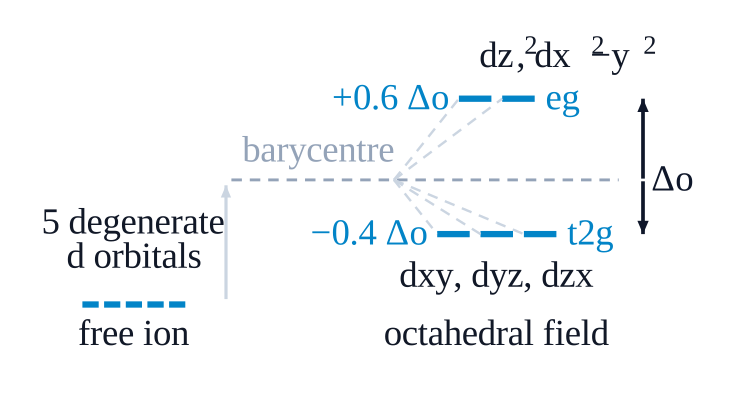
    The figureDraw a horizontal dashed line in the middle labelled the barycentre — this is the average energy the five orbitals would have if the ligand field were spread out evenly over a sphere instead of concentrated on $\displaystyle 6$ points (a hypothetical reference, not a real level). Then:
    above the dashed line, draw two short lines close together, labelled \(\displaystyle e_g\) (\(\displaystyle d_{z^2}\), \(\displaystyle d_{x^2-y^2}\)), raised by \(\displaystyle 0.6\,\Delta_o\)
    below the dashed line, draw three short lines close together, labelled \(\displaystyle t_{2g}\) (\(\displaystyle d_{xy}\), \(\displaystyle d_{yz}\), \(\displaystyle d_{zx}\)), lowered by \(\displaystyle 0.4\,\Delta_o\)
    mark a vertical double-headed arrow spanning from the \(\displaystyle t_{2g}\) level up to the \(\displaystyle e_g\) level, and label it \(\displaystyle \Delta_o\) (also written \(\displaystyle 10\,Dq\)) — the crystal field splitting energy, the whole gap the question is asking you to show.
    Why the split is \(\displaystyle 0.6\,\Delta_o\) up and \(\displaystyle 0.4\,\Delta_o\) down, not some other splitThe barycentre rule says the total energy of the five orbitals cannot change just because you relabelled the reference — energy gained by the orbitals that go up must exactly cancel energy lost by the orbitals that go down, orbital-by-orbital:Let the \(\displaystyle e_g\) set rise by \(\displaystyle x\) and the \(\displaystyle t_{2g}\) set fall by \(\displaystyle y\), each measured from the barycentre.\[\Delta_o = x + y \]\[2x = 3y \quad \text{(2 orbitals up must balance 3 orbitals down)} \]Substituting \(\displaystyle x = \dfrac{3y}{2}\) into the first equation:\[\Delta_o = \frac{3y}{2} + y = \frac{5y}{2} \implies y = 0.4\,\Delta_o \]\[x = \Delta_o - y = \Delta_o - 0.4\,\Delta_o = 0.6\,\Delta_o \]This is the step people skip — it isn't an arbitrary $\displaystyle 50$-$\displaystyle 50$ split; it comes from requiring the weighted average energy of all five orbitals to stay at the barycentre.So the figure shows the \(\displaystyle t_{2g}\) set (\(\displaystyle d_{xy}, d_{yz}, d_{zx}\)) sitting at \(\displaystyle -0.4\,\Delta_o\) below the barycentre and the \(\displaystyle e_g\) set (\(\displaystyle d_{z^2}, d_{x^2-y^2}\)) sitting at \(\displaystyle +0.6\,\Delta_o\) above it, with the total gap between the two sets equal to \(\displaystyle \Delta_o\).Answer: In an octahedral crystal field the five degenerate d orbitals split into a lower, triply degenerate \(\displaystyle t_{2g}\) set (\(\displaystyle d_{xy}, d_{yz}, d_{zx}\)) at \(\displaystyle -0.4\,\Delta_o\), and a higher, doubly degenerate \(\displaystyle e_g\) set (\(\displaystyle d_{z^2}, d_{x^2-y^2}\)) at \(\displaystyle +0.6\,\Delta_o\), measured from the barycentre — the two sets separated by the crystal field splitting energy \(\displaystyle \Delta_o\).
  7. Exercise 5.17

    What is spectrochemical series? Explain the difference between a weak field ligand and a strong field ligand.

    Not cross-checked

    This solution has not been cross-checked against the answer printed in NCERT.

    Ligands are ranked by how strongly they split the d-orbitals of the metal ion — that ranking is the spectrochemical series.When ligands surround a central metal ion in a coordination compound, the electrostatic field they set up splits the metal's degenerate d-orbitals into two sets. In an octahedral complex these are the lower-energy \(\displaystyle t_{2g} \) set (three orbitals) and the higher-energy \(\displaystyle e_g \) set (two orbitals), separated by the crystal field splitting energy \(\displaystyle \Delta_o \).\(\displaystyle \Delta_o \) is not the same for every ligand — it depends on how strongly the ligand's electron field interacts with the metal d-orbitals. Arranging common ligands in order of increasing \(\displaystyle \Delta_o \) gives the spectrochemical series, found experimentally from the absorption spectra (hence the colours) of a large number of coordination compounds:\[\text{I}^- < \text{Br}^- < \text{SCN}^- < \text{Cl}^- < \text{S}^{2-} < \text{F}^- < \text{OH}^- < \text{C}_2\text{O}_4^{2-} < \text{H}_2\text{O} < \text{NCS}^- < \text{edta}^{4-} < \text{NH}_3 < \text{en} < \text{CN}^- \approx \text{CO} \]This is called a spectrochemical series because the value of \(\displaystyle \Delta_o \) for a given ligand can be read off from the wavelength of light the complex absorbs — a ligand producing a larger split absorbs higher-energy (shorter-wavelength) light.Where a ligand sits on this series decides whether electrons pair up or spread out — that split is what "weak field" and "strong field" mean.Whether the \(\displaystyle d^4 \)–\(\displaystyle d^7 \) electrons of the metal ion fill the \(\displaystyle t_{2g} \) and \(\displaystyle e_g \) sets singly (Hund's rule) or pair up first depends on a competition between two energies:
    \(\displaystyle \Delta_o \), the crystal field splitting energy (the energy cost of promoting an electron from \(\displaystyle t_{2g} \) to \(\displaystyle e_g \)), and
    \(\displaystyle P \), the pairing energy (the energy cost of forcing two electrons into the same orbital).
    Weak field ligands — the ones on the left of the series, such as \(\displaystyle \text{I}^-,\ \text{Br}^-,\ \text{Cl}^-,\ \text{F}^-,\ \text{H}_2\text{O} \) — cause only a small splitting, so \(\displaystyle \Delta_o < P \). It costs less energy for an electron to jump up to the empty \(\displaystyle e_g \) orbital than to pair with another electron already in \(\displaystyle t_{2g} \). Electrons therefore occupy \(\displaystyle t_{2g} \) and \(\displaystyle e_g \) singly first, giving the maximum number of unpaired electrons — a high spin complex.Strong field ligands — those on the right of the series, such as \(\displaystyle \text{NH}_3,\ \text{en},\ \text{CN}^-,\ \text{CO} \) — cause a large splitting, so \(\displaystyle \Delta_o > P \). Here it costs less energy to pair two electrons in the lower \(\displaystyle t_{2g} \) set than to promote one to the higher \(\displaystyle e_g \) set. Electrons pair up in \(\displaystyle t_{2g} \) before any occupy \(\displaystyle e_g \), giving the minimum number of unpaired electrons — a low spin complex.A short aside on the point most people slip on: this weak-field/strong-field distinction only matters for metal ions with \(\displaystyle d^4 \) to \(\displaystyle d^7 \) configurations. For \(\displaystyle d^1 \)–\(\displaystyle d^3 \) and \(\displaystyle d^8 \)–\(\displaystyle d^{10} \) there is only one possible way to fill the orbitals regardless of ligand strength, so the high-spin/low-spin question does not arise.Answer: The spectrochemical series is the experimentally determined ordering of ligands by increasing crystal field splitting energy \(\displaystyle \Delta_o \): \(\displaystyle \text{I}^- < \text{Br}^- < \text{Cl}^- < \text{F}^- < \text{H}_2\text{O} < \text{NH}_3 < \text{en} < \text{CN}^- \approx \text{CO} \) (weak to strong). Weak field ligands (left end, \(\displaystyle \Delta_o < P \)) leave electrons unpaired, giving high spin complexes; strong field ligands (right end, \(\displaystyle \Delta_o > P \)) force electron pairing in the lower \(\displaystyle t_{2g} \) set, giving low spin complexes.
  8. Exercise 5.18

    What is crystal field splitting energy? How does the magnitude of Δo\displaystyle Δ_{o} decide the actual configuration of d orbitals in a coordination entity?

    Not cross-checked

    This solution has not been cross-checked against the answer printed in NCERT.

    Crystal field splitting energy \(\displaystyle \left(\Delta_o\right)\) is the energy gap that opens up between two sets of d orbitals when ligands approach a metal ion — not any property of the free, isolated ion.In a free gaseous metal ion, all five d orbitals \(\displaystyle \left(d_{xy}, d_{yz}, d_{zx}, d_{x^2-y^2}, d_{z^2}\right)\) are degenerate — they all have the same energy, because there is nothing around the ion to repel one orbital more than another.Now bring up six ligands along the \(\displaystyle +x, -x, +y, -y, +z, -z\) axes to build an octahedral complex. Each ligand carries a lone pair (a region of negative charge), and this negative field repels the electrons sitting in the metal's d orbitals. The repulsion is not the same for every orbital, because the five d orbitals point in different directions in space:
    \(\displaystyle d_{x^2-y^2}\) and \(\displaystyle d_{z^2}\) have their lobes pointing directly along the axes, straight at the incoming ligands. Electrons in these orbitals experience strong repulsion, so their energy is pushed up. This higher-energy pair is called the \(\displaystyle e_g\) set.
    \(\displaystyle d_{xy}, d_{yz}, d_{zx}\) have their lobes pointing between the axes, away from the ligands. Electrons here feel comparatively weak repulsion, so their energy is pushed down. This lower-energy trio is called the \(\displaystyle t_{2g}\) set.
    So the octahedral field splits the five-fold degenerate d level into two levels: a lower \(\displaystyle t_{2g}\) ($\displaystyle 3$ orbitals) and an upper \(\displaystyle e_g\) ($\displaystyle 2$ orbitals). The energy difference between these two levels is defined as the crystal field splitting energy, \[\Delta_o = E(e_g) - E(t_{2g}) \] (the subscript "o" stands for octahedral). By convention, the splitting is set up around the average (barycentre) energy of the unsplit orbitals so that total orbital energy doesn't change on splitting: the \(\displaystyle e_g\) set is raised by \(\displaystyle \tfrac{3}{5}\Delta_o\) and the \(\displaystyle t_{2g}\) set is lowered by \(\displaystyle \tfrac{2}{5}\Delta_o\). This balances because $\displaystyle 3$ electrons could occupy \(\displaystyle t_{2g}\) and $\displaystyle 2$ could occupy \(\displaystyle e_g\): \[3\left(\tfrac{2}{5}\Delta_o\right) = 2\left(\tfrac{3}{5}\Delta_o\right) = \tfrac{6}{5}\Delta_o \] — the energy lost by the \(\displaystyle t_{2g}\) set exactly equals the energy gained by the \(\displaystyle e_g\) set, so nothing is created or destroyed, only redistributed.Where the magnitude of \(\displaystyle \Delta_o\) starts to matter: only for \(\displaystyle d^4\) to \(\displaystyle d^7\) ions.For \(\displaystyle d^1, d^2, d^3\) configurations, the three electrons simply go into the three separate \(\displaystyle t_{2g}\) orbitals, one each (Hund's rule) — there is no choice to make, so \(\displaystyle \Delta_o\) doesn't affect the outcome. The same is true at the other end, for \(\displaystyle d^8, d^9, d^{10}\): the \(\displaystyle t_{2g}\) set is already full and the remaining electrons must go into \(\displaystyle e_g\); again there's no choice.The ambiguity appears at \(\displaystyle d^4\): the fourth electron can either1. go into the empty, higher-energy \(\displaystyle e_g\) orbital, keeping all four electrons unpaired (obeying Hund's rule), or 2. pair up with an electron already sitting in a \(\displaystyle t_{2g}\) orbital, staying at the lower energy level but paying a price for pairing.The "price" for forcing two electrons into the same orbital is called the pairing energy, \(\displaystyle P\) — the extra energy needed to overcome the electron–electron repulsion of sharing one orbital. Which option actually happens is decided by comparing \(\displaystyle \Delta_o\) with \(\displaystyle P\):
    If \(\displaystyle \Delta_o < P\) (a weak-field ligand, e.g. \(\displaystyle \text{F}^-, \text{H}_2\text{O}\)): it costs less energy to promote the electron up to \(\displaystyle e_g\) than to pair it in \(\displaystyle t_{2g}\). Electrons spread out over all five orbitals following Hund's rule, giving the maximum number of unpaired electrons — a high-spin configuration. For \(\displaystyle d^4\): \(\displaystyle t_{2g}^{3}e_g^{1}\).
    If \(\displaystyle \Delta_o > P\) (a strong-field ligand, e.g. \(\displaystyle \text{CN}^-, \text{CO}, \text{NO}_2^-\)): it costs less energy to pair the electron in \(\displaystyle t_{2g}\) than to promote it across the large gap to \(\displaystyle e_g\). Electrons pack into \(\displaystyle t_{2g}\) first, pairing up before any electron enters \(\displaystyle e_g\) — a low-spin configuration. For \(\displaystyle d^4\): \(\displaystyle t_{2g}^{4}e_g^{0}\).
    This same comparison governs \(\displaystyle d^5, d^6, d^7\) as well (for example, \(\displaystyle d^6\) is \(\displaystyle t_{2g}^{4}e_g^{2}\), high-spin, $\displaystyle 4$ unpaired electrons, if \(\displaystyle \Delta_o<P\); or \(\displaystyle t_{2g}^{6}e_g^{0}\), low-spin, $\displaystyle 0$ unpaired electrons, if \(\displaystyle \Delta_o>P\)).Because \(\displaystyle \Delta_o\) itself depends on the ligand (its position in the spectrochemical series), the metal's oxidation state, and the metal itself, the same metal ion can end up high-spin with a weak-field ligand and low-spin with a strong-field ligand — the magnitude of \(\displaystyle \Delta_o\) relative to \(\displaystyle P\) is exactly what decides which d-orbital occupation pattern the coordination entity actually adopts.**Answer: \(\displaystyle \Delta_o\) is the energy gap between the higher-energy \(\displaystyle e_g\) set and the lower-energy \(\displaystyle t_{2g}\) set of d orbitals created by the octahedral ligand field. For \(\displaystyle d^4\)–\(\displaystyle d^7\) ions, if \(\displaystyle \Delta_o < P\) (pairing energy) the configuration is high-spin (electrons fill \(\displaystyle e_g\) before pairing in \(\displaystyle t_{2g}\), as with weak-field ligands); if \(\displaystyle \Delta_o > P\) it is low-spin (electrons pair up fully in \(\displaystyle t_{2g}\) first, as with strong-field ligands).
  9. Exercise 5.19

    [Cr(NH3)6]3+\displaystyle \mathrm{[Cr(NH_{3})_{6}]^{3+}} is paramagnetic while [Ni(CN)4]2\displaystyle \mathrm{[Ni(CN)_{4}]^{2-}} is diamagnetic. Explain why?

    Not cross-checked

    This solution has not been cross-checked against the answer printed in NCERT.

    Paramagnetism comes from unpaired electrons in the d-orbitals actually being used — and it is the ligand, through the hybridisation it forces, that decides how many of those electrons end up paired, not the oxidation state by itself.Step $\displaystyle 1$ — find the d-electron count on the metal ion.Cr (Z = $\displaystyle 24$): \(\displaystyle [Ar]3d^{5}4s^{1}\). Removing $\displaystyle 3$ electrons to form \(\displaystyle \mathrm{Cr^{3+}}\) takes both 4s electrons and one 3d electron, leaving\[Cr^{3+}: [Ar]3d^{3} \]Ni (Z = $\displaystyle 28$): \(\displaystyle [Ar]3d^{8}4s^{2}\). Removing $\displaystyle 2$ electrons to form \(\displaystyle \mathrm{Ni^{2+}}\) takes both 4s electrons, leaving\[Ni^{2+}: [Ar]3d^{8} \]Step $\displaystyle 2$ — \(\displaystyle [Cr(NH_3)_6]^{3+}\): six ligands force octahedral, \(\displaystyle d^2sp^3\) hybridisation.An octahedral complex uses two inner \(\displaystyle 3d\) orbitals plus one \(\displaystyle 4s\) and three \(\displaystyle 4p\) orbitals — the \(\displaystyle d^2sp^3\) (inner-orbital) set — to accept the six NH₃ lone pairs. \(\displaystyle \mathrm{Cr^{3+}}\) has only three d-electrons for five d-orbitals, so it can always spare two empty 3d orbitals for hybridisation without pairing up any of its existing electrons. By Hund's rule those three electrons simply occupy the three lower (\(\displaystyle t_{2g}\)) d-orbitals singly:\[t_{2g}:\ \uparrow \quad \uparrow \quad \uparrow \qquad e_g:\ \text{(used for bonding)} \]This is the step people skip: with a \(\displaystyle d^3\) ion there is nothing for the ligand field to pair up — three electrons in three orbitals are already unpaired at maximum, whether the ligand is weak-field or strong-field, so \(\displaystyle [Cr(NH_3)_6]^{3+}\) is paramagnetic regardless of which extreme NH₃ sits at.Number of unpaired electrons \(\displaystyle n = 3\). Using the spin-only formula for magnetic moment, \(\displaystyle \mu = \sqrt{n(n+2)}\) BM (where \(\displaystyle n\) is the number of unpaired electrons and \(\displaystyle \mu\) is in Bohr magnetons):\[\mu = \sqrt{3(3+2)} = \sqrt{15} \approx 3.87\ \text{BM} \]A non-zero moment confirms the complex is paramagnetic.Step $\displaystyle 3$ — \(\displaystyle [Ni(CN)_4]^{2-}\): CN⁻ is a strong-field ligand, forcing square planar, \(\displaystyle dsp^2\) hybridisation.\(\displaystyle \mathrm{Ni^{2+}}\) is \(\displaystyle 3d^8\) — eight electrons already fill four of the five 3d orbitals in pairs, leaving only the \(\displaystyle d_{x^2-y^2}\) orbital singly occupied in the free ion:\[3d^{8}:\ \uparrow\downarrow \quad \uparrow\downarrow \quad \uparrow\downarrow \quad \uparrow\downarrow\, \uparrow \ \ (\text{one orbital half-filled}) \]CN⁻ is a very strong-field ligand (high in the spectrochemical series). Its field is strong enough to pair up that last odd electron into one of the filled \(\displaystyle d_{xy}, d_{yz}, d_{zx}\) orbitals, completely emptying the \(\displaystyle d_{x^2-y^2}\) orbital:\[3d^{8}\ (\text{paired}):\ \uparrow\downarrow \quad \uparrow\downarrow \quad \uparrow\downarrow \quad \uparrow\downarrow \qquad d_{x^2-y^2}:\ \text{empty} \]The now-empty \(\displaystyle d_{x^2-y^2}\) orbital combines with one \(\displaystyle 4s\) and two \(\displaystyle 4p\) orbitals to give four \(\displaystyle dsp^2\) hybrid orbitals arranged in a square plane, which accept the four CN⁻ lone pairs. This is the step that is easy to get backwards: it is not that CN⁻ "avoids" the d-orbital — it is strong enough to force pairing so that a d-orbital becomes available for square-planar bonding, which a weaker ligand (e.g. Cl⁻, giving tetrahedral \(\displaystyle sp^3\) \(\displaystyle [NiCl_4]^{2-}\)) cannot do.With every 3d electron now paired, \(\displaystyle n = 0\), so\[\mu = \sqrt{0(0+2)} = 0\ \text{BM} \]zero magnetic moment means diamagnetic.Answer: \(\displaystyle [Cr(NH_3)_6]^{3+}\) is \(\displaystyle d^2sp^3\) (octahedral) with the \(\displaystyle 3d^3\) configuration leaving $\displaystyle 3$ electrons unpaired in \(\displaystyle t_{2g}\) (\(\displaystyle \mu \approx 3.87\) BM) — paramagnetic. \(\displaystyle [Ni(CN)_4]^{2-}\) is \(\displaystyle dsp^2\) (square planar); the strong-field CN⁻ ligand pairs all $\displaystyle 8$ of Ni²⁺'s 3d electrons, leaving $\displaystyle 0$ unpaired (\(\displaystyle \mu = 0\)) — diamagnetic.
  10. Exercise 5.20

    A solution of [Ni(H2O)6]2+\displaystyle \mathrm{[Ni(H_{2}O)_{6}]^{2+}} is green but a solution of [Ni(CN)4]2\displaystyle \mathrm{[Ni(CN)_{4}]^{2-}} is colourless. Explain.

    Not cross-checked

    This solution has not been cross-checked against the answer printed in NCERT.

    Colour in a transition-metal complex comes from a d–d electron transition, and that transition needs both an occupied and an empty d-orbital close in energy — no unpaired electron with a vacant orbital to jump to, no absorption, no colour.Nickel is element $\displaystyle 28$ with configuration \(\displaystyle [Ar]3d^{8}4s^{2}\). Losing the two 4s electrons to form \(\displaystyle \mathrm{Ni^{2+}}\) leaves $\displaystyle 8$ electrons in the 3d subshell: \(\displaystyle 3d^{8}\), in both complexes. The difference in colour comes entirely from how each ligand's field splits and fills those $\displaystyle 8$ electrons.\(\displaystyle [Ni(H_2O)_6]^{2+}\) — weak-field ligand, splitting stays small, electrons stay unpaired\(\displaystyle H_2O\) sits low in the spectrochemical series — a weak-field ligand. In an octahedral field, a weak-field ligand cannot supply enough crystal-field splitting energy, \(\displaystyle \Delta_o\) (the gap between the lower \(\displaystyle t_{2g}\) set of three orbitals and the upper \(\displaystyle e_g\) set of two orbitals), to make pairing electrons in \(\displaystyle t_{2g}\) cheaper than spreading them out. So the $\displaystyle 8$ electrons fill the way Hund's rule prefers on a free ion — spread across both sets before any forced pairing: \[t_{2g}^{6}\,e_g^{2} \] That leaves $\displaystyle 2$ unpaired electrons in \(\displaystyle e_g\), so the ion is paramagnetic. More importantly for colour: because \(\displaystyle \Delta_o\) is small and \(\displaystyle e_g\) still has room, an electron sitting in \(\displaystyle t_{2g}\) can absorb a photon of energy exactly \(\displaystyle \Delta_o\) — a photon from the visible part of the spectrum — and jump up into \(\displaystyle e_g\). That is the d–d transition. The complex absorbs the wavelength matching \(\displaystyle \Delta_o\) (from the red/orange region) and what reaches the eye is the complementary colour: green.A common mix-up here is pairing energy versus \(\displaystyle \Delta_o\). With a strong-field ligand, pairing costs less energy than promoting an electron to the upper set, so pairing wins. With a weak-field ligand like \(\displaystyle H_2O\), it is the reverse — staying unpaired across both sets costs less than forcing a pair — so \(\displaystyle \mathrm{Ni^{2+}}\) stays in this high-spin, \(\displaystyle sp^3d^2\)-hybridised, outer-orbital form.\(\displaystyle [Ni(CN)_4]^{2-}\) — strong-field ligand, all $\displaystyle 8$ electrons pair up, nothing left to promote\(\displaystyle CN^-\) sits at the very top of the spectrochemical series — a strong-field ligand. With four \(\displaystyle CN^-\) ligands, \(\displaystyle \mathrm{Ni^{2+}}\) adopts a square-planar geometry using \(\displaystyle dsp^2\) hybrid orbitals, and this strong field is enough to force every one of the $\displaystyle 8$ d-electrons to pair up in the lower-energy d orbitals. There is no unpaired electron left anywhere in the ion — it is diamagnetic.With no unpaired electron available to be promoted, there is no d–d transition this ion can undergo by absorbing a photon of visible light. Nothing in the visible range gets absorbed, so no complementary colour is produced, and the solution looks colourless.**Answer: \(\displaystyle [Ni(H_2O)_6]^{2+}\) is green because the weak-field ligand \(\displaystyle H_2O\) leaves \(\displaystyle \mathrm{Ni^{2+}}\) (\(\displaystyle 3d^8\)) high-spin with $\displaystyle 2$ unpaired electrons (\(\displaystyle t_{2g}^6e_g^2\)), allowing a d–d transition that absorbs visible light and shows the complementary colour, green; \(\displaystyle [Ni(CN)_4]^{2-}\) is colourless because the strong-field ligand \(\displaystyle CN^-\) pairs all $\displaystyle 8$ d-electrons in the square-planar (\(\displaystyle dsp^2\)) complex, leaving no unpaired electron to undergo a d–d transition, so no visible light is absorbed.