Exercise 5.1
Explain the bonding in coordination compounds in terms of Werner’s postulates.
Not cross-checked
This solution has not been cross-checked against the answer printed in NCERT.
Werner's central idea is that a metal ion in a complex satisfies two different kinds of valency at the same time — one that ions can neutralize, and one that only fixed positions in space can satisfy. Once you separate those two valencies, every observation about coordination compounds — why some chloride is precipitated by \(\displaystyle \text{AgNO}_3 \) and some is not, why the compounds have definite geometric shapes — falls into place.Postulate $\displaystyle 1$ — Primary and secondary valency are distinct.
Every metal ion has:
A primary valency, which is ionizable. It is satisfied only by negative ions and corresponds to what we now call the oxidation state of the metal.
A secondary valency, which is non-ionizable (does not dissociate into ions in solution). It is satisfied by neutral molecules or negative ions, called ligands, and corresponds to what we now call the coordination number.
Postulate $\displaystyle 2$ — Every metal has a fixed secondary valency.
The secondary valency (coordination number) is a fixed characteristic of the metal ion — for example \(\displaystyle \text{Co}^{3+} \) almost always shows a secondary valency of $\displaystyle 6$, \(\displaystyle \text{Pt}^{2+} \) shows $\displaystyle 4$ — and the metal tries to satisfy both its primary and secondary valencies.Postulate $\displaystyle 3$ — Secondary valencies point in fixed directions in space.
Because the secondary valencies are directional, the groups attached by secondary valency (ligands) occupy fixed positions around the metal, giving the complex a definite geometry: a coordination number of $\displaystyle 6$ gives an octahedral shape, $\displaystyle 4$ gives tetrahedral or square planar. Primary valencies, by contrast, are non-directional.Applying this to a real series of compounds.
Werner explained the puzzling behaviour of the compounds of \(\displaystyle \text{CoCl}_3 \) with \(\displaystyle \text{NH}_3 \) using exactly this idea. Experimentally, when treated with excess \(\displaystyle \text{AgNO}_3 \), the number of \(\displaystyle \text{Cl}^- \) ions precipitated as \(\displaystyle \text{AgCl} \) per formula unit was found to be:\[\text{CoCl}_3\cdot 6\text{NH}_3 \;\to\; 3\ \text{Cl}^-\text{ precipitated}
\]
\[\text{CoCl}_3\cdot 5\text{NH}_3 \;\to\; 2\ \text{Cl}^-\text{ precipitated}
\]
\[\text{CoCl}_3\cdot 4\text{NH}_3 \;\to\; 1\ \text{Cl}^-\text{ precipitated}
\]This is exactly the observation that a simple ionic formula cannot explain — all three compounds contain the same \(\displaystyle \text{Co}^{3+} \) and the same total \(\displaystyle \text{Cl}^- \), yet different fractions of the chloride behave as free ions. Werner resolved this by saying \(\displaystyle \text{Co}^{3+} \) has a primary valency of $\displaystyle 3$ and a secondary valency of $\displaystyle 6$, and that \(\displaystyle \text{NH}_3 \) molecules preferentially occupy the six secondary-valency positions, with \(\displaystyle \text{Cl}^- \) ions filling any secondary positions left over. A \(\displaystyle \text{Cl}^- \) held by secondary valency sits directly on the metal and is not free to ionize, while a \(\displaystyle \text{Cl}^- \) held only by primary valency is outside this fixed arrangement and ionizes in solution.This gives the constitutions
\[[\text{Co(NH}_3)_6]\text{Cl}_3,\qquad [\text{Co(NH}_3)_5\text{Cl}]\text{Cl}_2,\qquad [\text{Co(NH}_3)_4\text{Cl}_2]\text{Cl}
\]The species inside the square brackets is the coordination entity, held together by the six secondary valencies of cobalt (a fixed octahedral arrangement, per Postulate $\displaystyle 3$) — these ligands do not dissociate. The \(\displaystyle \text{Cl}^- \) ions written outside the bracket are held only by primary valency, remain as free ions in solution, and are the ones that precipitate with \(\displaystyle \text{AgNO}_3 \). This is why the count of precipitable chloride drops from $\displaystyle 3$ to $\displaystyle 2$ to $\displaystyle 1$ as more \(\displaystyle \text{NH}_3 \) molecules (up to the fixed secondary valency of $\displaystyle 6$) take up positions directly on the cobalt and push chloride ions out of the primary-valency role into the secondary-valency role inside the bracket.Answer: Werner's postulates explain bonding in coordination compounds by proposing that a metal has a fixed primary (ionizable) valency equal to its oxidation state and a fixed, spatially directed secondary (non-ionizable) valency equal to its coordination number; ligands occupying the secondary-valency positions form a fixed geometric coordination entity (e.g., octahedral for \(\displaystyle [\text{Co(NH}_3)_6]^{3+} \)) and do not ionize, while only groups satisfying primary valency outside this entity dissociate as free ions — as confirmed by the graded \(\displaystyle \text{AgCl} \) precipitation from \(\displaystyle \text{CoCl}_3\cdot 6\text{NH}_3 \), \(\displaystyle \text{CoCl}_3\cdot 5\text{NH}_3 \), and \(\displaystyle \text{CoCl}_3\cdot 4\text{NH}_3 \).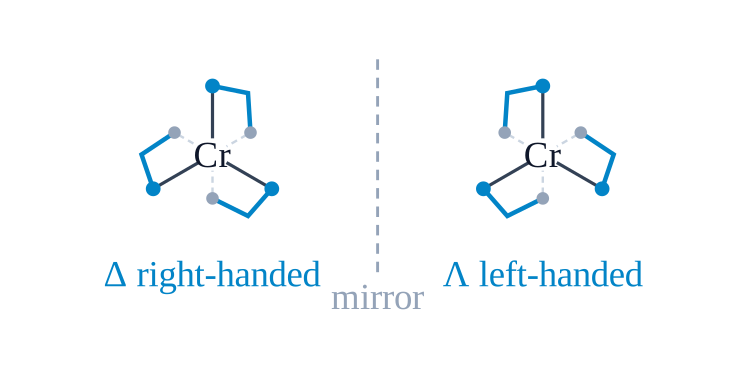 Δ and Λ of [Cr(C₂O₄)₃]³⁻. Looking straight down the three-fold axis: three donor atoms near (solid) and three far (faint), staggered $\displaystyle 60$°. Each heavy curve is one oxalate spanning a near and a far position, and the three of them wind like propeller blades. Winding them the other way gives a structure no rotation can bring back onto the first.Oxalate, \(\displaystyle C_2O_4^{2-}\), is a bidentate ligand, so this ion is an octahedral tris-chelate complex — the oxidation state check confirms Cr is +$\displaystyle 3$:
\[x + 3(-2) = -3 \;\Rightarrow\; x = +3
\]With three identical bidentate ligands each spanning two mutually cis coordination sites, the complex is isostructural with \(\displaystyle \left[Co(en)_3\right]^{3+}\): looking straight down the pseudo-three-fold axis, the six oxygen donors resolve into two triangles of three, staggered $\displaystyle 60$° from each other (a trigonal-antiprism projection of the octahedron), and each O–Cr–O chelate ring runs from a vertex of the near triangle to an adjacent vertex of the far triangle. Traced this way, the three rings wind around the axis like the blades of a propeller.There are exactly two ways to make that winding go — clockwise or anticlockwise as you trace it from the near triangle to the far one — and these two windings are mirror images of each other that cannot be rotated into coincidence, because the molecule has no \(\displaystyle \sigma\), no \(\displaystyle i\), and no \(\displaystyle S_n\). They are labelled \(\displaystyle \Delta\) (right-handed twist) and \(\displaystyle \Lambda\) (left-handed twist). This is the same Δ/Λ pair a student would draw for \(\displaystyle \left[Co(en)_3\right]^{3+}\), with oxalate's O–C–C–O backbone standing in for en's N–C–C–N backbone.(ii) \(\displaystyle \left[PtCl_2(en)_2\right]^{2+}\)
Δ and Λ of [Cr(C₂O₄)₃]³⁻. Looking straight down the three-fold axis: three donor atoms near (solid) and three far (faint), staggered $\displaystyle 60$°. Each heavy curve is one oxalate spanning a near and a far position, and the three of them wind like propeller blades. Winding them the other way gives a structure no rotation can bring back onto the first.Oxalate, \(\displaystyle C_2O_4^{2-}\), is a bidentate ligand, so this ion is an octahedral tris-chelate complex — the oxidation state check confirms Cr is +$\displaystyle 3$:
\[x + 3(-2) = -3 \;\Rightarrow\; x = +3
\]With three identical bidentate ligands each spanning two mutually cis coordination sites, the complex is isostructural with \(\displaystyle \left[Co(en)_3\right]^{3+}\): looking straight down the pseudo-three-fold axis, the six oxygen donors resolve into two triangles of three, staggered $\displaystyle 60$° from each other (a trigonal-antiprism projection of the octahedron), and each O–Cr–O chelate ring runs from a vertex of the near triangle to an adjacent vertex of the far triangle. Traced this way, the three rings wind around the axis like the blades of a propeller.There are exactly two ways to make that winding go — clockwise or anticlockwise as you trace it from the near triangle to the far one — and these two windings are mirror images of each other that cannot be rotated into coincidence, because the molecule has no \(\displaystyle \sigma\), no \(\displaystyle i\), and no \(\displaystyle S_n\). They are labelled \(\displaystyle \Delta\) (right-handed twist) and \(\displaystyle \Lambda\) (left-handed twist). This is the same Δ/Λ pair a student would draw for \(\displaystyle \left[Co(en)_3\right]^{3+}\), with oxalate's O–C–C–O backbone standing in for en's N–C–C–N backbone.(ii) \(\displaystyle \left[PtCl_2(en)_2\right]^{2+}\)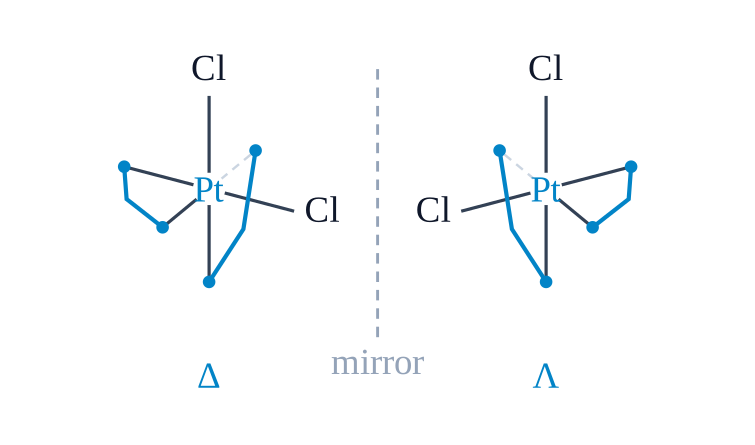 cis-[PtCl₂(en)₂]²⁺. Only the CIS form is chiral. In the trans form the two Cl are axial and a mirror plane runs through the equatorial girdle, so it is superimposable on its own mirror image and has no optical isomer. Each curve is one en.Two Cl⁻ plus two neutral bidentate en ligands give an octahedral Pt(IV) centre:
\[x + 2(-1) + 2(0) = +2 \;\Rightarrow\; x = +4
\]With the two en ligands together occupying four of the six sites, the two Cl atoms can sit either opposite each other (trans) or next to each other (cis) — a geometrical-isomer choice that has to be made before optical isomerism can even be asked about.In trans-\(\displaystyle \left[PtCl_2(en)_2\right]^{2+}\), the two Cl occupy the axial positions and the two en rings sit in the equatorial girdle, related to each other by the axial \(\displaystyle C_2\). Reflecting through the equatorial plane swaps top-Cl with bottom-Cl and maps each en ring onto itself — the molecule is superimposable on its own mirror image (it has a \(\displaystyle \sigma_h\)). Trans-\(\displaystyle \left[PtCl_2(en)_2\right]^{2+}\) is achiral: it has no optical isomer.In cis-\(\displaystyle \left[PtCl_2(en)_2\right]^{2+}\), the two Cl are adjacent, and no plane can be drawn through the ion that reflects it onto itself — one en ring is always left sticking out on the "wrong" side of any candidate mirror plane. With only a bare \(\displaystyle C_2\) axis and no \(\displaystyle \sigma\), cis-\(\displaystyle \left[PtCl_2(en)_2\right]^{2+}\) is chiral, and it is this cis form — not the trans form — that exists as a non-superimposable mirror-image pair, again conventionally labelled \(\displaystyle \Delta\) and \(\displaystyle \Lambda\).(iii) \(\displaystyle \left[Cr(NH_3)_2Cl_2(en)\right]^{+}\)
cis-[PtCl₂(en)₂]²⁺. Only the CIS form is chiral. In the trans form the two Cl are axial and a mirror plane runs through the equatorial girdle, so it is superimposable on its own mirror image and has no optical isomer. Each curve is one en.Two Cl⁻ plus two neutral bidentate en ligands give an octahedral Pt(IV) centre:
\[x + 2(-1) + 2(0) = +2 \;\Rightarrow\; x = +4
\]With the two en ligands together occupying four of the six sites, the two Cl atoms can sit either opposite each other (trans) or next to each other (cis) — a geometrical-isomer choice that has to be made before optical isomerism can even be asked about.In trans-\(\displaystyle \left[PtCl_2(en)_2\right]^{2+}\), the two Cl occupy the axial positions and the two en rings sit in the equatorial girdle, related to each other by the axial \(\displaystyle C_2\). Reflecting through the equatorial plane swaps top-Cl with bottom-Cl and maps each en ring onto itself — the molecule is superimposable on its own mirror image (it has a \(\displaystyle \sigma_h\)). Trans-\(\displaystyle \left[PtCl_2(en)_2\right]^{2+}\) is achiral: it has no optical isomer.In cis-\(\displaystyle \left[PtCl_2(en)_2\right]^{2+}\), the two Cl are adjacent, and no plane can be drawn through the ion that reflects it onto itself — one en ring is always left sticking out on the "wrong" side of any candidate mirror plane. With only a bare \(\displaystyle C_2\) axis and no \(\displaystyle \sigma\), cis-\(\displaystyle \left[PtCl_2(en)_2\right]^{2+}\) is chiral, and it is this cis form — not the trans form — that exists as a non-superimposable mirror-image pair, again conventionally labelled \(\displaystyle \Delta\) and \(\displaystyle \Lambda\).(iii) \(\displaystyle \left[Cr(NH_3)_2Cl_2(en)\right]^{+}\)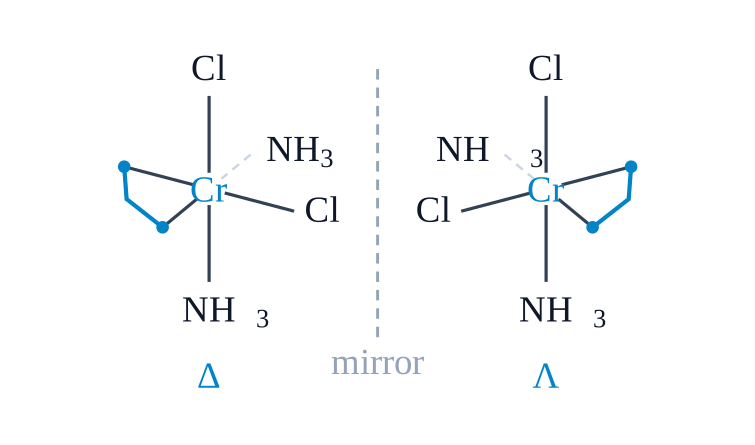 cis-[Cr(NH₃)₂Cl₂(en)]⁺. en takes two cis sites; the two Cl adjacent forces the two NH₃ adjacent as well, and no plane, centre or improper axis survives. The trans-Cl form keeps a plane through both Cl and is achiral.Here en occupies two cis sites (its short "bite" physically cannot reach across a $\displaystyle 180$° pair of trans sites), leaving two NH₃ and two Cl to fill the remaining four positions. Oxidation state:
\[x + 2(0) + 2(-1) + 1(0) = +1 \;\Rightarrow\; x = +3
\]Again the two Cl can end up trans or cis to each other, and again that choice decides whether an optical isomer exists at all.Trans-\(\displaystyle \left[Cr(NH_3)_2Cl_2(en)\right]^{+}\) (the two Cl opposite each other) has a mirror plane running through both Cl atoms, the Cr, and the midpoint of the en ring — reflection in that plane swaps the two NH₃ groups with each other and leaves everything else fixed, so the molecule maps onto itself. It is achiral: no optical isomer.Cis-\(\displaystyle \left[Cr(NH_3)_2Cl_2(en)\right]^{+}\) (the two Cl adjacent, which also forces the two NH₃ to be adjacent to each other) has four different "directions" around the Cr with no internal symmetry left to exploit — there is no plane, centre, or improper axis that maps the ion onto its mirror image. This lower-symmetry cis form is chiral and is the one that exists as a pair of non-superimposable enantiomers; the trans form does not.Answer: (i) \(\displaystyle \left[Cr(C_2O_4)_3\right]^{3-}\) is chiral and exists as a non-superimposable mirror-image pair, the right-handed (\(\displaystyle \Delta\)) and left-handed (\(\displaystyle \Lambda\)) propeller forms, exactly as in \(\displaystyle \left[Co(en)_3\right]^{3+}\). (ii) Of the two geometrical isomers of \(\displaystyle \left[PtCl_2(en)_2\right]^{2+}\), only cis-\(\displaystyle \left[PtCl_2(en)_2\right]^{2+}\) is chiral and gives a \(\displaystyle \Delta/\Lambda\) enantiomer pair; trans-\(\displaystyle \left[PtCl_2(en)_2\right]^{2+}\) has a mirror plane and is optically inactive. (iii) Of the two geometrical isomers of \(\displaystyle \left[Cr(NH_3)_2Cl_2(en)\right]^{+}\), only cis-\(\displaystyle \left[Cr(NH_3)_2Cl_2(en)\right]^{+}\) is chiral and gives a pair of enantiomers; trans-\(\displaystyle \left[Cr(NH_3)_2Cl_2(en)\right]^{+}\) has a mirror plane and is optically inactive.
cis-[Cr(NH₃)₂Cl₂(en)]⁺. en takes two cis sites; the two Cl adjacent forces the two NH₃ adjacent as well, and no plane, centre or improper axis survives. The trans-Cl form keeps a plane through both Cl and is achiral.Here en occupies two cis sites (its short "bite" physically cannot reach across a $\displaystyle 180$° pair of trans sites), leaving two NH₃ and two Cl to fill the remaining four positions. Oxidation state:
\[x + 2(0) + 2(-1) + 1(0) = +1 \;\Rightarrow\; x = +3
\]Again the two Cl can end up trans or cis to each other, and again that choice decides whether an optical isomer exists at all.Trans-\(\displaystyle \left[Cr(NH_3)_2Cl_2(en)\right]^{+}\) (the two Cl opposite each other) has a mirror plane running through both Cl atoms, the Cr, and the midpoint of the en ring — reflection in that plane swaps the two NH₃ groups with each other and leaves everything else fixed, so the molecule maps onto itself. It is achiral: no optical isomer.Cis-\(\displaystyle \left[Cr(NH_3)_2Cl_2(en)\right]^{+}\) (the two Cl adjacent, which also forces the two NH₃ to be adjacent to each other) has four different "directions" around the Cr with no internal symmetry left to exploit — there is no plane, centre, or improper axis that maps the ion onto its mirror image. This lower-symmetry cis form is chiral and is the one that exists as a pair of non-superimposable enantiomers; the trans form does not.Answer: (i) \(\displaystyle \left[Cr(C_2O_4)_3\right]^{3-}\) is chiral and exists as a non-superimposable mirror-image pair, the right-handed (\(\displaystyle \Delta\)) and left-handed (\(\displaystyle \Lambda\)) propeller forms, exactly as in \(\displaystyle \left[Co(en)_3\right]^{3+}\). (ii) Of the two geometrical isomers of \(\displaystyle \left[PtCl_2(en)_2\right]^{2+}\), only cis-\(\displaystyle \left[PtCl_2(en)_2\right]^{2+}\) is chiral and gives a \(\displaystyle \Delta/\Lambda\) enantiomer pair; trans-\(\displaystyle \left[PtCl_2(en)_2\right]^{2+}\) has a mirror plane and is optically inactive. (iii) Of the two geometrical isomers of \(\displaystyle \left[Cr(NH_3)_2Cl_2(en)\right]^{+}\), only cis-\(\displaystyle \left[Cr(NH_3)_2Cl_2(en)\right]^{+}\) is chiral and gives a pair of enantiomers; trans-\(\displaystyle \left[Cr(NH_3)_2Cl_2(en)\right]^{+}\) has a mirror plane and is optically inactive.