Exercise 3.21
The following data were obtained during the first order thermal decomposition of at a constant volume. SO Cl () g → SO () g + Cl () g Experiment Time/ Total pressure/atm Calculate the rate of the reaction when total pressure is atm.
NCERT’s answer
2.$\displaystyle 23$ × $\displaystyle 10$ -$\displaystyle 3$ s -$\displaystyle 1$, $\displaystyle 7.8$ ×$\displaystyle 10$ -$\displaystyle 4$ atm s -$\displaystyle 1$
For a gas-phase reaction run at constant volume and temperature, pressure is directly proportional to moles — so you can track the reaction using partial pressures exactly as you would use concentrations.The reaction is
\[SO_2Cl_2(g) \rightarrow SO_2(g) + Cl_2(g)
\]Let the initial pressure of \(\displaystyle SO_2Cl_2\) be \(\displaystyle p_0\), and let \(\displaystyle x\) be the drop in its pressure by time \(\displaystyle t\). Since one mole of \(\displaystyle SO_2Cl_2\) gives one mole each of \(\displaystyle SO_2\) and \(\displaystyle Cl_2\):
The total pressure at time \(\displaystyle t\) is the sum of all three partial pressures:
\[p_t = (p_0-x) + x + x = p_0 + x \quad\Rightarrow\quad x = p_t - p_0
\]So the partial pressure of the reactant that is actually left is\[p(SO_2Cl_2) = p_0 - x = p_0 - (p_t-p_0) = 2p_0 - p_t
\]This is the step people skip — the total pressure given in the table is not the reactant's pressure; you have to subtract off what the products have contributed.Step $\displaystyle 1$: find \(\displaystyle k\) from the first data point.Here \(\displaystyle p_0 = 0.5\ \text{atm}\) (the pressure at \(\displaystyle t=0\), Experiment $\displaystyle 1$). For a first-order reaction, using pressure in place of concentration:\[k = \frac{2.303}{t}\log\frac{p_0}{p(SO_2Cl_2)} = \frac{2.303}{t}\log\frac{p_0}{2p_0-p_t}
\]From Experiment $\displaystyle 2$, \(\displaystyle t = 100\ \text{s}\), \(\displaystyle p_t = 0.6\ \text{atm}\):\[p(SO_2Cl_2) = 2(0.5) - 0.6 = 0.4\ \text{atm}
\]\[k = \frac{2.303}{100\ \text{s}}\log\frac{0.5}{0.4} = \frac{2.303}{100\ \text{s}}\log(1.25) = \frac{2.303 \times 0.0969}{100\ \text{s}}
\]\[k = 2.232\times10^{-3}\ \text{s}^{-1}
\]Step $\displaystyle 2$: find the reactant's pressure when the total pressure is $\displaystyle 0.65$ atm.Using the same relation \(\displaystyle p(SO_2Cl_2) = 2p_0 - p_t\) with \(\displaystyle p_t = 0.65\ \text{atm}\):\[p(SO_2Cl_2) = 2(0.5) - 0.65 = 0.35\ \text{atm}
\]Step $\displaystyle 3$: get the rate from the first-order rate law.For a first-order reaction, \(\displaystyle \text{Rate} = k \times [\text{reactant}]\); with pressure standing in for concentration,\[\text{Rate} = k \times p(SO_2Cl_2)
\]\[\text{Rate} = \left(2.232\times10^{-3}\ \text{s}^{-1}\right)\times\left(0.35\ \text{atm}\right)
\]\[\text{Rate} = 7.81\times10^{-4}\ \text{atm}\ \text{s}^{-1}
\]Because concentration here is expressed as a partial pressure (atm) rather than mol L⁻¹, the rate correctly carries units of atm s⁻¹, not mol L⁻¹ s⁻¹ — don't relabel the unit out of habit.Answer: Rate \(\displaystyle \approx 7.81\times10^{-4}\ \text{atm s}^{-1}\) (with \(\displaystyle k \approx 2.23\times10^{-3}\ \text{s}^{-1}\)).
| \(\displaystyle SO_2Cl_2\) | \(\displaystyle SO_2\) | \(\displaystyle Cl_2\) | |
| at \(\displaystyle t=0\) | \(\displaystyle p_0\) | $\displaystyle 0$ | $\displaystyle 0$ |
| at \(\displaystyle t\) | \(\displaystyle p_0-x\) | \(\displaystyle x\) | \(\displaystyle x\) |
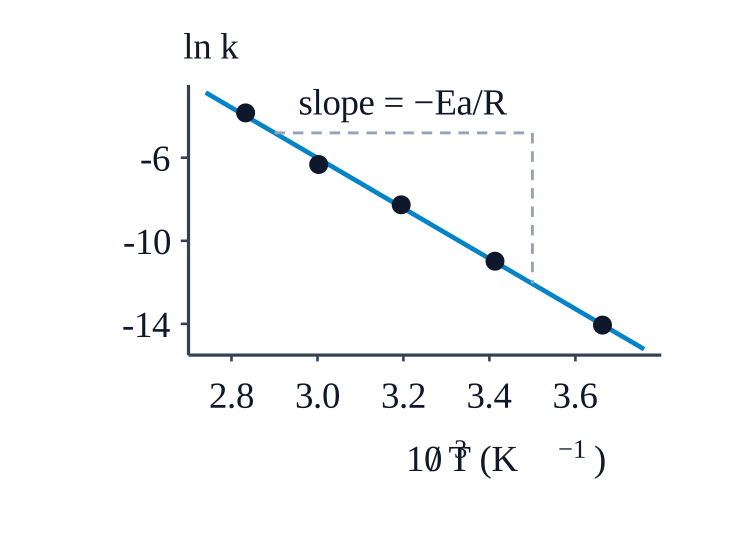 ln k against $\displaystyle 1$/T for N₂O₅. Taking logs of k = A e^(−Ea/RT) gives ln k = ln A − (Ea/R)($\displaystyle 1$/T), a straight line. The slope is −Ea/R, so Ea ≈ $\displaystyle 101$ kJ mol⁻¹; the intercept at $\displaystyle 1$/T = $\displaystyle 0$ is ln A, giving A ≈ $\displaystyle 1.43$ × $\displaystyle 10$¹³ s⁻¹. Note where that intercept sits — off the left of every measurement, at infinite temperature — which is why A is fitted and never measured directly.The Arrhenius equation turns into a straight line only after you take logs — plot \(\displaystyle \ln k\) (y-axis) against \(\displaystyle 1/T\) (x-axis), and the slope gives \(\displaystyle E_a\), the intercept gives \(\displaystyle A\).Starting from the Arrhenius equation\[k = A\,e^{-E_a/RT} \]taking the natural log of both sides gives\[\ln k = \ln A - \frac{E_a}{R}\cdot\frac{1}{T} \]This is a straight line \(\displaystyle y = mx + c\) with \(\displaystyle y=\ln k\), \(\displaystyle x = 1/T\), slope \(\displaystyle m = -E_a/R\), and intercept \(\displaystyle c = \ln A\). So a graph of \(\displaystyle \ln k\) vs \(\displaystyle 1/T\) lets you read off \(\displaystyle E_a\) and \(\displaystyle A\) without ever plugging numbers into the exponential form directly.Before plotting anything, fix the two traps in this data: temperature must be in kelvin (not °C), and the tabulated numbers are \(\displaystyle 10^{5}\times k\), not \(\displaystyle k\) itself.\(\displaystyle T/\mathrm{K} = T/^{\circ}\mathrm{C} + 273\), and \(\displaystyle k = (\text{tabulated value})\times10^{-5}\,\mathrm{s^{-1}}\). Working these out, and \(\displaystyle 1/T\) and \(\displaystyle \ln k\) alongside them: