SolveItClass 12 · NCERT

NCERT Solutions · Class 12 Chemistry Chemical Kinetics

30 questions · 10 still being checked

Exercises 3.11–3.20 (part 2 of 3)

  1. Exercise 3.11

    The following results have been obtained during the kinetic studies of the reaction: 2A + B → C + D Experiment [A]/mol L1\displaystyle L^{-1} [B]/mol L1\displaystyle L^{-1} Initial rate of formation of D/mol L1\displaystyle L^{-1} min1\displaystyle min^{-1} I 0.1\displaystyle 0.1 0.1\displaystyle 0.1 6.0\displaystyle 6.0 × 10³\displaystyle 10^{-3} II 0.3\displaystyle 0.3 0.2\displaystyle 0.2 7.2\displaystyle 7.2 × 10²\displaystyle 10^{-2} III 0.3\displaystyle 0.3 0.4\displaystyle 0.4 2.88\displaystyle 2.88 × 101\displaystyle 10^{-1} IV 0.4\displaystyle 0.4 0.1\displaystyle 0.1 2.40\displaystyle 2.40 × 10²\displaystyle 10^{-2} Determine the rate law and the rate constant for the reaction.
    NCERT’s answer
    rate law = k[A][B] $\displaystyle 2$; rate constant = $\displaystyle 6.0$ M
    Rate law comes from comparing pairs of experiments where only ONE concentration changes — never guess the order from the stoichiometric coefficients ($\displaystyle 2$ in front of A does not mean the reaction is second order in A).For the reaction \(\displaystyle 2A + B \rightarrow C + D\), write the rate law with unknown orders \(\displaystyle x\) and \(\displaystyle y\):\[\text{Rate} = k[A]^x[B]^y \]Step $\displaystyle 1$: Find the order in B.Pick two experiments where \(\displaystyle [A]\) is held fixed and \(\displaystyle [B]\) changes — Experiments II and III both have \(\displaystyle [A] = 0.3\ \text{mol L}^{-1}\).\[\frac{\text{Rate III}}{\text{Rate II}} = \frac{k(0.3)^x(0.4)^y}{k(0.3)^x(0.2)^y} = \left(\frac{0.4}{0.2}\right)^y = (2)^y \]Substituting the rates:\[\frac{2.88\times10^{-1}}{7.2\times10^{-2}} = 4.0 = 2^y \]So \(\displaystyle y = 2\): the reaction is second order in B.Step $\displaystyle 2$: Find the order in A.Now pick two experiments where \(\displaystyle [B]\) is held fixed and \(\displaystyle [A]\) changes — Experiments I and IV both have \(\displaystyle [B] = 0.1\ \text{mol L}^{-1}\).\[\frac{\text{Rate IV}}{\text{Rate I}} = \frac{k(0.4)^x(0.1)^y}{k(0.1)^x(0.1)^y} = \left(\frac{0.4}{0.1}\right)^x = (4)^x \]Substituting the rates:\[\frac{2.40\times10^{-2}}{6.0\times10^{-3}} = 4.0 = 4^x \]So \(\displaystyle x = 1\): the reaction is first order in A.Step $\displaystyle 3$: Write the rate law.\[\text{Rate} = k[A][B]^2 \]The overall order is \(\displaystyle x + y = 1 + 2 = 3\) (third order overall) — note this is different from the sum of the stoichiometric coefficients ($\displaystyle 3$ as well here only by coincidence; in general the two need not match, which is exactly why the rate law must be found from data, not from the balanced equation).Step $\displaystyle 4$: Find the rate constant \(\displaystyle k\).Rearrange the rate law and substitute Experiment I's data (\(\displaystyle [A] = 0.1\ \text{mol L}^{-1}\), \(\displaystyle [B] = 0.1\ \text{mol L}^{-1}\), rate \(\displaystyle = 6.0\times10^{-3}\ \text{mol L}^{-1}\text{min}^{-1}\)):\[k = \frac{\text{Rate}}{[A][B]^2} = \frac{6.0\times10^{-3}\ \text{mol L}^{-1}\text{min}^{-1}}{(0.1\ \text{mol L}^{-1})(0.1\ \text{mol L}^{-1})^2} \]\[k = \frac{6.0\times10^{-3}}{0.1 \times 0.01}\ \text{mol L}^{-1}\text{min}^{-1} \cdot \text{mol}^{-3}\text{L}^{3} = \frac{6.0\times10^{-3}}{1.0\times10^{-3}}\ \text{mol}^{-2}\text{L}^{2}\text{min}^{-1} \]\[k = 6.0\ \text{mol}^{-2}\text{L}^{2}\text{min}^{-1} \]Checking against the other three experiments confirms the same \(\displaystyle k\) — this cross-check is the whole point of using multiple experiments, not just a formality:\[\text{Exp II: } k = \frac{7.2\times10^{-2}}{(0.3)(0.2)^2} = \frac{7.2\times10^{-2}}{0.012} = 6.0\ \text{mol}^{-2}\text{L}^{2}\text{min}^{-1} \]\[\text{Exp III: } k = \frac{2.88\times10^{-1}}{(0.3)(0.4)^2} = \frac{2.88\times10^{-1}}{0.048} = 6.0\ \text{mol}^{-2}\text{L}^{2}\text{min}^{-1} \]\[\text{Exp IV: } k = \frac{2.40\times10^{-2}}{(0.4)(0.1)^2} = \frac{2.40\times10^{-2}}{0.004} = 6.0\ \text{mol}^{-2}\text{L}^{2}\text{min}^{-1} \]All four experiments give the identical value, which confirms the rate law is correct.The units of \(\displaystyle k\) are not arbitrary — for a rate law of overall order $\displaystyle 3$, \(\displaystyle k\) must carry units of \(\displaystyle \text{mol}^{-2}\text{L}^{2}\text{min}^{-1}\) (equivalently \(\displaystyle \text{L}^2\,\text{mol}^{-2}\,\text{min}^{-1}\)) so that \(\displaystyle k[A][B]^2\) comes out in \(\displaystyle \text{mol L}^{-1}\text{min}^{-1}\), the units of rate.Answer: Rate law is \(\displaystyle \text{Rate} = k[A][B]^2\) (first order in A, second order in B, third order overall), with \(\displaystyle k = 6.0\ \text{L}^2\,\text{mol}^{-2}\,\text{min}^{-1}\).
  2. Exercise 3.12

    The reaction between A and B is first order with respect to A and zero order with respect to B. Fill in the blanks in the following table: Experiment [A]/ mol L1\displaystyle L^{-1} [B]/ mol L1\displaystyle L^{-1} Initial rate/ mol L1\displaystyle L^{-1} min1\displaystyle min^{-1} I 0.1\displaystyle 0.1 0.1\displaystyle 0.1 2.0\displaystyle 2.0 × 10²\displaystyle 10^{-2} II - 0.2\displaystyle 0.2 4.0\displaystyle 4.0 × 10²\displaystyle 10^{-2} III 0.4\displaystyle 0.4 0.4\displaystyle 0.4 - IV - 0.2\displaystyle 0.2 2.0\displaystyle 2.0 × 10²\displaystyle 10^{-2}

    Not cross-checked

    This solution has not been cross-checked against the answer printed in NCERT.

    When the rate law is Rate \(\displaystyle = k[A]^1[B]^0 \), the concentration of B never enters the rate — only \(\displaystyle [A]\) and the rate constant \(\displaystyle k\) matter. Zero order in B means changing \(\displaystyle [B]\) does nothing to the rate; every blank in this table is found from Experiment I's rate law once you have \(\displaystyle k\).Step $\displaystyle 1$: Write the rate law and find \(\displaystyle k\) from Experiment I.Since the reaction is first order in A and zero order in B, \[\text{Rate} = k[A]^1[B]^0 = k[A] \] where \(\displaystyle k\) is the rate constant, \(\displaystyle [A]\) is the concentration of A, and \(\displaystyle [B]\) does not appear because its order is zero.Using Experiment I, where \(\displaystyle [A] = 0.1\ \text{mol L}^{-1}\) and Rate \(\displaystyle = 2.0\times10^{-2}\ \text{mol L}^{-1}\text{min}^{-1}\): \[2.0\times10^{-2}\ \text{mol L}^{-1}\text{min}^{-1} = k \times 0.1\ \text{mol L}^{-1} \] \[k = \frac{2.0\times10^{-2}\ \text{mol L}^{-1}\text{min}^{-1}}{0.1\ \text{mol L}^{-1}} = 0.2\ \text{min}^{-1} \]This \(\displaystyle k\) is fixed for the reaction (it does not change between experiments), so every other blank uses this same value.Step $\displaystyle 2$: Experiment II — find \(\displaystyle [A]\) from the given rate.Rate \(\displaystyle = 4.0\times10^{-2}\ \text{mol L}^{-1}\text{min}^{-1}\). The value of \(\displaystyle [B] = 0.2\ \text{mol L}^{-1}\) given alongside it is a distractor here — it plays no role in the rate law, since the order in B is zero. \[[A] = \frac{\text{Rate}}{k} = \frac{4.0\times10^{-2}\ \text{mol L}^{-1}\text{min}^{-1}}{0.2\ \text{min}^{-1}} = 0.2\ \text{mol L}^{-1} \]Step $\displaystyle 3$: Experiment III — find the rate from the given \(\displaystyle [A]\).\(\displaystyle [A] = 0.4\ \text{mol L}^{-1}\), and again \(\displaystyle [B] = 0.4\ \text{mol L}^{-1}\) is irrelevant to the calculation. \[\text{Rate} = k[A] = 0.2\ \text{min}^{-1} \times 0.4\ \text{mol L}^{-1} = 8.0\times10^{-2}\ \text{mol L}^{-1}\text{min}^{-1} \]Step $\displaystyle 4$: Experiment IV — find \(\displaystyle [A]\) from the given rate.Rate \(\displaystyle = 2.0\times10^{-2}\ \text{mol L}^{-1}\text{min}^{-1}\); \(\displaystyle [B] = 0.2\ \text{mol L}^{-1}\) again does not enter the calculation. \[[A] = \frac{\text{Rate}}{k} = \frac{2.0\times10^{-2}\ \text{mol L}^{-1}\text{min}^{-1}}{0.2\ \text{min}^{-1}} = 0.1\ \text{mol L}^{-1} \]Completed table:
    Experiment\(\displaystyle [A]\)/mol L\(\displaystyle ^{-1}\)\(\displaystyle [B]\)/mol L\(\displaystyle ^{-1}\)Initial rate/mol L\(\displaystyle ^{-1}\)min\(\displaystyle ^{-1}\)
    I$\displaystyle 0.1$$\displaystyle 0.1$\(\displaystyle 2.0\times10^{-2}\)
    II$\displaystyle 0.2$$\displaystyle 0.2$\(\displaystyle 4.0\times10^{-2}\)
    III$\displaystyle 0.4$$\displaystyle 0.4$\(\displaystyle 8.0\times10^{-2}\)
    IV$\displaystyle 0.1$$\displaystyle 0.2$\(\displaystyle 2.0\times10^{-2}\)
    Answer: \(\displaystyle k = 0.2\ \text{min}^{-1}\); Experiment II: \(\displaystyle [A] = 0.2\ \text{mol L}^{-1}\); Experiment III: Rate \(\displaystyle = 8.0\times10^{-2}\ \text{mol L}^{-1}\text{min}^{-1}\); Experiment IV: \(\displaystyle [A] = 0.1\ \text{mol L}^{-1}\).
  3. Exercise 3.13

    Calculate the half-life of a first order reaction from their rate constants given below:
    (i)
    200\displaystyle 200 s1\displaystyle s^{-1}
    (ii)
    2\displaystyle 2 min1\displaystyle min^{-1}
    (iii)
    4\displaystyle 4 years1\displaystyle years^{-1}
    NCERT’s answer
    (i)
    3.$\displaystyle 47$ x $\displaystyle 10$ -$\displaystyle 3$ seconds
    For a first-order reaction, the half-life does not depend on the starting concentration — it depends only on the rate constant \(\displaystyle k\).The half-life formula comes from integrating the first-order rate law, \(\displaystyle \ln\frac{[R]_0}{[R]} = kt \), and asking how long it takes for \(\displaystyle [R]\) to fall to \(\displaystyle [R]_0/2\):\[t_{1/2} = \frac{\ln 2}{k} = \frac{0.693}{k} \]Here \(\displaystyle k\) is the rate constant (with units of inverse time, since first-order rate constants carry units of \(\displaystyle \text{time}^{-1}\)), and \(\displaystyle t_{1/2}\) comes out in whatever time unit \(\displaystyle k\) is expressed in. This is the step people trip on: because \(\displaystyle t_{1/2} = 0.693/k\) only, you never need a concentration value to answer this kind of question — just divide $\displaystyle 0.693$ by \(\displaystyle k\), keeping the unit of time that \(\displaystyle k\) already carries.(i) \(\displaystyle k = 200\ \text{s}^{-1}\)\[t_{1/2} = \frac{0.693}{200\ \text{s}^{-1}} = 3.465\times10^{-3}\ \text{s} \]Rounded to three significant figures: \(\displaystyle t_{1/2} \approx 3.47\times10^{-3}\ \text{s}\).(ii) \(\displaystyle k = 2\ \text{min}^{-1}\)\[t_{1/2} = \frac{0.693}{2\ \text{min}^{-1}} = 0.3465\ \text{min} \]Rounded to three significant figures: \(\displaystyle t_{1/2} \approx 0.347\ \text{min}\).(iii) \(\displaystyle k = 4\ \text{years}^{-1}\)\[t_{1/2} = \frac{0.693}{4\ \text{years}^{-1}} = 0.17325\ \text{years} \]Rounded to three significant figures: \(\displaystyle t_{1/2} \approx 0.173\ \text{years}\).Notice the unit of \(\displaystyle t_{1/2}\) simply matches the unit of time built into \(\displaystyle k\) in each case — there is no unit conversion to do, only the division \(\displaystyle 0.693/k\).Answer: (i) \(\displaystyle t_{1/2} \approx 3.47\times10^{-3}\ \text{s}\) (ii) \(\displaystyle t_{1/2} \approx 0.347\ \text{min}\) (iii) \(\displaystyle t_{1/2} \approx 0.173\ \text{years}\)
  4. Exercise 3.14

    The half-life for radioactive decay of 14C is 5730\displaystyle 5730 years. An archaeological artifact containing wood had only 80\displaystyle 80% of the 14C found in a living tree. Estimate the age of the sample.
    NCERT’s answer
    $\displaystyle 1845$ years
    Radioactive decay is always first order, so the fraction of the isotope left tells you the elapsed time directly through the first‑order rate law — you never need to know the actual number of atoms, only the ratio.Step $\displaystyle 1$ — Get the rate constant from the half-life.For a first-order process, \[k = \frac{0.693}{t_{1/2}} \] where \(\displaystyle k\) is the decay (rate) constant and \(\displaystyle t_{1/2}\) is the half-life.\[k = \frac{0.693}{5730\ \text{year}} = 1.209\times10^{-4}\ \text{year}^{-1} \]Step $\displaystyle 2$ — Write the integrated first-order rate law in terms of the remaining fraction.\[t = \frac{2.303}{k}\log\frac{[R]_0}{[R]} \] Here \(\displaystyle [R]_0\) is the amount of \(\displaystyle ^{14}\text{C}\) in the living tree (taken as $\displaystyle 100$%) and \(\displaystyle [R]\) is the amount left in the artifact now.The artifact has $\displaystyle 80$% of the original \(\displaystyle ^{14}\text{C}\), so \[\frac{[R]}{[R]_0} = 0.80 \quad\Rightarrow\quad \frac{[R]_0}{[R]} = \frac{1}{0.80} = 1.25 \]This is the step people invert by mistake — the ratio inside the log must be initial over remaining (a number bigger than $\displaystyle 1$), not remaining over initial, or the log comes out negative and the age comes out negative too.Step $\displaystyle 3$ — Substitute and solve for \(\displaystyle t\).\[t = \frac{2.303}{1.209\times10^{-4}\ \text{year}^{-1}}\times \log(1.25) \]\[\log(1.25) = 0.0969 \]\[t = 1.9043\times10^{4}\ \text{year} \times 0.0969 \]\[t \approx 1845\ \text{year} \]The half-life ($\displaystyle 5730$ year, $\displaystyle 4$ significant figures) sets the precision here, so the answer is kept to four significant figures.Answer: The archaeological sample is about $\displaystyle 1845$ years old.
  5. Exercise 3.15

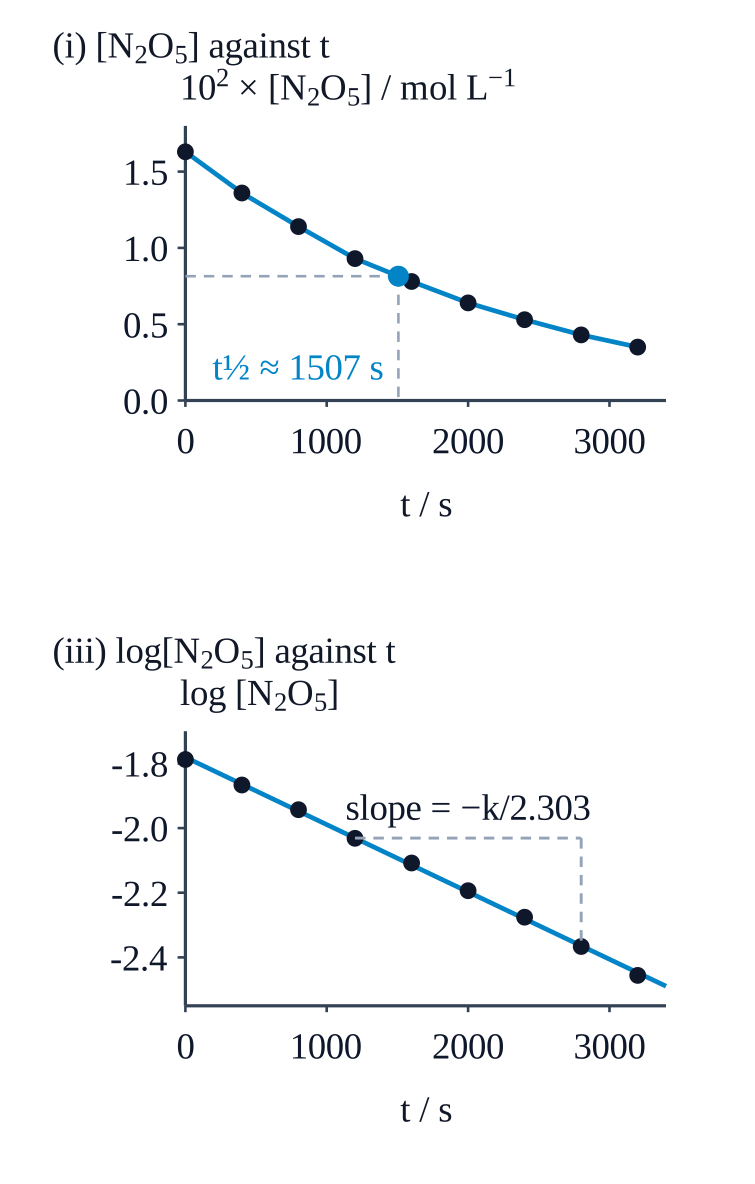
    The experimental data for decomposition of N2O5\displaystyle \mathrm{N_{2}O_{5}} [2N2\displaystyle 2N_{2}O5\displaystyle O_{5}4NO2\displaystyle \mathrm{4NO_{2}} + O2\displaystyle O_{2}] in gas phase at 318K are given below: t/s 0\displaystyle 0 400\displaystyle 400 800\displaystyle 800 1200\displaystyle 1200 1600\displaystyle 1600 2000\displaystyle 2000 2400\displaystyle 2400 2800\displaystyle 2800 3200\displaystyle 3200 102\displaystyle 10^{2} × [N2O5]\displaystyle \mathrm{[N_{2}O_{5}]}/ 1.63\displaystyle 1.63 1.36\displaystyle 1.36 1.14\displaystyle 1.14 0.93\displaystyle 0.93 0.78\displaystyle 0.78 0.64\displaystyle 0.64 0.53\displaystyle 0.53 0.43\displaystyle 0.43 0.35\displaystyle 0.35 mol L1\displaystyle L^{-1}
    (i)
    Plot [N2O5]\displaystyle \mathrm{[N_{2}O_{5}]} against t.
    (ii)
    Find the half-life period for the reaction.
    (iii)
    Draw a graph between log[N2\displaystyle N_{2}O5\displaystyle O_{5}] and t.
    (iv)
    What is the rate law ?
    (v)
    Calculate the rate constant.
    (vi)
    Calculate the half-life period from k and compare it with (ii).

    Not cross-checked

    This solution has not been cross-checked against the answer printed in NCERT.

    A straight line on a plot of \(\displaystyle \log[N_2O_5]\) against \(\displaystyle t\) is the signature of first-order kinetics — its slope hands you the rate constant directly, which is why part (iii) asks for that particular graph and not just the raw concentration curve.(i) Plotting \(\displaystyle [N_2O_5]\) against \(\displaystyle t\)The raw data are
    \(\displaystyle t\)/s$\displaystyle 0$$\displaystyle 400$$\displaystyle 800$$\displaystyle 1200$$\displaystyle 1600$$\displaystyle 2000$$\displaystyle 2400$$\displaystyle 2800$$\displaystyle 3200$
    \(\displaystyle [N_2O_5]\)/mol L\(\displaystyle ^{-1}\)$\displaystyle 0.0163$$\displaystyle 0.0136$$\displaystyle 0.0114$$\displaystyle 0.00930$$\displaystyle 0.00780$$\displaystyle 0.00640$$\displaystyle 0.00530$$\displaystyle 0.00430$$\displaystyle 0.00350$
    Plotted on ordinary axes these nine points trace a smoothly falling, concave-up curve: steep near \(\displaystyle t=0\) and flattening out as \(\displaystyle [N_2O_5]\) gets small — the shape any exponential decay produces. A curve like this cannot be measured with a ruler, which is exactly the problem part (iii) fixes.(ii) Half-life read from the plotHalf of the starting concentration is \[\frac{[N_2O_5]_0}{2}=\frac{0.0163}{2}=0.00815\ \text{mol L}^{-1}. \] This value sits between the readings at \(\displaystyle t=1200\ \text{s}\) (\(\displaystyle 0.00930\)) and \(\displaystyle t=1600\ \text{s}\) (\(\displaystyle 0.00780\)). Interpolating linearly along the curve between those two points: \[t_{1/2}=1200+400\times\frac{0.00930-0.00815}{0.00930-0.00780}=1200+400\times\frac{0.00115}{0.00150}=1200+307=1507\ \text{s}. \] So, reading the graph, \(\displaystyle t_{1/2}\approx 1.51\times10^{3}\ \text{s}\).(iii) Plotting \(\displaystyle \log[N_2O_5]\) against \(\displaystyle t\)Taking \(\displaystyle \log_{10}\) of each concentration:
    \(\displaystyle t\)/s$\displaystyle 0$$\displaystyle 400$$\displaystyle 800$$\displaystyle 1200$$\displaystyle 1600$$\displaystyle 2000$$\displaystyle 2400$$\displaystyle 2800$$\displaystyle 3200$
    \(\displaystyle \log[N_2O_5]\)\(\displaystyle -1.788\)\(\displaystyle -1.866\)\(\displaystyle -1.943\)\(\displaystyle -2.032\)\(\displaystyle -2.108\)\(\displaystyle -2.194\)\(\displaystyle -2.276\)\(\displaystyle -2.367\)\(\displaystyle -2.456\)
    These nine points fall on a single straight line of negative slope. Turning the curved decay in part (i) into a straight line here is the whole point of the log transform — it lets you read a slope, not just eyeball a curve.(iv) The rate lawA straight line for \(\displaystyle \log[N_2O_5]\) versus \(\displaystyle t\) is only possible if the integrated first-order law holds: \[\log[N_2O_5]=\log[N_2O_5]_0-\frac{k}{2.303}\,t. \] This is the equation of a line with slope \(\displaystyle -\dfrac{k}{2.303}\), and the data obey it (part iii). That means the reaction is first order in \(\displaystyle N_2O_5\), so the rate law is \[\text{Rate}=k[N_2O_5]^{1}. \] This is consistent with the decomposition being effectively a unimolecular step for each \(\displaystyle N_2O_5\) molecule, even though the balanced equation \(\displaystyle 2N_2O_5\rightarrow 4NO_2+O_2\) has a stoichiometric coefficient of $\displaystyle 2$ — order is an experimental fact, not something you read off the balanced equation.(v) The rate constant, from the slopeFor a line \(\displaystyle y=mx+c\), the slope is \(\displaystyle m=\dfrac{\Delta y}{\Delta x}\). Using the first and last points of the log table, \(\displaystyle (0,\,-1.788)\) and \(\displaystyle (3200,\,-2.456)\): \[m=\frac{-2.456-(-1.788)}{3200-0}=\frac{-0.668}{3200}=-2.088\times10^{-4}\ \text{s}^{-1}. \] Since \(\displaystyle m=-\dfrac{k}{2.303}\): \[k=-m\times2.303=(2.088\times10^{-4})\times2.303=4.81\times10^{-4}\ \text{s}^{-1}. \] Fitting the best straight line through all nine points (rather than just the two ends) gives the same slope to three figures, \(\displaystyle k=4.80\times10^{-4}\ \text{s}^{-1}\) — a useful check that the "first order" call in part (iv) isn't riding on two convenient data points. A first-order rate constant carries units of s\(\displaystyle ^{-1}\) only — no concentration in sight — which is a quick way to catch an order mistake before it reaches the rate law.(vi) Half-life calculated from \(\displaystyle k\), and comparisonFor a first-order reaction the half-life does not depend on the starting concentration: \[t_{1/2}=\frac{0.693}{k}=\frac{0.693}{4.80\times10^{-4}\ \text{s}^{-1}}=1444\ \text{s}\approx1.44\times10^{3}\ \text{s}. \] This is close to the graphical estimate of \(\displaystyle 1.51\times10^{3}\ \text{s}\) from part (ii) — the two differ by only about $\displaystyle 5$%, which is well inside the uncertainty of interpolating a curve by eye. Getting essentially the same half-life two different ways (once from the raw decay curve, once from the rate constant) is the real confirmation that the reaction is first order, not just the straight log-plot on its own.Answer: First order in \(\displaystyle N_2O_5\), Rate \(\displaystyle =k[N_2O_5]\); \(\displaystyle k\approx4.80\times10^{-4}\ \text{s}^{-1}\); \(\displaystyle t_{1/2}\) (from graph) \(\displaystyle \approx1.51\times10^{3}\ \text{s}\), \(\displaystyle t_{1/2}\) (from \(\displaystyle k\)) \(\displaystyle \approx1.44\times10^{3}\ \text{s}\) — in close agreement.
  6. Exercise 3.16

    The rate constant for a first order reaction is 60\displaystyle 60 s1\displaystyle s^{-1}. How much time will it take to reduce the initial concentration of the reactant to its 1\displaystyle 1/16th\displaystyle 16^{th} value?
    NCERT’s answer
    4.$\displaystyle 6$ × $\displaystyle 10$ -$\displaystyle 2$ s
    A first-order reaction has a fixed integrated rate law linking time to how much the concentration has fallen — you don't need to know the actual starting concentration, only the ratio by which it has dropped.For a first-order reaction, the integrated rate law is\[k = \frac{2.303}{t}\log\frac{[A]_0}{[A]} \]where \(\displaystyle k\) is the rate constant, \(\displaystyle t\) is the elapsed time, \(\displaystyle [A]_0\) is the initial concentration, and \(\displaystyle [A]\) is the concentration at time \(\displaystyle t\).Rearranging for \(\displaystyle t\):\[t = \frac{2.303}{k}\log\frac{[A]_0}{[A]} \]Set up the concentration ratio. The reactant falls to \(\displaystyle \dfrac{1}{16}\)th of its initial value, so\[\frac{[A]_0}{[A]} = \frac{[A]_0}{[A]_0/16} = 16 \]A step people rush past: \(\displaystyle 16 = 2^4\), so \(\displaystyle \log 16 = 4\log 2 = 4(0.3010) = 1.2041\). Using this instead of trying to evaluate \(\displaystyle \log 16\) directly avoids arithmetic slips.Substitute \(\displaystyle k = 60\ \text{s}^{-1}\) and \(\displaystyle \log\dfrac{[A]_0}{[A]} = 1.2041\):\[t = \frac{2.303}{60\ \text{s}^{-1}} \times 1.2041 \]\[t = \frac{2.303 \times 1.2041}{60}\ \text{s} \]\[t = \frac{2.7731}{60}\ \text{s} \]\[t = 0.04622\ \text{s} \]Another place to be careful: the units work out to seconds only because \(\displaystyle k\) is given in \(\displaystyle \text{s}^{-1}\); the \(\displaystyle 2.303\) and \(\displaystyle \log\) terms are pure numbers, so \(\displaystyle t\) inherits its unit directly from \(\displaystyle 1/k\).Rounding to three significant figures (matching the precision of \(\displaystyle \log 2 = 0.3010\)):\[t = 4.62 \times 10^{-2}\ \text{s} \]Answer: \(\displaystyle t = 4.62 \times 10^{-2}\ \text{s}\) (about $\displaystyle 0.0462$ s, i.e. $\displaystyle 46.2$ ms).
  7. Exercise 3.17

    During nuclear explosion, one of the products is 90Sr with half-life of 28.1\displaystyle 28.1 years. If 1\displaystyle 1μg of 90Sr was absorbed in the bones of a newly born baby instead of calcium, how much of it will remain after 10\displaystyle 10 years and 60\displaystyle 60 years if it is not lost metabolically.
    NCERT’s answer
    0.$\displaystyle 7814$ μg and $\displaystyle 0.227$ μg.
    Radioactive decay is a first-order process, so the amount left after any time \(\displaystyle t \) is fixed once you know the half-life — you don't halve it in chunks, you use the exponential decay law.Step $\displaystyle 1$ — Get the rate constant from the half-life.For a first-order reaction, \[k = \frac{0.693}{t_{1/2}} \] where \(\displaystyle t_{1/2} \) is the half-life and \(\displaystyle k \) is the decay constant.Substituting \(\displaystyle t_{1/2} = 28.1 \) years: \[k = \frac{0.693}{28.1\ \text{year}} = 0.02466\ \text{year}^{-1} \]Step $\displaystyle 2$ — Apply the first-order decay law.\[N = N_0\,e^{-kt} \] where \(\displaystyle N_0 \) is the amount present at \(\displaystyle t = 0 \) (here \(\displaystyle N_0 = 1\ \mu\text{g} \)) and \(\displaystyle N \) is the amount remaining after time \(\displaystyle t \).This is the step people skip: because $\displaystyle 10$ years and $\displaystyle 60$ years are not whole multiples of the $\displaystyle 28.1$-year half-life, you cannot just say "less than half is gone" — you have to put \(\displaystyle kt \) into the exponential directly.After $\displaystyle 10$ years: \[kt = 0.02466\ \text{year}^{-1} \times 10\ \text{year} = 0.2466 \] \[N = 1\ \mu\text{g} \times e^{-0.2466} = 1\ \mu\text{g} \times 0.7814 = 0.7814\ \mu\text{g} \]After $\displaystyle 60$ years: \[kt = 0.02466\ \text{year}^{-1} \times 60\ \text{year} = 1.480 \] \[N = 1\ \mu\text{g} \times e^{-1.480} = 1\ \mu\text{g} \times 0.2277 = 0.2277\ \mu\text{g} \]So of the original $\displaystyle 1$ μg of \(\displaystyle {}^{90}\text{Sr} \), about $\displaystyle 78.1$% is still in the bone after $\displaystyle 10$ years, and only about $\displaystyle 22.8$% is left after $\displaystyle 60$ years — the decay looks slow at first only because $\displaystyle 10$ years is a small fraction of the $\displaystyle 28.1$-year half-life; by $\displaystyle 60$ years (a bit over two half-lives) most of it is gone.Answer: about $\displaystyle 0.7814$ μg remains after $\displaystyle 10$ years, and about $\displaystyle 0.2277$ μg remains after $\displaystyle 60$ years.
  8. Exercise 3.18

    For a first order reaction, show that time required for 99\displaystyle 99% completion is twice the time required for the completion of 90\displaystyle 90% of reaction.

    Not cross-checked

    This solution has not been cross-checked against the answer printed in NCERT.

    A first-order reaction has a fixed integrated rate law, and that law converts "% completion" into a log term — comparing two percentages is just comparing two logarithms.For a first-order reaction, the integrated rate equation is \[k = \frac{2.303}{t}\log\frac{[A]_0}{[A]} \] where \(\displaystyle [A]_0\) is the initial concentration, \(\displaystyle [A]\) is the concentration left at time \(\displaystyle t\), and \(\displaystyle k\) is the rate constant (the same fixed number throughout the reaction — this is the property that makes the comparison work).Rearranging for \(\displaystyle t\): \[t = \frac{2.303}{k}\log\frac{[A]_0}{[A]} \]Time for $\displaystyle 90$% completion, \(\displaystyle t_{90}\). If $\displaystyle 90$% of \(\displaystyle [A]_0\) has reacted, $\displaystyle 10$% remains, so \(\displaystyle [A] = 0.10\,[A]_0\), which gives \[\frac{[A]_0}{[A]} = \frac{[A]_0}{0.10\,[A]_0} = 10 \] Substituting: \[t_{90} = \frac{2.303}{k}\log 10 = \frac{2.303}{k}(1) = \frac{2.303}{k} \] (\(\displaystyle \log 10 = 1\) because \(\displaystyle \log\) here is \(\displaystyle \log_{10}\), not \(\displaystyle \ln\) — the $\displaystyle 2.303$ already absorbs the conversion from natural log, so no further base change is needed.)Time for $\displaystyle 99$% completion, \(\displaystyle t_{99}\). If $\displaystyle 99$% has reacted, $\displaystyle 1$% remains, so \(\displaystyle [A] = 0.01\,[A]_0\), which gives \[\frac{[A]_0}{[A]} = \frac{[A]_0}{0.01\,[A]_0} = 100 \] Substituting: \[t_{99} = \frac{2.303}{k}\log 100 = \frac{2.303}{k}(2) = 2 \times \frac{2.303}{k} \] (\(\displaystyle \log 100 = \log 10^2 = 2\) — this is the step that produces the factor of $\displaystyle 2$; it is easy to instead write \(\displaystyle \log 100\) as some decimal and lose the exact relationship.)Comparing the two. Since \(\displaystyle t_{90} = \dfrac{2.303}{k}\), the expression for \(\displaystyle t_{99}\) is just \[t_{99} = 2 \times \frac{2.303}{k} = 2\,t_{90} \]The rate constant \(\displaystyle k\) is a constant for a given reaction at a given temperature, so it cancels out of the comparison entirely — the factor of $\displaystyle 2$ comes purely from \(\displaystyle \log 100 = 2\log 10\), which is a property of first-order kinetics, not of any particular reaction. This is why the result holds for every first-order reaction, regardless of its actual \(\displaystyle k\) value: doubling how far a first-order reaction has progressed (in this log sense, from $\displaystyle 90$% left-to-go being $\displaystyle 10$× down to $\displaystyle 99$% being $\displaystyle 100$× down) exactly doubles the time.**Answer: \(\displaystyle t_{99\%} = 2\,t_{90\%}\), since \(\displaystyle t_{90} = \dfrac{2.303}{k}\log 10 = \dfrac{2.303}{k}\) and \(\displaystyle t_{99} = \dfrac{2.303}{k}\log 100 = \dfrac{2\times 2.303}{k} = 2\,t_{90}\).
  9. Exercise 3.19

    A first order reaction takes 40\displaystyle 40 min for 30\displaystyle 30% decomposition. Calculate t1/2\displaystyle t_{1/2}.
    NCERT’s answer
    77.$\displaystyle 7$ minutes
    For a first-order reaction, the rate constant depends only on the ratio of initial to remaining concentration — not on the actual amounts — so "$\displaystyle 30$% decomposed" is enough information by itself.The integrated first-order rate law is \[k = \frac{2.303}{t}\log\frac{[A]_0}{[A]} \] where \(\displaystyle k\) is the rate constant, \(\displaystyle t\) is the elapsed time, \(\displaystyle [A]_0\) is the concentration at the start, and \(\displaystyle [A]\) is the concentration remaining at time \(\displaystyle t\).Setting up the concentrations. Take \(\displaystyle [A]_0 = 100\) (any convenient starting value works, since only the ratio matters). If $\displaystyle 30$% has decomposed in \(\displaystyle t = 40\) min, then $\displaystyle 70$% remains: \[[A]_0 = 100, \qquad [A] = 100 - 30 = 70 \]Substituting into the rate law. \[k = \frac{2.303}{40\ \text{min}}\log\frac{100}{70} \]Evaluate the logarithm first: \[\log\frac{100}{70} = \log(1.4286) = 0.1549 \]So \[k = \frac{2.303}{40\ \text{min}} \times 0.1549 = \frac{0.35674}{40}\ \text{min}^{-1} = 8.918\times10^{-3}\ \text{min}^{-1} \]Getting the half-life. For a first-order reaction the half-life is independent of concentration and given by \[t_{1/2} = \frac{0.693}{k} \] Here \(\displaystyle 0.693 = \ln 2\), and this formula holds only for first-order kinetics — for any other order \(\displaystyle t_{1/2}\) would depend on the starting concentration, which is exactly why this problem could be solved without knowing an actual concentration in moles per litre.Substituting the value of \(\displaystyle k\): \[t_{1/2} = \frac{0.693}{8.918\times10^{-3}\ \text{min}^{-1}} = 77.70\ \text{min} \]Rounding to three significant figures (matching the precision of the given data, $\displaystyle 40$ min and $\displaystyle 30$%):Answer: \(\displaystyle t_{1/2} \approx 77.7\ \text{min}\)
  10. Exercise 3.20

    For the decomposition of azoisopropane to hexane and nitrogen at 543\displaystyle 543 K, the following data are obtained. t (sec) P(mm of Hg) 0\displaystyle 0 35.0\displaystyle 35.0 360\displaystyle 360 54.0\displaystyle 54.0 720\displaystyle 720 63.0\displaystyle 63.0 Calculate the rate constant.
    NCERT’s answer
    2.$\displaystyle 20$ × $\displaystyle 10$ -$\displaystyle 3$ s -$\displaystyle 1$
    The trick here is that pressure is being used as a stand-in for concentration — you never get to see \(\displaystyle [A]\) directly, only the total pressure of the gas mixture, so the first job is to dig the partial pressure of azoisopropane back out of that total.The decomposition is\[\text{(CH}_3)_2\text{CHN=NCH(CH}_3)_2(g) \;\longrightarrow\; \text{N}_2(g) + \text{C}_6\text{H}_{14}(g) \]One mole of azoisopropane (call it \(\displaystyle A\)) gives one mole of \(\displaystyle \text{N}_2\) and one mole of hexane — two moles of gas for every one that reacts. That is why the total pressure rises above the starting value of $\displaystyle 35.0$ mm Hg as the reaction proceeds.Setting up pressures with an ICE-type tableLet \(\displaystyle P_0\) be the initial pressure of \(\displaystyle A\) ($\displaystyle 35.0$ mm Hg), and let \(\displaystyle x\) be the drop in the partial pressure of \(\displaystyle A\) after time \(\displaystyle t\):\[\begin{array}{lccc} & A(g) & \to & \text{N}_2(g) + \text{C}_6\text{H}_{14}(g) \\ t=0 & P_0 & & 0 \\ t=t & P_0-x & & x \; (\text{each product}) \end{array} \]The total pressure at time \(\displaystyle t\) is the sum of all three partial pressures:\[P_t = (P_0-x) + x + x = P_0 + x \]So the extra pressure above \(\displaystyle P_0\) tells you exactly how much \(\displaystyle A\) has reacted:\[x = P_t - P_0 \qquad\Rightarrow\qquad P_A = P_0 - x = 2P_0 - P_t \]Getting \(\displaystyle P_A\) at each recorded timeUsing \(\displaystyle P_0 = 35.0\) mm Hg:
    At \(\displaystyle t = 360\) s: \(\displaystyle P_A = 2(35.0) - 54.0 = 70.0 - 54.0 = 16.0\) mm Hg
    At \(\displaystyle t = 720\) s: \(\displaystyle P_A = 2(35.0) - 63.0 = 70.0 - 63.0 = 7.0\) mm Hg
    Applying the first-order integrated rate lawSince pressure is directly proportional to concentration at fixed temperature and volume, the first-order equation can be written directly in pressures:\[k = \frac{2.303}{t}\log_{10}\!\left(\frac{P_0}{P_A}\right) \]Here \(\displaystyle k\) is the rate constant, \(\displaystyle t\) is the elapsed time, \(\displaystyle P_0\) is the initial pressure of \(\displaystyle A\), and \(\displaystyle P_A\) is the pressure of unreacted \(\displaystyle A\) remaining at that time.Using \(\displaystyle t = 360\) s:\[k_1 = \frac{2.303}{360\ \text{s}}\log_{10}\!\left(\frac{35.0}{16.0}\right) = \frac{2.303}{360\ \text{s}}\log_{10}(2.1875) \]\[\log_{10}(2.1875) = 0.3400 \]\[k_1 = \frac{2.303 \times 0.3400}{360\ \text{s}} = \frac{0.78302}{360\ \text{s}} = 2.175 \times 10^{-3}\ \text{s}^{-1} \]Using \(\displaystyle t = 720\) s:\[k_2 = \frac{2.303}{720\ \text{s}}\log_{10}\!\left(\frac{35.0}{7.0}\right) = \frac{2.303}{720\ \text{s}}\log_{10}(5.0) \]\[\log_{10}(5.0) = 0.6990 \]\[k_2 = \frac{2.303 \times 0.6990}{720\ \text{s}} = \frac{1.60979}{720\ \text{s}} = 2.236 \times 10^{-3}\ \text{s}^{-1} \]Checking consistency, then averaging\(\displaystyle k_1\) and \(\displaystyle k_2\) come out close to each other ($\displaystyle 2.175$ and $\displaystyle 2.236$, both \(\displaystyle \times 10^{-3}\ \text{s}^{-1}\)), which confirms the reaction really is first order — a constant \(\displaystyle k\) from two independent data points is the whole point of testing it this way, not an assumption made in advance. The reported rate constant is their average:\[k = \frac{k_1 + k_2}{2} = \frac{(2.175 + 2.236)\times 10^{-3}}{2}\ \text{s}^{-1} = 2.206 \times 10^{-3}\ \text{s}^{-1} \]Rounding to three significant figures, consistent with the precision of the pressure data:Answer: \(\displaystyle k \approx 2.20 \times 10^{-3}\ \text{s}^{-1}\)