SolveIt is under development
SolveItNCERT · CBSE · NEET

NCERT Exemplar · Class 11 Mathematics Introduction to Three Dimensional Geometry

50 questions · 50 still being checked

EXERCISE 12.3 21–30 (part 3 of 5)

  1. Exercise 21

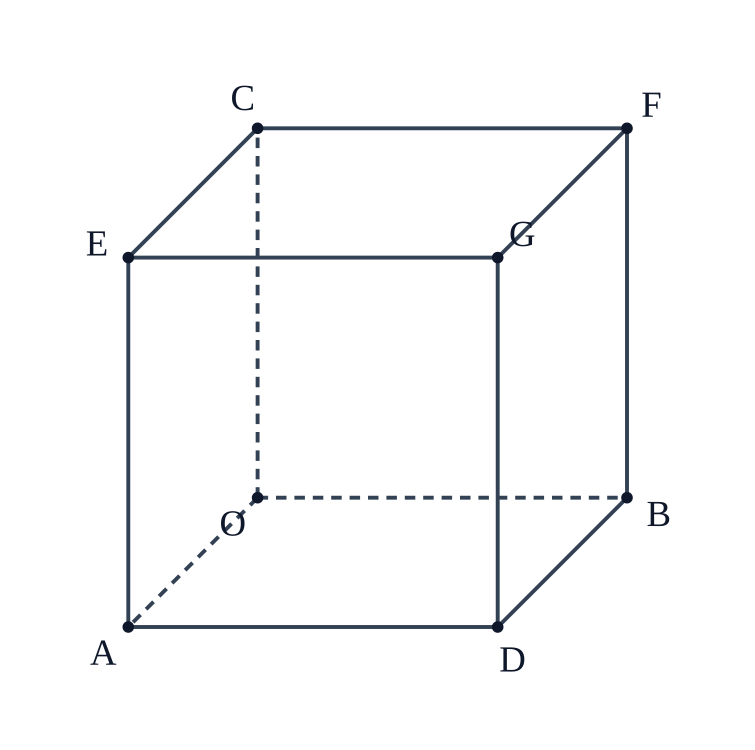
    What are the coordinates of the vertices of a cube whose edge is 2\displaystyle 2 units, one of whose vertices coincides with the origin and the three edges passing through the origin, coincides with the positive direction of the axes through the origin?

    Matches the book, not yet reviewed

    This working reaches the answer NCERT prints. It has not yet been read through by hand.

    NCERT’s answer
    ($\displaystyle 2,0,0$), ($\displaystyle 2,2,0$), ($\displaystyle 0,2,0$), ($\displaystyle 0,2,2$) ($\displaystyle 0,0,2$) ($\displaystyle 2,0,2$), ($\displaystyle 0,0,0$), ($\displaystyle 2,2,2$)
    Edges of length $\displaystyle 2$ lie along the positive \(\displaystyle x\), \(\displaystyle y\), \(\displaystyle z\)-axes from \(\displaystyle O\), so every coordinate of a vertex is \(\displaystyle 0\) or \(\displaystyle 2\). \[O(0,0,0),\quad A(2,0,0),\quad B(0,2,0),\quad C(0,0,2) \] \[D(2,2,0),\quad E(2,0,2),\quad F(0,2,2),\quad G(2,2,2) \] NCERT_Solution_Class11_Maths_Exemplar_Ch12_Ex12-3_Q21 Answer: \(\displaystyle (0,0,0),(2,0,0),(0,2,0),(0,0,2),(2,2,0),(2,0,2),(0,2,2),(2,2,2)\)
  2. Choose the correct answer from the given four options inidcated against each of the Exercises from $\displaystyle 22$ (M.C.Q.).

    Exercise 22

    The distance of point P(3,4,5)\displaystyle \mathrm{P}(3,4,5) from the yz\displaystyle y z-plane is
    (A)
    3\displaystyle 3 units
    (B)
    4\displaystyle 4 units
    (C)
    5\displaystyle 5 units
    (D)
    550\displaystyle 550

    Matches the book, not yet reviewed

    This working reaches the answer NCERT prints. It has not yet been read through by hand.

    NCERT’s answer
    A
    (A) $\displaystyle 3$ units. The distance of a point from the \(\displaystyle yz\)-plane is the absolute value of its \(\displaystyle x\)-coordinate. \[d=|x|=|3|=3 \]
  3. Exercise 23

    What is the length of foot of perpendicular drawn from the point P(3,4,5)\displaystyle \mathrm{P}(3,4,5) on y\displaystyle y-axis
    (A)
    41\displaystyle \sqrt{41}
    (B)
    34\displaystyle \sqrt{34}
    (C)
    5\displaystyle 5 (D) none of these

    Matches the book, not yet reviewed

    This working reaches the answer NCERT prints. It has not yet been read through by hand.

    NCERT’s answer
    B
    (B) \(\displaystyle \sqrt{34}\). The foot of the perpendicular from \(\displaystyle P(3,4,5)\) on the \(\displaystyle y\)-axis is \(\displaystyle M(0,4,0)\). \[PM=\sqrt{(3-0)^2+(4-4)^2+(5-0)^2}=\sqrt{34} \]
  4. Exercise 24

    Distance of the point (3\displaystyle 3, 4\displaystyle 4, 5\displaystyle 5) from the origin (0\displaystyle 0, 0\displaystyle 0, 0\displaystyle 0) is
    (A)
    50\displaystyle \sqrt{50}
    (B)
    3\displaystyle 3 (C) 4\displaystyle 4 (D) 5\displaystyle 5

    Matches the book, not yet reviewed

    This working reaches the answer NCERT prints. It has not yet been read through by hand.

    NCERT’s answer
    A
    (A) \(\displaystyle \sqrt{50}\). Distance formula from the origin: \[OP=\sqrt{3^2+4^2+5^2}=\sqrt{9+16+25}=\sqrt{50} \]
  5. Exercise 25

    If the distance between the points (a,0,1)\displaystyle (a, 0,1) and (0,1,2)\displaystyle (0,1,2) is 27\displaystyle \sqrt{27}, then the value of a\displaystyle a is
    (A)
    5\displaystyle 5 (B) ±5\displaystyle \pm 5
    (C)
    5\displaystyle 5
    (D) none of these

    Matches the book, not yet reviewed

    This working reaches the answer NCERT prints. It has not yet been read through by hand.

    NCERT’s answer
    B
    (B) \(\displaystyle \pm 5\)Distance formula: \[(a-0)^2 + (0-1)^2 + (1-2)^2 = (\sqrt{27})^2 \] \[a^2 + 1 + 1 = 27 \] \[a^2 = 25 \] \[a = \pm 5 \] Answer: (B) \(\displaystyle \pm 5\)
  6. Exercise 26

    x\displaystyle x-axis is the intersection of two planes
    (A)
    xy\displaystyle x y and xz\displaystyle x z
    (B)
    yz\displaystyle y z and zx\displaystyle z x
    (C)
    xy\displaystyle x y and yz\displaystyle y z
    (D)
    none of these

    Matches the book, not yet reviewed

    This working reaches the answer NCERT prints. It has not yet been read through by hand.

    NCERT’s answer
    A
    (A) \(\displaystyle xy\) and \(\displaystyle xz\)On the \(\displaystyle x\)-axis \(\displaystyle y = 0\) and \(\displaystyle z = 0\). \[xy\text{-plane}: z = 0 \] \[xz\text{-plane}: y = 0 \] Both hold together exactly on the \(\displaystyle x\)-axis. Answer: (A)
  7. Exercise 27

    Equation of y\displaystyle y-axis is considered as
    (A)
    x=0,y=0\displaystyle x=0, y=0
    (B)
    y=0,z=0\displaystyle y=0, z=0
    (C)
    z=0,x=0\displaystyle z=0, x=0
    (D)
    none of these

    Check this one against your book

    NCERT’s printed answer for this exercise does not match its own question. This working follows the question as printed.

    (C) \(\displaystyle z=0,\ x=0\)Every point of the \(\displaystyle y\)-axis has \(\displaystyle x\)- and \(\displaystyle z\)-coordinates zero: \[(0, y, 0) \Rightarrow x = 0,\ z = 0 \] Answer: (C)
  8. Exercise 28

    The point (-2\displaystyle 2, -3\displaystyle 3, -4\displaystyle 4) lies in the
    (A)
    First octant
    (B)
    Seventh octant
    (C)
    Second octant
    (D)
    Eighth octant

    Matches the book, not yet reviewed

    This working reaches the answer NCERT prints. It has not yet been read through by hand.

    NCERT’s answer
    B
    (B) Seventh octantSigns of the coordinates: \[(-2, -3, -4) \to (-, -, -) \] The octant with signs \(\displaystyle (-,-,-)\) is the seventh. Answer: (B) Seventh octant
  9. Exercise 29

    A plane is parallel to yz\displaystyle y z-plane so it is perpendicular to :
    (A)
    x\displaystyle x-axis
    (B)
    y\displaystyle y-axis
    (C)
    z\displaystyle z-axis
    (D)
    none of these

    Matches the book, not yet reviewed

    This working reaches the answer NCERT prints. It has not yet been read through by hand.

    NCERT’s answer
    A
    (A) \(\displaystyle x\)-axisThe \(\displaystyle yz\)-plane is \(\displaystyle x = 0\), so a parallel plane is \[x = k \] Every point on it has the same \(\displaystyle x\); the plane meets the \(\displaystyle x\)-axis at right angles. Answer: (A) \(\displaystyle x\)-axis
  10. Exercise 30

    The locus of a point for which y=0,z=0\displaystyle y=0, z=0 is
    (A)
    equation of x\displaystyle x-axis
    (B)
    equation of y\displaystyle y-axis
    (C)
    equation at z\displaystyle z-axis
    (D)
    none of these

    Matches the book, not yet reviewed

    This working reaches the answer NCERT prints. It has not yet been read through by hand.

    NCERT’s answer
    A
    (A) equation of \(\displaystyle x\)-axisPoints with \[y = 0,\ z = 0 \] are \(\displaystyle (x, 0, 0)\), which is the \(\displaystyle x\)-axis. Answer: (A)