SolveIt is under development
SolveItNCERT · CBSE · NEET

NCERT Exemplar · Class 11 Mathematics Introduction to Three Dimensional Geometry

50 questions · 50 still being checked

EXERCISE 12.3 1–10 (part 1 of 5)

  1. Exercise 1

    Locate the following points:
    (i)
    (1,−1,3)\displaystyle (1,-1,3),
    (ii)
    (- 1\displaystyle 1, 2\displaystyle 2, 4\displaystyle 4)
    (iii)
    (-2\displaystyle 2, -4\displaystyle 4, -7\displaystyle 7)
    (iv)
    (-4\displaystyle 4, 2\displaystyle 2, -5\displaystyle 5).

    Not cross-checked

    NCERT prints no numerical answer for this exercise, so this working has not been cross-checked against the book.

    From \(\displaystyle O\), move in the order \(\displaystyle x\), \(\displaystyle y\), \(\displaystyle z\):1. \(\displaystyle |x|\) units along the \(\displaystyle x\)-axis (\(\displaystyle OX\) if \(\displaystyle x>0\), \(\displaystyle OX'\) if \(\displaystyle x<0\)). 2. \(\displaystyle |y|\) units parallel to the \(\displaystyle y\)-axis, towards \(\displaystyle OY\) or \(\displaystyle OY'\) by the sign. 3. \(\displaystyle |z|\) units parallel to the \(\displaystyle z\)-axis (up if \(\displaystyle z>0\), down if \(\displaystyle z<0\)).\[\text{(i)}\quad O \to (1,0,0) \to (1,-1,0) \to (1,-1,3) \] \[\text{(ii)}\quad O \to (-1,0,0) \to (-1,2,0) \to (-1,2,4) \] \[\text{(iii)}\quad O \to (-2,0,0) \to (-2,-4,0) \to (-2,-4,-7) \] \[\text{(iv)}\quad O \to (-4,0,0) \to (-4,2,0) \to (-4,2,-5) \]Answer: \(\displaystyle (1,-1,3)\) lies in octant IV, \(\displaystyle (-1,2,4)\) in octant II, \(\displaystyle (-2,-4,-7)\) in octant VII and \(\displaystyle (-4,2,-5)\) in octant VI.
  2. Exercise 2

    Name the octant in which each of the following points lies.
    (i)
    (1,2,3)\displaystyle (1,2,3),
    (ii)
    (4\displaystyle 4, -2\displaystyle 2, 3\displaystyle 3),
    (iii)
    (4\displaystyle 4, -2\displaystyle 2, -5\displaystyle 5)
    (iv)
    (4\displaystyle 4, 2\displaystyle 2, -5\displaystyle 5)
    (v)
    (- 4\displaystyle 4, 2\displaystyle 2, 5\displaystyle 5)
    (vi)
    (-3\displaystyle 3, -1\displaystyle 1, 6\displaystyle 6)
    (vii)
    (2\displaystyle 2, -4\displaystyle 4, -7\displaystyle 7)
    (viii)
    (-4\displaystyle 4, 2\displaystyle 2, -5\displaystyle 5).

    Matches the book, not yet reviewed

    This working reaches the answer NCERT prints. It has not yet been read through by hand.

    NCERT’s answer
    (i)
    \(\displaystyle 1^{\text {st }}\) octant
    (ii)
    \(\displaystyle 4^{\text {th }}\) octant
    (iii)
    \(\displaystyle \mathrm{viii}^{\text {th }}\) octant
    (iv)
    \(\displaystyle \mathrm{v}^{\text {th }}\) octant
    (v)
    \(\displaystyle 2^{\text {nd }}\) octant
    (vi)
    \(\displaystyle 3^{\text {rd }}\) octant
    (vii)
    \(\displaystyle \mathrm{viii}^{\text {th }}\) octant
    (viii)
    \(\displaystyle \mathrm{vi}^{\text {th }}\) octant
    Read the octant from the signs of \(\displaystyle (x,y,z)\).\[\begin{aligned} (1,2,3)&:\ (+,+,+)\to \text{I}\\ (4,-2,3)&:\ (+,-,+)\to \text{IV}\\ (4,-2,-5)&:\ (+,-,-)\to \text{VIII}\\ (4,2,-5)&:\ (+,+,-)\to \text{V}\\ (-4,2,5)&:\ (-,+,+)\to \text{II}\\ (-3,-1,6)&:\ (-,-,+)\to \text{III}\\ (2,-4,-7)&:\ (+,-,-)\to \text{VIII}\\ (-4,2,-5)&:\ (-,+,-)\to \text{VI} \end{aligned} \]Answer: (i) I, (ii) IV, (iii) VIII, (iv) V, (v) II, (vi) III, (vii) VIII, (viii) VI.
  3. Exercise 3

    Let A,B,C\displaystyle \mathrm{A}, \mathrm{B}, \mathrm{C} be the feet of perpendiculars from a point P on the x,y,z\displaystyle x, y, z-axis respectively. Find the coordinates of A, B and C in each of the following where the point P is :
    (i)
    A=(3,4,2)\displaystyle \mathrm{A}=(3,4,2)
    (ii)
    (-5\displaystyle 5, 3\displaystyle 3, 7\displaystyle 7)
    (iii)
    (4\displaystyle 4, - 3\displaystyle 3, - 5\displaystyle 5)

    Check this one against your book

    NCERT’s printed answer for this exercise does not match its own question. This working follows the question as printed.

    The foot on an axis keeps that one coordinate of \(\displaystyle P\) and has the other two equal to \(\displaystyle 0\).\[P(3,4,2):\quad A(3,0,0),\ B(0,4,0),\ C(0,0,2) \] \[P(-5,3,7):\quad A(-5,0,0),\ B(0,3,0),\ C(0,0,7) \] \[P(4,-3,-5):\quad A(4,0,0),\ B(0,-3,0),\ C(0,0,-5) \]Answer: as above; \(\displaystyle A\), \(\displaystyle B\), \(\displaystyle C\) are the feet on the \(\displaystyle x\)-, \(\displaystyle y\)-, \(\displaystyle z\)-axes.
  4. Exercise 4

    Let A,B,C\displaystyle \mathrm{A}, \mathrm{B}, \mathrm{C} be the feet of perpendiculars from a point P on the xy,yz\displaystyle x y, y z and zx\displaystyle z x-planes respectively. Find the coordinates of A,B,C\displaystyle \mathrm{A}, \mathrm{B}, \mathrm{C} in each of the following where the point P is
    (i)
    (3\displaystyle 3, 4\displaystyle 4, 5\displaystyle 5)
    (ii)
    (-5\displaystyle 5, 3\displaystyle 3, 7\displaystyle 7)
    (iii)
    (4\displaystyle 4, - 3\displaystyle 3, - 5\displaystyle 5).

    Matches the book, not yet reviewed

    This working reaches the answer NCERT prints. It has not yet been read through by hand.

    NCERT’s answer
    (i)
    ($\displaystyle 3,4,0$), ($\displaystyle 0,4,5$), ($\displaystyle 3,0,5$)
    (ii)
    (-$\displaystyle 5$, $\displaystyle 3$, $\displaystyle 0$),($\displaystyle 0,3,7$), (-$\displaystyle 5$, $\displaystyle 0$, $\displaystyle 7$)
    (iii)
    ($\displaystyle 4$,-$\displaystyle 3$, $\displaystyle 0$), ($\displaystyle 0$,-$\displaystyle 3$,-$\displaystyle 5$), ($\displaystyle 4$, $\displaystyle 0$,-$\displaystyle 5$)
    The foot on a coordinate plane keeps the two coordinates named in the plane and has the third equal to \(\displaystyle 0\): \(\displaystyle xy\) zeroes \(\displaystyle z\), \(\displaystyle yz\) zeroes \(\displaystyle x\), \(\displaystyle zx\) zeroes \(\displaystyle y\).\[P(3,4,5):\quad A(3,4,0),\ B(0,4,5),\ C(3,0,5) \] \[P(-5,3,7):\quad A(-5,3,0),\ B(0,3,7),\ C(-5,0,7) \] \[P(4,-3,-5):\quad A(4,-3,0),\ B(0,-3,-5),\ C(4,0,-5) \]Answer: as above; \(\displaystyle A\), \(\displaystyle B\), \(\displaystyle C\) are the feet on the \(\displaystyle xy\)-, \(\displaystyle yz\)-, \(\displaystyle zx\)-planes.
  5. Exercise 5

    How far apart are the points (2\displaystyle 2, 0\displaystyle 0, 0\displaystyle 0) and (-3\displaystyle 3, 0\displaystyle 0, 0\displaystyle 0)?

    Matches the book, not yet reviewed

    This working reaches the answer NCERT prints. It has not yet been read through by hand.

    NCERT’s answer
    $\displaystyle 5$
    Both points lie on the \(\displaystyle x\)-axis.\[d=\sqrt{(2-(-3))^2+(0-0)^2+(0-0)^2} \] \[d=\sqrt{25}=5 \]Answer: \(\displaystyle 5\) units.
  6. Exercise 6

    Find the distance from the origin to (6\displaystyle 6, 6\displaystyle 6, 7\displaystyle 7).

    Matches the book, not yet reviewed

    This working reaches the answer NCERT prints. It has not yet been read through by hand.

    NCERT’s answer
    $\displaystyle 11$
    \[d=\sqrt{(6-0)^2+(6-0)^2+(7-0)^2} \] \[d=\sqrt{36+36+49}=\sqrt{121} \] \[d=11 \]Answer: \(\displaystyle 11\) units.
  7. Exercise 7

    Show that if x2+y2=1\displaystyle x^2+y^2=1, then the point (x,y,1−x2−y2)\displaystyle \left(x, y, \sqrt{1-x^2-y^2}\right) is at a distance 1\displaystyle 1 unit from the origin.

    Not cross-checked

    NCERT prints no numerical answer for this exercise, so this working has not been cross-checked against the book.

    Let \(\displaystyle O=(0,0,0)\) and \(\displaystyle P=\left(x,y,\sqrt{1-x^2-y^2}\right)\).\[x^2+y^2=1 \ \Rightarrow\ \sqrt{1-x^2-y^2}=\sqrt{1-1}=0 \] \[OP^2=x^2+y^2+\left(\sqrt{1-x^2-y^2}\right)^2=1+0 \] \[OP=\sqrt{1}=1 \]Answer: \(\displaystyle OP=1\) unit.
  8. Exercise 8

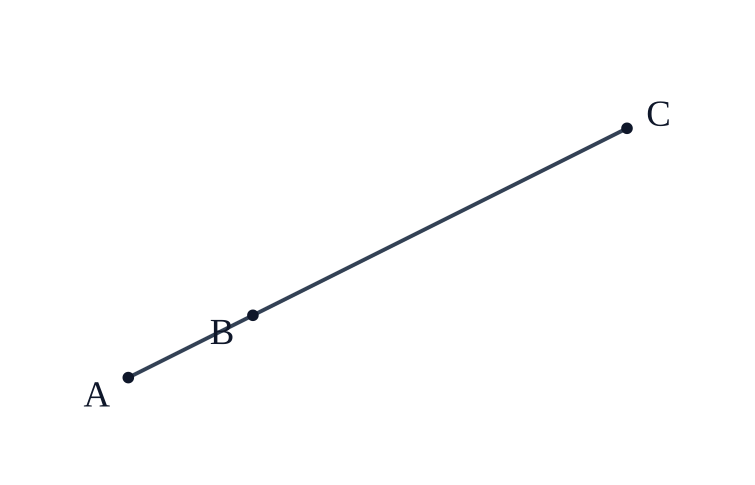
    Show that the point A(1,−1,3),B(2,−4,5)\displaystyle \mathrm{A}(1,-1,3), \mathrm{B}(2,-4,5) and (5,−13,11)\displaystyle (5,-13,11) are collinear.

    Not cross-checked

    NCERT prints no numerical answer for this exercise, so this working has not been cross-checked against the book.

    Take \(\displaystyle C=(5,-13,11)\).\[AB=\sqrt{(2-1)^2+(-4+1)^2+(5-3)^2}=\sqrt{1+9+4}=\sqrt{14} \] \[BC=\sqrt{(5-2)^2+(-13+4)^2+(11-5)^2}=\sqrt{9+81+36}=\sqrt{126}=3\sqrt{14} \] \[AC=\sqrt{(5-1)^2+(-13+1)^2+(11-3)^2}=\sqrt{16+144+64}=\sqrt{224}=4\sqrt{14} \] \[AB+BC=\sqrt{14}+3\sqrt{14}=4\sqrt{14}=AC \]NCERT_Solution_Class11_Maths_Exemplar_Ch12_Ex12-3_Q8Answer: \(\displaystyle AB+BC=AC\), so \(\displaystyle B\) lies on segment \(\displaystyle AC\) and \(\displaystyle A\), \(\displaystyle B\), \(\displaystyle C\) are collinear.
  9. Exercise 9

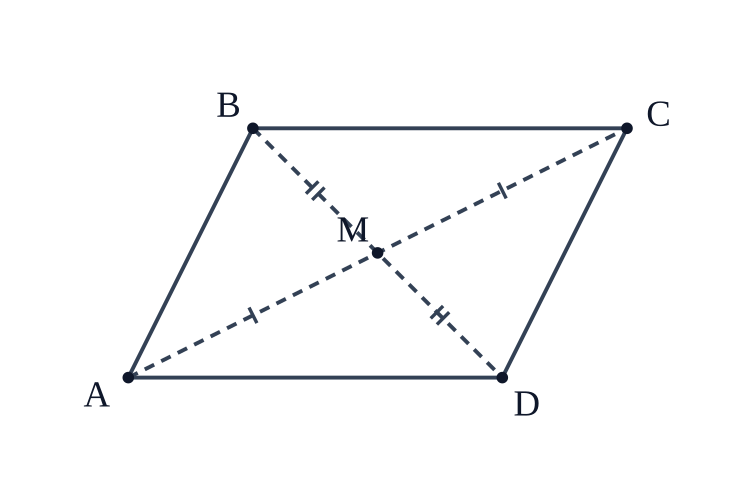
    Three consecutive vertices of a parallelogram ABCD are A(6,−2,4),B(2,4,−8)\displaystyle \mathrm{A}(6,-2,4), \mathrm{B}(2,4,-8), C (-2\displaystyle 2, 2\displaystyle 2, 4\displaystyle 4). Find the coordinates of the fourth vertex. [Hint: Diagonals of a parallelogram have the same mid-point.]

    Matches the book, not yet reviewed

    This working reaches the answer NCERT prints. It has not yet been read through by hand.

    NCERT’s answer
    ($\displaystyle 2$,-$\displaystyle 4,16$)
    Diagonals AC and BD bisect each other, so they share a mid-point M.NCERT_Solution_Class11_Maths_Exemplar_Ch12_Ex12-3_Q9\[M=\left(\frac{6-2}{2},\ \frac{-2+2}{2},\ \frac{4+4}{2}\right)=(2,\,0,\,4) \] Let \(\displaystyle \mathrm{D}=(x,y,z)\). M is the mid-point of BD: \[\frac{2+x}{2}=2,\qquad \frac{4+y}{2}=0,\qquad \frac{-8+z}{2}=4 \] \[x=2,\qquad y=-4,\qquad z=16 \] Answer: \(\displaystyle \mathrm{D}(2,\,-4,\,16)\)
  10. Exercise 10

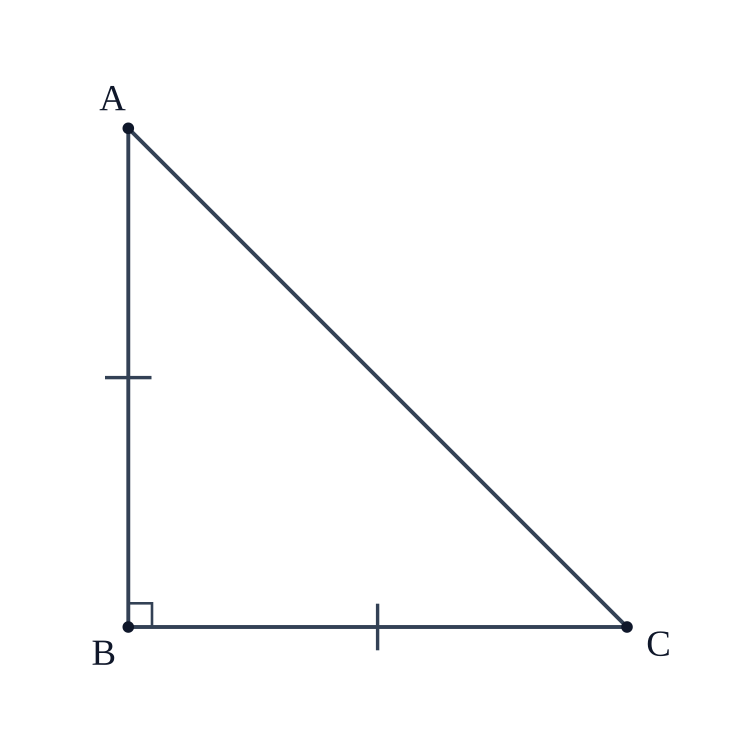
    Show that the triangle ABC with vertices A (0\displaystyle 0, 4\displaystyle 4, 1\displaystyle 1), B (2\displaystyle 2, 3\displaystyle 3, - 1\displaystyle 1) and C (4\displaystyle 4, 5\displaystyle 5, 0\displaystyle 0) is right angled.

    Not cross-checked

    NCERT prints no numerical answer for this exercise, so this working has not been cross-checked against the book.

    NCERT_Solution_Class11_Maths_Exemplar_Ch12_Ex12-3_Q10\[AB^2=(2-0)^2+(3-4)^2+(-1-1)^2=4+1+4=9 \] \[BC^2=(4-2)^2+(5-3)^2+(0+1)^2=4+4+1=9 \] \[CA^2=(0-4)^2+(4-5)^2+(1-0)^2=16+1+1=18 \] \[AB^2+BC^2=9+9=18=CA^2 \] By the converse of Pythagoras' theorem, the angle opposite CA is a right angle.Answer: \(\displaystyle \angle B=90^\circ\), so triangle ABC is right-angled at B (with \(\displaystyle AB=BC=3\)).