Exercise 11
Find the third vertex of triangle whose centroid is origin and two vertices are (, , ) and (, -, -).
Matches the book, not yet reviewed
This working reaches the answer NCERT prints. It has not yet been read through by hand.
NCERT’s answer
(-$\displaystyle 2$, -$\displaystyle 2$, -$\displaystyle 1$)
Let the third vertex be \(\displaystyle (x,y,z)\). The centroid is the origin:
\[\left(\frac{2+0+x}{3},\ \frac{4-2+y}{3},\ \frac{6-5+z}{3}\right)=(0,0,0) \]
\[2+x=0,\qquad 2+y=0,\qquad 1+z=0 \]
\[x=-2,\qquad y=-2,\qquad z=-1 \]
Answer: \(\displaystyle (-2,\,-2,\,-1)\)
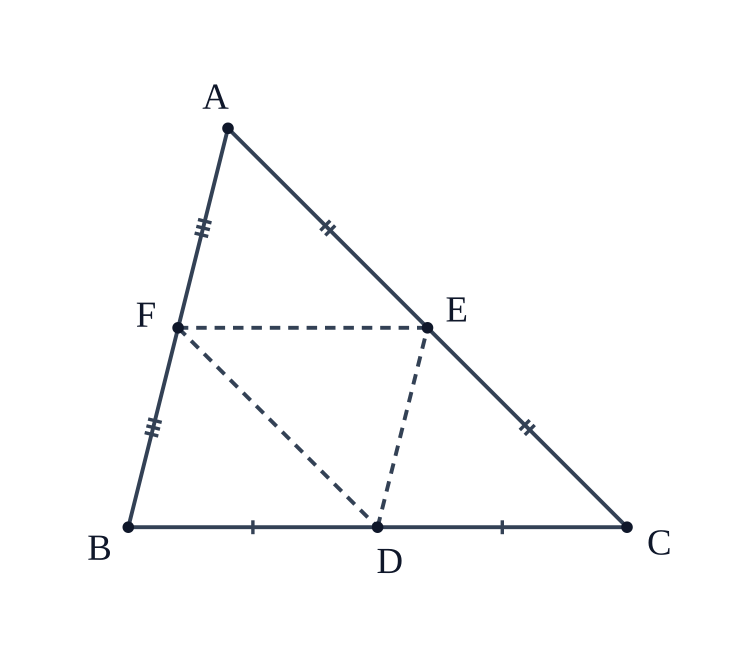 Adding the three mid-point formulas, coordinate by coordinate:
\[x_D+x_E+x_F=\frac{x_B+x_C}{2}+\frac{x_C+x_A}{2}+\frac{x_A+x_B}{2}=x_A+x_B+x_C \]
The same holds for \(\displaystyle y\) and \(\displaystyle z\), so the centroid of ABC is
\[G=\left(\frac{x_A+x_B+x_C}{3},\ \frac{y_A+y_B+y_C}{3},\ \frac{z_A+z_B+z_C}{3}\right)=\left(\frac{x_D+x_E+x_F}{3},\ \frac{y_D+y_E+y_F}{3},\ \frac{z_D+z_E+z_F}{3}\right) \]
\[G=\left(\frac{1+3-1}{3},\ \frac{2+0+1}{3},\ \frac{-3+1-4}{3}\right)=(1,\,1,\,-2) \]
Answer: \(\displaystyle (1,\,1,\,-2)\)
Adding the three mid-point formulas, coordinate by coordinate:
\[x_D+x_E+x_F=\frac{x_B+x_C}{2}+\frac{x_C+x_A}{2}+\frac{x_A+x_B}{2}=x_A+x_B+x_C \]
The same holds for \(\displaystyle y\) and \(\displaystyle z\), so the centroid of ABC is
\[G=\left(\frac{x_A+x_B+x_C}{3},\ \frac{y_A+y_B+y_C}{3},\ \frac{z_A+z_B+z_C}{3}\right)=\left(\frac{x_D+x_E+x_F}{3},\ \frac{y_D+y_E+y_F}{3},\ \frac{z_D+z_E+z_F}{3}\right) \]
\[G=\left(\frac{1+3-1}{3},\ \frac{2+0+1}{3},\ \frac{-3+1-4}{3}\right)=(1,\,1,\,-2) \]
Answer: \(\displaystyle (1,\,1,\,-2)\)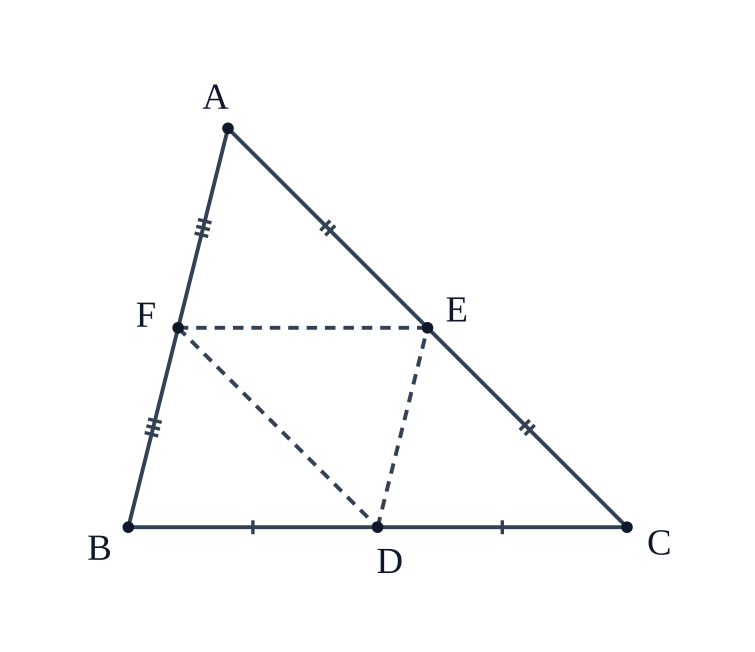 \[B+C=2D=(10,\,14,\,22) \]
\[C+A=2E=(0,\,16,\,10) \]
\[A+B=2F=(4,\,6,\,-2) \]
Adding and halving:
\[A+B+C=(7,\,18,\,15) \]
Subtracting each pair sum:
\[A=(7,18,15)-(10,14,22)=(-3,\,4,\,-7) \]
\[B=(7,18,15)-(0,16,10)=(7,\,2,\,5) \]
\[C=(7,18,15)-(4,6,-2)=(3,\,12,\,17) \]
Answer: \(\displaystyle \mathrm{A}(-3,4,-7)\), \(\displaystyle \mathrm{B}(7,2,5)\), \(\displaystyle \mathrm{C}(3,12,17)\)
\[B+C=2D=(10,\,14,\,22) \]
\[C+A=2E=(0,\,16,\,10) \]
\[A+B=2F=(4,\,6,\,-2) \]
Adding and halving:
\[A+B+C=(7,\,18,\,15) \]
Subtracting each pair sum:
\[A=(7,18,15)-(10,14,22)=(-3,\,4,\,-7) \]
\[B=(7,18,15)-(0,16,10)=(7,\,2,\,5) \]
\[C=(7,18,15)-(4,6,-2)=(3,\,12,\,17) \]
Answer: \(\displaystyle \mathrm{A}(-3,4,-7)\), \(\displaystyle \mathrm{B}(7,2,5)\), \(\displaystyle \mathrm{C}(3,12,17)\)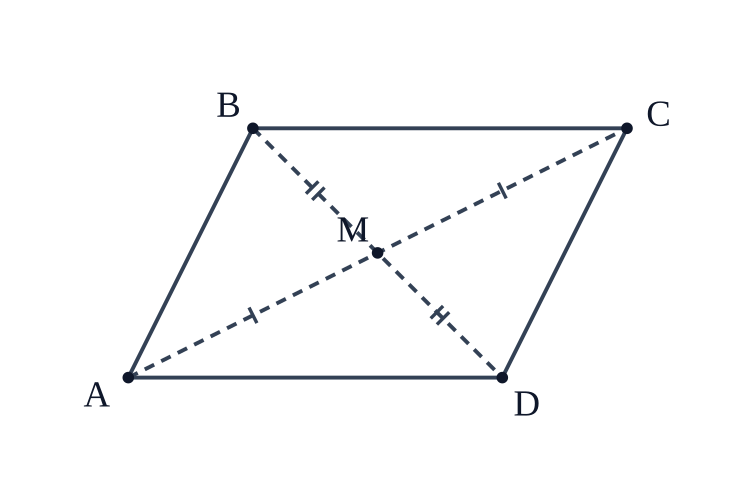 \[\text{mid-point of } AC=\left(\frac{1+2}{2},\ \frac{2+3}{2},\ \frac{3+2}{2}\right)=\left(\frac32,\,\frac52,\,\frac52\right) \]
Let \(\displaystyle \mathrm{D}=(x,y,z)\). The mid-point of BD is the same:
\[\frac{-1+x}{2}=\frac32,\qquad \frac{-2+y}{2}=\frac52,\qquad \frac{-1+z}{2}=\frac52 \]
\[x=4,\qquad y=7,\qquad z=6 \]
Answer: \(\displaystyle \mathrm{D}(4,\,7,\,6)\)
\[\text{mid-point of } AC=\left(\frac{1+2}{2},\ \frac{2+3}{2},\ \frac{3+2}{2}\right)=\left(\frac32,\,\frac52,\,\frac52\right) \]
Let \(\displaystyle \mathrm{D}=(x,y,z)\). The mid-point of BD is the same:
\[\frac{-1+x}{2}=\frac32,\qquad \frac{-2+y}{2}=\frac52,\qquad \frac{-1+z}{2}=\frac52 \]
\[x=4,\qquad y=7,\qquad z=6 \]
Answer: \(\displaystyle \mathrm{D}(4,\,7,\,6)\)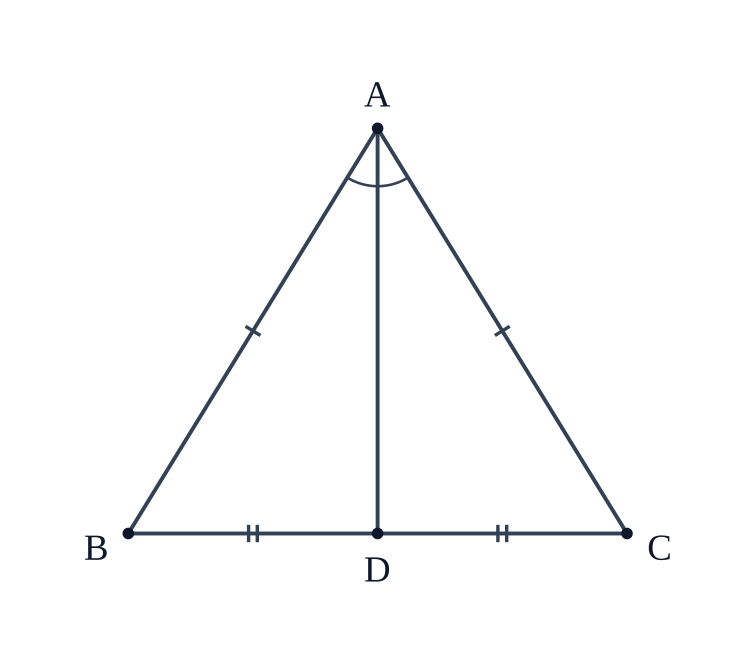 D is the mid-point of \(\displaystyle BC\):
\[D=\left(\frac{5+2}{2},\frac{6+7}{2},\frac{9+9}{2}\right)=\left(\frac72,\frac{13}{2},9\right) \]
Answer: \(\displaystyle D=\left(\dfrac72,\dfrac{13}{2},9\right)\)
D is the mid-point of \(\displaystyle BC\):
\[D=\left(\frac{5+2}{2},\frac{6+7}{2},\frac{9+9}{2}\right)=\left(\frac72,\frac{13}{2},9\right) \]
Answer: \(\displaystyle D=\left(\dfrac72,\dfrac{13}{2},9\right)\)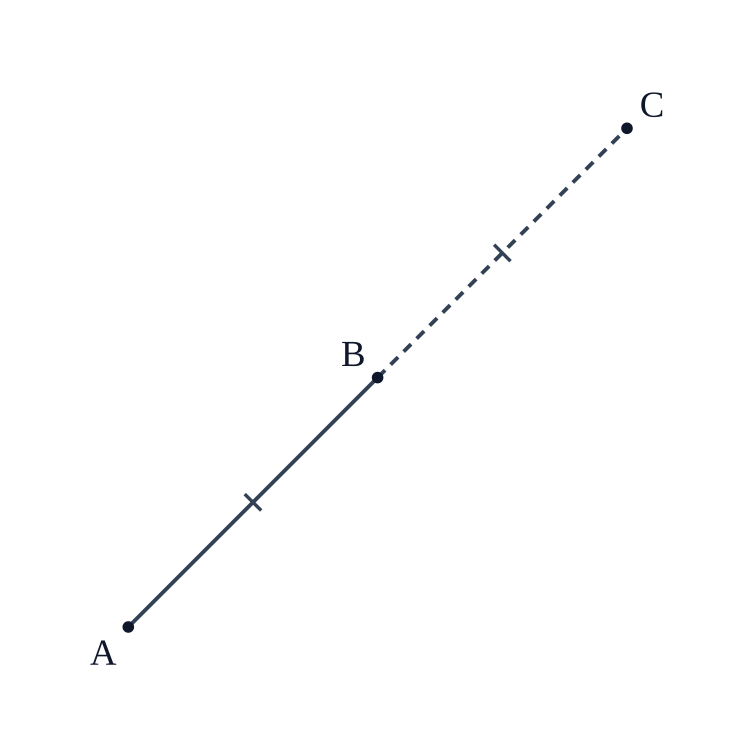 \[AC:CB=2\sqrt{59}:\sqrt{59}=2:1 \]
Check, external ratio \(\displaystyle 2:1\):
\[\left(\frac{2(-1)-1(2)}{2-1},\frac{2(2)-1(3)}{2-1},\frac{2(-3)-1(4)}{2-1}\right)=(-4,1,-10)=C \]
Answer: collinear; \(\displaystyle C\) divides \(\displaystyle AB\) externally in the ratio \(\displaystyle 2:1\).
\[AC:CB=2\sqrt{59}:\sqrt{59}=2:1 \]
Check, external ratio \(\displaystyle 2:1\):
\[\left(\frac{2(-1)-1(2)}{2-1},\frac{2(2)-1(3)}{2-1},\frac{2(-3)-1(4)}{2-1}\right)=(-4,1,-10)=C \]
Answer: collinear; \(\displaystyle C\) divides \(\displaystyle AB\) externally in the ratio \(\displaystyle 2:1\).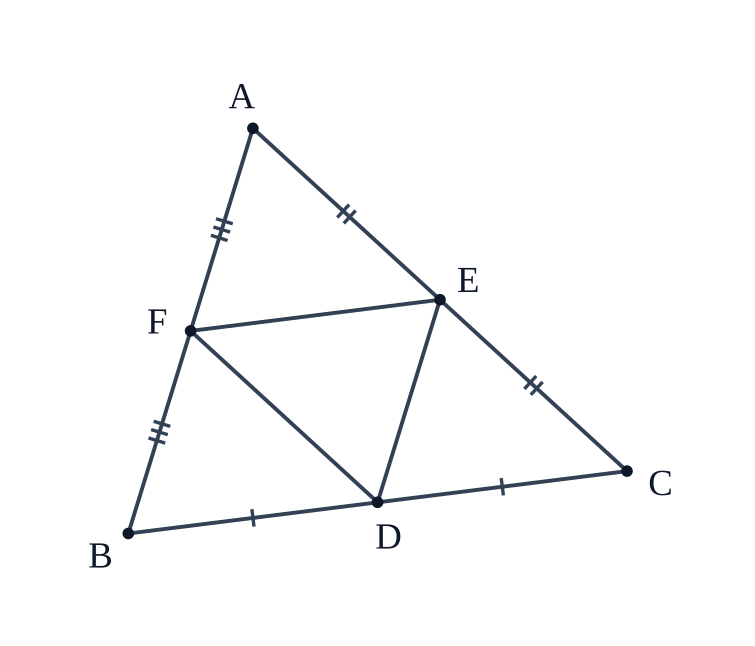 \[B+C=2D=(2,10,-2) \]
\[C+A=2E=(0,8,-4) \]
\[A+B=2F=(4,6,8) \]
\[A+B+C=\tfrac12(6,24,2)=(3,12,1) \]
\[A=(3,12,1)-(2,10,-2)=(1,2,3) \]
\[B=(3,12,1)-(0,8,-4)=(3,4,5) \]
\[C=(3,12,1)-(4,6,8)=(-1,6,-7) \]
\[G=\tfrac13(A+B+C)=\left(1,4,\tfrac13\right) \]
Answer: \(\displaystyle A(1,2,3),\ B(3,4,5),\ C(-1,6,-7)\); centroid \(\displaystyle \left(1,4,\dfrac13\right)\).
\[B+C=2D=(2,10,-2) \]
\[C+A=2E=(0,8,-4) \]
\[A+B=2F=(4,6,8) \]
\[A+B+C=\tfrac12(6,24,2)=(3,12,1) \]
\[A=(3,12,1)-(2,10,-2)=(1,2,3) \]
\[B=(3,12,1)-(0,8,-4)=(3,4,5) \]
\[C=(3,12,1)-(4,6,8)=(-1,6,-7) \]
\[G=\tfrac13(A+B+C)=\left(1,4,\tfrac13\right) \]
Answer: \(\displaystyle A(1,2,3),\ B(3,4,5),\ C(-1,6,-7)\); centroid \(\displaystyle \left(1,4,\dfrac13\right)\).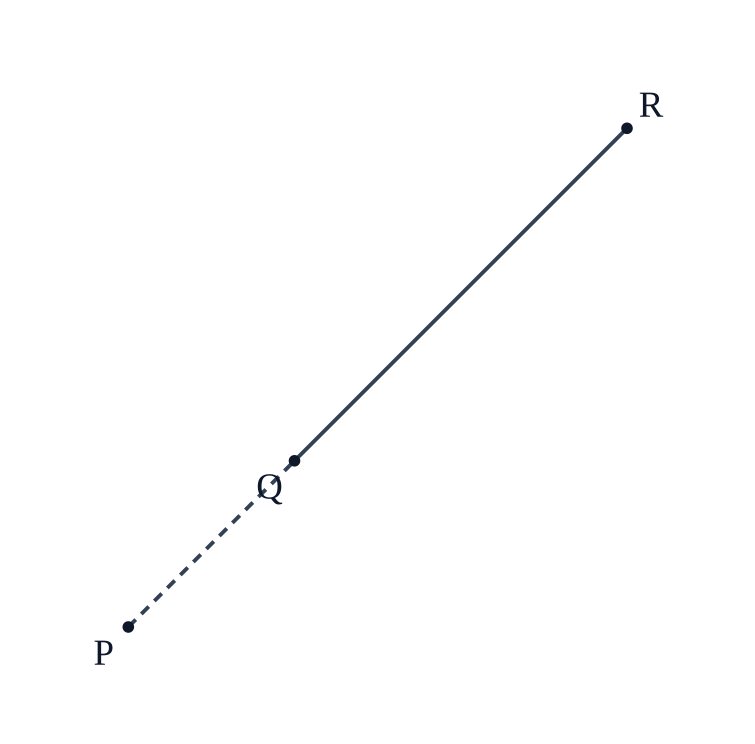 \[QP:PR=2\sqrt3:6\sqrt3=1:3 \]
Check, external ratio \(\displaystyle 1:3\) on \(\displaystyle Q,R\):
\[\left(\frac{1(6)-3(2)}{1-3},\frac{1(5)-3(1)}{1-3},\frac{1(-13)-3(-9)}{1-3}\right)=(0,-1,-7)=P \]
Answer: collinear; the first point divides the join of the other two externally in the ratio \(\displaystyle 1:3\).
\[QP:PR=2\sqrt3:6\sqrt3=1:3 \]
Check, external ratio \(\displaystyle 1:3\) on \(\displaystyle Q,R\):
\[\left(\frac{1(6)-3(2)}{1-3},\frac{1(5)-3(1)}{1-3},\frac{1(-13)-3(-9)}{1-3}\right)=(0,-1,-7)=P \]
Answer: collinear; the first point divides the join of the other two externally in the ratio \(\displaystyle 1:3\).