SolveIt is under development
SolveItNCERT · CBSE · NEET

NCERT Exemplar · Class 11 Mathematics Conic Sections

59 questions · 59 still being checked

EXERCISE 11.3 31–40 (part 4 of 6)

  1. Exercise 31

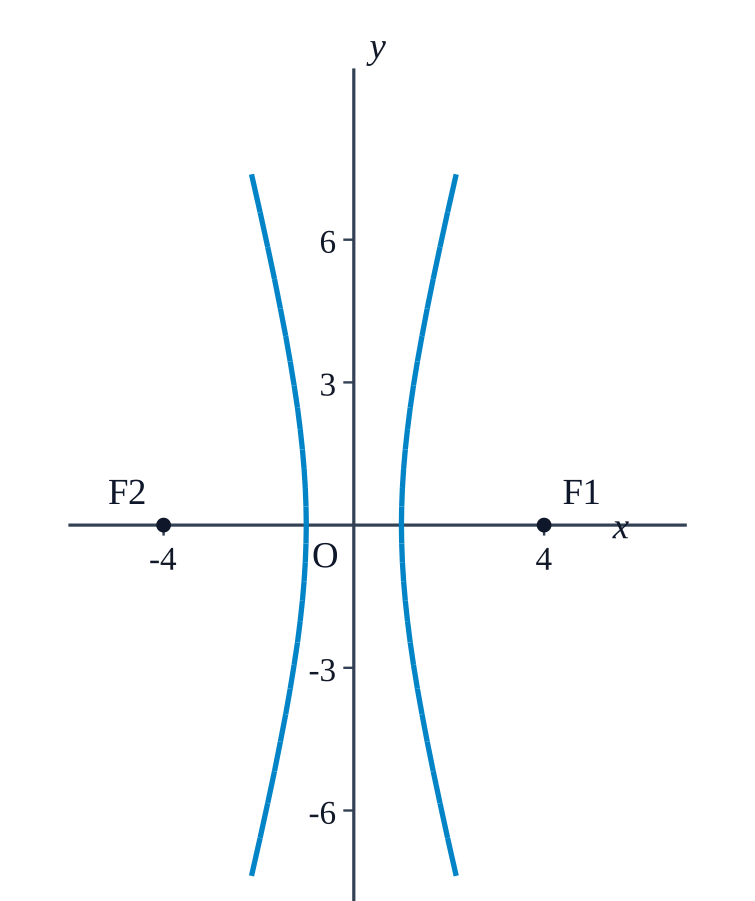
    Show that the set of all points such that the difference of their distances from (4,0)\displaystyle (4,0) and (−4,0)\displaystyle (- 4, 0) is always equal to 2\displaystyle 2 represent a hyperbola.

    Not cross-checked

    NCERT prints no numerical answer for this exercise, so this working has not been cross-checked against the book.

    Let \(\displaystyle P(x,y)\), \(\displaystyle F_1(4,0)\), \(\displaystyle F_2(-4,0)\), with \(\displaystyle PF_2 - PF_1 = 2\). The case \(\displaystyle PF_1 - PF_2 = 2\) gives the same equation, by symmetry. \[d_1 = \sqrt{(x-4)^2+y^2},\qquad d_2 = \sqrt{(x+4)^2+y^2} \] \[d_2 - d_1 = 2 \] \[d_2^2 - d_1^2 = 16x \Rightarrow d_2 + d_1 = 8x \] \[d_2 = 4x + 1 \] \[(x+4)^2 + y^2 = (4x+1)^2 \] \[15x^2 - y^2 = 15 \] NCERT_Solution_Class11_Maths_Exemplar_Ch11_Ex11-3_Q31 \[x^2 - \frac{y^2}{15} = 1 \] This is \(\displaystyle \dfrac{x^2}{a^2}-\dfrac{y^2}{b^2}=1\) with \(\displaystyle a=1,\ b^2=15\); then \(\displaystyle c^2=a^2+b^2=16\), so the foci are \(\displaystyle (\pm4,0)\). Every point of it has \(\displaystyle |PF_1-PF_2|=2a=2\). Answer: the locus is the hyperbola \(\displaystyle x^2-\dfrac{y^2}{15}=1\).
  2. Exercise 32

    Find the equation of the hyperbola with
    (a)
    Vertices (±5,0)\displaystyle ( \pm 5,0), foci (±7,0)\displaystyle ( \pm 7,0)
    (b)
    Vertices (0,±7),e=43\displaystyle (0, \pm 7), e=\frac{4}{3}
    (c)
    Foci (0,±10)\displaystyle (0, \pm \sqrt{10}), passing through (2,3)\displaystyle (2,3)

    Check this one against your book

    NCERT’s printed answer for this exercise does not match its own question. This working follows the question as printed.

    (a) Transverse axis along the \(\displaystyle x\)-axis: \(\displaystyle a=5,\ c=7\). \[b^2 = c^2 - a^2 = 49 - 25 = 24 \] \[\frac{x^2}{25} - \frac{y^2}{24} = 1 \] (b) Transverse axis along the \(\displaystyle y\)-axis: \(\displaystyle a=7,\ e=\tfrac43\). \[b^2 = a^2(e^2-1) = 49\left(\tfrac{16}{9}-1\right) = \tfrac{343}{9} \] \[\frac{y^2}{49} - \frac{9x^2}{343} = 1 \] (c) Foci on the \(\displaystyle y\)-axis, \(\displaystyle c^2 = 10\): \(\displaystyle \dfrac{y^2}{a^2}-\dfrac{x^2}{b^2}=1\) with \(\displaystyle b^2 = 10 - a^2\). Through \(\displaystyle (2,3)\): \[\frac{9}{a^2} - \frac{4}{10-a^2} = 1 \] \[a^4 - 23a^2 + 90 = 0 \] \[(a^2-5)(a^2-18) = 0 \Rightarrow a^2 = 5 \quad (a^2<10) \] \[b^2 = 5,\qquad \frac{y^2}{5} - \frac{x^2}{5} = 1 \] Answer: (a) \(\displaystyle \dfrac{x^2}{25}-\dfrac{y^2}{24}=1\); (b) \(\displaystyle \dfrac{y^2}{49}-\dfrac{9x^2}{343}=1\); (c) \(\displaystyle y^2-x^2=5\)
  3. State Whether the statements in each of the Exercises from $\displaystyle 33$ to $\displaystyle 40$ are True or False. Justify

    Exercise 33

    The line x+3y=0\displaystyle x+3 y=0 is a diameter of the circle x2+y2+6x+2y=0\displaystyle x^2+y^2+6 x+2 y=0.

    Matches the book, not yet reviewed

    This working reaches the answer NCERT prints. It has not yet been read through by hand.

    NCERT’s answer
    False
    False. A diameter passes through the centre.\[x^2+y^2+6x+2y=0 \;\Rightarrow\; \text{centre } (-3,-1) \]\[x+3y = -3+3(-1) = -6 \neq 0 \]The centre is not on the line, so it is not a diameter.
  4. Exercise 34

    The shortest distance from the point (2,−7)\displaystyle (2, -7) to the circle x2+y2−14x−10y−151=0\displaystyle x^2+y^2-14 x-10 y-151=0 is equal to 5. [Hint: The shortest distance is equal to the difference of the radius and the distance between the centre and the given point.]

    Matches the book, not yet reviewed

    This working reaches the answer NCERT prints. It has not yet been read through by hand.

    NCERT’s answer
    False
    False. The point is inside the circle, so the shortest distance is \(\displaystyle r-CP\).\[(x-7)^2+(y-5)^2 = 49+25+151 = 225 \;\Rightarrow\; C(7,5),\; r=15 \]\[CP=\sqrt{(2-7)^2+(-7-5)^2}=\sqrt{25+144}=13 \]\[r-CP = 15-13 = 2 \neq 5 \]
  5. Exercise 35

    If the line lx+my=1\displaystyle l x+m y=1 is a tangent to the circle x2+y2=a2\displaystyle x^2+y^2=a^2, then the point (l,m)\displaystyle (l, m) lies on a circle. [Hint: Use that distance from the centre of the circle to the given line is equal to radius of the circle.]

    Matches the book, not yet reviewed

    This working reaches the answer NCERT prints. It has not yet been read through by hand.

    NCERT’s answer
    True
    True. Tangency means the distance from the centre \(\displaystyle (0,0)\) to the line equals the radius.\[\frac{|\,l\cdot 0+m\cdot 0-1\,|}{\sqrt{l^2+m^2}} = a \]\[l^2+m^2=\frac{1}{a^2} \]So \(\displaystyle (l,m)\) lies on the circle \(\displaystyle x^2+y^2=\dfrac{1}{a^2}\).
  6. Exercise 36

    The point (1,2)\displaystyle (1,2) lies inside the circle x2+y2−2x+6y+1=0\displaystyle x^2+y^2-2 x+6 y+1=0.

    Matches the book, not yet reviewed

    This working reaches the answer NCERT prints. It has not yet been read through by hand.

    NCERT’s answer
    False
    False. Evaluate the circle's expression at the point.\[S_1 = 1^2+2^2-2(1)+6(2)+1 = 16 > 0 \]Positive means the point lies outside the circle.Check: centre \(\displaystyle (1,-3)\), \(\displaystyle r=3\), and\[\sqrt{(1-1)^2+(2+3)^2}=5>3 \]
  7. Exercise 37

    The line lx+my+n=0\displaystyle l x+m y+n=0 will touch the parabola y2=4ax\displaystyle y^2=4 a x if ln=am2\displaystyle l n=a m^2.

    Matches the book, not yet reviewed

    This working reaches the answer NCERT prints. It has not yet been read through by hand.

    NCERT’s answer
    True
    True. Put \(\displaystyle x=-\dfrac{my+n}{l}\) (\(\displaystyle l\neq 0\)) into \(\displaystyle y^2=4ax\).\[y^2=-\frac{4a(my+n)}{l} \]\[l\,y^2+4am\,y+4an=0 \]Tangency needs a zero discriminant.\[(4am)^2-4\,l\,(4an)=0 \]\[16a\,(am^2-ln)=0 \;\Rightarrow\; ln=am^2 \]
  8. Exercise 38

    If P is a point on the ellipse x216+y225=1\displaystyle \frac{x^2}{16}+\frac{y^2}{25}=1 whose foci are S and S′\displaystyle \mathrm{S}^{\prime}, then PS+PS′=8\displaystyle \mathrm{PS}+\mathrm{PS}^{\prime}=8.

    Matches the book, not yet reviewed

    This working reaches the answer NCERT prints. It has not yet been read through by hand.

    NCERT’s answer
    False
    False. Here \(\displaystyle 25>16\), so the major axis lies along the \(\displaystyle y\)-axis and the semi-major axis is \(\displaystyle \sqrt{25}=5\).\[PS+PS' = 2\cdot(\text{semi-major axis}) \]\[PS+PS' = 2\cdot 5 = 10 \neq 8 \]
  9. Exercise 39

    The line 2x+3y=12\displaystyle 2 x+3 y=12 touches the ellipse x29+y24=2\displaystyle \frac{x^2}{9}+\frac{y^2}{4}=2 at the point (3,2)\displaystyle (3,2).

    Matches the book, not yet reviewed

    This working reaches the answer NCERT prints. It has not yet been read through by hand.

    NCERT’s answer
    True
    True. The point lies on the ellipse, and the line is the tangent there.\[\frac{3^2}{9}+\frac{2^2}{4}=1+1=2 \]Tangent at \(\displaystyle (x_1,y_1)\) is \(\displaystyle \dfrac{xx_1}{9}+\dfrac{yy_1}{4}=2\).\[\frac{3x}{9}+\frac{2y}{4}=2 \]\[2x+3y=12 \]
  10. Exercise 40

    The locus of the point of intersection of lines 3x−y−43k=0\displaystyle \sqrt{3} x-y-4 \sqrt{3} k=0 and 3kx+ky−43=0\displaystyle \sqrt{3} k x+k y-4 \sqrt{3}=0 for different value of k\displaystyle k is a hyperbola whose eccentricity is 2. [Hint:Eliminate k\displaystyle k between the given equations]

    Matches the book, not yet reviewed

    This working reaches the answer NCERT prints. It has not yet been read through by hand.

    NCERT’s answer
    True
    True. Solve each line for \(\displaystyle k\) and equate.\[k=\frac{\sqrt3\,x-y}{4\sqrt3},\qquad k=\frac{4\sqrt3}{\sqrt3\,x+y} \]\[(\sqrt3\,x-y)(\sqrt3\,x+y)=(4\sqrt3)(4\sqrt3)=48 \]\[3x^2-y^2=48 \;\Rightarrow\; \frac{x^2}{16}-\frac{y^2}{48}=1 \]\[e=\sqrt{1+\frac{48}{16}}=\sqrt4=2 \]