SolveIt is under development
SolveItNCERT · CBSE · NEET

NCERT Exemplar · Class 11 Mathematics Conic Sections

59 questions · 59 still being checked

EXERCISE 11.3 21–30 (part 3 of 6)

  1. Exercise 21

    Find the eccentricity of the hyperbola 9y2−4x2=36\displaystyle 9 y^2-4 x^2=36.

    Matches the book, not yet reviewed

    This working reaches the answer NCERT prints. It has not yet been read through by hand.

    NCERT’s answer
    \(\displaystyle \frac{\sqrt{13}}{2}\)
    The \(\displaystyle y^2\) term is positive, so the transverse axis is the \(\displaystyle y\)-axis. \[9y^2-4x^2=36 \Rightarrow \frac{y^2}{4}-\frac{x^2}{9}=1 \] \[a^2=4,\quad b^2=9 \] \[e^2=1+\frac{b^2}{a^2}=1+\frac94=\frac{13}{4} \] Answer: \(\displaystyle e=\dfrac{\sqrt{13}}{2}\)
  2. Exercise 22

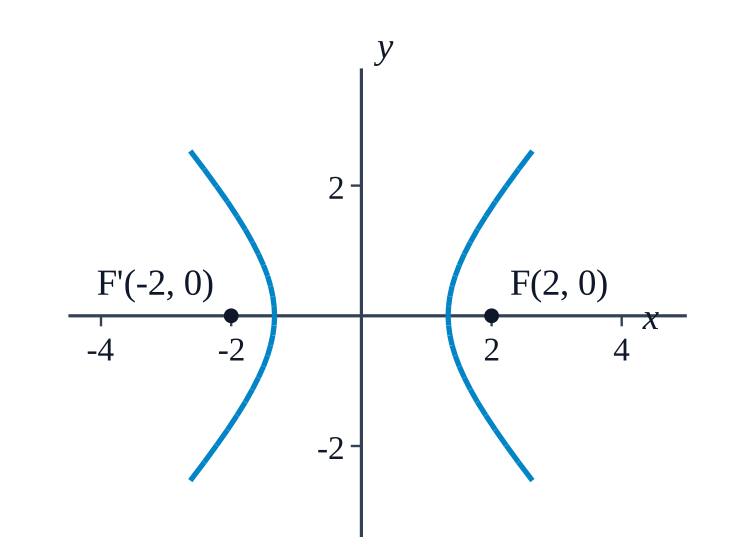
    Find the equation of the hyperbola with eccentricity 32\displaystyle \frac{3}{2} and foci at (±2,0)\displaystyle ( \pm 2,0).

    Matches the book, not yet reviewed

    This working reaches the answer NCERT prints. It has not yet been read through by hand.

    NCERT’s answer
    \(\displaystyle \frac{x^2}{4}-\frac{y^2}{5}=\frac{4}{9}\).
    The foci lie on the \(\displaystyle x\)-axis, so the centre is the origin and the transverse axis is the \(\displaystyle x\)-axis. \[ae=2,\quad e=\tfrac32 \Rightarrow a=\tfrac43,\quad a^2=\tfrac{16}{9} \] \[b^2=a^2(e^2-1)=\tfrac{16}{9}\left(\tfrac94-1\right)=\tfrac{20}{9} \] \[\frac{x^2}{16/9}-\frac{y^2}{20/9}=1 \] NCERT_Solution_Class11_Maths_Exemplar_Ch11_Ex11-3_Q22 \[a^2+b^2=\tfrac{36}{9}=4=c^2 \quad \text{(check)} \] Answer: \(\displaystyle \dfrac{9x^2}{16}-\dfrac{9y^2}{20}=1\), i.e. \(\displaystyle 45x^2-36y^2=80\)
  3. Exercise 23

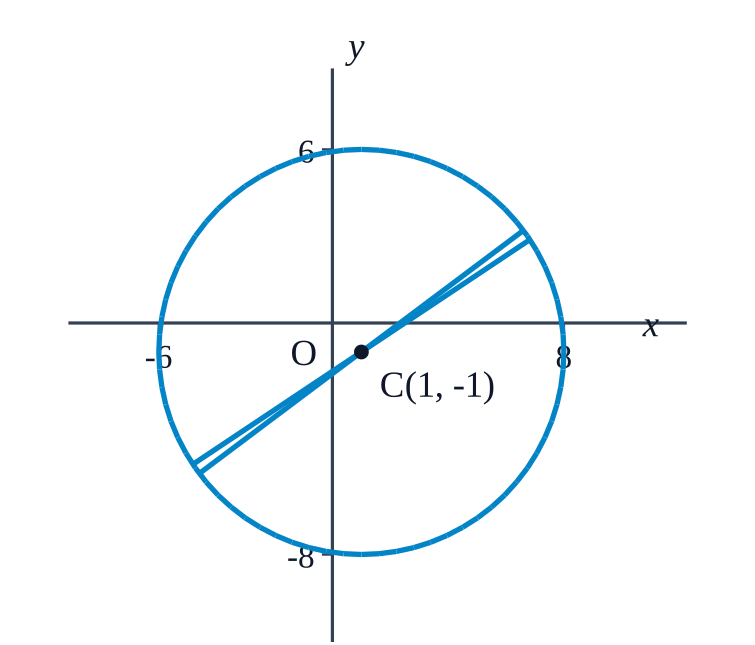
    If the lines 2x−3y=5\displaystyle 2 x-3 y=5 and 3x−4y=7\displaystyle 3 x-4 y=7 are the diameters of a circle of area 154\displaystyle 154 square units, then obtain the equation of the circle.

    Matches the book, not yet reviewed

    This working reaches the answer NCERT prints. It has not yet been read through by hand.

    NCERT’s answer
    \(\displaystyle x^2+y^2-2 x+2 y=47\)
    Both diameters pass through the centre, so it is their intersection. \[2x-3y=5,\quad 3x-4y=7 \] \[6x-9y=15,\quad 6x-8y=14 \Rightarrow y=-1,\ x=1 \] \[\text{centre } (1,-1) \] \[\pi r^2=154 \Rightarrow r^2=154\cdot\frac{7}{22}=49 \quad \left(\pi=\tfrac{22}{7}\right) \] NCERT_Solution_Class11_Maths_Exemplar_Ch11_Ex11-3_Q23 \[(x-1)^2+(y+1)^2=49 \] Answer: \(\displaystyle (x-1)^2+(y+1)^2=49\), i.e. \(\displaystyle x^2+y^2-2x+2y-47=0\)
  4. Exercise 24

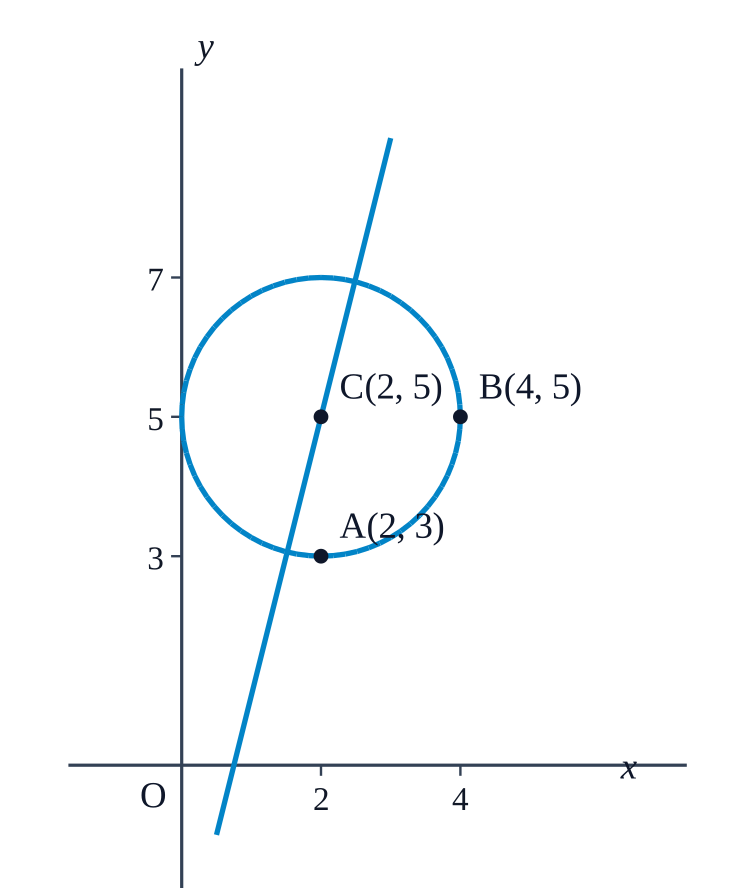
    Find the equation of the circle which passes through the points (2,3)\displaystyle (2,3) and (4,5)\displaystyle (4,5) and the centre lies on the straight line y−4x+3=0\displaystyle y-4 x+3=0.

    Matches the book, not yet reviewed

    This working reaches the answer NCERT prints. It has not yet been read through by hand.

    NCERT’s answer
    \(\displaystyle x^2+y^2-4 x-10 y+25=0\)
    The centre \(\displaystyle (h,k)\) lies on the line, so \(\displaystyle k=4h-3\), and it is equidistant from \(\displaystyle (2,3)\) and \(\displaystyle (4,5)\). \[(h-2)^2+(k-3)^2=(h-4)^2+(k-5)^2 \] \[4h+4k=28 \Rightarrow h+k=7 \] \[h+(4h-3)=7 \Rightarrow h=2,\ k=5 \] \[r^2=(2-2)^2+(5-3)^2=4 \] NCERT_Solution_Class11_Maths_Exemplar_Ch11_Ex11-3_Q24 \[(4-2)^2+(5-5)^2=4 \quad \text{(check)} \] Answer: \(\displaystyle (x-2)^2+(y-5)^2=4\), i.e. \(\displaystyle x^2+y^2-4x-10y+25=0\)
  5. Exercise 25

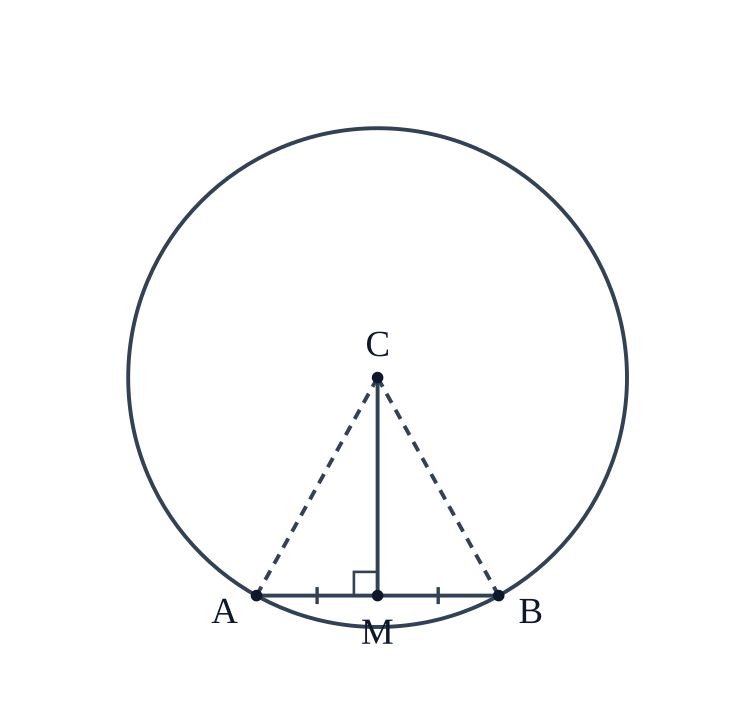
    Find the equation of a circle whose centre is (3,−1)\displaystyle (3,-1) and which cuts off a chord of length 6\displaystyle 6 units on the line 2x−5y+18=0\displaystyle 2 x-5 y+18=0. [Hint: To determine the radius of the circle, find the perpendicular distance from the centre to the given line.]

    Matches the book, not yet reviewed

    This working reaches the answer NCERT prints. It has not yet been read through by hand.

    NCERT’s answer
    \(\displaystyle (x-3)^2+(y+1)^2=38\)
    Perpendicular distance from the centre to the line: \[d = \frac{|2(3) - 5(-1) + 18|}{\sqrt{2^2 + 5^2}} = \frac{29}{\sqrt{29}} = \sqrt{29} \] The perpendicular from the centre bisects the chord, so the half-chord is 3. NCERT_Solution_Class11_Maths_Exemplar_Ch11_Ex11-3_Q25 \[r^2 = d^2 + 3^2 = 29 + 9 = 38 \] \[(x-3)^2 + (y+1)^2 = 38 \] \[x^2 + y^2 - 6x + 2y - 28 = 0 \] Answer: \(\displaystyle x^2+y^2-6x+2y-28=0\)
  6. Exercise 26

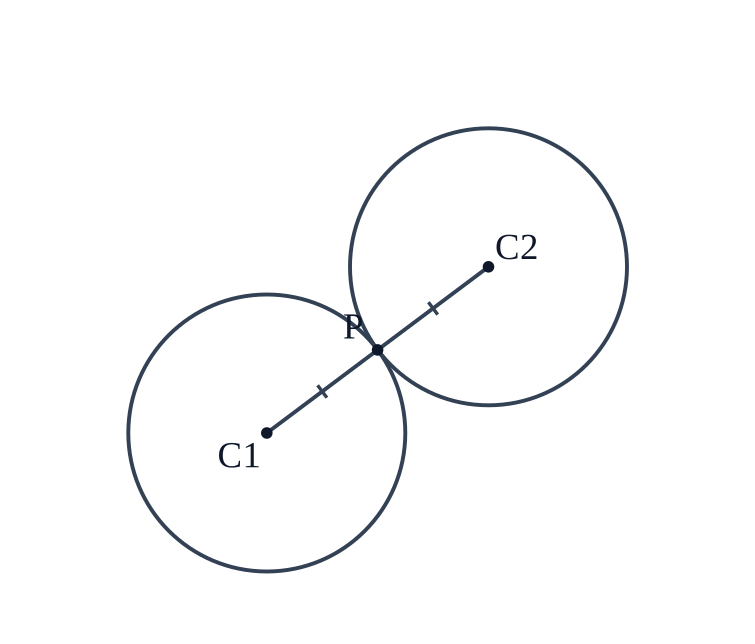
    Find the equation of a circle of radius 5\displaystyle 5 which is touching another circle x2+y2−2x−4y−20=0\displaystyle x^2+y^2-2 x-4 y-20=0 at (5,5)\displaystyle (5, 5).

    Matches the book, not yet reviewed

    This working reaches the answer NCERT prints. It has not yet been read through by hand.

    NCERT’s answer
    \(\displaystyle x^2+y^2-18 x-16 y+120=0\)
    Given circle: \[x^2+y^2-2x-4y-20=0 \Rightarrow C_1=(1,2),\quad r_1=\sqrt{1+4+20}=5 \] The new circle has the same radius and touches it at \(\displaystyle P(5,5)\), so \(\displaystyle C_1, P, C_2\) are collinear with \(\displaystyle PC_2=5\). Touching externally, \(\displaystyle P\) is the midpoint of \(\displaystyle C_1C_2\). NCERT_Solution_Class11_Maths_Exemplar_Ch11_Ex11-3_Q26 \[C_2 = 2P - C_1 = (10-1,\ 10-2) = (9,8) \] \[C_1C_2 = \sqrt{8^2+6^2} = 10 = r_1 + r_2 \] \[(x-9)^2+(y-8)^2 = 25 \] \[x^2+y^2-18x-16y+120=0 \] The other side of \(\displaystyle P\) gives \(\displaystyle C_2=C_1\), the given circle itself. Answer: \(\displaystyle x^2+y^2-18x-16y+120=0\)
  7. Exercise 27

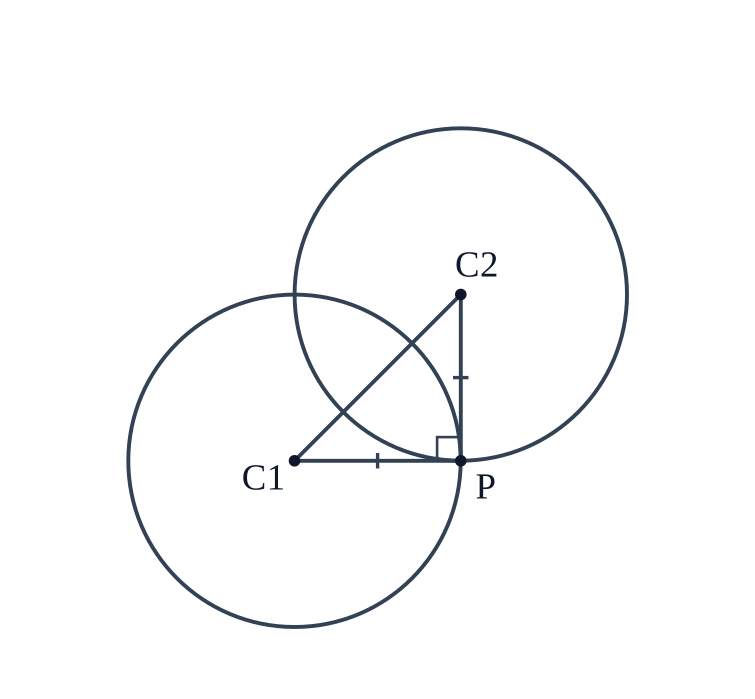
    Find the equation of a circle passing through the point (7,3)\displaystyle (7,3) having radius 3\displaystyle 3 units and whose centre lies on the line y=x−1\displaystyle y=x-1.

    Matches the book, not yet reviewed

    This working reaches the answer NCERT prints. It has not yet been read through by hand.

    NCERT’s answer
    \(\displaystyle x^2+y^2-8 x-6 y+16=0\)
    Centre lies on \(\displaystyle y=x-1\), so take it as \(\displaystyle (h,\ h-1)\). Radius $\displaystyle 3$ and passing through \(\displaystyle (7,3)\): \[(h-7)^2 + (h-1-3)^2 = 3^2 \] \[2h^2 - 22h + 65 = 9 \] \[h^2 - 11h + 28 = 0 \] \[(h-4)(h-7) = 0 \Rightarrow h = 4 \text{ or } 7 \] NCERT_Solution_Class11_Maths_Exemplar_Ch11_Ex11-3_Q27 Centres \(\displaystyle (4,3)\) and \(\displaystyle (7,6)\): \[(x-4)^2+(y-3)^2 = 9 \quad\Rightarrow\quad x^2+y^2-8x-6y+16=0 \] \[(x-7)^2+(y-6)^2 = 9 \quad\Rightarrow\quad x^2+y^2-14x-12y+76=0 \] Answer: \(\displaystyle x^2+y^2-8x-6y+16=0\) or \(\displaystyle x^2+y^2-14x-12y+76=0\)
  8. Exercise 28

    Find the equation of each of the following parabolas
    (a)
    Directrix x=0\displaystyle x=0, focus at (6,0)\displaystyle (6,0)
    (b)
    Vertex at (0,4)\displaystyle (0,4), focus at (0,2)\displaystyle (0,2)
    (c)
    Focus at (−1,−2)\displaystyle (-1,-2), directrix x−2y+3=0\displaystyle x-2 y+3=0

    Matches the book, not yet reviewed

    This working reaches the answer NCERT prints. It has not yet been read through by hand.

    NCERT’s answer
    (a)
    \(\displaystyle y^2=12 x-36\),
    (b)
    \(\displaystyle x^2=32-8 y\),
    (c)
    \(\displaystyle 4 x^2+4 x y+y^2+4 x+32 y+16=0\)
    (a) Focus \(\displaystyle (6,0)\), directrix \(\displaystyle x=0\): distance to focus = distance to directrix. \[\sqrt{(x-6)^2+y^2} = |x| \] \[x^2 - 12x + 36 + y^2 = x^2 \] \[y^2 = 12(x-3) \] (b) Axis is \(\displaystyle x=0\); the focus is below the vertex, so the parabola opens downward with \(\displaystyle a = 4-2 = 2\). \[x^2 = -4a(y-4) = -8(y-4) \] \[x^2 + 8y - 32 = 0 \] (c) Focus \(\displaystyle (-1,-2)\), directrix \(\displaystyle x-2y+3=0\): \[\sqrt{(x+1)^2+(y+2)^2} = \frac{|x-2y+3|}{\sqrt{5}} \] \[5\left(x^2+y^2+2x+4y+5\right) = (x-2y+3)^2 \] \[4x^2+4xy+y^2+4x+32y+16 = 0 \] Answer: (a) \(\displaystyle y^2=12x-36\); (b) \(\displaystyle x^2+8y-32=0\); (c) \(\displaystyle 4x^2+4xy+y^2+4x+32y+16=0\)
  9. Exercise 29

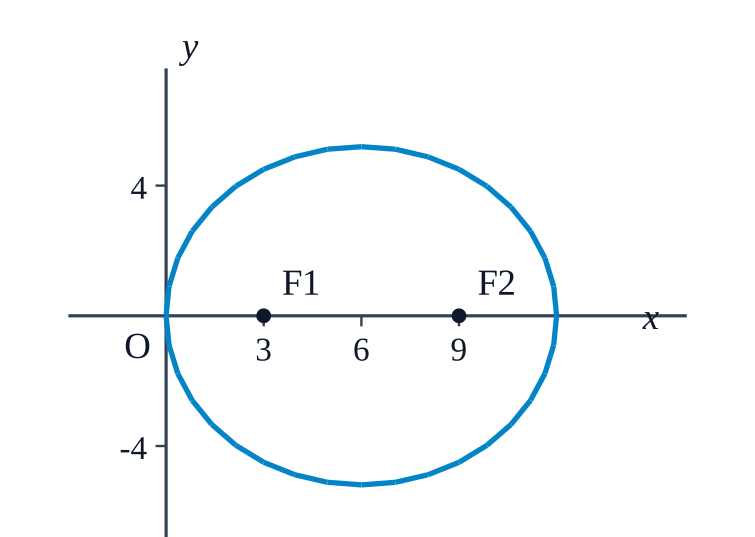
    Find the equation of the set of all points the sum of whose distances from the points (3,0)\displaystyle (3,0) and (9,0)\displaystyle (9,0) is 12.

    Matches the book, not yet reviewed

    This working reaches the answer NCERT prints. It has not yet been read through by hand.

    NCERT’s answer
    \(\displaystyle 3 x^2+4 y^2-36 x=0\)
    \[PF_1 + PF_2 = 12 > F_1F_2 = 6,\qquad F_1(3,0),\ F_2(9,0) \] So \(\displaystyle P\) traces an ellipse with foci \(\displaystyle F_1, F_2\) and centre their midpoint \(\displaystyle (6,0)\). NCERT_Solution_Class11_Maths_Exemplar_Ch11_Ex11-3_Q29 \[2a = 12 \Rightarrow a = 6 \] \[2c = 6 \Rightarrow c = 3 \] \[b^2 = a^2 - c^2 = 36 - 9 = 27 \] \[\frac{(x-6)^2}{36} + \frac{y^2}{27} = 1 \] \[3x^2 + 4y^2 - 36x = 0 \] Answer: \(\displaystyle 3x^2+4y^2-36x=0\), i.e. \(\displaystyle \dfrac{(x-6)^2}{36}+\dfrac{y^2}{27}=1\)
  10. Exercise 30

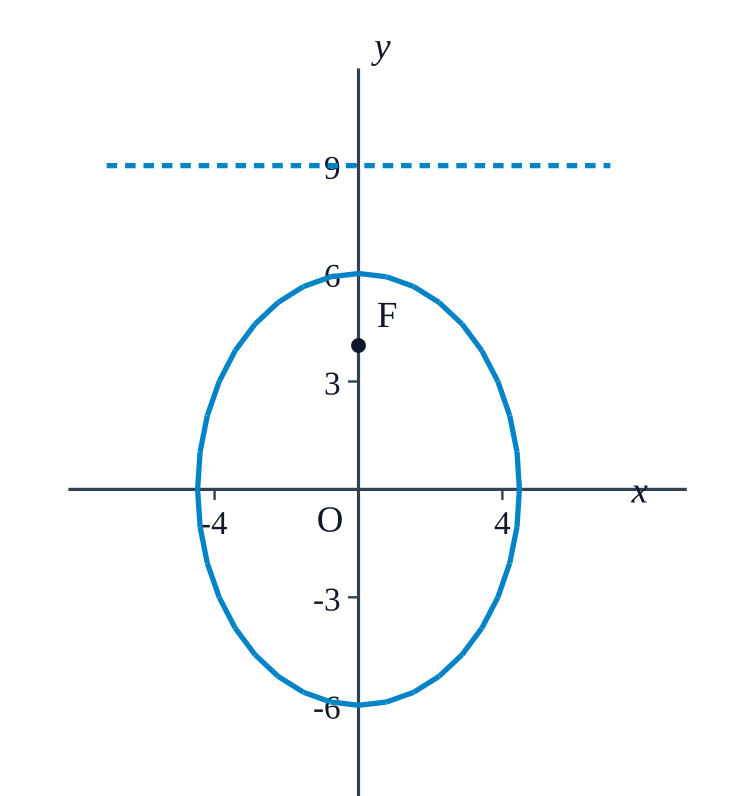
    Find the equation of the set of all points whose distance from (0,4)\displaystyle (0,4) are 23\displaystyle \frac{2}{3} of their distance from the line y=9\displaystyle y=9.

    Matches the book, not yet reviewed

    This working reaches the answer NCERT prints. It has not yet been read through by hand.

    NCERT’s answer
    \(\displaystyle 9 x^2+5 y^2=180\)
    Let \(\displaystyle P(x,y)\); distance to \(\displaystyle (0,4)\) is \(\displaystyle \tfrac23\) of distance to \(\displaystyle y=9\). \[\sqrt{x^2+(y-4)^2} = \tfrac{2}{3}\,|y-9| \] \[9\left(x^2+y^2-8y+16\right) = 4\left(y^2-18y+81\right) \] \[9x^2 + 5y^2 = 180 \] NCERT_Solution_Class11_Maths_Exemplar_Ch11_Ex11-3_Q30 \[\frac{x^2}{20} + \frac{y^2}{36} = 1 \] Answer: \(\displaystyle 9x^2+5y^2=180\), i.e. \(\displaystyle \dfrac{x^2}{20}+\dfrac{y^2}{36}=1\)