SolveIt is under development
SolveItNCERT · CBSE · NEET

NCERT Exemplar · Class 11 Mathematics Conic Sections

59 questions · 59 still being checked

EXERCISE 11.3 1–10 (part 1 of 6)

  1. Exercise 1

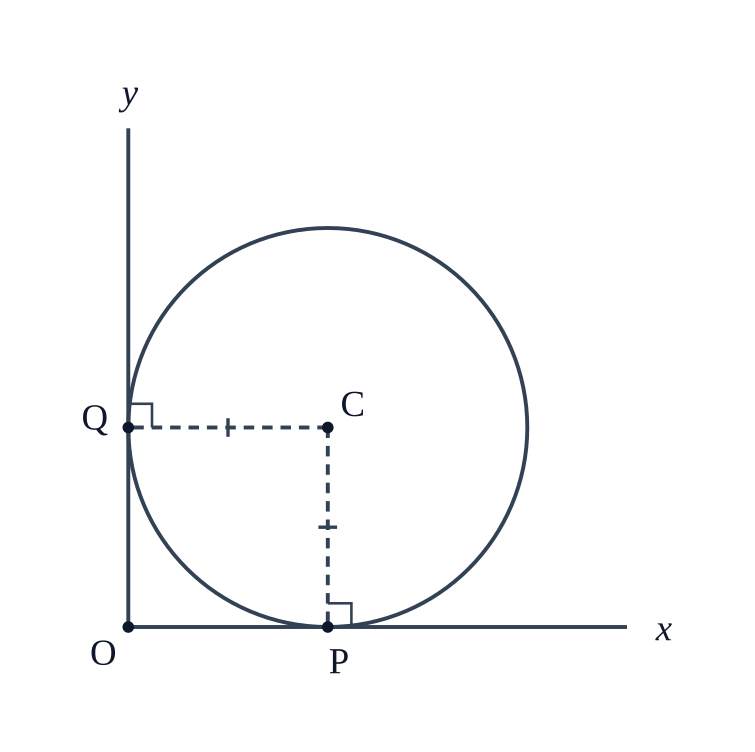
    Find the equation of the circle which touches the both axes in first quadrant and whose radius is a\displaystyle a.

    Matches the book, not yet reviewed

    This working reaches the answer NCERT prints. It has not yet been read through by hand.

    NCERT’s answer
    \(\displaystyle x^2+y^2-2 a x-2 a y+a^2=0\)
    The centre is at distance \(\displaystyle a\) from each axis, so it is \(\displaystyle (a, a)\).NCERT_Solution_Class11_Maths_Exemplar_Ch11_Ex11-3_Q1\[(x-a)^2 + (y-a)^2 = a^2 \] \[x^2 + y^2 - 2ax - 2ay + a^2 = 0 \]Answer: \(\displaystyle x^2 + y^2 - 2ax - 2ay + a^2 = 0\)
  2. Exercise 2

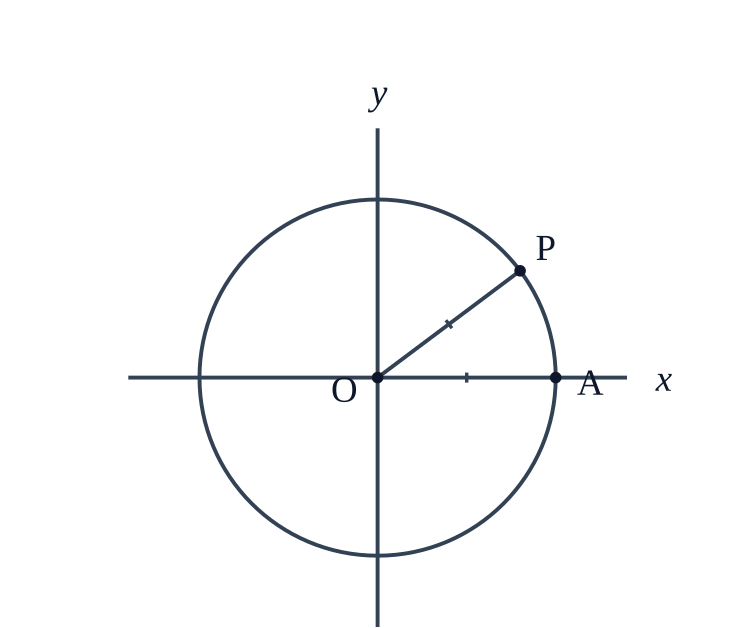
    Show that the point (x,y)\displaystyle (x, y) given by x=2at1+t2\displaystyle x=\frac{2 a t}{1+t^2} and y=a(1−t2)1+t2\displaystyle y=\frac{a\left(1-t^2\right)}{1+t^2} lies on a circle for all real values of t\displaystyle t such that −1≤t≤1\displaystyle -1 \leq \mathrm{t} \leq 1 where a\displaystyle a is any given real numbers.

    Not cross-checked

    NCERT prints no numerical answer for this exercise, so this working has not been cross-checked against the book.

    \[x^2 + y^2 = \frac{4a^2t^2 + a^2(1-t^2)^2}{(1+t^2)^2} \] \[= \frac{a^2\left(4t^2 + 1 - 2t^2 + t^4\right)}{(1+t^2)^2} \] \[= \frac{a^2(1+t^2)^2}{(1+t^2)^2} = a^2 \]NCERT_Solution_Class11_Maths_Exemplar_Ch11_Ex11-3_Q2Answer: every such point satisfies \(\displaystyle x^2 + y^2 = a^2\), the circle with centre \(\displaystyle (0, 0)\) and radius \(\displaystyle |a|\).
  3. Exercise 3

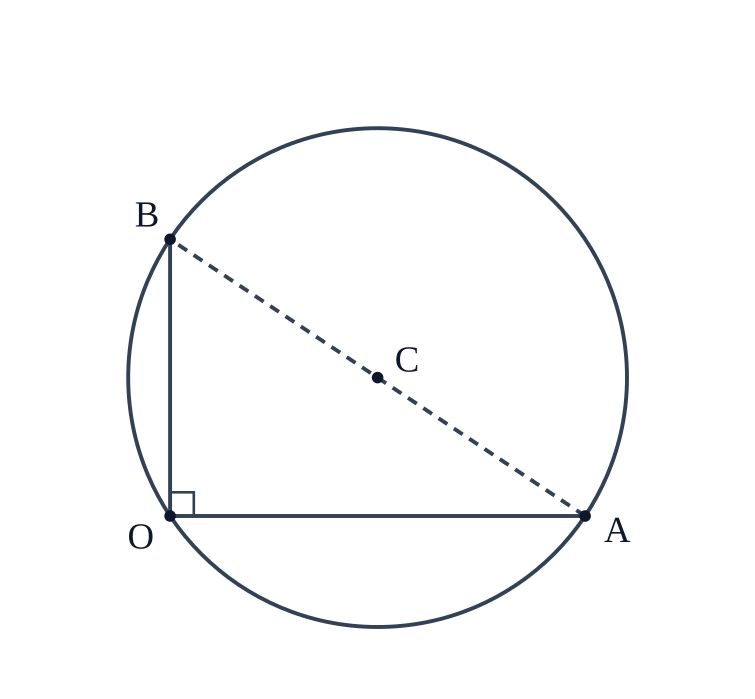
    If a circle passes through the point (0,0)(a,0),(0,b)\displaystyle (0,0)(a, 0),(0, b) then find the coordinates of its centre.

    Matches the book, not yet reviewed

    This working reaches the answer NCERT prints. It has not yet been read through by hand.

    NCERT’s answer
    \(\displaystyle \left(\frac{a}{2}, \frac{b}{2}\right)\)
    Take the circle \(\displaystyle x^2 + y^2 + 2gx + 2fy + c = 0\), with \(\displaystyle a, b \neq 0\).\[c = 0 \quad \text{(through } (0,0)\text{)} \] \[a^2 + 2ga = 0 \Rightarrow g = -\tfrac{a}{2} \quad \text{(through } (a,0)\text{)} \] \[b^2 + 2fb = 0 \Rightarrow f = -\tfrac{b}{2} \quad \text{(through } (0,b)\text{)} \] \[\text{centre} = (-g, -f) = \left(\tfrac{a}{2}, \tfrac{b}{2}\right) \]NCERT_Solution_Class11_Maths_Exemplar_Ch11_Ex11-3_Q3Answer: \(\displaystyle \left(\dfrac{a}{2}, \dfrac{b}{2}\right)\)
  4. Exercise 4

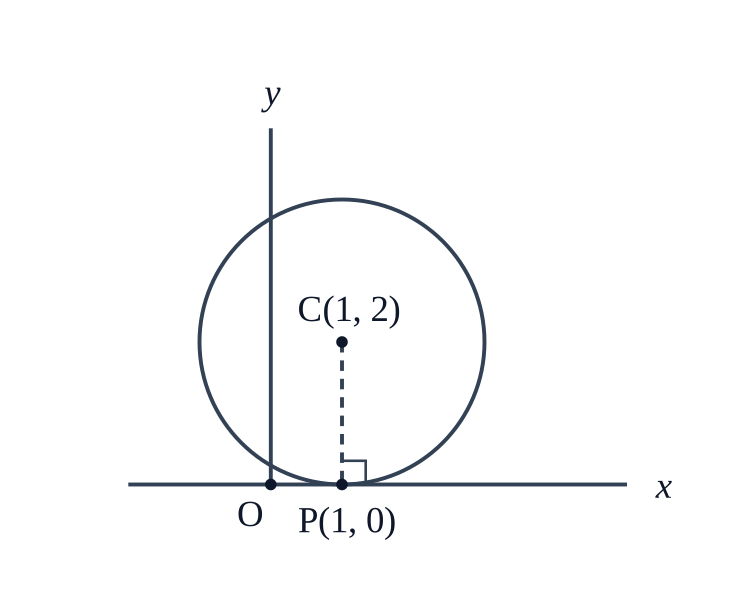
    Find the equation of the circle which touches x\displaystyle x-axis and whose centre is (1,2)\displaystyle (1,2).

    Matches the book, not yet reviewed

    This working reaches the answer NCERT prints. It has not yet been read through by hand.

    NCERT’s answer
    \(\displaystyle x^2+y^2-2 x-4 y+1=0\)
    The circle touches the \(\displaystyle x\)-axis, so its radius is the distance of \(\displaystyle (1, 2)\) from that axis.\[r = 2 \]NCERT_Solution_Class11_Maths_Exemplar_Ch11_Ex11-3_Q4\[(x-1)^2 + (y-2)^2 = 2^2 \] \[x^2 + y^2 - 2x - 4y + 1 = 0 \]Answer: \(\displaystyle x^2 + y^2 - 2x - 4y + 1 = 0\)
  5. Exercise 5

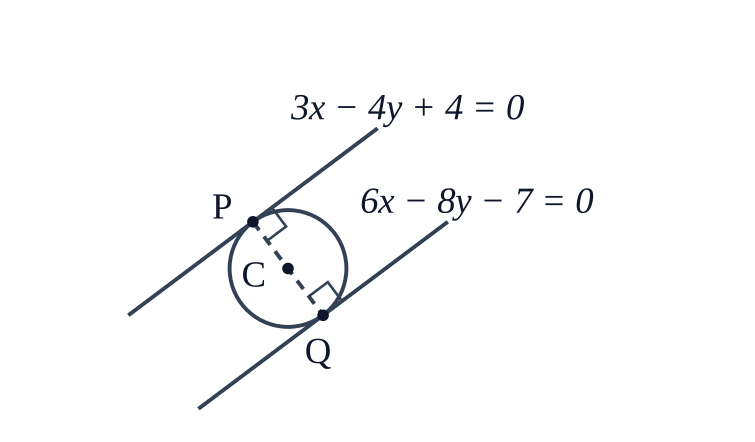
    If the lines 3x−4y+4=0\displaystyle 3 x-4 y+4=0 and 6x−8y−7=0\displaystyle 6 x-8 y-7=0 are tangents to a circle, then find the radius of the circle. [Hint: Distance between given parallel lines gives the diameter of the circle.]

    Matches the book, not yet reviewed

    This working reaches the answer NCERT prints. It has not yet been read through by hand.

    NCERT’s answer
    \(\displaystyle \frac{3}{4}\)
    The lines are parallel; write the second as \(\displaystyle 3x - 4y - \tfrac{7}{2} = 0\).\[d = \frac{\left|4 - \left(-\tfrac{7}{2}\right)\right|}{\sqrt{3^2 + 4^2}} = \frac{15/2}{5} = \frac{3}{2} \]The circle lies between the two tangents, so \(\displaystyle d\) is its diameter.NCERT_Solution_Class11_Maths_Exemplar_Ch11_Ex11-3_Q5\[r = \frac{d}{2} = \frac{3}{4} \]Answer: \(\displaystyle r = \dfrac{3}{4}\)
  6. Exercise 6

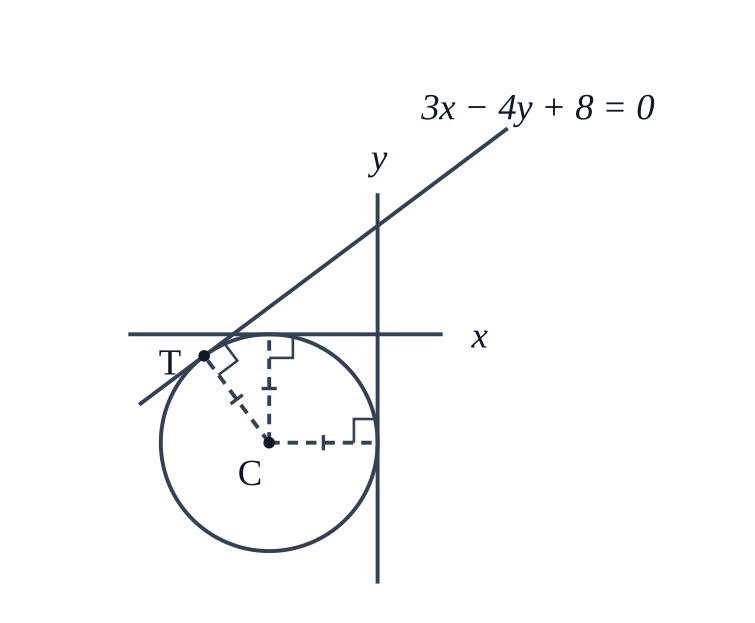
    Find the equation of a circle which touches both the axes and the line 3x−4y+8=0\displaystyle 3 x-4 y+8=0 and lies in the third quadrant. [Hint: Let a\displaystyle a be the radius of the circle, then (−a,−a)\displaystyle (-a,-a) will be centre and perpendicular distance from the centre to the given line gives the radius of the circle.]

    Matches the book, not yet reviewed

    This working reaches the answer NCERT prints. It has not yet been read through by hand.

    NCERT’s answer
    \(\displaystyle x^2+y^2+4 x+4 y+4=0\)
    The circle lies in the third quadrant and touches both axes, so the centre is \(\displaystyle (-a, -a)\) with radius \(\displaystyle a > 0\). Its distance from the line equals \(\displaystyle a\).\[\frac{|3(-a) - 4(-a) + 8|}{\sqrt{3^2 + 4^2}} = a \] \[\frac{|a + 8|}{5} = a \] \[a + 8 = 5a \quad (a + 8 > 0) \] \[a = 2 \]NCERT_Solution_Class11_Maths_Exemplar_Ch11_Ex11-3_Q6\[(x+2)^2 + (y+2)^2 = 2^2 \] \[x^2 + y^2 + 4x + 4y + 4 = 0 \]Answer: \(\displaystyle x^2 + y^2 + 4x + 4y + 4 = 0\)
  7. Exercise 7

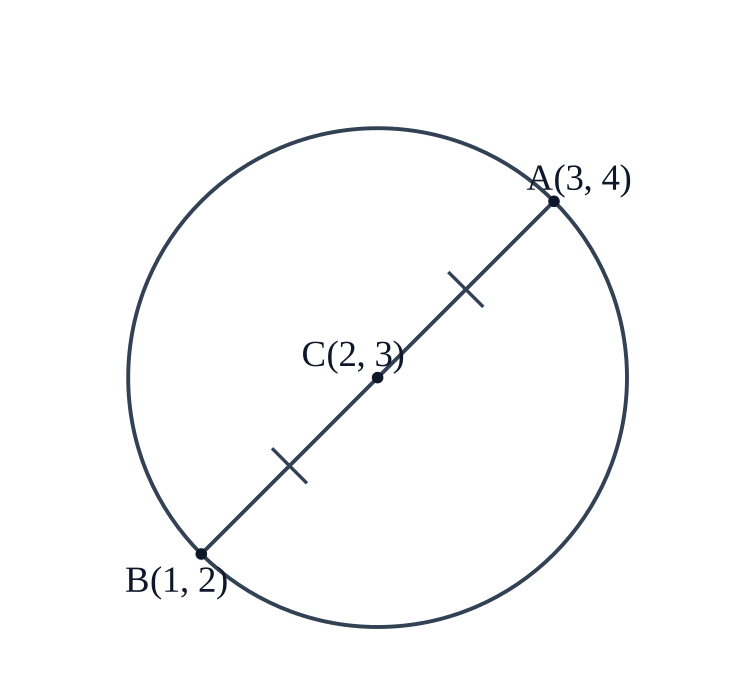
    If one end of a diameter of the circle x2+y2−4x−6y+11=0\displaystyle x^2+y^2-4 x-6 y+11=0 is (3,4)\displaystyle (3, 4), then find the coordinate of the other end of the diameter.

    Matches the book, not yet reviewed

    This working reaches the answer NCERT prints. It has not yet been read through by hand.

    NCERT’s answer
    \(\displaystyle (1,2)\)
    \[\text{centre} = \left(-\tfrac{-4}{2},\, -\tfrac{-6}{2}\right) = (2, 3) \]The centre is the midpoint of a diameter. Let the other end be \(\displaystyle (x, y)\).\[\frac{3 + x}{2} = 2, \qquad \frac{4 + y}{2} = 3 \] \[x = 1, \qquad y = 2 \]NCERT_Solution_Class11_Maths_Exemplar_Ch11_Ex11-3_Q7Answer: \(\displaystyle (1, 2)\)
  8. Exercise 8

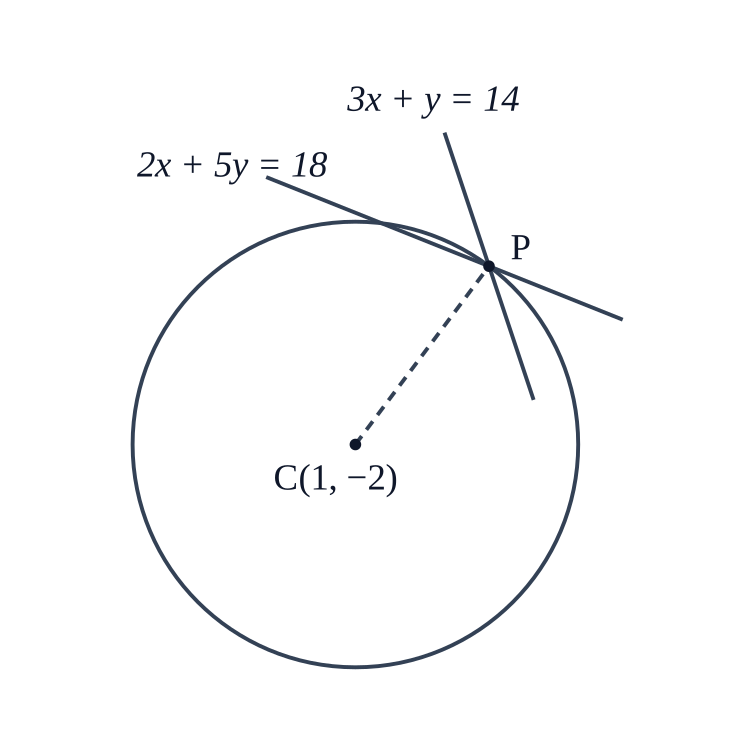
    Find the equation of the circle having (1,−2)\displaystyle (1,-2) as its centre and passing through 3x+y=14,2x+5y=18\displaystyle 3 x+y=14,2 x+5 y=18

    Matches the book, not yet reviewed

    This working reaches the answer NCERT prints. It has not yet been read through by hand.

    NCERT’s answer
    \(\displaystyle x^2+y^2-2 x+4 y-20=0\)
    The circle passes through the point where the two lines meet. Solve them.\[3x + y = 14 \Rightarrow y = 14 - 3x \] \[2x + 5(14 - 3x) = 18 \Rightarrow -13x = -52 \Rightarrow x = 4 \] \[y = 14 - 3(4) = 2 \]The point is \(\displaystyle P(4, 2)\); the centre is \(\displaystyle (1, -2)\).\[r^2 = (4-1)^2 + (2+2)^2 = 25 \]NCERT_Solution_Class11_Maths_Exemplar_Ch11_Ex11-3_Q8\[(x-1)^2 + (y+2)^2 = 25 \] \[x^2 + y^2 - 2x + 4y - 20 = 0 \]Answer: \(\displaystyle x^2 + y^2 - 2x + 4y - 20 = 0\)
  9. Exercise 9

    If the line y=3x+k\displaystyle y=\sqrt{3} x+k touches the circle x2+y2=16\displaystyle x^2+y^2=16, then find the value of k\displaystyle k. [Hint: Equate perpendicular distance from the centre of the circle to its radius].

    Matches the book, not yet reviewed

    This working reaches the answer NCERT prints. It has not yet been read through by hand.

    NCERT’s answer
    \(\displaystyle k \pm 8\)
    Tangent means the distance from the centre \(\displaystyle (0,0)\) to the line equals the radius \(\displaystyle 4\). \[\sqrt{3}\,x - y + k = 0 \] \[\frac{|k|}{\sqrt{(\sqrt{3})^2 + (-1)^2}} = 4 \] \[\frac{|k|}{2} = 4 \] \[|k| = 8 \] Answer: \(\displaystyle k = \pm 8\)
  10. Exercise 10

    Find the equation of a circle concentric with the circle x2+y2−6x+12y+15=0\displaystyle x^2+y^2-6 x+12 y+15=0 and has double of its area. [Hint: concentric circles have the same centre.]

    Matches the book, not yet reviewed

    This working reaches the answer NCERT prints. It has not yet been read through by hand.

    NCERT’s answer
    \(\displaystyle x^2+y^2-6 x+12 y-15=0\)
    \[x^2 + y^2 - 6x + 12y + 15 = 0 \] \[(x-3)^2 + (y+6)^2 = 9 + 36 - 15 = 30 \] Centre \(\displaystyle (3,-6)\), \(\displaystyle r^2 = 30\). Concentric, so the centre is the same. \[\pi R^2 = 2\pi r^2 \] \[R^2 = 60 \] \[(x-3)^2 + (y+6)^2 = 60 \] \[x^2 + y^2 - 6x + 12y + 45 - 60 = 0 \] Answer: \(\displaystyle x^2 + y^2 - 6x + 12y - 15 = 0\)