Exercise 1
Two line segments AB and AC include an angle of ° where AB = cm and . Locate points P and Q on AB and AC, respectively such that and . Join P and Q and measure the length PQ.
Matches the book, not yet reviewed
This working reaches the answer NCERT prints. It has not yet been read through by hand.
NCERT’s answer
3.$\displaystyle 25$ cm
1. Draw \(\displaystyle AB = 5\text{ cm}\), \(\displaystyle AC = 7\text{ cm}\) with \(\displaystyle \angle BAC = 60^\circ\).
2. Draw ray \(\displaystyle AX\) making an acute angle with \(\displaystyle AB\); mark \(\displaystyle 4\) equal arcs \(\displaystyle A_1,A_2,A_3,A_4\).
3. Join \(\displaystyle A_4B\); through \(\displaystyle A_3\) draw a line \(\displaystyle \parallel A_4B\), meeting \(\displaystyle AB\) at \(\displaystyle P\), so \(\displaystyle AP:PB=3:1\).
4. Draw ray \(\displaystyle AY\) making an acute angle with \(\displaystyle AC\); mark \(\displaystyle 4\) equal arcs.
5. Join the \(\displaystyle 4\)th arc-point to \(\displaystyle C\); through the \(\displaystyle 1\)st draw a line \(\displaystyle \parallel\) to it, meeting \(\displaystyle AC\) at \(\displaystyle Q\), so \(\displaystyle AQ:QC=1:3\).
6. Join \(\displaystyle PQ\).
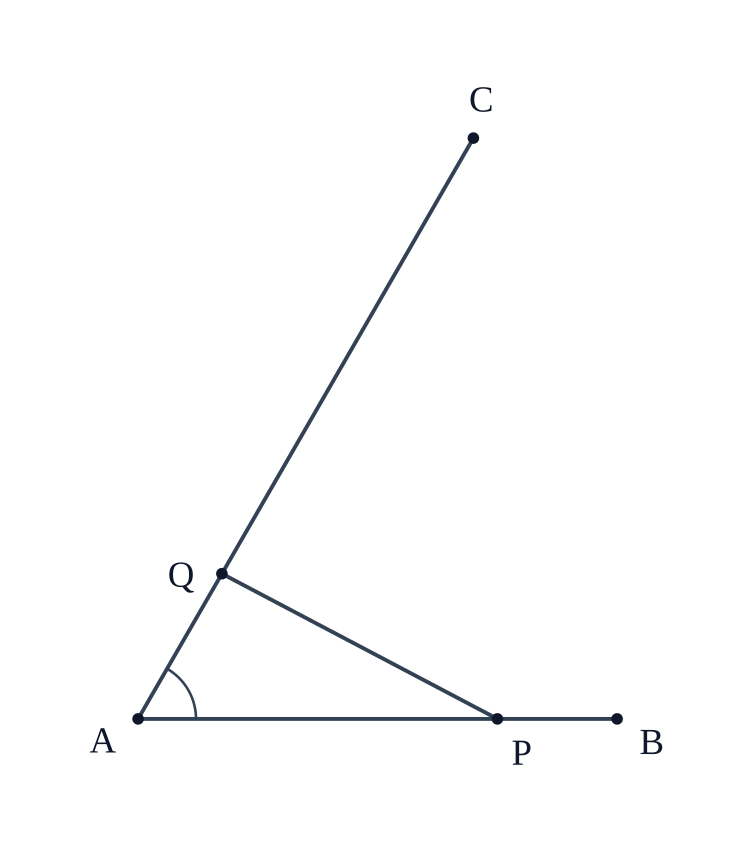 Since \(\displaystyle \angle PAQ=\angle BAC=60^\circ\):
\[AP=\tfrac34(5)=3.75\text{ cm},\quad AQ=\tfrac14(7)=1.75\text{ cm} \]
\[PQ^2=AP^2+AQ^2-2\cdot AP\cdot AQ\cos60^\circ=3.75^2+1.75^2-2(3.75)(1.75)(0.5)=10.5625 \]
Since \(\displaystyle \angle PAQ=\angle BAC=60^\circ\):
\[AP=\tfrac34(5)=3.75\text{ cm},\quad AQ=\tfrac14(7)=1.75\text{ cm} \]
\[PQ^2=AP^2+AQ^2-2\cdot AP\cdot AQ\cos60^\circ=3.75^2+1.75^2-2(3.75)(1.75)(0.5)=10.5625 \]
Since \(\displaystyle \angle PAQ=\angle BAC=60^\circ\):
\[AP=\tfrac34(5)=3.75\text{ cm},\quad AQ=\tfrac14(7)=1.75\text{ cm} \]
\[PQ^2=AP^2+AQ^2-2\cdot AP\cdot AQ\cos60^\circ=3.75^2+1.75^2-2(3.75)(1.75)(0.5)=10.5625 \]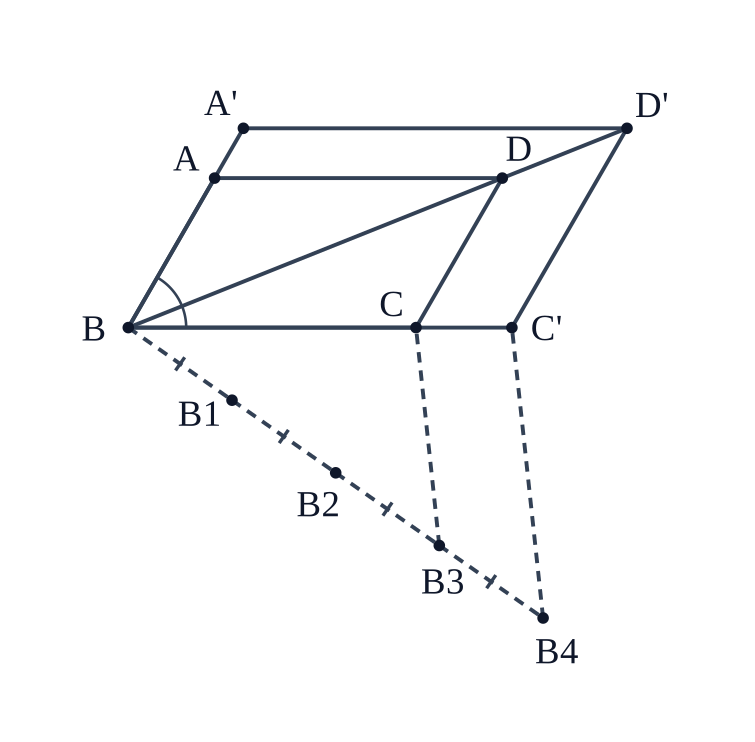 \[A'B \parallel D'C' \quad (D'C' \parallel DC \parallel AB) \]
\[A'D' \parallel BC' \quad (A'D' \parallel DA \parallel BC) \]
\[A'BC'D' \text{ is a parallelogram} \quad \text{(both pairs of opposite sides parallel)} \]
Answer: Yes, \(\displaystyle A'BC'D'\) is a parallelogram.
\[A'B \parallel D'C' \quad (D'C' \parallel DC \parallel AB) \]
\[A'D' \parallel BC' \quad (A'D' \parallel DA \parallel BC) \]
\[A'BC'D' \text{ is a parallelogram} \quad \text{(both pairs of opposite sides parallel)} \]
Answer: Yes, \(\displaystyle A'BC'D'\) is a parallelogram.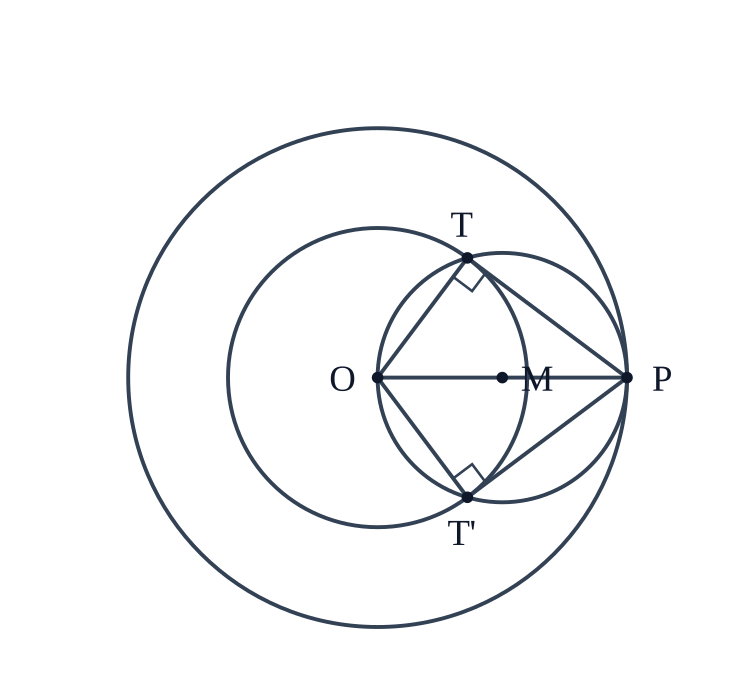 \(\displaystyle \angle OTP=90^\circ\) (radius \(\displaystyle \perp\) tangent), so in \(\displaystyle \triangle OTP\):
\[PT=\sqrt{OP^2-OT^2}=\sqrt{5^2-3^2}=\sqrt{16}=4\text{ cm} \]
matching the measured length.
\(\displaystyle \angle OTP=90^\circ\) (radius \(\displaystyle \perp\) tangent), so in \(\displaystyle \triangle OTP\):
\[PT=\sqrt{OP^2-OT^2}=\sqrt{5^2-3^2}=\sqrt{16}=4\text{ cm} \]
matching the measured length.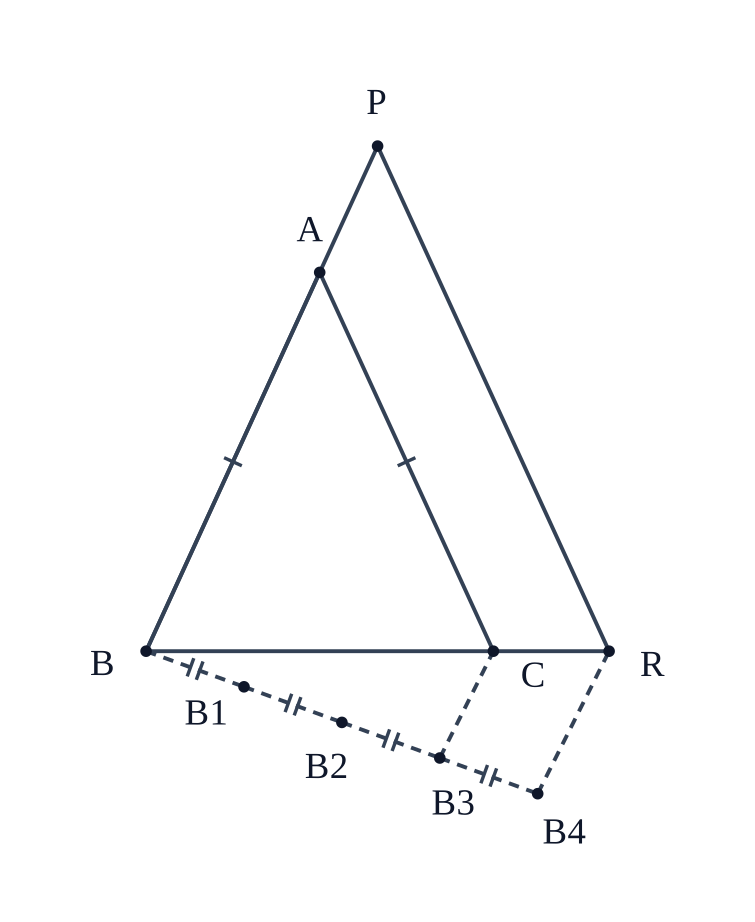 \[\frac{BR}{BC}=\frac{BB_4}{BB_3}=\frac43 \quad \text{(BPT, } B_4R\parallel B_3C) \]
\[\triangle BRP\sim\triangle BCA \quad (RP\parallel CA) \]
\[\frac{BP}{BA}=\frac{RP}{CA}=\frac{BR}{BC}=\frac43 \]
\[BP=\tfrac43(6)=8\text{ cm},\quad BR=\tfrac43(5)=\tfrac{20}{3}\text{ cm},\quad RP=\tfrac43(6)=8\text{ cm} \]
Answer: \(\displaystyle PQ=8\text{ cm}\), \(\displaystyle QR=\tfrac{20}{3}\text{ cm}\), \(\displaystyle RP=8\text{ cm}\).
\[\frac{BR}{BC}=\frac{BB_4}{BB_3}=\frac43 \quad \text{(BPT, } B_4R\parallel B_3C) \]
\[\triangle BRP\sim\triangle BCA \quad (RP\parallel CA) \]
\[\frac{BP}{BA}=\frac{RP}{CA}=\frac{BR}{BC}=\frac43 \]
\[BP=\tfrac43(6)=8\text{ cm},\quad BR=\tfrac43(5)=\tfrac{20}{3}\text{ cm},\quad RP=\tfrac43(6)=8\text{ cm} \]
Answer: \(\displaystyle PQ=8\text{ cm}\), \(\displaystyle QR=\tfrac{20}{3}\text{ cm}\), \(\displaystyle RP=8\text{ cm}\).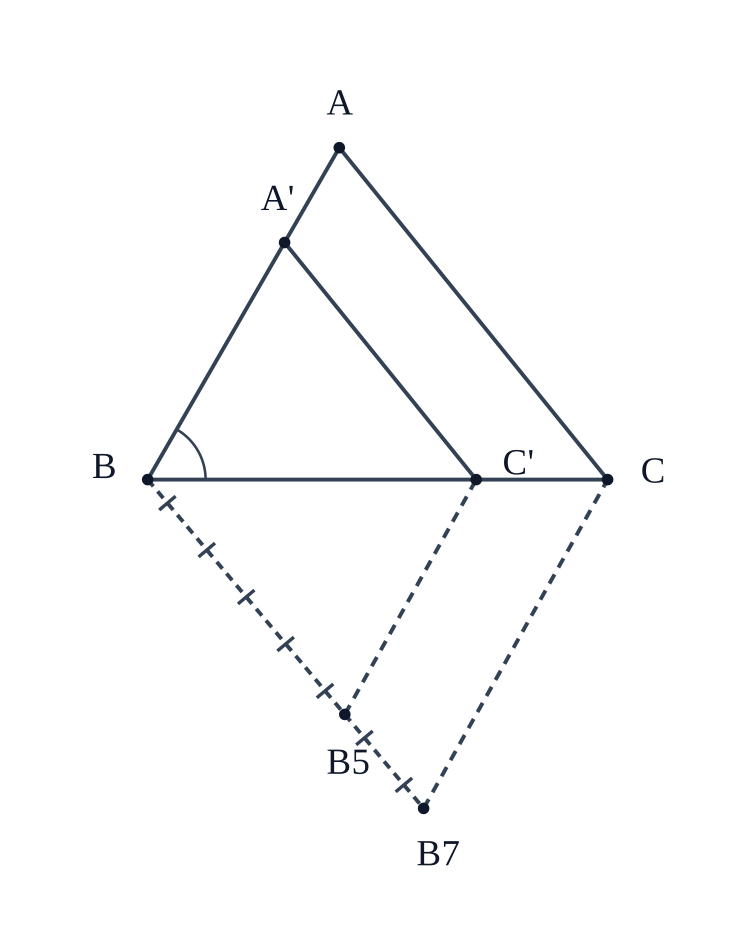 \[\frac{BC'}{BC}=\frac{BB_5}{BB_7}=\frac57 \quad \text{(BPT, } B_5C'\parallel B_7C) \]
\[\triangle BC'A'\sim\triangle BCA \quad (C'A'\parallel CA) \]
\[\frac{BA'}{BA}=\frac{C'A'}{CA}=\frac{BC'}{BC}=\frac57 \]
\[BA'=\tfrac57(5)=\tfrac{25}{7}\text{ cm},\quad BC'=\tfrac57(6)=\tfrac{30}{7}\text{ cm} \]
Answer: \(\displaystyle \triangle A'BC'\) with \(\displaystyle BA'=\tfrac{25}{7}\text{ cm}\), \(\displaystyle BC'=\tfrac{30}{7}\text{ cm}\), \(\displaystyle \angle B=60^\circ\).
\[\frac{BC'}{BC}=\frac{BB_5}{BB_7}=\frac57 \quad \text{(BPT, } B_5C'\parallel B_7C) \]
\[\triangle BC'A'\sim\triangle BCA \quad (C'A'\parallel CA) \]
\[\frac{BA'}{BA}=\frac{C'A'}{CA}=\frac{BC'}{BC}=\frac57 \]
\[BA'=\tfrac57(5)=\tfrac{25}{7}\text{ cm},\quad BC'=\tfrac57(6)=\tfrac{30}{7}\text{ cm} \]
Answer: \(\displaystyle \triangle A'BC'\) with \(\displaystyle BA'=\tfrac{25}{7}\text{ cm}\), \(\displaystyle BC'=\tfrac{30}{7}\text{ cm}\), \(\displaystyle \angle B=60^\circ\).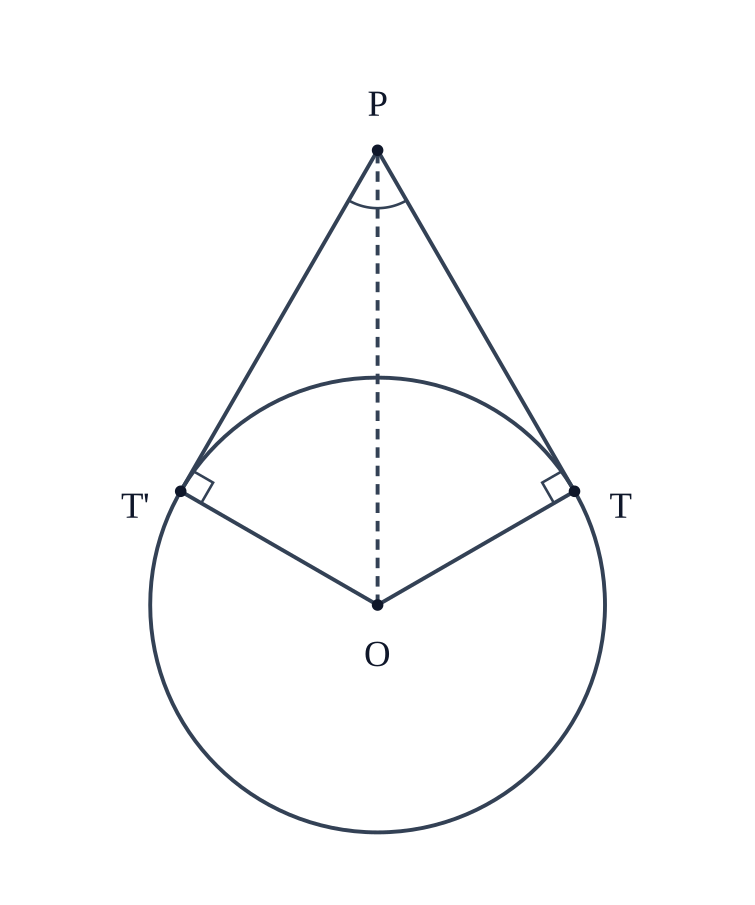 \[\angle OTP=\angle OT'P=90^\circ \quad \text{(construction, so } PT,\ PT' \text{ touch the circle)} \]
\[\angle TPT'=360^\circ-90^\circ-90^\circ-120^\circ=60^\circ \quad \text{(angle sum of } OTPT') \]
\[\triangle OTP\cong\triangle OT'P \quad \text{(RHS: } OT=OT',\ \text{hypotenuse } OP \text{ common)} \]
\[\angle TOP=\tfrac12\angle TOT'=60^\circ \quad \text{(CPCT)} \]
\[OP=\frac{OT}{\cos60^\circ}=\frac{4}{0.5}=8\text{ cm} \]
Answer: \(\displaystyle OP=8\text{ cm}\).
\[\angle OTP=\angle OT'P=90^\circ \quad \text{(construction, so } PT,\ PT' \text{ touch the circle)} \]
\[\angle TPT'=360^\circ-90^\circ-90^\circ-120^\circ=60^\circ \quad \text{(angle sum of } OTPT') \]
\[\triangle OTP\cong\triangle OT'P \quad \text{(RHS: } OT=OT',\ \text{hypotenuse } OP \text{ common)} \]
\[\angle TOP=\tfrac12\angle TOT'=60^\circ \quad \text{(CPCT)} \]
\[OP=\frac{OT}{\cos60^\circ}=\frac{4}{0.5}=8\text{ cm} \]
Answer: \(\displaystyle OP=8\text{ cm}\).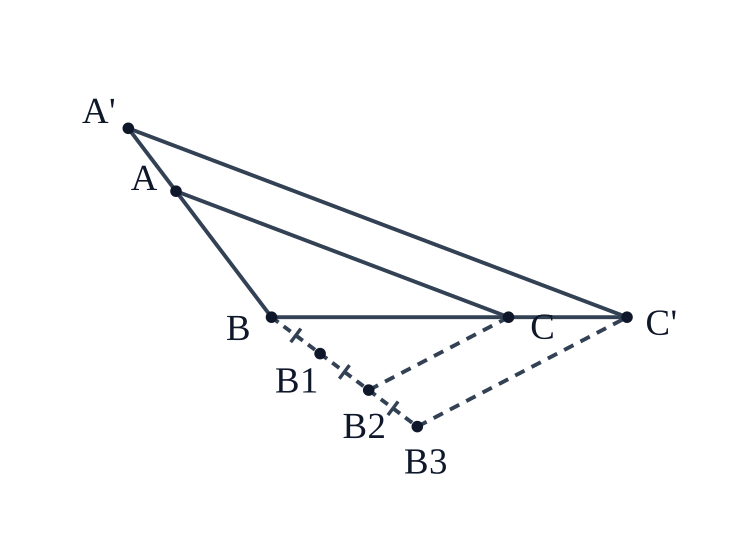 \[\frac{BC'}{BC}=\frac{BB_3}{BB_2}=\frac32 \quad \text{(BPT, } B_3C'\parallel B_2C) \]
\[\triangle A'BC'\sim\triangle ABC \quad (C'A'\parallel CA) \]
\[\frac{BA'}{BA}=\frac{A'C'}{AC}=\frac{BC'}{BC}=\frac32 \]
\[BA'=\tfrac32(4)=6\text{ cm},\quad BC'=\tfrac32(6)=9\text{ cm},\quad A'C'=\tfrac32(9)=13.5\text{ cm} \]
\[AB=4\neq BA'=6,\quad BC=6\neq BC'=9,\quad AC=9\neq A'C'=13.5 \]
The sides \(\displaystyle 6\) and \(\displaystyle 9\) equal \(\displaystyle BC\) and \(\displaystyle AC\) only in value; they are not corresponding sides.
Answer: No, the triangles are similar but not congruent.
\[\frac{BC'}{BC}=\frac{BB_3}{BB_2}=\frac32 \quad \text{(BPT, } B_3C'\parallel B_2C) \]
\[\triangle A'BC'\sim\triangle ABC \quad (C'A'\parallel CA) \]
\[\frac{BA'}{BA}=\frac{A'C'}{AC}=\frac{BC'}{BC}=\frac32 \]
\[BA'=\tfrac32(4)=6\text{ cm},\quad BC'=\tfrac32(6)=9\text{ cm},\quad A'C'=\tfrac32(9)=13.5\text{ cm} \]
\[AB=4\neq BA'=6,\quad BC=6\neq BC'=9,\quad AC=9\neq A'C'=13.5 \]
The sides \(\displaystyle 6\) and \(\displaystyle 9\) equal \(\displaystyle BC\) and \(\displaystyle AC\) only in value; they are not corresponding sides.
Answer: No, the triangles are similar but not congruent.