SolveIt is under development
SolveItNCERT · CBSE · NEET

NCERT Exemplar · Class 10 Mathematics Constructions

21 questions · 21 still being checked

EXERCISE 10.1 1–6 (part 1 of 4)

  1. Choose the correct answer from the given four options:

    Exercise 1

    To divide a line segment AB in the ratio 5\displaystyle 5:7\displaystyle 7, first a ray AX is drawn so that ∠BAX\displaystyle \angle \mathrm{BAX} is an acute angle and then at equal distances points are marked on the ray AX such that the minimum number of these points is
    (A)
    8\displaystyle 8 (B) 10\displaystyle 10
    (C)
    11\displaystyle 11
    (D)
    12\displaystyle 12

    Matches the book, not yet reviewed

    This working reaches the answer NCERT prints. It has not yet been read through by hand.

    NCERT’s answer
    (D)
    (D) \(\displaystyle 12\)Equal points marked \(\displaystyle = m+n\), the ratio's two terms. \[m+n = 5+7 = 12 \]
  2. Exercise 2

    To divide a line segment AB in the ratio 4\displaystyle 4:7\displaystyle 7, a ray AX is drawn first such that ∠BAX\displaystyle \angle \mathrm{BAX} is an acute angle and then points A1, A2, A3,…\displaystyle \mathrm{A}_1, \mathrm{~A}_2, \mathrm{~A}_3, \ldots. are located at equal distances on the ray AX and the point B is joined to
    (A)
    A12\displaystyle \mathrm{A}_{12}
    (B)
    A11\displaystyle \mathrm{A}_{11}
    (C)
    A10\displaystyle \mathrm{A}_{10}
    (D)
    A9\displaystyle \mathrm{A}_9

    Matches the book, not yet reviewed

    This working reaches the answer NCERT prints. It has not yet been read through by hand.

    NCERT’s answer
    (B)
    (B) \(\displaystyle A_{11}\)B joins the \(\displaystyle (m+n)\)-th point on AX. \[A_{m+n} = A_{4+7} = A_{11} \]
  3. Exercise 3

    To divide a line segment AB in the ratio 5\displaystyle 5 : 6\displaystyle 6, draw a ray AX such that ∠BAX\displaystyle \angle \mathrm{BAX} is an acute angle, then draw a ray BY parallel to AX and the points A1, A2, A3,…\displaystyle \mathrm{A}_1, \mathrm{~A}_2, \mathrm{~A}_3, \ldots and B1, B2, B3,…\displaystyle \mathrm{B}_1, \mathrm{~B}_2, \mathrm{~B}_3, \ldots are located at equal distances on ray AX and BY, respectively. Then the points joined are
    (A)
    A5\displaystyle \mathrm{A}_5 and B6\displaystyle \mathrm{B}_6
    (B)
    A6\displaystyle \mathrm{A}_6 and B5\displaystyle \mathrm{B}_5
    (C)
    A4\displaystyle \mathrm{A}_4 and B5\displaystyle \mathrm{B}_5
    (D)
    A5\displaystyle \mathrm{A}_5 and B4\displaystyle \mathrm{B}_4

    Matches the book, not yet reviewed

    This working reaches the answer NCERT prints. It has not yet been read through by hand.

    NCERT’s answer
    (A)
    (A) \(\displaystyle A_5\) and \(\displaystyle B_6\)Join \(\displaystyle A_5B_6\); it meets AB at P. \[\frac{AP}{PB} = \frac{AA_5}{BB_6} = \frac{5}{6} \quad (\triangle AA_5P \sim \triangle BB_6P,\ AX \parallel BY) \]
  4. Exercise 4

    To construct a triangle similar to a given ΔABC\displaystyle \Delta \mathrm{ABC} with its sides 37\displaystyle \frac{3}{7} of the corresponding sides of ΔABC\displaystyle \Delta \mathrm{ABC}, first draw a ray BX such that ∠CBX\displaystyle \angle \mathrm{CBX} is an acute angle and X lies on the opposite side of A with respect to BC. Then locate points B1, B2, B3,…\displaystyle \mathrm{B}_1, \mathrm{~B}_2, \mathrm{~B}_3, \ldots on BX at equal distances and next step is to join
    (A)
    B10\displaystyle \mathrm{B}_{10} to C
    (B)
    B3\displaystyle \mathrm{B}_3 to C
    (C)
    B7\displaystyle \mathrm{B}_7 to C
    (D)
    B4\displaystyle \mathrm{B}_4 to C

    Matches the book, not yet reviewed

    This working reaches the answer NCERT prints. It has not yet been read through by hand.

    NCERT’s answer
    (C)
    (C) \(\displaystyle B_7\) to CJoin \(\displaystyle B_7C\); draw \(\displaystyle B_3C' \parallel B_7C\), meeting BC at \(\displaystyle C'\). \[\frac{BC'}{BC} = \frac{BB_3}{BB_7} = \frac{3}{7} \quad (B_3C' \parallel B_7C) \]
  5. Exercise 5

    To construct a triangle similar to a given ΔABC\displaystyle \Delta \mathrm{ABC} with its sides 85\displaystyle \frac{8}{5} of the corresponding sides of ΔABC\displaystyle \Delta \mathrm{ABC} draw a ray BX such that ∠CBX\displaystyle \angle \mathrm{CBX} is an acute angle and X is on the opposite side of A with respect to BC. The minimum number of points to be located at equal distances on ray BX is
    (A)
    5\displaystyle 5 (B) 8\displaystyle 8 (C) 13\displaystyle 13

    Matches the book, not yet reviewed

    This working reaches the answer NCERT prints. It has not yet been read through by hand.

    NCERT’s answer
    (B)
    (B) \(\displaystyle 8\)Points needed \(\displaystyle = \max(p,q)\) for scale \(\displaystyle \frac{p}{q}\). \[\max(8,5) = 8 \]
  6. Exercise 6

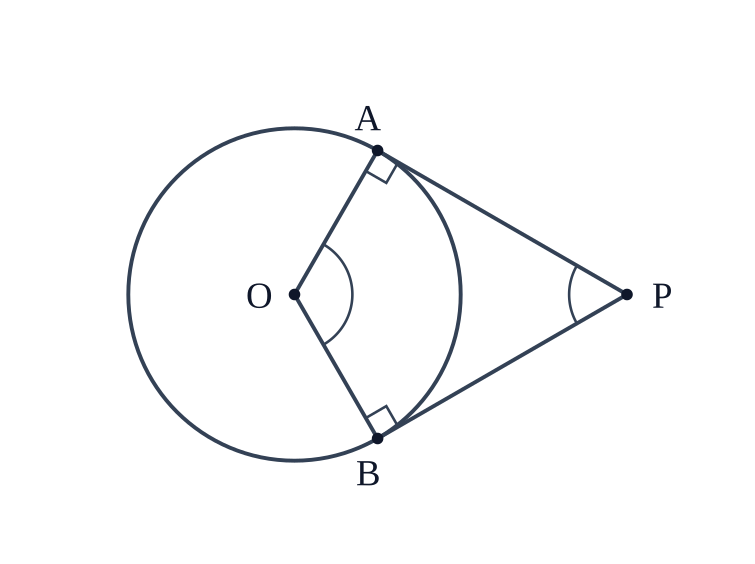
    To draw a pair of tangents to a circle which are inclined to each other at an angle of 60\displaystyle 60°, it is required to draw tangents at end points of those two radii of the circle, the angle between them should be
    (A)
    135\displaystyle 135°
    (B)
    90\displaystyle 90°
    (C)
    60\displaystyle 60°
    (D)
    120\displaystyle 120°

    Matches the book, not yet reviewed

    This working reaches the answer NCERT prints. It has not yet been read through by hand.

    NCERT’s answer
    (D)
    (D) \(\displaystyle 120^\circ\)For tangents PA, PB with \(\displaystyle \angle APB = 60^\circ\), the radii OA, OB meet them at right angles.NCERT_Solution_Class10_Maths_Exemplar_Ch10_Ex10-1_Q6\[\angle OAP = \angle OBP = 90^\circ \quad \text{(radius} \perp \text{tangent)} \] \[\angle AOB = 180^\circ - \angle APB = 180^\circ - 60^\circ = 120^\circ \quad \text{(angle sum of OAPB)} \]