SolveIt is under development
SolveItNCERT · CBSE · NEET

NCERT Exemplar · Class 10 Mathematics Constructions

21 questions · 21 still being checked

EXERCISE 10.2 1–4 (part 2 of 4)

  1. Write True or False and give reasons for your answer in each of the following:

    Exercise 1

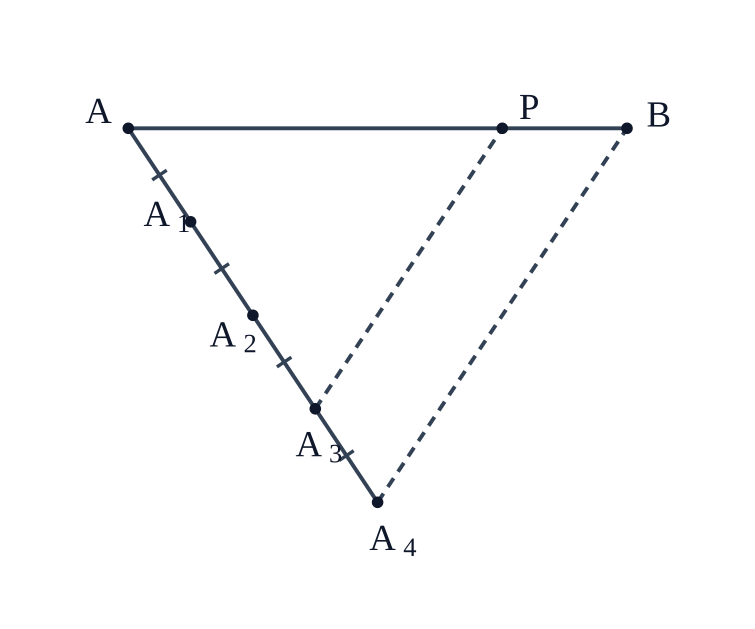
    By geometrical construction, it is possible to divide a line segment in the ratio 3:13\displaystyle \sqrt{3}: \frac{1}{\sqrt{3}}.

    Matches the book, not yet reviewed

    This working reaches the answer NCERT prints. It has not yet been read through by hand.

    NCERT’s answer
    True
    True \[\sqrt{3} : \frac{1}{\sqrt{3}} = \left(\sqrt{3}\cdot\sqrt{3}\right) : \left(\frac{1}{\sqrt{3}}\cdot\sqrt{3}\right) = 3 : 1 \] On a ray \(\displaystyle AX\), mark \(\displaystyle A_1, A_2, A_3, A_4\) at equal distances, join \(\displaystyle A_4B\), and draw \(\displaystyle A_3P \parallel A_4B\). \[\frac{AP}{PB} = \frac{AA_3}{A_3A_4} = \frac{3}{1} \quad \text{(basic proportionality theorem)} \] NCERT_Solution_Class10_Maths_Exemplar_Ch10_Ex10-2_Q1
  2. Exercise 2

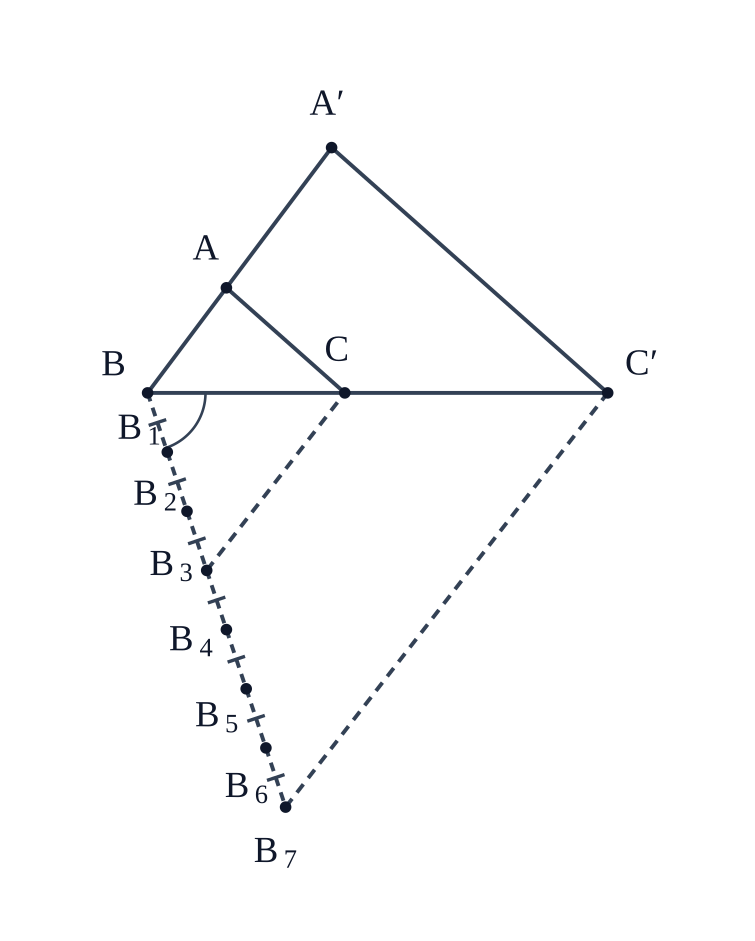
    To construct a triangle similar to a given ΔABC\displaystyle \Delta \mathrm{ABC} with its sides 73\displaystyle \frac{7}{3} of the corresponding sides of ΔABC\displaystyle \Delta \mathrm{ABC}, draw a ray BX making acute angle with BC and X lies on the opposite side of A with respect to BC. The points B1, B2,…\displaystyle \mathrm{B}_1, \mathrm{~B}_2, \ldots., B7\displaystyle \mathrm{B}_7 are located at equal distances on BX,B3\displaystyle \mathrm{BX}, \mathrm{B}_3 is joined to C and then a line segment B6C′\displaystyle \mathrm{B}_6 \mathrm{C}^{\prime} is drawn parallel to B3C\displaystyle \mathrm{B}_3 \mathrm{C} where C′\displaystyle \mathrm{C}^{\prime} lies on BC produced. Finally, line segment A′C′\displaystyle \mathrm{A}^{\prime} \mathrm{C}^{\prime} is drawn parallel to AC.

    Matches the book, not yet reviewed

    This working reaches the answer NCERT prints. It has not yet been read through by hand.

    NCERT’s answer
    False
    False \[B_6C' \parallel B_3C \;\Rightarrow\; \frac{BC'}{BC} = \frac{BB_6}{BB_3} = \frac{6}{3} = 2 \neq \frac{7}{3} \] The parallel must be drawn from \(\displaystyle B_7\): \[B_7C' \parallel B_3C \;\Rightarrow\; \frac{BC'}{BC} = \frac{BB_7}{BB_3} = \frac{7}{3} \] NCERT_Solution_Class10_Maths_Exemplar_Ch10_Ex10-2_Q2
  3. Exercise 3

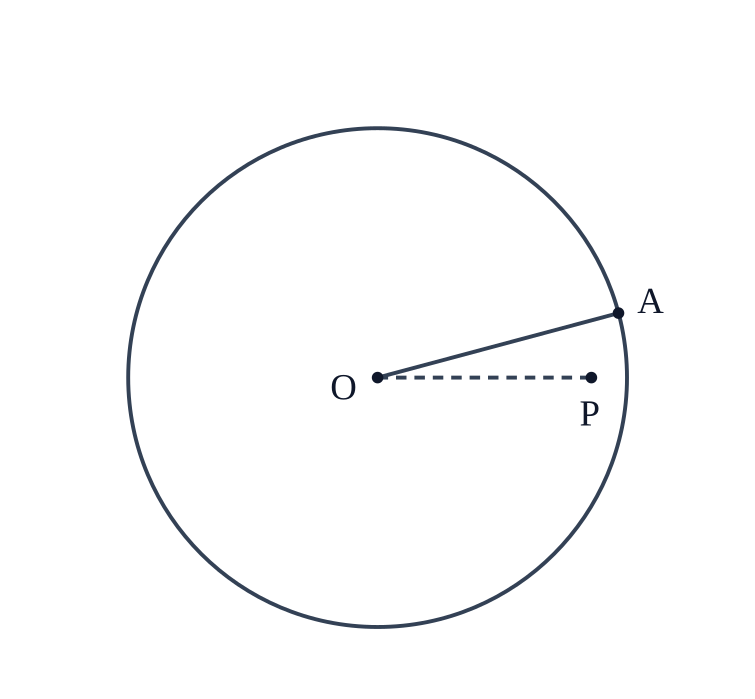
    A pair of tangents can be constructed from a point P to a circle of radius 3.5\displaystyle 3.5 cm situated at a distance of 3\displaystyle 3 cm from the centre.

    Matches the book, not yet reviewed

    This working reaches the answer NCERT prints. It has not yet been read through by hand.

    NCERT’s answer
    False
    False \[OP = 3\text{ cm} < 3.5\text{ cm} = \text{radius} \] \(\displaystyle P\) lies inside the circle, and no tangent can be drawn to a circle from a point inside it. NCERT_Solution_Class10_Maths_Exemplar_Ch10_Ex10-2_Q3
  4. Exercise 4

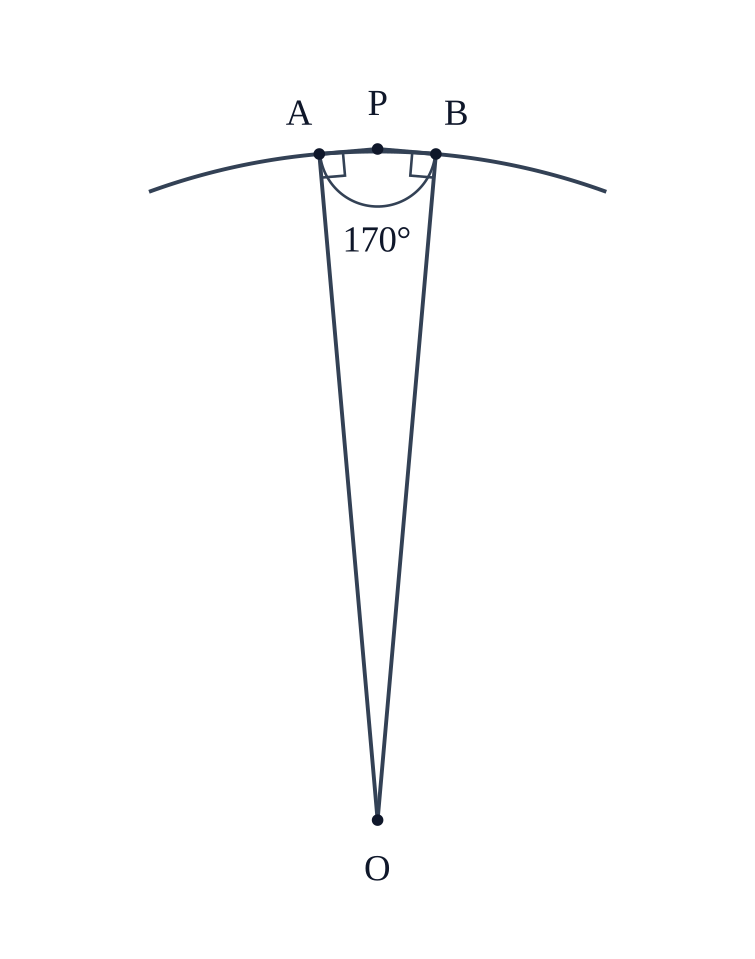
    A pair of tangents can be constructed to a circle inclined at an angle of 170\displaystyle 170°.

    Matches the book, not yet reviewed

    This working reaches the answer NCERT prints. It has not yet been read through by hand.

    NCERT’s answer
    True
    True \[\angle OAP + \angle OBP + \angle APB + \angle AOB = 360^\circ \] \[90^\circ + 90^\circ + 170^\circ + \angle AOB = 360^\circ \;\Rightarrow\; \angle AOB = 10^\circ \] Draw radii \(\displaystyle OA, OB\) with \(\displaystyle \angle AOB = 10^\circ\); the tangents at \(\displaystyle A\) and \(\displaystyle B\) meet at \(\displaystyle P\) with \(\displaystyle \angle APB = 170^\circ\). NCERT_Solution_Class10_Maths_Exemplar_Ch10_Ex10-2_Q4