SolveIt is under development
SolveItNCERT · CBSE · NEET

NCERT Exemplar · Class 10 Mathematics Circles

44 questions · 44 still being checked

EXERCISE 9.4 1–10 (part 4 of 5)

  1. Exercise 1

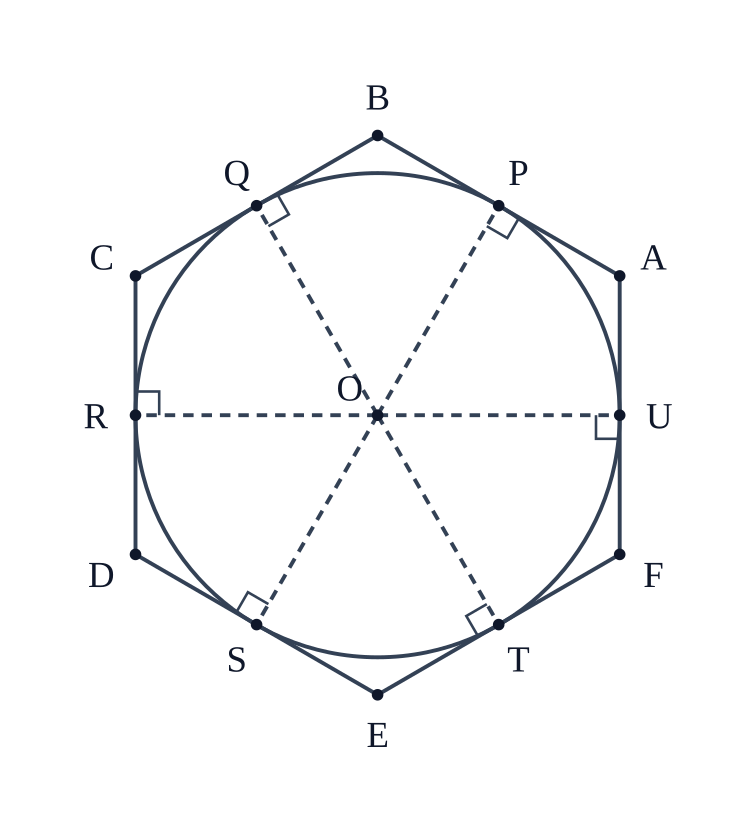
    If a hexagon ABCDEF circumscribe a circle, prove that AB+CD+EF=BC+DE+FA\displaystyle \mathrm{AB}+\mathrm{CD}+\mathrm{EF}=\mathrm{BC}+\mathrm{DE}+\mathrm{FA}.

    Not cross-checked

    NCERT prints no numerical answer for this exercise, so this working has not been cross-checked against the book.

    Since the circle touches AB, BC, CD, DE, EF, FA at P, Q, R, S, T, U respectively, tangents from each vertex are equal: \[AP=AU,\quad BP=BQ,\quad CQ=CR,\quad DR=DS,\quad ES=ET,\quad FT=FU \] \[AB+CD+EF=(AP+PB)+(CR+RD)+(ET+TF) \] \[=(AU+BQ)+(CQ+DS)+(ES+FU) \] \[=(BQ+CQ)+(DS+ES)+(FU+AU) \] \[=BC+DE+FA \] NCERT_Solution_Class10_Maths_Exemplar_Ch9_Ex9-4_Q1 Answer: \(\displaystyle AB+CD+EF=BC+DE+FA\)
  2. Exercise 2

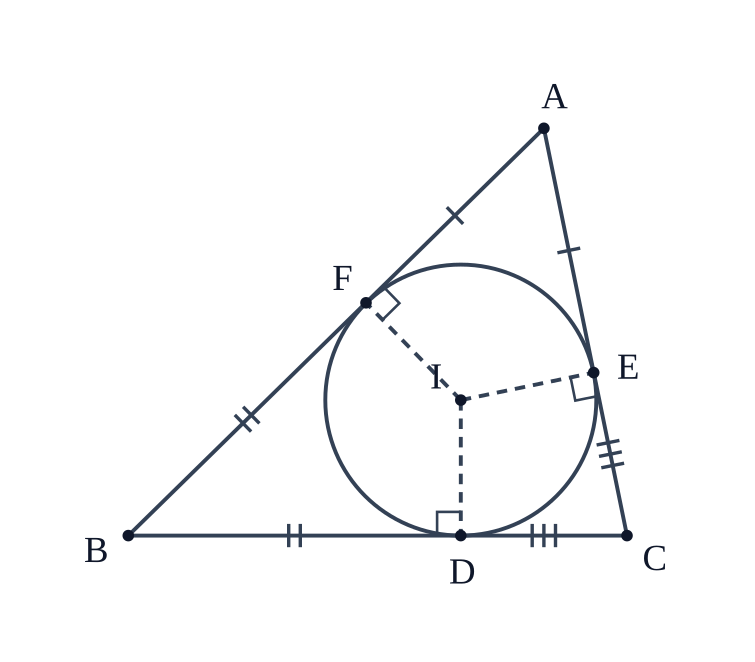
    Let s\displaystyle s denote the semi-perimeter of a triangle ABC in which BC=a,CA=b\displaystyle \mathrm{BC}=a, \mathrm{CA}=b, AB=c\displaystyle \mathrm{AB}=c. If a circle touches the sides BC, CA, AB at D, E, F, respectively, prove that BD=s−b\displaystyle \mathrm{BD}=s-b.

    Not cross-checked

    NCERT prints no numerical answer for this exercise, so this working has not been cross-checked against the book.

    Let the equal tangent lengths from each vertex be \(\displaystyle AF=AE=x,\ BF=BD=y,\ CD=CE=z\). \[c=AB=x+y,\quad a=BC=y+z,\quad b=CA=z+x \] Adding all three, \[a+b+c=2(x+y+z)\ \Rightarrow\ x+y+z=s \] \[BD=y=s-(x+z)=s-b \] NCERT_Solution_Class10_Maths_Exemplar_Ch9_Ex9-4_Q2 Answer: \(\displaystyle BD=s-b\)
  3. Exercise 3

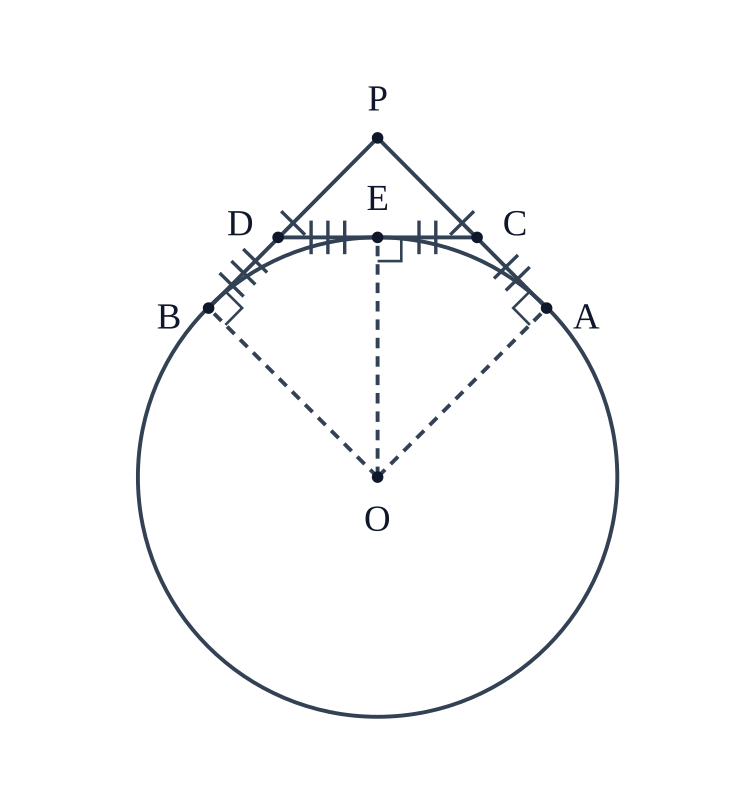
    From an external point P, two tangents, PA and PB are drawn to a circle with centre O. At one point E on the circle tangent is drawn which intersects PA and PB at C and D, respectively. If PA=10 cm\displaystyle \mathrm{PA}=10 \mathrm{~cm}, find the the perimeter of the triangle PCD.

    Matches the book, not yet reviewed

    This working reaches the answer NCERT prints. It has not yet been read through by hand.

    NCERT’s answer
    $\displaystyle 20$ cm
    Since PA, PB and the tangent CD (touching at E) are tangents to the same circle, \[CA=CE,\quad DB=DE \] \[\text{Perimeter}(\triangle PCD)=PC+CD+DP=PC+(CE+ED)+DP \] \[=(PC+CA)+(DB+DP)=PA+PB \] Since \(\displaystyle PA=PB=10\text{ cm}\) (tangents from P), \[\text{Perimeter}(\triangle PCD)=10+10=20\text{ cm} \] NCERT_Solution_Class10_Maths_Exemplar_Ch9_Ex9-4_Q3 Answer: $\displaystyle 20$ cm
  4. Exercise 4

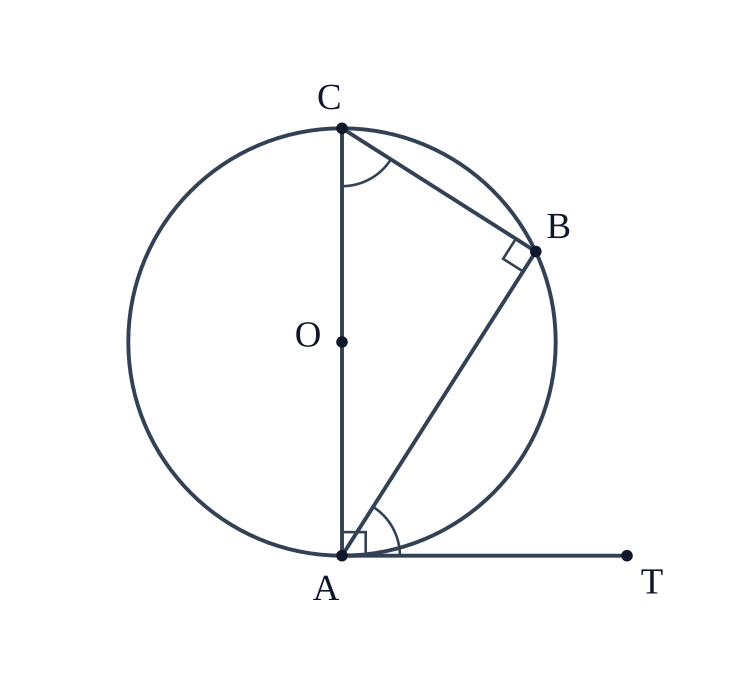
    If AB is a chord of a circle with centre O, AOC is a diameter and AT is the tangent at A as shown in Fig. 9.17. Prove that ∠BAT=∠ACB\angle \mathrm{BAT}=\angle \mathrm{ACB} NCERT_Question_Class10_Maths_Exemplar_Ch9_Ex9-4_Q4

    Not cross-checked

    NCERT prints no numerical answer for this exercise, so this working has not been cross-checked against the book.

    Since AOC is a diameter, \(\displaystyle \angle ABC=90^\circ\) (angle in a semicircle). \[\angle ACB+\angle BAC=90^\circ \] Since AT is tangent at A and AC is a diameter, \(\displaystyle AC\perp AT\): \[\angle BAT+\angle BAC=\angle CAT=90^\circ \] \[\therefore\ \angle BAT=90^\circ-\angle BAC=\angle ACB \] NCERT_Solution_Class10_Maths_Exemplar_Ch9_Ex9-4_Q4 Answer: \(\displaystyle \angle BAT=\angle ACB\) (proved)
  5. Exercise 5

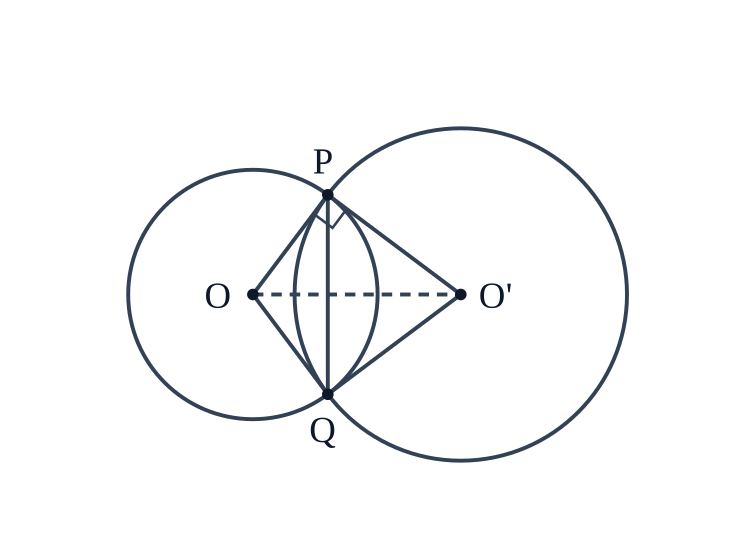
    Two circles with centres O and O′\displaystyle \mathrm{O}^{\prime} of radii 3\displaystyle 3 cm and 4\displaystyle 4 cm, respectively intersect at two points P and Q such that OP and O′P\displaystyle \mathrm{O}^{\prime} \mathrm{P} are tangents to the two circles. Find the length of the common chord PQ.

    Matches the book, not yet reviewed

    This working reaches the answer NCERT prints. It has not yet been read through by hand.

    NCERT’s answer
    4.$\displaystyle 8$ cm
    Since OP is tangent to the circle centred \(\displaystyle O'\) at P, \(\displaystyle OP\perp O'P\), so \(\displaystyle \triangle OPO'\) is right-angled at P. \[OO'=\sqrt{OP^2+O'P^2}=\sqrt{3^2+4^2}=5\text{ cm} \] \(\displaystyle OO'\) is the perpendicular bisector of the common chord PQ, so half of PQ equals the altitude from P to \(\displaystyle OO'\): \[\tfrac12 PQ=\dfrac{OP\cdot O'P}{OO'}=\dfrac{3\times4}{5}=2.4\text{ cm} \] \[PQ=2\times2.4=4.8\text{ cm} \] NCERT_Solution_Class10_Maths_Exemplar_Ch9_Ex9-4_Q5 Answer: PQ = $\displaystyle 4.8$ cm
  6. Exercise 6

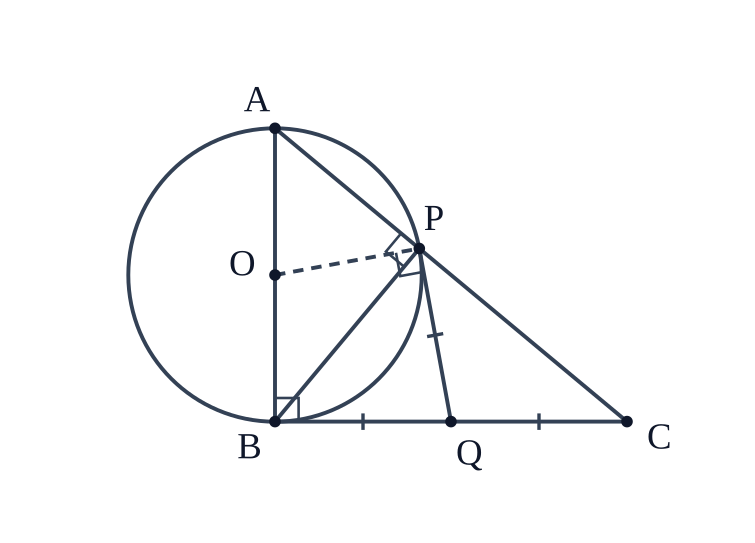
    In a right triangle ABC in which ∠B=90∘\displaystyle \angle \mathrm{B}=90^{\circ}, a circle is drawn with AB as diameter intersecting the hypotenuse AC and P. Prove that the tangent to the circle at P bisects BC.

    Not cross-checked

    NCERT prints no numerical answer for this exercise, so this working has not been cross-checked against the book.

    \[\angle APB=90^\circ \quad\text{(angle in semicircle, AB diameter)} \] \[\therefore\ BP\perp AC,\qquad \angle BPC=90^\circ \] Since \(\displaystyle \angle ABC=90^\circ\), \(\displaystyle BC\perp AB\), so BC is tangent to the circle at B. Let the tangent at P meet BC at Q. \[QB=QP \quad\text{(tangents from Q)} \] \[\angle QPB=\angle QBP=\angle PBC \] \[\angle QPC=90^\circ-\angle QPB=90^\circ-\angle PBC=\angle PCB \quad\text{(}\angle PBC+\angle PCB=90^\circ\text{ in }\triangle PBC\text{)} \] \[\therefore\ QP=QC \] \[QB=QP=QC \] NCERT_Solution_Class10_Maths_Exemplar_Ch9_Ex9-4_Q6 Answer: The tangent at P bisects BC (proved)
  7. Exercise 7

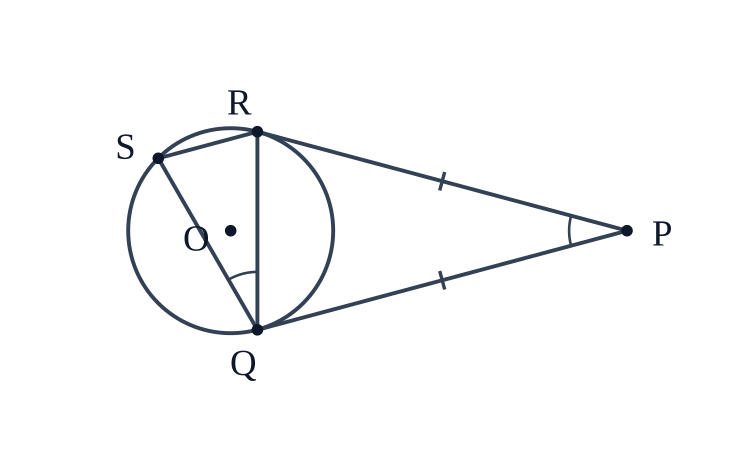
    In Fig. 9.18\displaystyle 9.18, tangents PQ and PR are drawn to a circle such that ∠RPQ=30∘\displaystyle \angle \mathrm{RPQ}=30^{\circ}. A chord RS is drawn parallel to the tangent PQ. Find the ∠RQS\displaystyle \angle \mathrm{RQS}. [Hint: Draw a line through Q and perpendicular to QP.] NCERT_Question_Class10_Maths_Exemplar_Ch9_Ex9-4_Q7

    Matches the book, not yet reviewed

    This working reaches the answer NCERT prints. It has not yet been read through by hand.

    NCERT’s answer
    \(\displaystyle 30^{\circ}\)
    \[\angle PQR=\angle PRQ=\dfrac{180^\circ-30^\circ}{2}=75^\circ \quad\text{(}PQ=PR\text{, tangents from P)} \] \[\angle QRS=\angle PQR=75^\circ \quad\text{(alternate angles, }RS\parallel PQ\text{)} \] \[\angle QSR=\angle PQR=75^\circ \quad\text{(tangent-chord angle = angle in alternate segment)} \] \[\angle RQS=180^\circ-\angle QRS-\angle QSR=180^\circ-75^\circ-75^\circ=30^\circ \] NCERT_Solution_Class10_Maths_Exemplar_Ch9_Ex9-4_Q7 Answer: \(\displaystyle \angle RQS=30^\circ\)
  8. Exercise 8

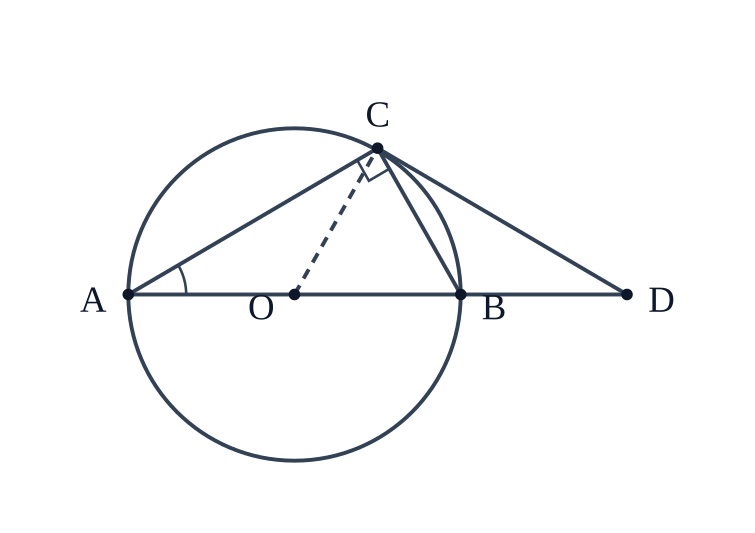
    AB is a diameter and AC is a chord of a circle with centre O such that ∠BAC=30∘\displaystyle \angle \mathrm{BAC}=30^{\circ}. The tangent at C intersects extended AB at a point D. Prove that BC=BD\displaystyle \mathrm{BC}=\mathrm{BD}.

    Not cross-checked

    NCERT prints no numerical answer for this exercise, so this working has not been cross-checked against the book.

    \[\angle ACB = 90^\circ \quad \text{(angle in a semicircle, } AB \text{ diameter)} \] \[\angle ABC = 180^\circ-90^\circ-30^\circ = 60^\circ \quad \text{(angle sum, } \triangle ABC\text{)} \] \[\angle CBD = 180^\circ-\angle ABC = 120^\circ \quad \text{(linear pair, } D \text{ on } AB \text{ extended)} \] \[\angle BCD = \angle BAC = 30^\circ \quad \text{(tangent–chord} = \text{alternate segment)} \] \[\angle BDC = 180^\circ-120^\circ-30^\circ = 30^\circ \quad \text{(angle sum, } \triangle BCD\text{)} \] \[BC = BD \quad (\angle BCD=\angle BDC \Rightarrow \text{sides opposite equal angles are equal}) \]NCERT_Solution_Class10_Maths_Exemplar_Ch9_Ex9-4_Q8
  9. Exercise 9

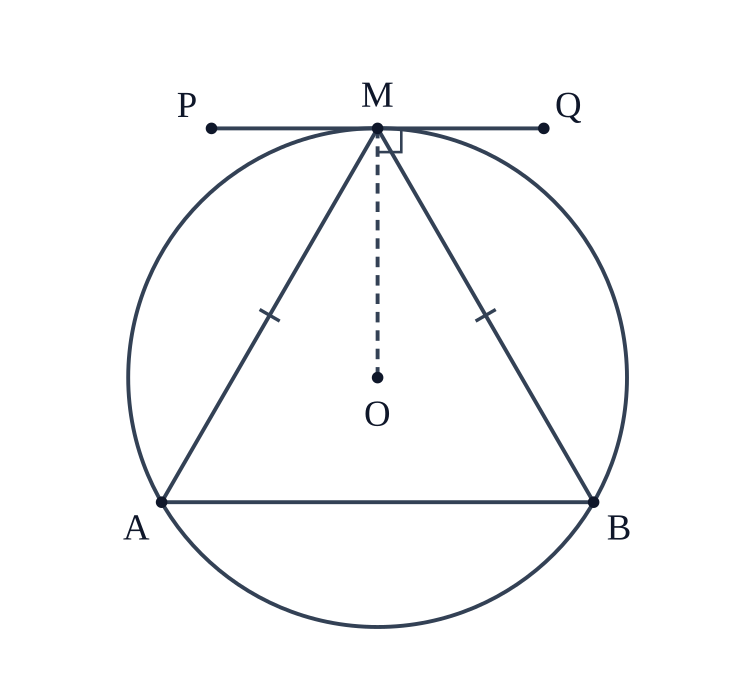
    Prove that the tangent drawn at the mid-point of an arc of a circle is parallel to the chord joining the end points of the arc.

    Not cross-checked

    NCERT prints no numerical answer for this exercise, so this working has not been cross-checked against the book.

    \[MA = MB \quad \text{(equal arcs, equal chords)} \] \[OA = OB \quad \text{(radii)} \] \[OM \perp AB \quad \text{(O and M are each equidistant from A and B)} \] \[OM \perp PQ \quad \text{(tangent} \perp \text{radius at the point of contact } M) \] \[\therefore AB \parallel PQ \quad \text{(both} \perp OM) \]NCERT_Solution_Class10_Maths_Exemplar_Ch9_Ex9-4_Q9
  10. Exercise 10

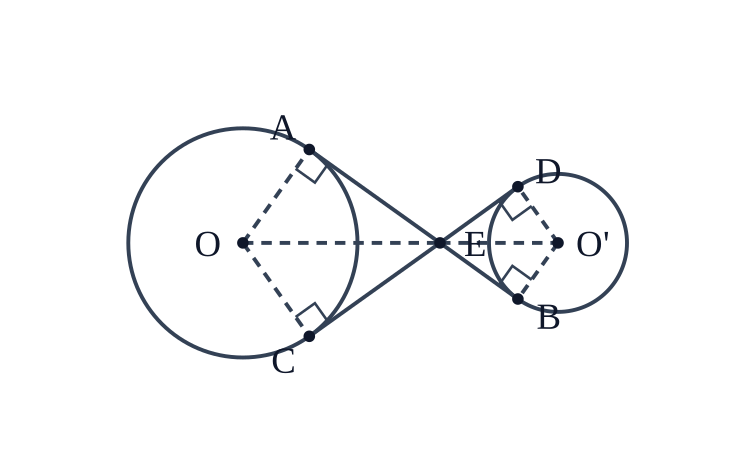
    In Fig. 9.19\displaystyle 9.19, the common tangent, AB and CD to two circles with centres O and O′\displaystyle \mathrm{O}^{\prime} intersect at E. Prove that the points O,E,O′\displaystyle \mathrm{O}, \mathrm{E}, \mathrm{O}^{\prime} are collinear. NCERT_Question_Class10_Maths_Exemplar_Ch9_Ex9-4_Q10

    Not cross-checked

    NCERT prints no numerical answer for this exercise, so this working has not been cross-checked against the book.

    \[EA = EC \quad (\text{tangents from } E \text{ to circle } O) \] \[\triangle OAE \cong \triangle OCE \quad (OA=OC,\ OE=OE,\ EA=EC) \Rightarrow \angle OEA = \angle OEC \] \[EB = ED \quad (\text{tangents from } E \text{ to circle } O') \] \[\triangle O'BE \cong \triangle O'DE \quad (O'B=O'D,\ O'E=O'E,\ EB=ED) \Rightarrow \angle O'EB = \angle O'ED \] \[\angle AEC = \angle BED \quad (\text{vertically opposite angles}) \] \[\angle OEA = \tfrac12\angle AEC = \tfrac12\angle BED = \angle O'EB \] \[\angle AEO+\angle OEB = 180^\circ \quad (A,E,B \text{ collinear}) \] \[\Rightarrow \angle OEB+\angle BEO' = 180^\circ \] \[\therefore O,\,E,\,O' \text{ are collinear} \]NCERT_Solution_Class10_Maths_Exemplar_Ch9_Ex9-4_Q10