Exercise 1
If a chord AB subtends an angle of ° at the centre of a circle, then angle between the tangents at A and B is also .
Matches the book, not yet reviewed
This working reaches the answer NCERT prints. It has not yet been read through by hand.
NCERT’s answer
False
False.
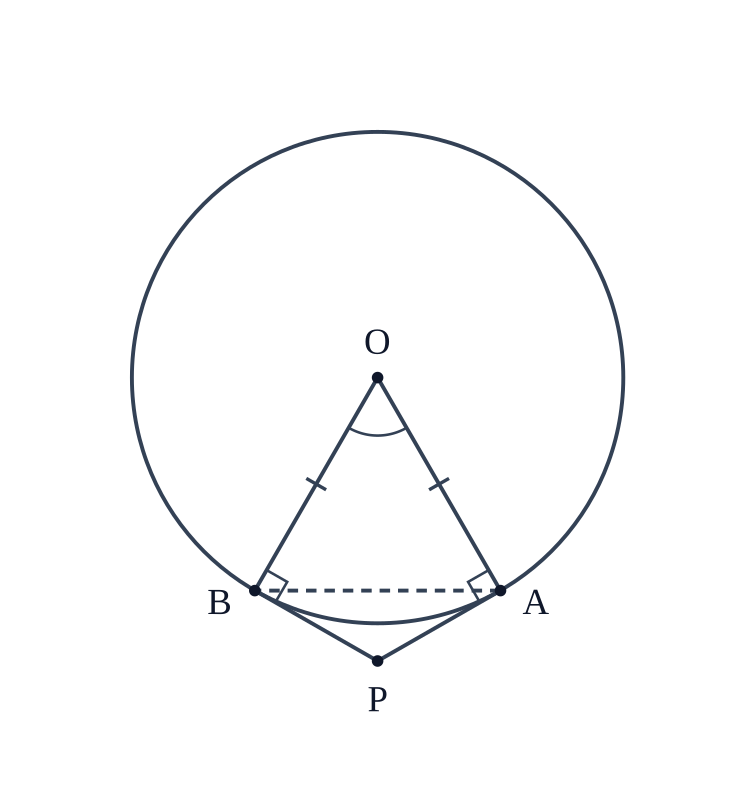 \[\angle OAP = \angle OBP = 90^{\circ} \quad \text{(radius \(\displaystyle \perp\) tangent)} \]
\[\angle AOB + \angle APB = 360^{\circ} - 90^{\circ} - 90^{\circ} = 180^{\circ} \]
\[\angle APB = 180^{\circ} - 60^{\circ} = 120^{\circ} \neq 60^{\circ} \]
\[\angle OAP = \angle OBP = 90^{\circ} \quad \text{(radius \(\displaystyle \perp\) tangent)} \]
\[\angle AOB + \angle APB = 360^{\circ} - 90^{\circ} - 90^{\circ} = 180^{\circ} \]
\[\angle APB = 180^{\circ} - 60^{\circ} = 120^{\circ} \neq 60^{\circ} \]
\[\angle OAP = \angle OBP = 90^{\circ} \quad \text{(radius \(\displaystyle \perp\) tangent)} \]
\[\angle AOB + \angle APB = 360^{\circ} - 90^{\circ} - 90^{\circ} = 180^{\circ} \]
\[\angle APB = 180^{\circ} - 60^{\circ} = 120^{\circ} \neq 60^{\circ} \]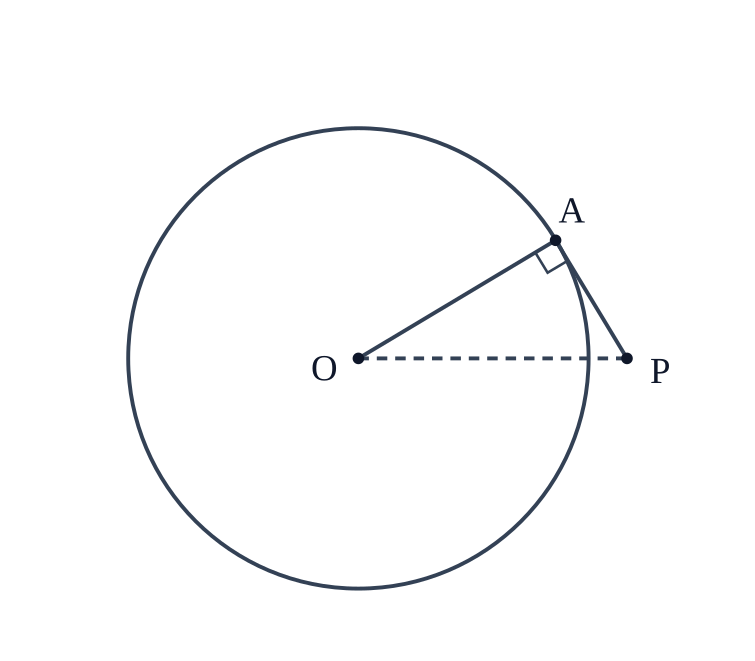 \[PA = \sqrt{OP^{2} - r^{2}} \quad \text{(right triangle \(\displaystyle OAP\))} \]
\[PA < r \iff OP < r\sqrt{2} \]
So for any external point with \(\displaystyle r < OP < r\sqrt{2}\), the tangent is shorter than the radius.
\[PA = \sqrt{OP^{2} - r^{2}} \quad \text{(right triangle \(\displaystyle OAP\))} \]
\[PA < r \iff OP < r\sqrt{2} \]
So for any external point with \(\displaystyle r < OP < r\sqrt{2}\), the tangent is shorter than the radius.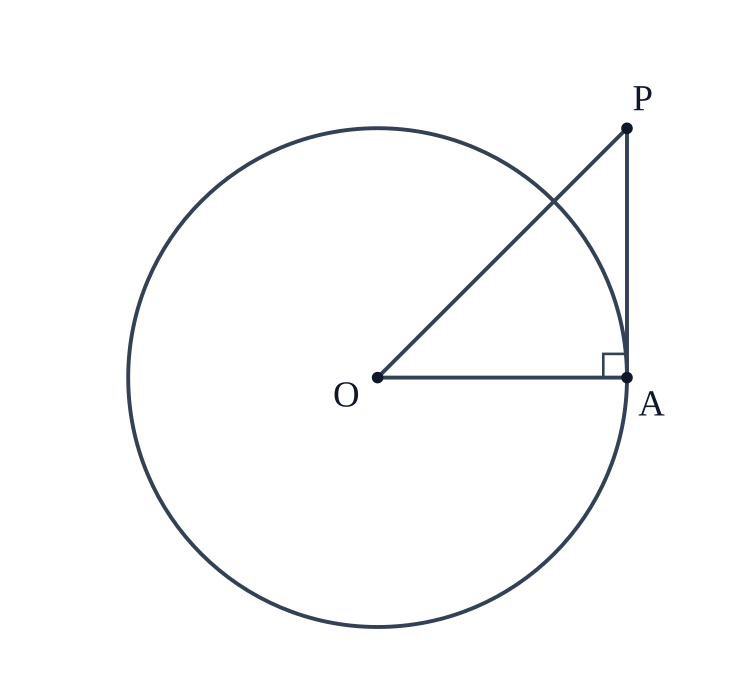 \[\angle OAP = 90^{\circ} \quad \text{(radius \(\displaystyle \perp\) tangent)} \]
\[OP^{2} = OA^{2} + PA^{2} \quad \text{(Pythagoras)} \]
\[OP > PA \quad \text{(hypotenuse is the longest side)} \]
\[\angle OAP = 90^{\circ} \quad \text{(radius \(\displaystyle \perp\) tangent)} \]
\[OP^{2} = OA^{2} + PA^{2} \quad \text{(Pythagoras)} \]
\[OP > PA \quad \text{(hypotenuse is the longest side)} \]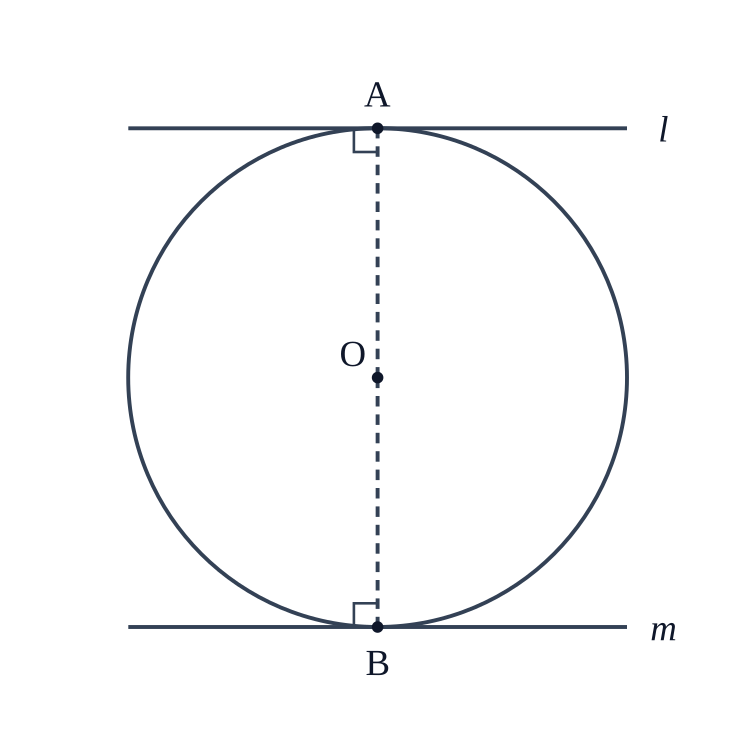 \[l \perp AB, \quad m \perp AB \quad \text{(radius \(\displaystyle \perp\) tangent, \(\displaystyle A,O,B\) collinear)} \]
\[l \parallel m \]
Tangents at the two ends of a diameter are parallel: the angle between them is \(\displaystyle 0^{\circ}\).
\[l \perp AB, \quad m \perp AB \quad \text{(radius \(\displaystyle \perp\) tangent, \(\displaystyle A,O,B\) collinear)} \]
\[l \parallel m \]
Tangents at the two ends of a diameter are parallel: the angle between them is \(\displaystyle 0^{\circ}\).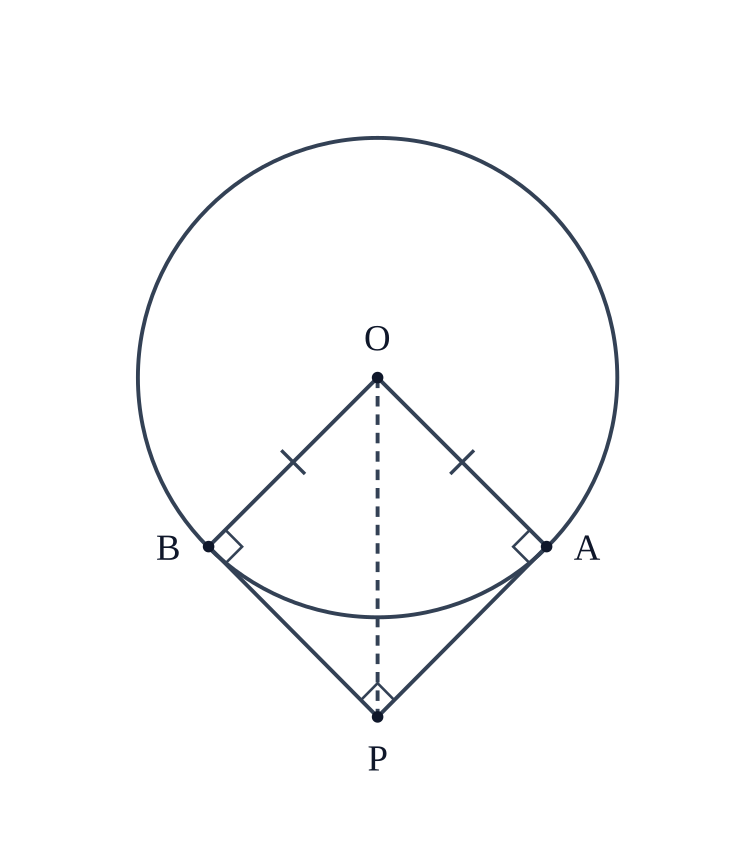 \[\angle OAP = \angle OBP = 90^{\circ} \quad \text{(radius \(\displaystyle \perp\) tangent)} \]
\[\angle APB = 90^{\circ} \quad \text{(given)} \]
\[\angle APO = \tfrac{1}{2}\angle APB = 45^{\circ} \quad \text{(\(\displaystyle OP\) bisects \(\displaystyle \angle APB\))} \]
\[\sin 45^{\circ} = \dfrac{OA}{OP} = \dfrac{a}{OP} \]
\[OP = \dfrac{a}{\sin 45^{\circ}} = a\sqrt{2} \]
\[\angle OAP = \angle OBP = 90^{\circ} \quad \text{(radius \(\displaystyle \perp\) tangent)} \]
\[\angle APB = 90^{\circ} \quad \text{(given)} \]
\[\angle APO = \tfrac{1}{2}\angle APB = 45^{\circ} \quad \text{(\(\displaystyle OP\) bisects \(\displaystyle \angle APB\))} \]
\[\sin 45^{\circ} = \dfrac{OA}{OP} = \dfrac{a}{OP} \]
\[OP = \dfrac{a}{\sin 45^{\circ}} = a\sqrt{2} \]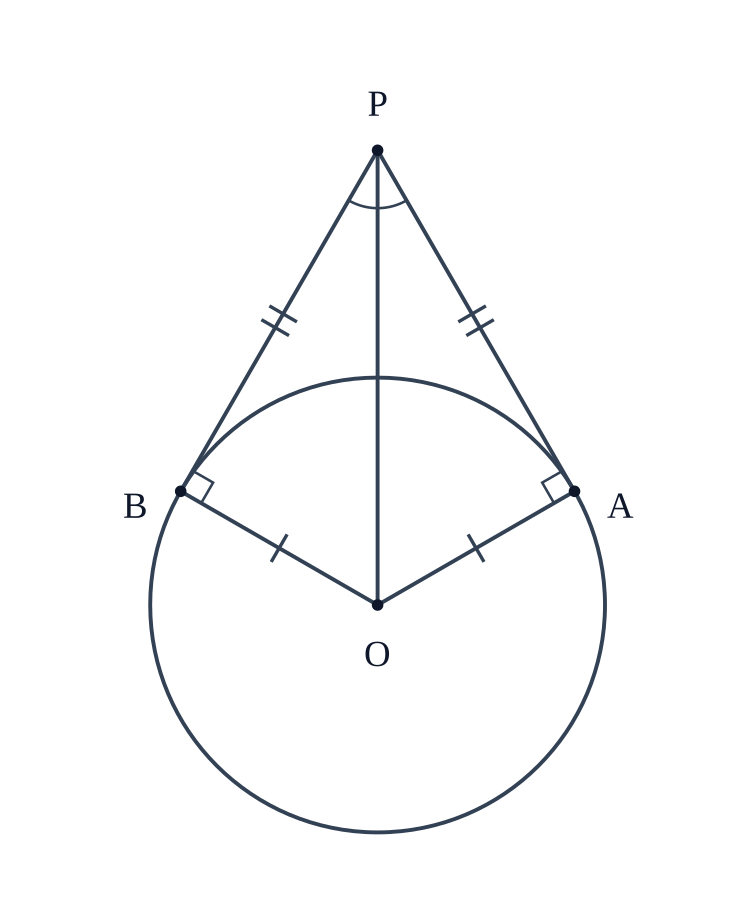 \[\sin(\angle OPA) = \frac{OA}{OP} = \frac{a}{OP} \]
\[\sin 30^\circ = \frac{a}{OP} \implies OP = 2a \]
\[2a \neq a\sqrt{3} \]
\[\sin(\angle OPA) = \frac{OA}{OP} = \frac{a}{OP} \]
\[\sin 30^\circ = \frac{a}{OP} \implies OP = 2a \]
\[2a \neq a\sqrt{3} \]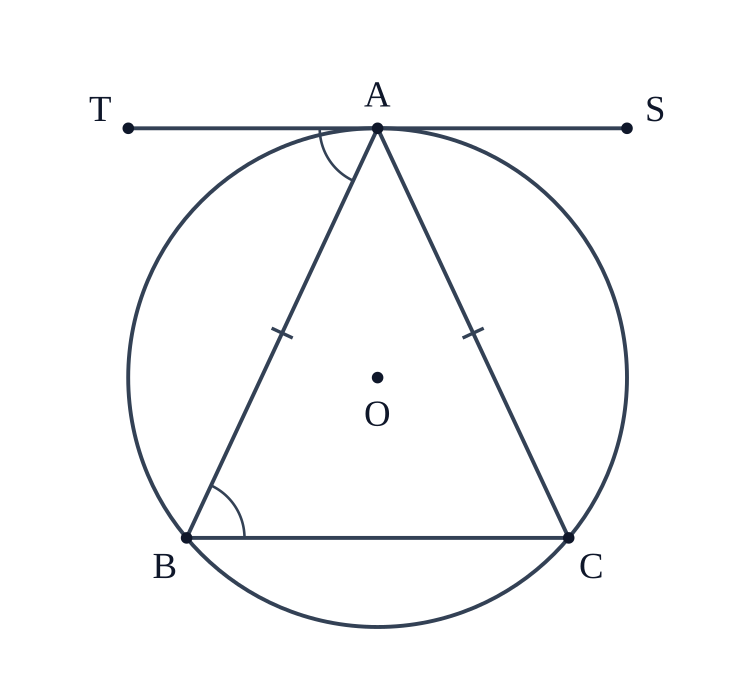 \[\angle TAB = \angle ABC \implies TA \parallel BC \quad \text{(alternate angles, transversal } AB \text{)} \]
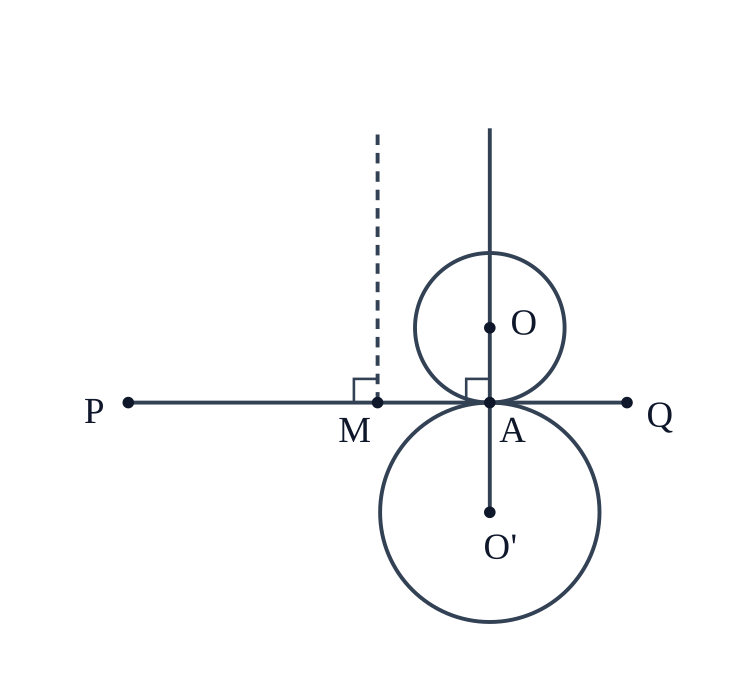 So every centre lies on the line through \(\displaystyle A\) perpendicular to \(\displaystyle PQ\). That line is the perpendicular bisector only if \(\displaystyle A\) is the midpoint \(\displaystyle M\) of \(\displaystyle PQ\); \(\displaystyle A\) need not be (in the figure, \(\displaystyle PA \neq AQ\)).
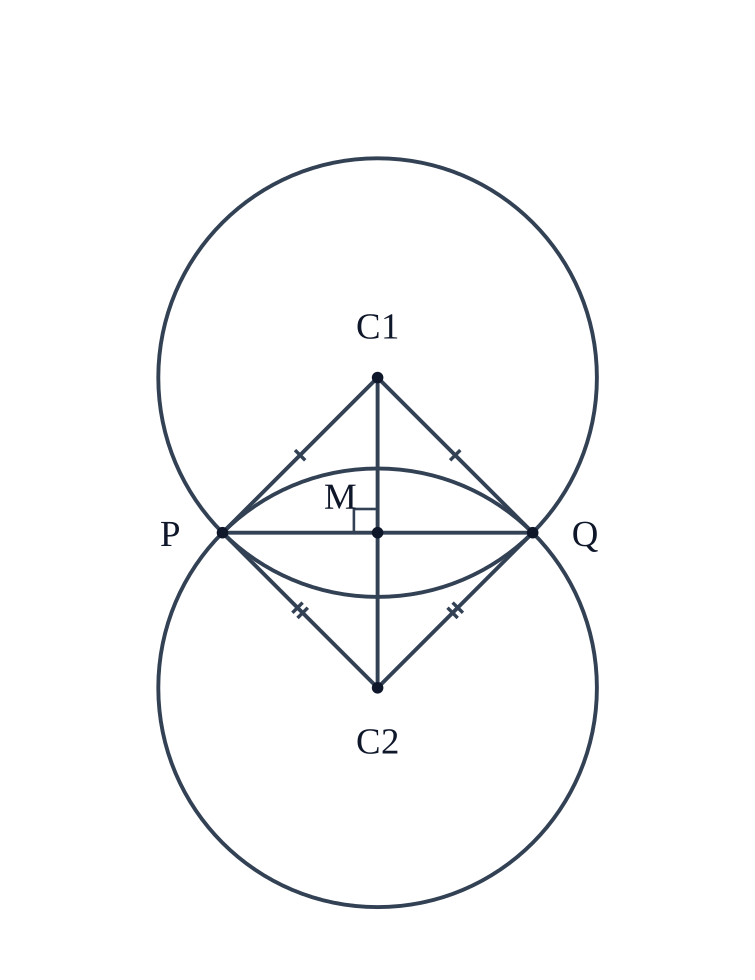 \[CP = CQ \implies C \in \text{perpendicular bisector of } PQ \quad \text{(locus of points equidistant from } P, Q \text{)} \]
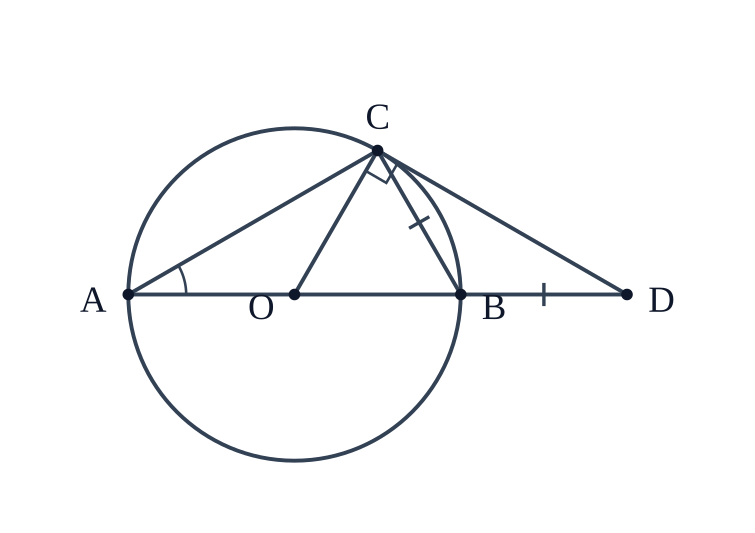 \[\angle OCD = 90^\circ \quad \text{(tangent} \perp \text{radius at } C \text{)} \]
\[\angle BCD = \angle OCD - \angle OCB = 90^\circ - 60^\circ = 30^\circ \]
\[\angle DBC = 180^\circ - \angle ABC = 120^\circ \quad \text{(} A, B, D \text{ collinear)} \]
\[\angle BDC = 180^\circ - 120^\circ - 30^\circ = 30^\circ \]
\[\angle BDC = \angle BCD \implies BC = BD \quad \text{(isosceles } \triangle BCD \text{)} \]
\[\angle OCD = 90^\circ \quad \text{(tangent} \perp \text{radius at } C \text{)} \]
\[\angle BCD = \angle OCD - \angle OCB = 90^\circ - 60^\circ = 30^\circ \]
\[\angle DBC = 180^\circ - \angle ABC = 120^\circ \quad \text{(} A, B, D \text{ collinear)} \]
\[\angle BDC = 180^\circ - 120^\circ - 30^\circ = 30^\circ \]
\[\angle BDC = \angle BCD \implies BC = BD \quad \text{(isosceles } \triangle BCD \text{)} \]