Exercise 1
Out of the two concentric circles, the radius of the outer circle is cm and the chord AC of length cm is a tangent to the inner circle. Find the radius of the inner circle.
Matches the book, not yet reviewed
This working reaches the answer NCERT prints. It has not yet been read through by hand.
NCERT’s answer
$\displaystyle 3$ cm
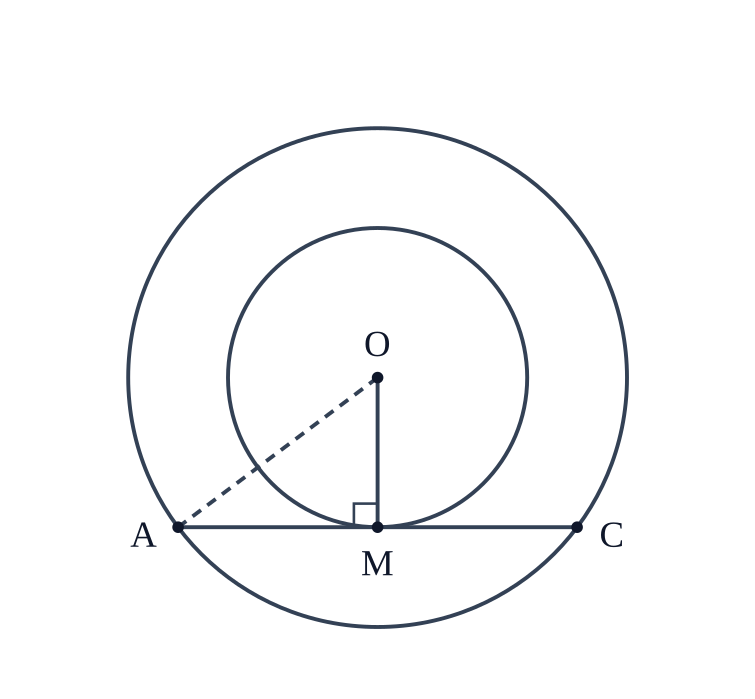 The chord touches the inner circle at M, so \(\displaystyle OM \perp AC\) and M bisects AC.
\[AM = \frac{AC}{2} = 4 \text{ cm} \]
\[OA = 5 \text{ cm} \quad \text{(outer radius)} \]
\[OM^2 = OA^2 - AM^2 = 25 - 16 = 9 \]
\[OM = 3 \text{ cm} \]
Answer: inner circle radius \(\displaystyle = 3\) cm.
The chord touches the inner circle at M, so \(\displaystyle OM \perp AC\) and M bisects AC.
\[AM = \frac{AC}{2} = 4 \text{ cm} \]
\[OA = 5 \text{ cm} \quad \text{(outer radius)} \]
\[OM^2 = OA^2 - AM^2 = 25 - 16 = 9 \]
\[OM = 3 \text{ cm} \]
Answer: inner circle radius \(\displaystyle = 3\) cm.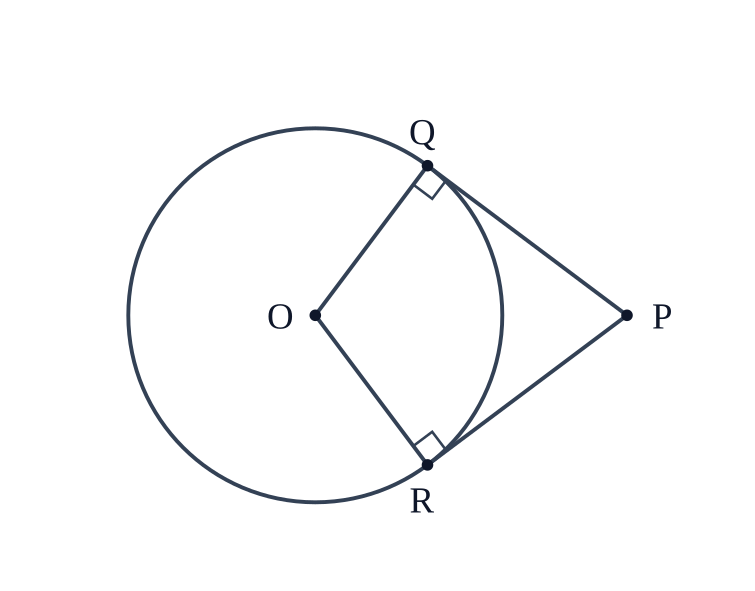 \[\angle OQP = 90^\circ, \quad \angle ORP = 90^\circ \quad \text{(radius \(\displaystyle \perp\) tangent at the point of contact)} \]
\[\angle OQP + \angle ORP = 180^\circ \]
Q and R are opposite vertices of quadrilateral QORP, so this pair of opposite angles sums to \(\displaystyle 180^\circ\); by the converse of the cyclic-quadrilateral theorem, QORP is a cyclic quadrilateral.
Answer: QORP is a cyclic quadrilateral.
\[\angle OQP = 90^\circ, \quad \angle ORP = 90^\circ \quad \text{(radius \(\displaystyle \perp\) tangent at the point of contact)} \]
\[\angle OQP + \angle ORP = 180^\circ \]
Q and R are opposite vertices of quadrilateral QORP, so this pair of opposite angles sums to \(\displaystyle 180^\circ\); by the converse of the cyclic-quadrilateral theorem, QORP is a cyclic quadrilateral.
Answer: QORP is a cyclic quadrilateral.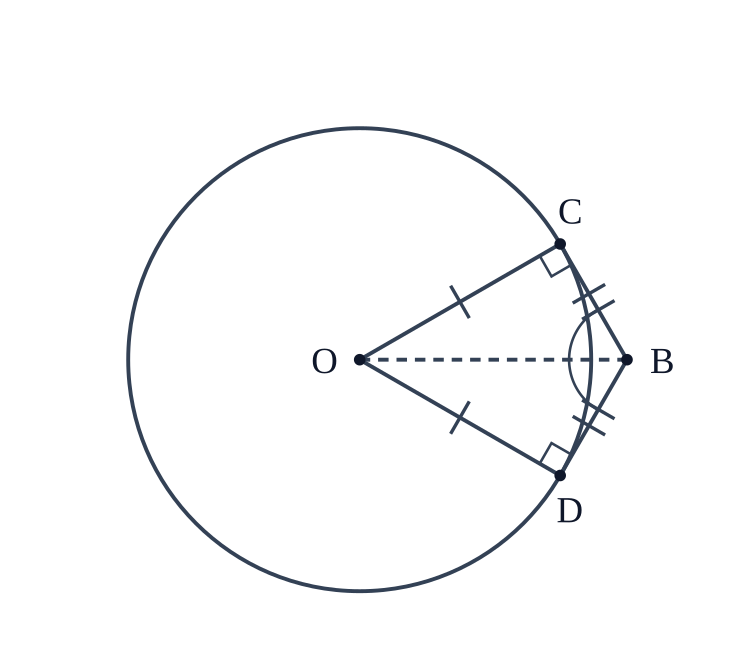 \[BC = BD \quad \text{(tangents from an external point)} \]
\[\angle OBC = \angle OBD = 60^\circ \quad \text{(OB bisects \(\displaystyle \angle DBC\))} \]
\[\angle OCB = 90^\circ \quad \text{(radius \(\displaystyle \perp\) tangent)} \]
In right triangle OCB:
\[\cos 60^\circ = \frac{BC}{OB} \]
\[BC = OB \cos 60^\circ = \frac{OB}{2} \quad \Rightarrow \quad OB = 2BC \]
\[BC + BD = 2BC = OB \]
Answer: \(\displaystyle BO = 2BC\).
\[BC = BD \quad \text{(tangents from an external point)} \]
\[\angle OBC = \angle OBD = 60^\circ \quad \text{(OB bisects \(\displaystyle \angle DBC\))} \]
\[\angle OCB = 90^\circ \quad \text{(radius \(\displaystyle \perp\) tangent)} \]
In right triangle OCB:
\[\cos 60^\circ = \frac{BC}{OB} \]
\[BC = OB \cos 60^\circ = \frac{OB}{2} \quad \Rightarrow \quad OB = 2BC \]
\[BC + BD = 2BC = OB \]
Answer: \(\displaystyle BO = 2BC\).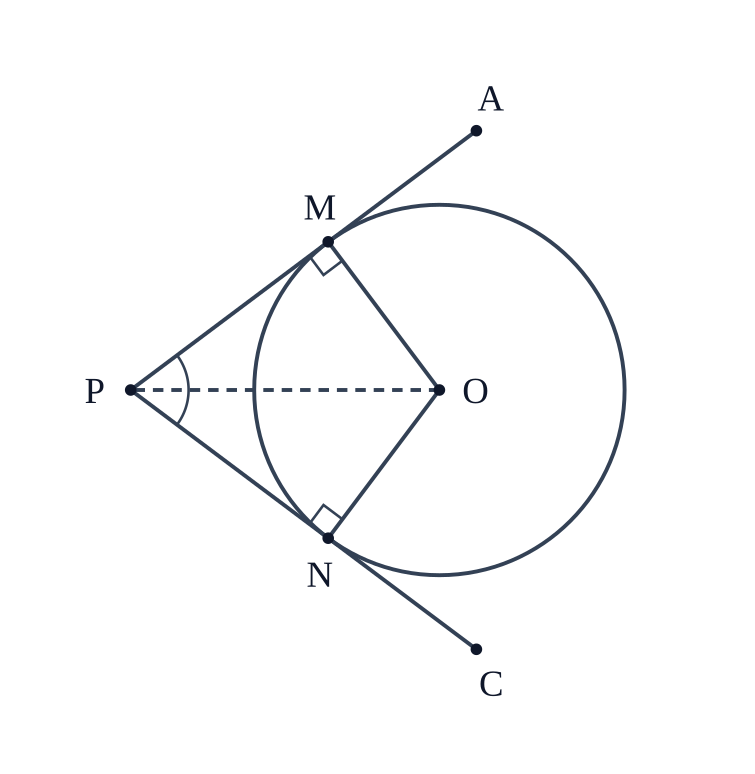 Let the two lines meet at P, and a circle with centre O touch them at M and N.
\[OM = ON \quad \text{(radii)} \]
\[\angle OMP = \angle ONP = 90^\circ \quad \text{(radius \(\displaystyle \perp\) tangent)} \]
\[OP = OP \quad \text{(common)} \]
\[\triangle OMP \cong \triangle ONP \quad \text{(RHS)} \]
\[\angle OPM = \angle OPN \]
So OP bisects the angle between the lines.
Answer: the centre O lies on the angle bisector of the two lines.
Let the two lines meet at P, and a circle with centre O touch them at M and N.
\[OM = ON \quad \text{(radii)} \]
\[\angle OMP = \angle ONP = 90^\circ \quad \text{(radius \(\displaystyle \perp\) tangent)} \]
\[OP = OP \quad \text{(common)} \]
\[\triangle OMP \cong \triangle ONP \quad \text{(RHS)} \]
\[\angle OPM = \angle OPN \]
So OP bisects the angle between the lines.
Answer: the centre O lies on the angle bisector of the two lines.
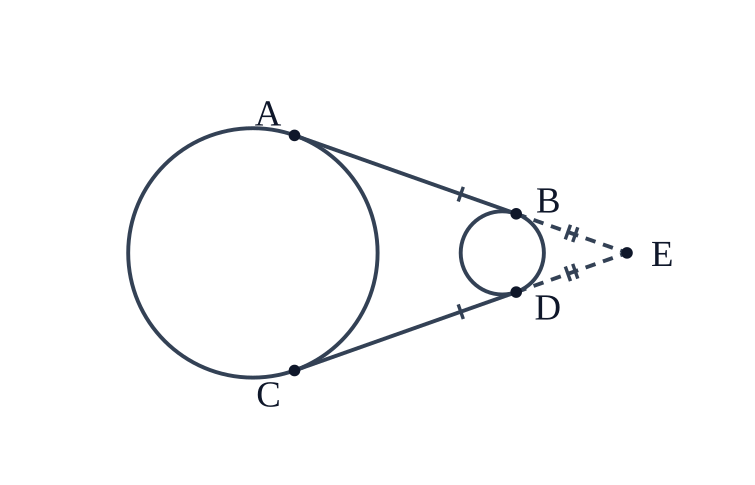 Produce BA and DC to meet at E (the radii are unequal, so they meet).
\[EA = EC \quad \text{(tangents from E to the larger circle)} \]
\[EB = ED \quad \text{(tangents from E to the smaller circle)} \]
\[AB = EA - EB, \quad CD = EC - ED \quad \text{(B, D lie between A, E and C, E)} \]
\[AB = EA - EB = EC - ED = CD \]
Answer: \(\displaystyle AB = CD\).
Produce BA and DC to meet at E (the radii are unequal, so they meet).
\[EA = EC \quad \text{(tangents from E to the larger circle)} \]
\[EB = ED \quad \text{(tangents from E to the smaller circle)} \]
\[AB = EA - EB, \quad CD = EC - ED \quad \text{(B, D lie between A, E and C, E)} \]
\[AB = EA - EB = EC - ED = CD \]
Answer: \(\displaystyle AB = CD\).
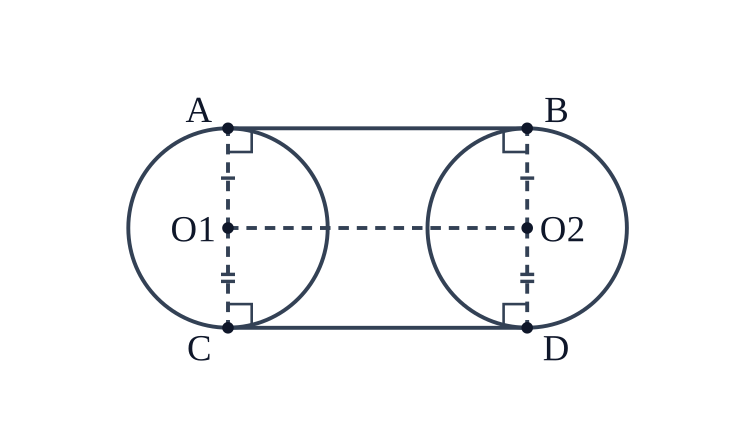 Let \(\displaystyle O_1, O_2\) be the centres, radius \(\displaystyle r\) each.
\[O_1A \perp AB, \quad O_2B \perp AB \quad \text{(tangent} \perp \text{radius)} \]
\[O_1A \parallel O_2B, \quad O_1A = O_2B = r \]
\[\Rightarrow O_1ABO_2 \text{ is a rectangle} \Rightarrow AB = O_1O_2 \]
Similarly,
\[O_1C \perp CD, \quad O_2D \perp CD \]
\[O_1C \parallel O_2D, \quad O_1C = O_2D = r \]
\[\Rightarrow O_1CDO_2 \text{ is a rectangle} \Rightarrow CD = O_1O_2 \]
\[\therefore AB = CD \]
Answer: \(\displaystyle AB = CD \).
Let \(\displaystyle O_1, O_2\) be the centres, radius \(\displaystyle r\) each.
\[O_1A \perp AB, \quad O_2B \perp AB \quad \text{(tangent} \perp \text{radius)} \]
\[O_1A \parallel O_2B, \quad O_1A = O_2B = r \]
\[\Rightarrow O_1ABO_2 \text{ is a rectangle} \Rightarrow AB = O_1O_2 \]
Similarly,
\[O_1C \perp CD, \quad O_2D \perp CD \]
\[O_1C \parallel O_2D, \quad O_1C = O_2D = r \]
\[\Rightarrow O_1CDO_2 \text{ is a rectangle} \Rightarrow CD = O_1O_2 \]
\[\therefore AB = CD \]
Answer: \(\displaystyle AB = CD \).
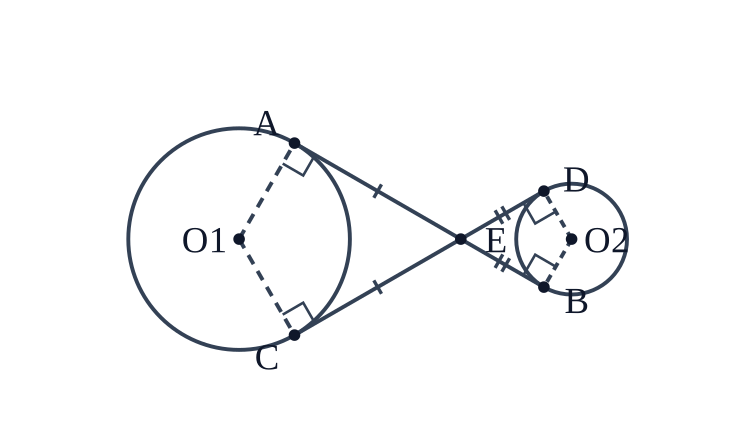 Since \(\displaystyle CD\) is tangent to the first circle at \(\displaystyle C\) and \(\displaystyle E\) lies on \(\displaystyle CD\),
\[EA = EC \quad \text{(tangents from } E \text{ to circle 1)} \]
Since \(\displaystyle AB\) is tangent to the second circle at \(\displaystyle B\) and \(\displaystyle E\) lies on \(\displaystyle AB\),
\[EB = ED \quad \text{(tangents from } E \text{ to circle 2)} \]
\[AB = EA + EB, \quad CD = EC + ED \]
\[\Rightarrow AB = EC + ED = CD \]
Answer: \(\displaystyle AB = CD \).
Since \(\displaystyle CD\) is tangent to the first circle at \(\displaystyle C\) and \(\displaystyle E\) lies on \(\displaystyle CD\),
\[EA = EC \quad \text{(tangents from } E \text{ to circle 1)} \]
Since \(\displaystyle AB\) is tangent to the second circle at \(\displaystyle B\) and \(\displaystyle E\) lies on \(\displaystyle AB\),
\[EB = ED \quad \text{(tangents from } E \text{ to circle 2)} \]
\[AB = EA + EB, \quad CD = EC + ED \]
\[\Rightarrow AB = EC + ED = CD \]
Answer: \(\displaystyle AB = CD \).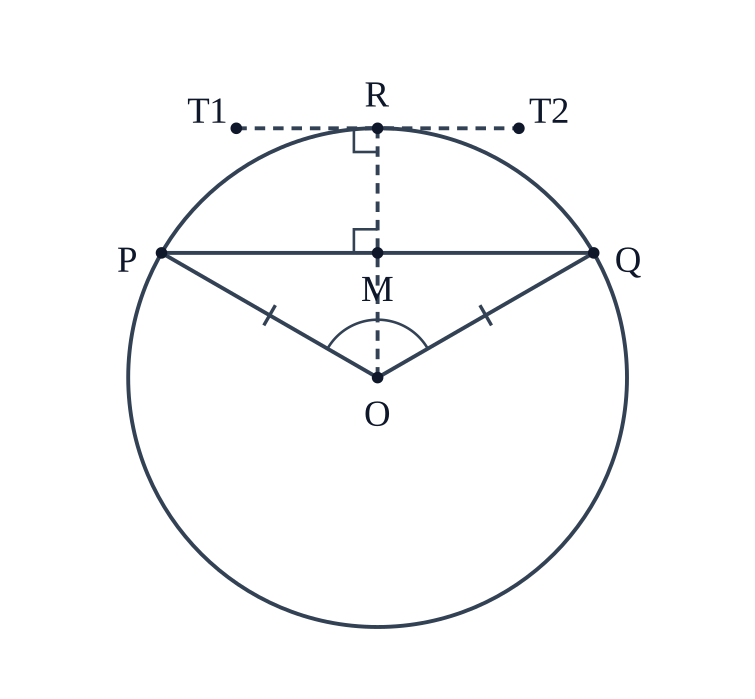 Let \(\displaystyle O\) be the centre; the tangent at \(\displaystyle R\) is parallel to chord \(\displaystyle PQ\).
\[OR \perp \text{tangent at } R \quad \text{(tangent} \perp \text{radius)} \]
\[\Rightarrow OR \perp PQ \]
Let \(\displaystyle OR\) meet \(\displaystyle PQ\) at \(\displaystyle M\).
\[OP = OQ \quad \text{(radii)}, \quad OM = OM \quad \text{(common)}, \quad \angle OMP = \angle OMQ = 90^\circ \]
\[\Rightarrow \triangle OMP \cong \triangle OMQ \quad \text{(RHS)} \]
\[\Rightarrow \angle MOP = \angle MOQ \]
\[\Rightarrow \text{arc } PR = \text{arc } RQ \quad \text{(equal central angles subtend equal arcs)} \]
Answer: \(\displaystyle R\) bisects arc \(\displaystyle PRQ\).
Let \(\displaystyle O\) be the centre; the tangent at \(\displaystyle R\) is parallel to chord \(\displaystyle PQ\).
\[OR \perp \text{tangent at } R \quad \text{(tangent} \perp \text{radius)} \]
\[\Rightarrow OR \perp PQ \]
Let \(\displaystyle OR\) meet \(\displaystyle PQ\) at \(\displaystyle M\).
\[OP = OQ \quad \text{(radii)}, \quad OM = OM \quad \text{(common)}, \quad \angle OMP = \angle OMQ = 90^\circ \]
\[\Rightarrow \triangle OMP \cong \triangle OMQ \quad \text{(RHS)} \]
\[\Rightarrow \angle MOP = \angle MOQ \]
\[\Rightarrow \text{arc } PR = \text{arc } RQ \quad \text{(equal central angles subtend equal arcs)} \]
Answer: \(\displaystyle R\) bisects arc \(\displaystyle PRQ\).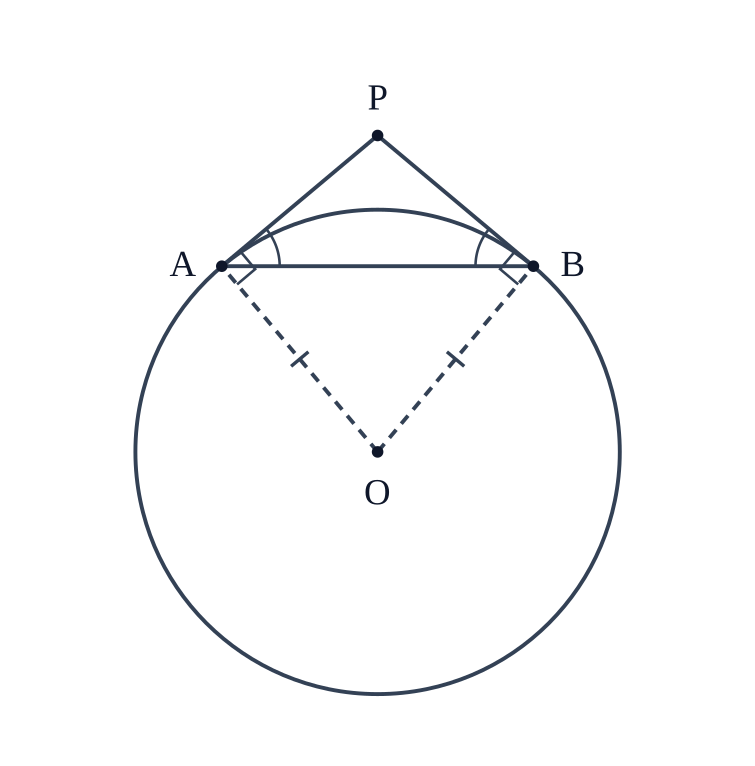 Let \(\displaystyle O\) be the centre, \(\displaystyle AB\) the chord, and \(\displaystyle P\) the point where the tangents at \(\displaystyle A\) and \(\displaystyle B\) meet.
\[OA = OB \quad \text{(radii)} \Rightarrow \angle OAB = \angle OBA \quad \text{(isosceles } \triangle OAB\text{)} \]
\[PA \perp OA, \quad PB \perp OB \quad \text{(tangent} \perp \text{radius)} \]
\[\angle PAB = 90^\circ - \angle OAB, \quad \angle PBA = 90^\circ - \angle OBA \]
\[\Rightarrow \angle PAB = \angle PBA \]
Answer: \(\displaystyle \angle PAB = \angle PBA \).
Let \(\displaystyle O\) be the centre, \(\displaystyle AB\) the chord, and \(\displaystyle P\) the point where the tangents at \(\displaystyle A\) and \(\displaystyle B\) meet.
\[OA = OB \quad \text{(radii)} \Rightarrow \angle OAB = \angle OBA \quad \text{(isosceles } \triangle OAB\text{)} \]
\[PA \perp OA, \quad PB \perp OB \quad \text{(tangent} \perp \text{radius)} \]
\[\angle PAB = 90^\circ - \angle OAB, \quad \angle PBA = 90^\circ - \angle OBA \]
\[\Rightarrow \angle PAB = \angle PBA \]
Answer: \(\displaystyle \angle PAB = \angle PBA \).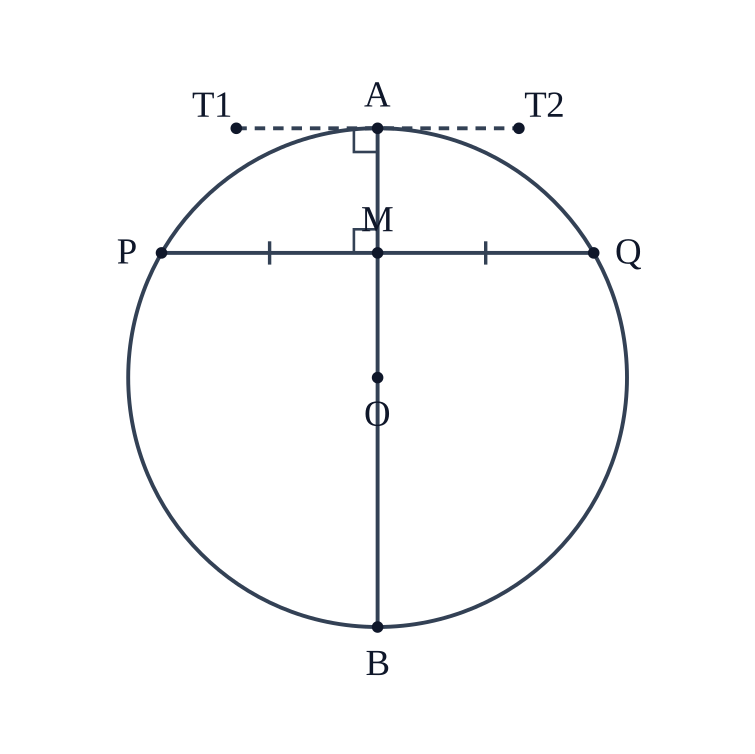 Let \(\displaystyle O\) be the centre; \(\displaystyle AB\) is a diameter and \(\displaystyle PQ\) a chord parallel to the tangent at \(\displaystyle A\).
\[\text{tangent at } A \perp OA \quad \text{(tangent} \perp \text{radius)} \]
\[PQ \parallel \text{tangent at } A \Rightarrow PQ \perp OA, \text{ i.e., } PQ \perp AB \]
Let \(\displaystyle AB\) meet \(\displaystyle PQ\) at \(\displaystyle M\).
\[OM \perp PQ, \quad O \text{ is the centre} \]
\[\Rightarrow M \text{ is the midpoint of } PQ \quad \text{(perpendicular from centre bisects a chord)} \]
Answer: \(\displaystyle AB\) bisects \(\displaystyle PQ\) (\(\displaystyle M\) is the midpoint of \(\displaystyle PQ\)).
Let \(\displaystyle O\) be the centre; \(\displaystyle AB\) is a diameter and \(\displaystyle PQ\) a chord parallel to the tangent at \(\displaystyle A\).
\[\text{tangent at } A \perp OA \quad \text{(tangent} \perp \text{radius)} \]
\[PQ \parallel \text{tangent at } A \Rightarrow PQ \perp OA, \text{ i.e., } PQ \perp AB \]
Let \(\displaystyle AB\) meet \(\displaystyle PQ\) at \(\displaystyle M\).
\[OM \perp PQ, \quad O \text{ is the centre} \]
\[\Rightarrow M \text{ is the midpoint of } PQ \quad \text{(perpendicular from centre bisects a chord)} \]
Answer: \(\displaystyle AB\) bisects \(\displaystyle PQ\) (\(\displaystyle M\) is the midpoint of \(\displaystyle PQ\)).