SolveIt is under development
SolveItNCERT · CBSE · NEET

NCERT Exemplar · Class 10 Mathematics Area Related to Circles

60 questions · 60 still being checked

EXERCISE 11.2 1–10 (part 2 of 7)

  1. Exercise 1

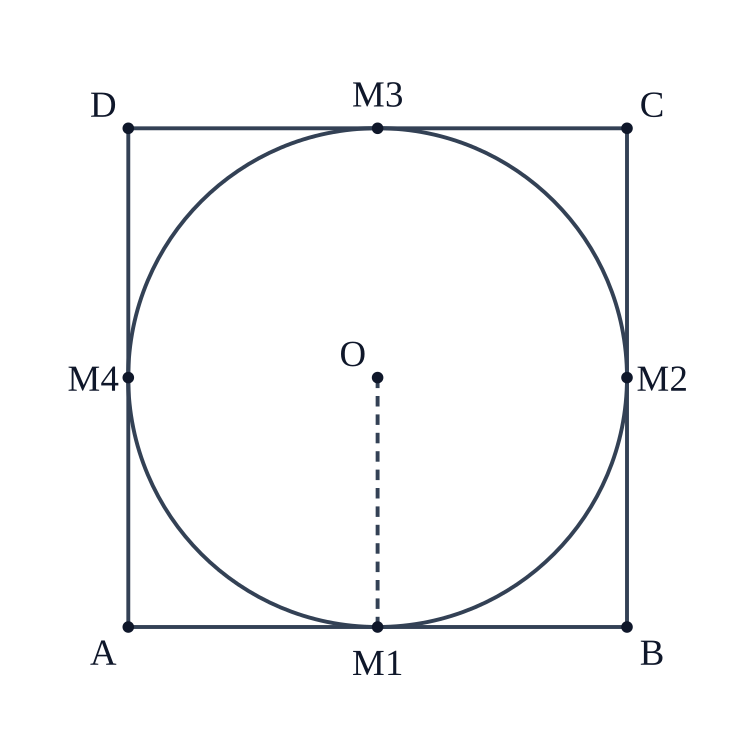
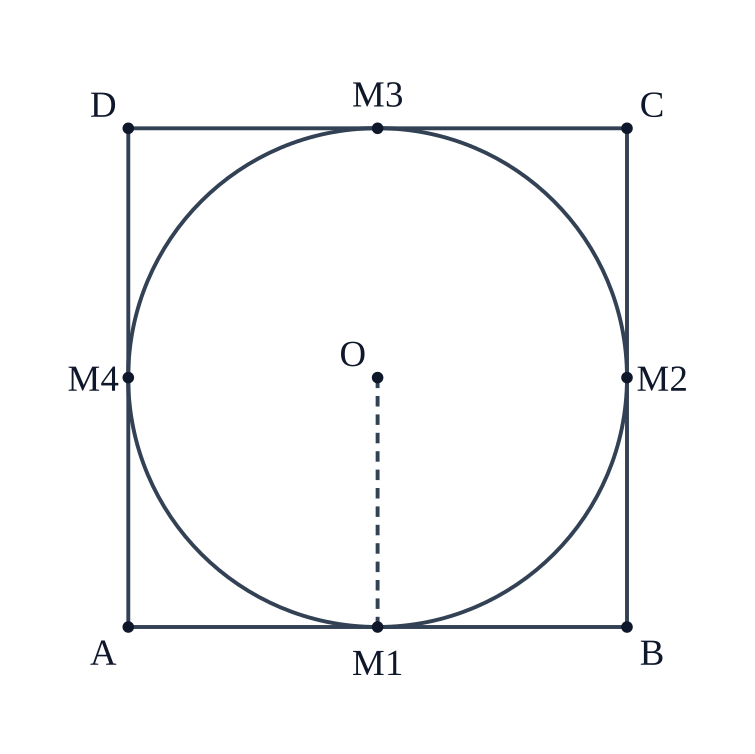
    Is the area of the circle inscribed in a square of side a cm,πa2 cm2\displaystyle a \mathrm{~cm}, \pi a^2 \mathrm{~cm}^2 ? Give reasons for your answer.

    Matches the book, not yet reviewed

    This working reaches the answer NCERT prints. It has not yet been read through by hand.

    NCERT’s answer
    No, radius of the circle is \(\displaystyle \frac{a}{2}\)
    FalseThe circle's diameter equals the square's side \(\displaystyle a\), so \[r = \frac{a}{2} \] \[\text{Area} = \pi r^2 = \pi\left(\frac{a}{2}\right)^2 = \frac{\pi a^2}{4} \] not \(\displaystyle \pi a^2\).NCERT_Solution_Class10_Maths_Exemplar_Ch11_Ex11-2_Q1
  2. Exercise 2

    Will it be true to say that the perimeter of a square circumscribing a circle of radius a\displaystyle a cm is 8a\displaystyle 8 a cm? Give reasons for your answer.

    Matches the book, not yet reviewed

    This working reaches the answer NCERT prints. It has not yet been read through by hand.

    NCERT’s answer
    Yes, side of the square is \(\displaystyle 2 a \mathrm{~cm}\)
    TrueThe square circumscribes the circle, so its side equals the diameter: \[\text{side} = 2a \] \[\text{Perimeter} = 4(2a) = 8a \]NCERT_Solution_Class10_Maths_Exemplar_Ch11_Ex11-2_Q2
  3. Exercise 3

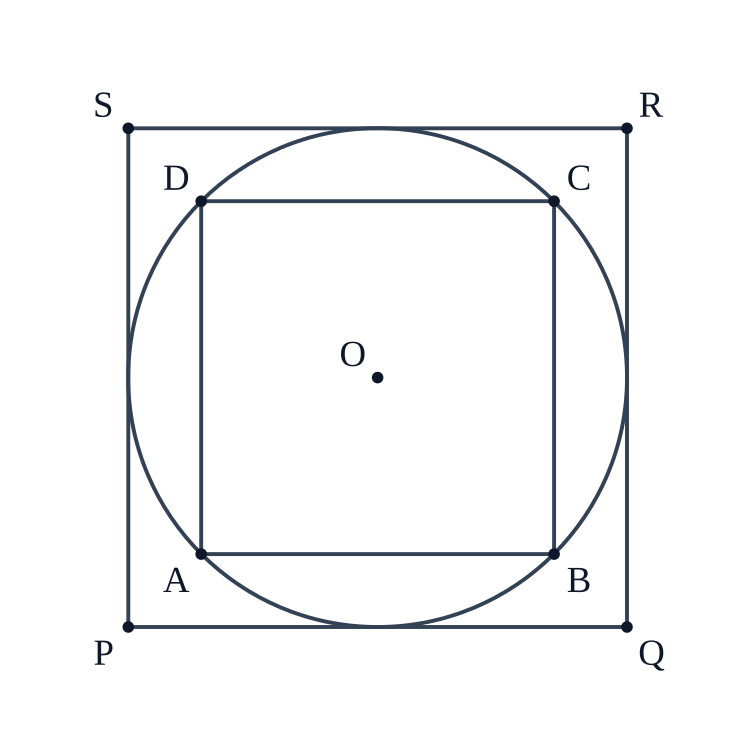
    In Fig 11.3\displaystyle 11.3, a square is inscribed in a circle of diameter d\displaystyle d and another square is circumscribing the circle. Is the area of the outer square four times the area of the inner square? Give reasons for your answer. NCERT_Question_Class10_Maths_Exemplar_Ch11_Ex11-2_Q3

    Matches the book, not yet reviewed

    This working reaches the answer NCERT prints. It has not yet been read through by hand.

    NCERT’s answer
    No, side of the outer square = diagonal of the inner square
    FalseThe outer square's side equals \(\displaystyle d\); the inner square's diagonal equals \(\displaystyle d\): \[\text{Area}_{\text{outer}} = d^2 \] \[\text{side}_{\text{inner}} = \frac{d}{\sqrt2} \implies \text{Area}_{\text{inner}} = \frac{d^2}{2} \] \[\frac{\text{Area}_{\text{outer}}}{\text{Area}_{\text{inner}}} = \frac{d^2}{d^2/2} = 2 \]NCERT_Solution_Class10_Maths_Exemplar_Ch11_Ex11-2_Q3
  4. Exercise 4

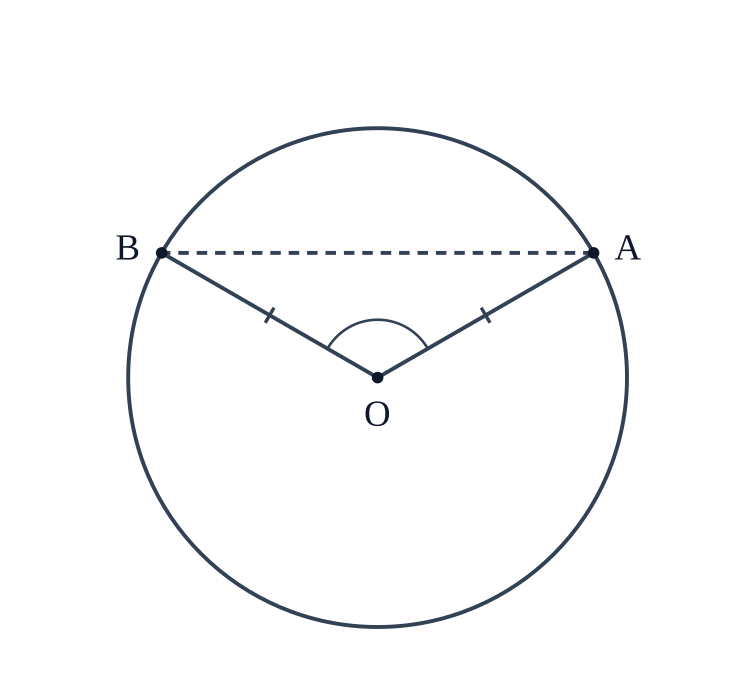
    Is it true to say that area of a segment of a circle is less than the area of its corresponding sector? Why?

    Matches the book, not yet reviewed

    This working reaches the answer NCERT prints. It has not yet been read through by hand.

    NCERT’s answer
    No, it is only true for minor segment.
    FalseIt holds only for a minor segment; a major segment is larger than its sector. \[\text{minor segment} = \text{minor sector} - \text{Area}(\triangle OAB) \] \[\text{major segment} = \text{major sector} + \text{Area}(\triangle OAB) \] \[\text{major segment} > \text{major sector} \]NCERT_Solution_Class10_Maths_Exemplar_Ch11_Ex11-2_Q4
  5. Exercise 5

    Is it true that the distance travelled by a circular wheel of diameter d\displaystyle d cm in one revolution is 2πd cm\displaystyle 2 \pi d \mathrm{~cm} ? Why?

    Matches the book, not yet reviewed

    This working reaches the answer NCERT prints. It has not yet been read through by hand.

    NCERT’s answer
    No, it is \(\displaystyle \pi d\).
    FalseThe circumference of a circle of diameter \(\displaystyle d\) is \[C = \pi d \] One revolution covers \(\displaystyle C\), i.e. \(\displaystyle \pi d\) cm, not \(\displaystyle 2\pi d\) cm.NCERT_Solution_Class10_Maths_Exemplar_Ch11_Ex11-2_Q5
  6. Exercise 6

    In covering a distance s\displaystyle s metres, a circular wheel of radius r\displaystyle r metres makes s2πr\displaystyle \frac{s}{2 \pi r} revolutions. Is this statement true? Why?

    Matches the book, not yet reviewed

    This working reaches the answer NCERT prints. It has not yet been read through by hand.

    NCERT’s answer
    Yes, distance covered in one revolution \(\displaystyle =2 \pi r\)
    TrueEach revolution covers the circumference \(\displaystyle 2\pi r\), so \[\text{Number of revolutions} = \frac{\text{distance}}{\text{circumference}} = \frac{s}{2\pi r} \]
  7. Exercise 7

    The numerical value of the area of a circle is greater than the numerical value of its circumference. Is this statement true? Why?

    Matches the book, not yet reviewed

    This working reaches the answer NCERT prints. It has not yet been read through by hand.

    NCERT’s answer
    No, it will depend on the value of radius.
    FalseEquate the numerical values: \[\pi r^2 > 2\pi r \iff r > 2 \] So the area exceeds the circumference only when \(\displaystyle r>2\); they are equal at \(\displaystyle r=2\), and the circumference is larger when \(\displaystyle r<2\).
  8. Exercise 8

    If the length of an arc of a circle of radius r\displaystyle r is equal to that of an arc of a circle of radius 2r\displaystyle 2 r, then the angle of the corresponding sector of the first circle is double the angle of the corresponding sector of the other circle. Is this statement false? Why?

    Check this one against your book

    NCERT’s printed answer for this exercise does not match its own question. This working follows the question as printed.

    True — the statement is not false.Arc length is \(\displaystyle l=\dfrac{\theta}{360^\circ}\times 2\pi r \). Take angle \(\displaystyle \theta_1\) in radius \(\displaystyle r\) and \(\displaystyle \theta_2\) in radius \(\displaystyle 2r\); equal arc lengths give \[\frac{\theta_1}{360^\circ}\cdot 2\pi r=\frac{\theta_2}{360^\circ}\cdot 2\pi(2r) \] \[\theta_1=2\theta_2 \] So the first sector's angle is double the other's, exactly as stated.
  9. Exercise 9

    The areas of two sectors of two different circles with equal corresponding arc lengths are equal. Is this statement true? Why?

    Matches the book, not yet reviewed

    This working reaches the answer NCERT prints. It has not yet been read through by hand.

    NCERT’s answer
    No, it will be true for the arcs of the same circle.
    False.Sector area is \(\displaystyle A=\tfrac12\,r\,l \), so for equal \(\displaystyle l\) with different radii \(\displaystyle r_1\neq r_2\): \[A_1=\frac12 r_1 l, \qquad A_2=\frac12 r_2 l \] \[A_1\neq A_2 \ \text{unless}\ r_1=r_2 \] Area depends on radius, not on arc length alone.
  10. Exercise 10

    The areas of two sectors of two different circles are equal. Is it necessary that their corresponding arc lengths are equal? Why?

    Matches the book, not yet reviewed

    This working reaches the answer NCERT prints. It has not yet been read through by hand.

    NCERT’s answer
    No, it will be true for arcs of the same circle.
    False.From \(\displaystyle A=\tfrac12 r l \), \(\displaystyle l=\dfrac{2A}{r} \). For equal \(\displaystyle A\) with \(\displaystyle r_1\neq r_2\): \[l_1=\frac{2A}{r_1},\qquad l_2=\frac{2A}{r_2} \] \[l_1\neq l_2 \] Equal areas need not give equal arc lengths.