SolveIt is under development
SolveItNCERT · CBSE · NEET

NCERT Exemplar · Class 10 Mathematics Area Related to Circles

60 questions · 60 still being checked

EXERCISE 11.1 1–10 (part 1 of 7)

  1. Choose the correct answer from the given four options:

    Exercise 1

    If the sum of the areas of two circles with radii R1\displaystyle R_1 and R2\displaystyle R_2 is equal to the area of a circle of radius R\displaystyle R, then
    (A)
    R1+R2=R\displaystyle \mathrm{R}_1+\mathrm{R}_2=\mathrm{R}
    (B)
    R12+R22=R2\displaystyle \mathrm{R}_1^2+\mathrm{R}_2^2=\mathrm{R}^2
    (C)
    R1+R2<R\displaystyle \mathrm{R}_1+\mathrm{R}_2<R
    (D)
    R12+R22<R2\displaystyle \mathrm{R}_1^2+\mathrm{R}_2^2<\mathrm{R}^2

    Matches the book, not yet reviewed

    This working reaches the answer NCERT prints. It has not yet been read through by hand.

    NCERT’s answer
    (B)
    (B) \(\displaystyle R_1^2+R_2^2=R^2\)\[\pi R_1^2 + \pi R_2^2 = \pi R^2 \] \[R_1^2+R_2^2=R^2 \]
  2. Exercise 2

    If the sum of the circumferences of two circles with radii R1\displaystyle R_1 and R2\displaystyle R_2 is equal to the circumference of a circle of radius R, then
    (A)
    R1+R2=R\displaystyle \mathrm{R}_1+\mathrm{R}_2=\mathrm{R}
    (B)
    R1+R2>R\displaystyle \mathrm{R}_1+\mathrm{R}_2>\mathrm{R}
    (C)
    R1+R2<R\displaystyle \mathrm{R}_1+\mathrm{R}_2<\mathrm{R}
    (D)
    Nothing definite can be said about the relation among R1,R2\displaystyle \mathrm{R}_1, \mathrm{R}_2 and R.

    Matches the book, not yet reviewed

    This working reaches the answer NCERT prints. It has not yet been read through by hand.

    NCERT’s answer
    (A)
    (A) \(\displaystyle R_1+R_2=R\)\[2\pi R_1 + 2\pi R_2 = 2\pi R \] \[R_1+R_2=R \]
  3. Exercise 3

    If the circumference of a circle and the perimeter of a square are equal, then
    (A)
    Area of the circle = Area of the square
    (B)
    Area of the circle > Area of the square
    (C)
    Area of the circle < Area of the square
    (D)
    Nothing definite can be said about the relation between the areas of the circle and square.

    Matches the book, not yet reviewed

    This working reaches the answer NCERT prints. It has not yet been read through by hand.

    NCERT’s answer
    (B)
    (B) Area of the circle > Area of the squareLet circle radius \(\displaystyle r\), square side \(\displaystyle a\). \[2\pi r = 4a \implies a=\frac{\pi r}{2} \] \[\text{Area of circle} = \pi r^2, \qquad \text{Area of square}=a^2=\frac{\pi^2 r^2}{4} \] \[\pi r^2 - \frac{\pi^2 r^2}{4} = \pi r^2\left(1-\frac{\pi}{4}\right) > 0 \quad \text{since } \pi<4 \]
  4. Exercise 4

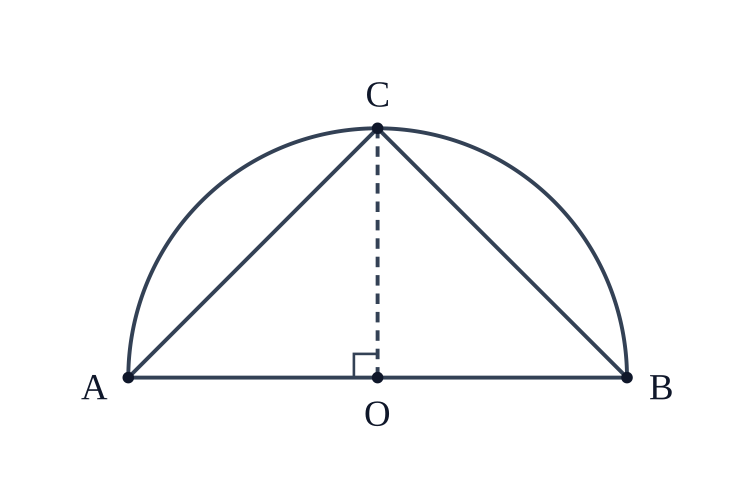
    Area of the largest triangle that can be inscribed in a semi-circle of radius r\displaystyle r units is
    (A)
    r2\displaystyle r^2 sq. units
    (B)
    12r2\displaystyle \frac{1}{2} r^2 sq. units
    (C)
    2r2\displaystyle 2 r^2 sq. units
    (D)
    2r2\displaystyle \sqrt{2} r^2 sq. units

    Matches the book, not yet reviewed

    This working reaches the answer NCERT prints. It has not yet been read through by hand.

    NCERT’s answer
    (A)
    (A) \(\displaystyle r^2\) sq. unitsNCERT_Solution_Class10_Maths_Exemplar_Ch11_Ex11-1_Q4\[AB = 2r \] \[\text{height of } C \text{ above } AB \le OC = r \] \[\text{Area} = \frac{1}{2}\times AB \times \text{height} \le \frac{1}{2}\times 2r\times r = r^2 \]Maximum when \(\displaystyle C\) is directly above \(\displaystyle O\).
  5. Exercise 5

    If the perimeter of a circle is equal to that of a square, then the ratio of their areas is
    (A)
    22:7\displaystyle 22: 7
    (B)
    14\displaystyle 14 : 11\displaystyle 11
    (C)
    7:22\displaystyle 7: 22
    (D)
    11\displaystyle 11: 14\displaystyle 14

    Matches the book, not yet reviewed

    This working reaches the answer NCERT prints. It has not yet been read through by hand.

    NCERT’s answer
    (B)
    (B) $\displaystyle 14$ : $\displaystyle 11$\[2\pi r = 4a \implies a=\frac{\pi r}{2} \] \[\frac{\text{Area of circle}}{\text{Area of square}} = \frac{\pi r^2}{a^2} = \frac{\pi r^2}{\dfrac{\pi^2 r^2}{4}} = \frac{4}{\pi} \] \[\frac{4}{\pi} = \frac{4}{22/7} = \frac{28}{22} = \frac{14}{11} \]
  6. Exercise 6

    It is proposed to build a single circular park equal in area to the sum of areas of two circular parks of diameters 16\displaystyle 16 m and 12\displaystyle 12 m in a locality. The radius of the new park would be
    (A)
    10\displaystyle 10 m
    (B)
    15\displaystyle 15 m
    (C)
    20\displaystyle 20 m
    (D)
    24\displaystyle 24 m

    Matches the book, not yet reviewed

    This working reaches the answer NCERT prints. It has not yet been read through by hand.

    NCERT’s answer
    (A)
    (A) \(\displaystyle 10\) m — the new park's area equals the sum of the two given areas. \[r_1 = 8 \text{ m}, \quad r_2 = 6 \text{ m} \] \[\pi R^2 = \pi r_1^2 + \pi r_2^2 \] \[R^2 = 8^2 + 6^2 = 64 + 36 = 100 \] \[R = 10 \text{ m} \]
  7. Exercise 7

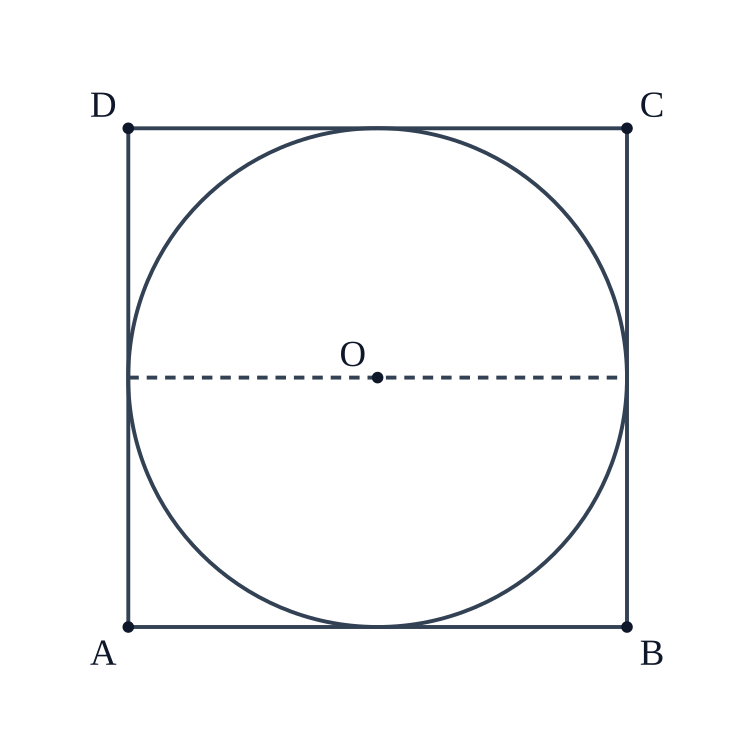
    The area of the circle that can be inscribed in a square of side 6\displaystyle 6 cm is
    (A)
    36π cm2\displaystyle 36 \pi \mathrm{~cm}^2
    (B)
    18π cm2\displaystyle 18 \pi \mathrm{~cm}^2
    (C)
    12π cm2\displaystyle 12 \pi \mathrm{~cm}^2
    (D)
    9π cm2\displaystyle 9 \pi \mathrm{~cm}^2

    Matches the book, not yet reviewed

    This working reaches the answer NCERT prints. It has not yet been read through by hand.

    NCERT’s answer
    (D)
    (D) \(\displaystyle 9\pi\ \text{cm}^2\) — the inscribed circle's diameter equals the square's side. NCERT_Solution_Class10_Maths_Exemplar_Ch11_Ex11-1_Q7 \[d = 6 \text{ cm} \Rightarrow r = 3 \text{ cm} \] \[A = \pi r^2 = \pi (3)^2 = 9\pi \text{ cm}^2 \]
  8. Exercise 8

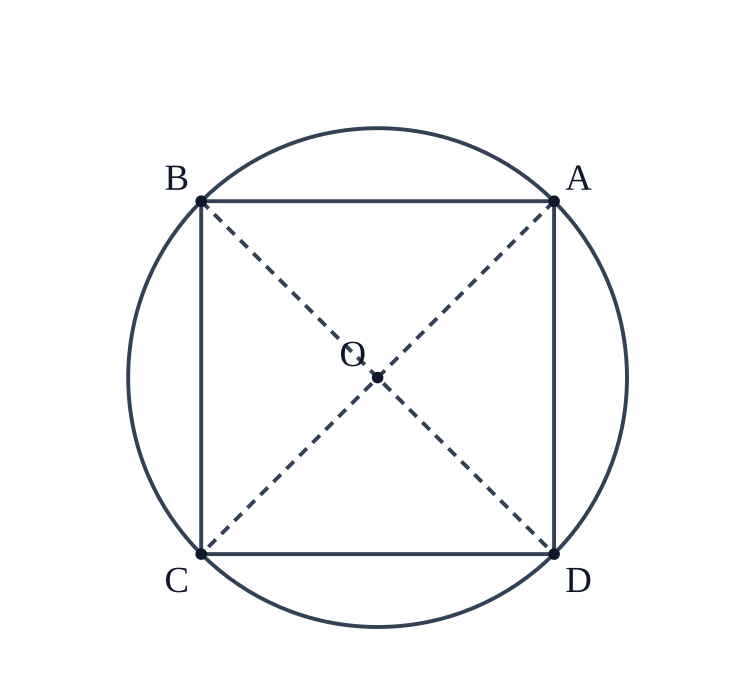
    The area of the square that can be inscribed in a circle of radius 8\displaystyle 8 cm is
    (A)
    256 cm2\displaystyle 256 \mathrm{~cm}^2
    (B)
    128 cm2\displaystyle 128 \mathrm{~cm}^2
    (C)
    642 cm2\displaystyle 64 \sqrt{2} \mathrm{~cm}^2
    (D)
    64 cm2\displaystyle 64 \mathrm{~cm}^2

    Matches the book, not yet reviewed

    This working reaches the answer NCERT prints. It has not yet been read through by hand.

    NCERT’s answer
    (B)
    (B) \(\displaystyle 128\ \text{cm}^2\) — the inscribed square's diagonal equals the circle's diameter. NCERT_Solution_Class10_Maths_Exemplar_Ch11_Ex11-1_Q8 \[d = 2r = 16 \text{ cm} \] \[A = \frac{d^2}{2} = \frac{16^2}{2} = \frac{256}{2} = 128 \text{ cm}^2 \]
  9. Exercise 9

    The radius of a circle whose circumference is equal to the sum of the circumferences of the two circles of diameters 36\displaystyle 36 cm and 20\displaystyle 20 cm is
    (A)
    56\displaystyle 56 cm
    (B)
    42\displaystyle 42 cm
    (C)
    28\displaystyle 28 cm
    (D)
    16\displaystyle 16 cm

    Matches the book, not yet reviewed

    This working reaches the answer NCERT prints. It has not yet been read through by hand.

    NCERT’s answer
    (C)
    (C) \(\displaystyle 28\) cm — the new circumference equals the sum of the two given circumferences. \[r_1 = 18 \text{ cm}, \quad r_2 = 10 \text{ cm} \] \[2\pi R = 2\pi r_1 + 2\pi r_2 \] \[R = r_1 + r_2 = 18 + 10 = 28 \text{ cm} \]
  10. Exercise 10

    The diameter of a circle whose area is equal to the sum of the areas of the two circles of radii 24\displaystyle 24 cm and 7\displaystyle 7 cm is
    (A)
    31\displaystyle 31 cm
    (B)
    25\displaystyle 25 cm
    (C)
    62\displaystyle 62 cm
    (D)
    50\displaystyle 50 cm

    Matches the book, not yet reviewed

    This working reaches the answer NCERT prints. It has not yet been read through by hand.

    NCERT’s answer
    (D)
    (D) \(\displaystyle 50\) cm — the new circle's area equals the sum of the two given areas. \[r_1 = 24 \text{ cm}, \quad r_2 = 7 \text{ cm} \] \[\pi R^2 = \pi r_1^2 + \pi r_2^2 \] \[R^2 = 24^2 + 7^2 = 576 + 49 = 625 \Rightarrow R = 25 \text{ cm} \] \[d = 2R = 50 \text{ cm} \]