SolveIt is under development
SolveItNCERT · CBSE · NEET

NCERT Exemplar · Class 10 Mathematics Area Related to Circles

60 questions · 60 still being checked

EXERCISE 11.4 11–20 (part 7 of 7)

  1. Exercise 11

    Floor of a room is of dimensions 5\displaystyle 5 m × 4\displaystyle 4 m and it is covered with circular tiles of diameters 50\displaystyle 50 cm each as shown in Fig. 11.18. Find the area of floor that remains uncovered with tiles. (Use π=3.14\displaystyle \pi=3.14) NCERT_Question_Class10_Maths_Exemplar_Ch11_Ex11-4_Q11

    Matches the book, not yet reviewed

    This working reaches the answer NCERT prints. It has not yet been read through by hand.

    NCERT’s answer
    \(\displaystyle 4.3 \mathrm{~m}^2\)
    \[\text{Tiles along 5 m} = \frac{5}{0.5}=10, \quad \text{along 4 m} = \frac{4}{0.5}=8 \quad \Rightarrow \quad \text{Number of tiles} = 80 \] \[\text{Area of floor} = 5\times 4 = 20 \text{ m}^2 \] \[\text{Area of one tile} = \pi r^2 = 3.14\times(0.25)^2 = 0.19625 \text{ m}^2 \] \[\text{Area covered} = 80\times 0.19625 = 15.7 \text{ m}^2 \] \[\text{Uncovered area} = 20-15.7 = 4.3 \text{ m}^2 \] Answer: \(\displaystyle 4.3 \text{ m}^2\)
  2. Exercise 12

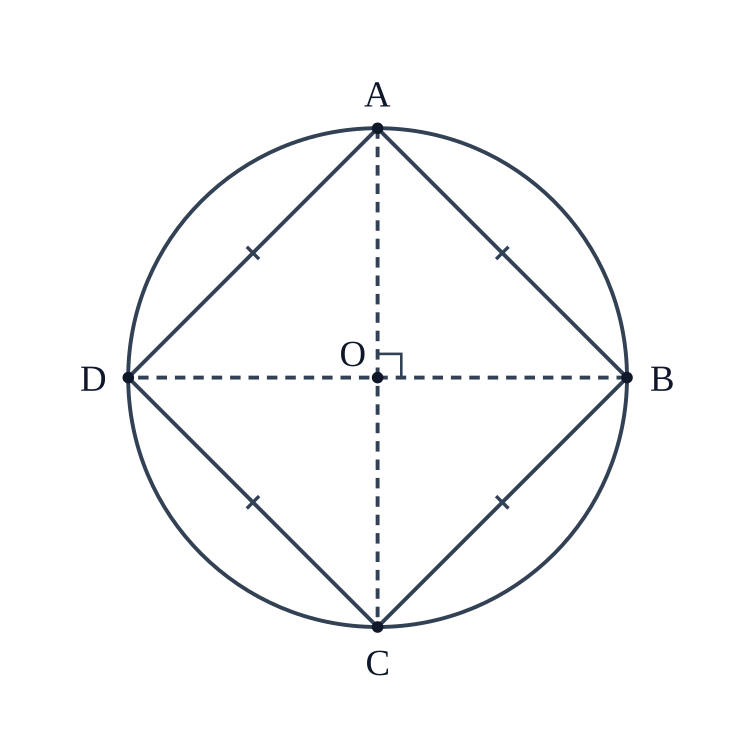
    All the vertices of a rhombus lie on a circle. Find the area of the rhombus, if area of the circle is 1256 cm2\displaystyle 1256 \mathrm{~cm}^2. (Use π=3.14\displaystyle \pi=3.14).

    Matches the book, not yet reviewed

    This working reaches the answer NCERT prints. It has not yet been read through by hand.

    NCERT’s answer
    \(\displaystyle 800 \mathrm{~cm}^2\)
    \[\angle A + \angle C = 180^\circ \quad \text{(opposite angles of cyclic quadrilateral } ABCD\text{)} \] \[\angle A = \angle C \quad \text{(opposite angles of a rhombus)} \] \[\angle A = 90^\circ \;\Rightarrow\; ABCD \text{ is a square} \] NCERT_Solution_Class10_Maths_Exemplar_Ch11_Ex11-4_Q12 \[\pi r^2 = 1256 \quad \Rightarrow \quad r^2 = \frac{1256}{3.14}=400 \quad \Rightarrow \quad r=20 \text{ cm} \] \[AC = BD = 2r = 40 \text{ cm} \quad \text{(diagonal is a diameter)} \] \[\text{Area of square} = \frac{1}{2} \times AC \times BD = \frac{1}{2}(40)(40)=800 \text{ cm}^2 \] Answer: \(\displaystyle 800 \text{ cm}^2\)
  3. Exercise 13

    An archery target has three regions formed by three concentric circles as shown in Fig. 11.19. If the diameters of the concentric circles are in the ratio 1:2:3\displaystyle 1: 2: 3, then find the ratio of the areas of three regions. NCERT_Question_Class10_Maths_Exemplar_Ch11_Ex11-4_Q13

    Matches the book, not yet reviewed

    This working reaches the answer NCERT prints. It has not yet been read through by hand.

    NCERT’s answer
    $\displaystyle 1$ : $\displaystyle 3$ : $\displaystyle 5$
    \[\text{Let the radii be } r, 2r, 3r \quad \text{(diameters in ratio } 1:2:3\text{)} \] \[A_1 = \pi r^2 \] \[A_2 = \pi(2r)^2-\pi r^2 = 3\pi r^2 \] \[A_3 = \pi(3r)^2-\pi(2r)^2 = 5\pi r^2 \] \[A_1:A_2:A_3 = 1:3:5 \] Answer: \(\displaystyle 1:3:5\)
  4. Exercise 14

    The length of the minute hand of a clock is 5\displaystyle 5 cm. Find the area swept by the minute hand during the time period 6\displaystyle 6 : 05\displaystyle 05 a m and 6\displaystyle 6 : 40\displaystyle 40 a m.

    Matches the book, not yet reviewed

    This working reaches the answer NCERT prints. It has not yet been read through by hand.

    NCERT’s answer
    \(\displaystyle 45 \frac{5}{6} \mathrm{~cm}^2\)
    \[\text{Time elapsed} = 6{:}40 - 6{:}05 = 35 \text{ min} \] \[\theta = 35\times 6^\circ = 210^\circ \quad \text{(minute hand turns } 6^\circ\text{/min)} \] \[\text{Area swept} = \frac{\theta}{360^\circ}\times \pi r^2 = \frac{210}{360}\times\frac{22}{7}\times 5^2 \] \[= \frac{7}{12}\times\frac{22}{7}\times 25 = \frac{275}{6} \text{ cm}^2 \] Answer: \(\displaystyle \dfrac{275}{6} \text{ cm}^2 \approx 45.83 \text{ cm}^2\)
  5. Exercise 15

    Area of a sector of central angle 200\displaystyle 200° of a circle is 770 cm2\displaystyle 770 \mathrm{~cm}^2. Find the length of the corresponding arc of this sector.

    Matches the book, not yet reviewed

    This working reaches the answer NCERT prints. It has not yet been read through by hand.

    NCERT’s answer
    \(\displaystyle 73 \frac{1}{3} \mathrm{~cm}\)
    \[\text{Area} = \frac{\theta}{360^\circ}\pi r^2 \] \[770 = \frac{200}{360}\times\frac{22}{7}\times r^2 \] \[r^2 = 441 \quad\Rightarrow\quad r = 21\text{ cm} \] \[\text{Arc length} = \frac{\theta}{360^\circ}\times 2\pi r = \frac{200}{360}\times 2\times\frac{22}{7}\times 21 \] \[= \frac{220}{3}\text{ cm} \] Answer: \(\displaystyle \dfrac{220}{3}\text{ cm} \approx 73.3\text{ cm} \)
  6. Exercise 16

    The central angles of two sectors of circles of radii 7\displaystyle 7 cm and 21\displaystyle 21 cm are respectively 120\displaystyle 120° and 40\displaystyle 40°. Find the areas of the two sectors as well as the lengths of the corresponding arcs. What do you observe?

    Matches the book, not yet reviewed

    This working reaches the answer NCERT prints. It has not yet been read through by hand.

    NCERT’s answer
    Areas: \(\displaystyle \frac{154}{3} \mathrm{~cm}^2, 154 \mathrm{~cm}^2\); Arc lengths: \(\displaystyle \frac{44}{3} \mathrm{~cm}\); Arc lengths of two sectors of two different circles may be equal, but their area need not be equal.
    \[\text{Area}_1=\frac{120}{360}\pi(7)^2=\frac{1}{3}\times\frac{22}{7}\times49=\frac{154}{3}\text{ cm}^2 \] \[\text{Arc}_1=\frac{120}{360}\times2\pi(7)=\frac{44}{3}\text{ cm} \] \[\text{Area}_2=\frac{40}{360}\pi(21)^2=\frac{1}{9}\times\frac{22}{7}\times441=154\text{ cm}^2 \] \[\text{Arc}_2=\frac{40}{360}\times2\pi(21)=\frac{44}{3}\text{ cm} \] The two arcs are equal, \(\displaystyle \tfrac{44}{3}\text{ cm} \) each, though the sector areas differ. Answer: Area\(\displaystyle _1=\dfrac{154}{3}\text{ cm}^2\approx51.3\text{ cm}^2\), Area\(\displaystyle _2=154\text{ cm}^2\); both arcs \(\displaystyle =\dfrac{44}{3}\text{ cm}\approx14.7\text{ cm}\)
  7. Exercise 17

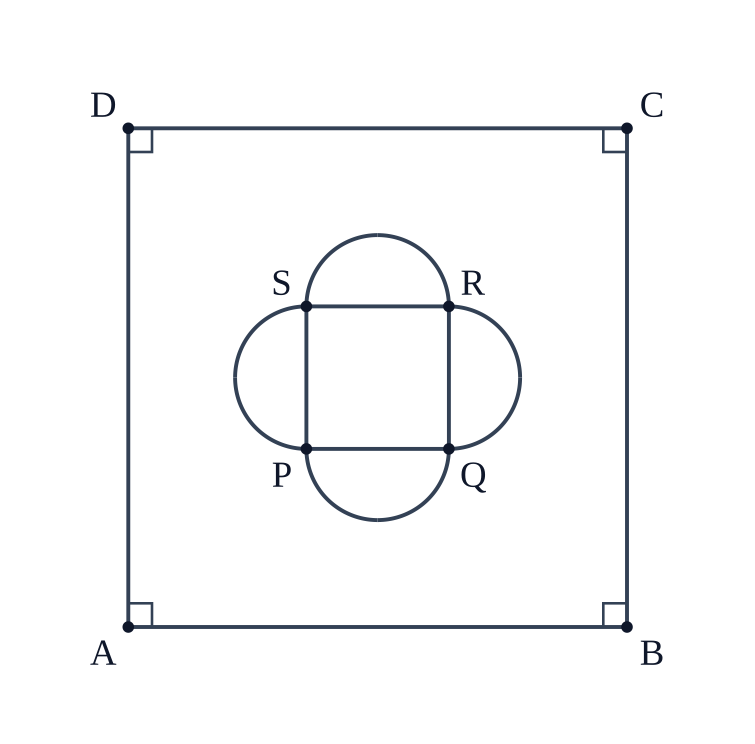
    Find the area of the shaded region given in Fig. 11.20. NCERT_Question_Class10_Maths_Exemplar_Ch11_Ex11-4_Q17

    Matches the book, not yet reviewed

    This working reaches the answer NCERT prints. It has not yet been read through by hand.

    NCERT’s answer
    \(\displaystyle (180-8 \pi) \mathrm{~cm}^2\)
    NCERT_Solution_Class10_Maths_Exemplar_Ch11_Ex11-4_Q17 Each semicircle has diameter \(\displaystyle s\), the side of \(\displaystyle PQRS\), so \(\displaystyle r=\tfrac{s}{2}\) and its tip is \(\displaystyle \tfrac{s}{2}+r\) from the centre. \[\frac{s}{2}+r=s=\frac{14}{2}-3=4\text{ cm} \] \[r=\frac{s}{2}=2\text{ cm} \] \[\text{Design}=s^2+4\left(\tfrac12\pi r^2\right)=16+8\pi \] \[\text{Shaded}=14^2-(16+8\pi)=180-8\pi \] \[=180-\frac{176}{7}=\frac{1084}{7}\text{ cm}^2 \] Answer: \(\displaystyle (180-8\pi)\text{ cm}^2=\dfrac{1084}{7}\text{ cm}^2\approx154.9\text{ cm}^2 \)
  8. Exercise 18

    Find the number of revolutions made by a circular wheel of area 1.54 m2\displaystyle 1.54 \mathrm{~m}^2 in rolling a distance of 176\displaystyle 176 m.

    Matches the book, not yet reviewed

    This working reaches the answer NCERT prints. It has not yet been read through by hand.

    NCERT’s answer
    $\displaystyle 40$
    \[\text{Area}=\pi r^2=1.54\text{ m}^2 \] \[r^2=1.54\times\frac{7}{22}=0.49 \quad\Rightarrow\quad r=0.7\text{ m} \] \[\text{Circumference}=2\pi r=2\times\frac{22}{7}\times0.7=4.4\text{ m} \] \[\text{Revolutions}=\frac{176}{4.4}=40 \] Answer: $\displaystyle 40$ revolutions
  9. Exercise 19

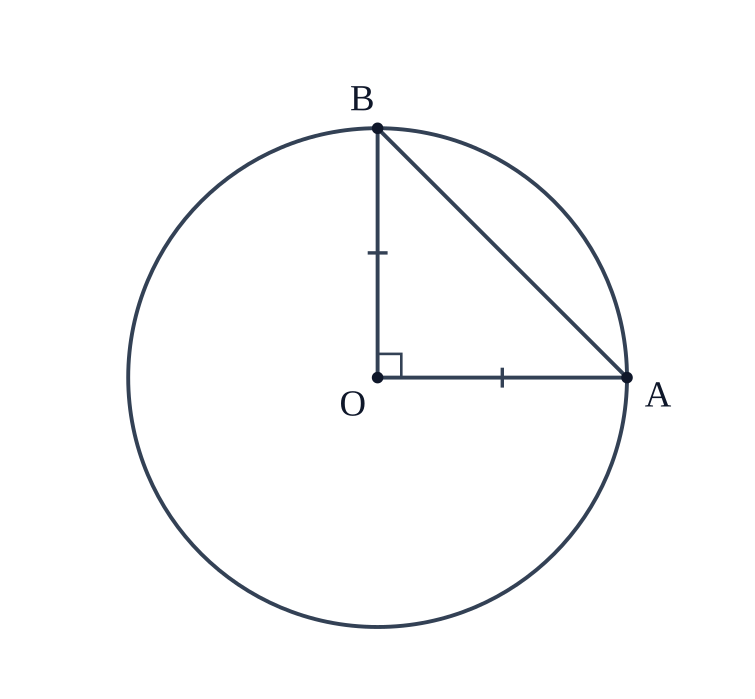
    Find the difference of the areas of two segments of a circle formed by a chord of length 5\displaystyle 5 cm subtending an angle of 90\displaystyle 90° at the centre.

    Matches the book, not yet reviewed

    This working reaches the answer NCERT prints. It has not yet been read through by hand.

    NCERT’s answer
    \(\displaystyle \left(\frac{25 \pi}{4}+\frac{25}{2}\right) \mathrm{~cm}^2\)
    NCERT_Solution_Class10_Maths_Exemplar_Ch11_Ex11-4_Q19 \[AB^2=OA^2+OB^2=2r^2 \quad(\angle AOB=90^\circ) \] \[25=2r^2 \quad\Rightarrow\quad r^2=\frac{25}{2} \] \[\text{Minor segment}=\tfrac14\pi r^2-\tfrac12 r^2=\frac{25\pi}{8}-\frac{25}{4} \] \[\text{Difference}=(\pi r^2-\text{minor})-\text{minor}=\pi r^2-2(\text{minor}) \] \[=\frac{25\pi}{2}-\frac{25\pi}{4}+\frac{25}{2}=\frac{25\pi}{4}+\frac{25}{2} \] \[=\frac{25}{4}\times\frac{22}{7}+\frac{25}{2}=\frac{225}{7}\text{ cm}^2 \] Answer: \(\displaystyle \left(\dfrac{25\pi}{4}+\dfrac{25}{2}\right)\text{ cm}^2=\dfrac{225}{7}\text{ cm}^2\approx32.1\text{ cm}^2 \)
  10. Exercise 20

    Find the difference of the areas of a sector of angle 120\displaystyle 120° and its corresponding major sector of a circle of radius 21\displaystyle 21 cm.

    Matches the book, not yet reviewed

    This working reaches the answer NCERT prints. It has not yet been read through by hand.

    NCERT’s answer
    \(\displaystyle 462 \mathrm{~cm}^2\)
    \[\text{Circle area}=\pi r^2=\frac{22}{7}\times21^2=1386\text{ cm}^2 \] \[\text{Minor sector}(120^\circ)=\frac{120}{360}\times1386=462\text{ cm}^2 \] \[\text{Major sector}(240^\circ)=1386-462=924\text{ cm}^2 \] \[\text{Difference}=924-462=462\text{ cm}^2 \] Answer: $\displaystyle 462$ cm\(\displaystyle ^2\)