✓ Board-verified
Physics · 2025 · 5 marks
CBSE 2025 · Region 5 · Set 1 · Q31
(a) (i) Three batteries E_1, E_2 and E_3 of emfs and internal resistances ( 4 V, 2 Ω ), ( 2 V, 4 Ω ) and ( 6 V, 2 Ω ) respectively are connected as…
(i)
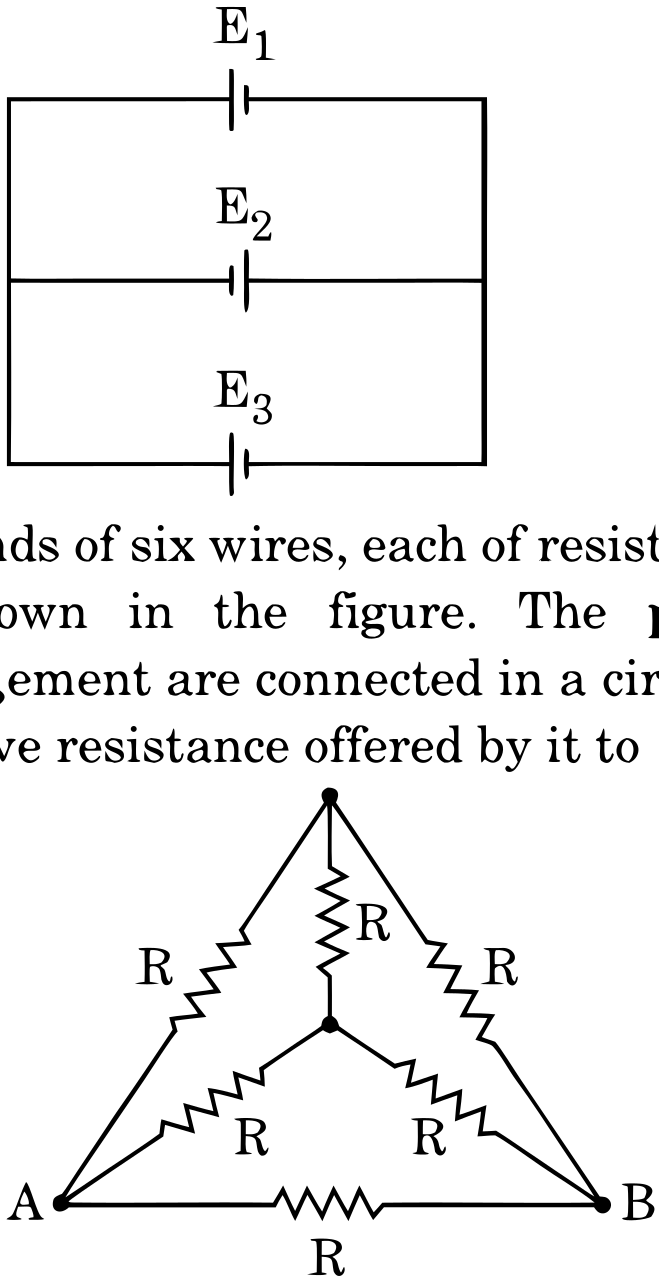
Three batteries $\displaystyle \mathrm{E}_{1}, \mathrm{E}_{2}$ and $\displaystyle \mathrm{E}_{3}$ of emfs and internal resistances ( $\displaystyle 4 \mathrm{~V}, 2 \Omega$ ), ( $\displaystyle 2 \mathrm{~V}, 4 \Omega$ ) and ( $\displaystyle 6 \mathrm{~V}, 2 \Omega$ ) respectively are connected as shown in the figure. Find the values of the currents passing through batteries $\displaystyle \mathrm{E}_{1}, \mathrm{E}_{2}$ and $\displaystyle \mathrm{E}_{3}$.
(ii)
The ends of six wires, each of resistance $\displaystyle \mathrm{R}(=10 \Omega)$ are joined as shown in the figure. The points A and B of the arrangement are connected in a circuit. Find the value of the effective resistance offered by it to the circuit.
(i)
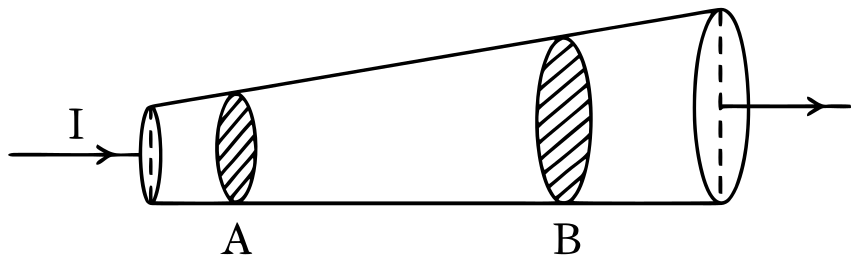
Current I ( $\displaystyle =1 \mathrm{~A}$ ) is passing through a copper rod ( $\displaystyle \mathrm{n}=8.5 \times 10^{28} \mathrm{~m}^{-3}$ ) of varying cross-sections as shown in the figure. The areas of cross-section at points A and B along its length are $\displaystyle 1 \cdot 0 \times 10^{-7} \mathrm{~m}^{2}$ and $\displaystyle 2 \cdot 0 \times 10^{-7} \mathrm{~m}^{2}$ respectively. Calculate :
(I)
the ratio of electric fields at points A and B .
(II)
the drift velocity of free electrons at point B .
(ii)
Two point charges $\displaystyle \mathrm{q}_{1}(=16 \mu \mathrm{C})$ and $\displaystyle \mathrm{q}_{2}(=1 \mu \mathrm{C})$ are placed at points $\displaystyle \overrightarrow{r_{1}}=(3 \mathrm{~m}) \hat{\mathrm{i}}$ and $\displaystyle \overrightarrow{r_{2}}=(4 \mathrm{~m}) \hat{\mathrm{j}}$. Find the net electric field $\displaystyle \vec{\mathrm{E}}$ at point $\displaystyle \vec{r}=(3 m) \hat{\mathrm{i}}+(4 m) \hat{\mathrm{j}}$.
Marking-scheme solution
(i)
In closed loop ABCD, using Kirchhoff's loop law:
$\displaystyle 4 I_{1}+6 I_{2}=6$ …………………………..($\displaystyle 1$)
Similarly in closed loop CDFE:
$\displaystyle 6 I_{1}+4 I_{2}=8$ …………………………..($\displaystyle 2$)
Solving eqn. ($\displaystyle 1$) and ($\displaystyle 2$):
$\displaystyle I_{2}=\frac{1}{5} \mathrm{~A}$
$\displaystyle I_{1}=\frac{6}{5} \mathrm{~A}$
$\displaystyle I_{1}+I_{2}=\frac{7}{5} \mathrm{~A}$
(ii)
Resistances $\displaystyle R_{AC}$, $\displaystyle R_{CB}$, $\displaystyle R_{AD}$ and $\displaystyle R_{DB}$ form a balanced Wheatstone bridge.
Hence current through $\displaystyle R_{CD}$ is zero and will not contribute to the equivalent resistance.
Series combinations of $\displaystyle R_{AC}$ & $\displaystyle R_{CB}$ and $\displaystyle R_{AD}$ & $\displaystyle R_{DB}$ are in parallel with $\displaystyle R_{AB}$:
$\displaystyle \frac{1}{R_{e q}}=\frac{1}{R}+\frac{1}{R}$
$\displaystyle R_{e q}=\frac{R}{2}$
Given $\displaystyle R=10 \Omega$, therefore $\displaystyle R_{e q}=5 \Omega$
(i)
(I)
$\displaystyle j=\sigma E$
$\displaystyle \frac{j_{A}}{j_{B}}=\frac{E_{A}}{E_{B}}$
$\displaystyle =\frac{I / A_{A}}{I / A_{B}}=\frac{A_{B}}{A_{A}}$
$\displaystyle =\frac{2}{1}$
(II)
$\displaystyle v_{d}=\frac{I}{n e A}$
$\displaystyle =\frac{1}{8.5 \times 10^{28} \times 1.6 \times 10^{-19} \times 2 \times 10^{-7}}$
$\displaystyle =3.6 \times 10^{-4} \mathrm{~m} / \mathrm{s}$
(ii)
$\displaystyle \vec{E}=\frac{K q}{r^{2}} \hat{r}$
$\displaystyle E_{1}=\frac{9 \times 10^{9} \times 16 \times 10^{-6}}{(4)^{2}} \hat{j}$
$\displaystyle =9 \times 10^{3} \hat{j}$
$\displaystyle E_{2}=\frac{9 \times 10^{9} \times 1 \times 10^{-6}}{(3)^{2}} \hat{i}$
$\displaystyle =10^{3} \hat{i}$
$\displaystyle \vec{E}_{n e t}=(\hat{i}+9 \hat{j}) 10^{3} \mathrm{~N} / \mathrm{C}$
All Current Electricity questions2025 question paperNCERT solutions: Current ElectricityPractice Current Electricity →
More from Current Electricity
- A steady current flows through a metallic wire whose area of cross-section increases continuously from one end of the wire to the other. The…2023
- (i) Define mobility of electrons. Give its SI units. (ii) A steady current flows through a wire AB, as shown in the figure. What happens to the…2023
- What is the order of magnitude of drift velocity of electrons in a conductor? Deduce the relation between the current flowing through a conductor and…2026
- 'Current is a scalar quantity, although we represent current with an arrow.' Explain. Derive the balance condition of a Wheatstone Bridge.2026
- The number of electrons flowing through a conductor per second is 3 · 3 × 10^19. The current flowing through the conductor is:2023
- A student sets up the circuit as shown in the figure to find the value of unknown resistance X and records a set of readings of the voltmeter and the…2026
- Define current density and relaxation time. Derive an expression for resistivity of a conductor in terms of number density of charge carriers in the…2023
- A battery of e. m. f. 12 V and internal resistance 0.5 Ω is connected to a 9.5 Ω resistor through a key. The ratio of potential difference between…2025
CBSE Class 12 Physics past-paper question from the 2025 board exam, with the answer as CBSE’s own marking scheme gives it. Where our answers come from.