✓ Board-verified
Physics · 2026 · 4 marks
CBSE 2026 · Region 4 · Set 2 · Q30
A student sets up the circuit as shown in the figure to find the value of unknown resistance X and records a set of readings of the voltmeter and the…
A student sets up the circuit as shown in the figure to find the value of unknown resistance X and records a set of readings of the voltmeter and the ammeter by using the rheostat.
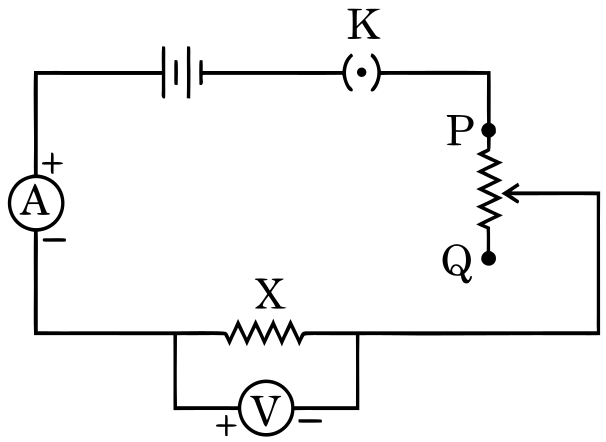
(i)
If resistor X were made of manganin and readings for V and I are taken without switching off the circuit, the graph between V and I will be as :
(A)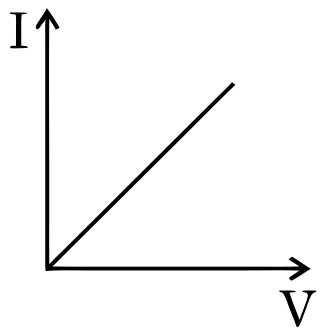
(B)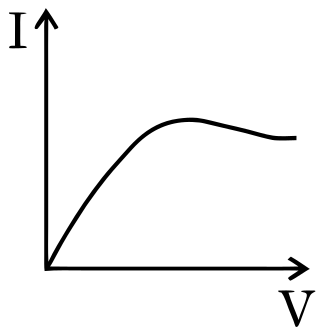
(C)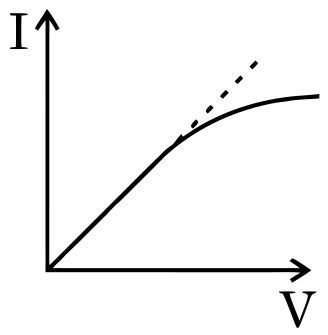
(D)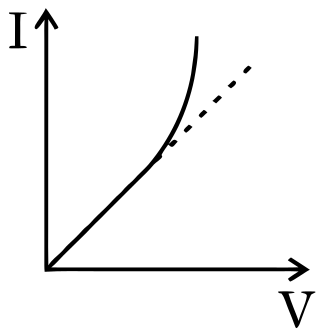
(ii)
Error in the value of X obtained from different sets of voltmeter and ammeter readings, is :
(A)
due to error in voltmeter reading only.
(B)
due to error in ammeter reading only.
(C)
equal to the sum of error in voltmeter reading and error in ammeter reading.
(D)
equal to error in voltmeter reading divided by the error in ammeter reading.
(iii)
If the movable end of rheostat is moved towards P, then :
(A)
reading in ammeter decreases and reading in voltmeter increases.
(B)
readings in both voltmeter and ammeter increase.
(C)
reading in ammeter increases and reading in voltmeter decreases.
(D)
readings in both voltmeter and ammeter decrease.
(iv)(a)
Suppose the unknown resistance X is replaced by a wire made of the same metal. This wire consists of three parts, of the same length L but has radii r, r/$\displaystyle 3$ and r/$\displaystyle 2$ as shown in the figure.
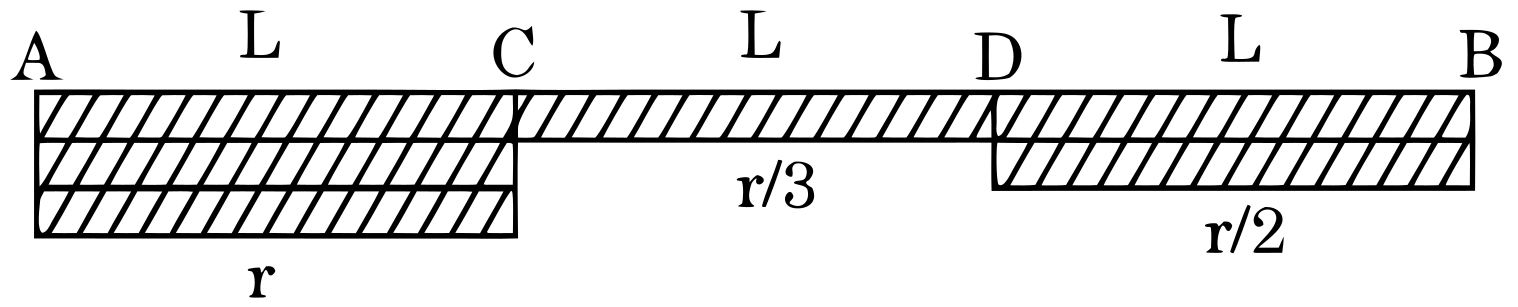
For a particular setting of the rheostat, let $\displaystyle \mathrm{v}_{1}, \mathrm{v}_{2}$ and $\displaystyle \mathrm{v}_{3}$ be the value of drift velocities in parts AC, CD and DB. Then :
(A)
$\displaystyle \mathrm{v}_{1}>\mathrm{v}_{2}>\mathrm{v}_{3}$
(B)
$\displaystyle \mathrm{v}_{2}>\mathrm{v}_{3}>\mathrm{v}_{1}$
(C)
$\displaystyle \mathrm{v}_{3}>\mathrm{v}_{2}>\mathrm{v}_{1}$
(D)
$\displaystyle \mathrm{v}_{1}=\mathrm{v}_{2}=\mathrm{v}_{3}$
Consider the same wire, as shown in figure in question
(iv)(a)
connected in place of X. For a particular setting of rheostat, let $\displaystyle \mathrm{E}_{1}, \mathrm{E}_{2}$ and $\displaystyle \mathrm{E}_{3}$ be the value of electric fields in part AC, CD and DB. Then :
(A)
$\displaystyle \mathrm{E}_{1}=\mathrm{E}_{2}=\mathrm{E}_{3}$
(B)
$\displaystyle \mathrm{E}_{3}>\mathrm{E}_{2}>\mathrm{E}_{1}$
(C)
$\displaystyle \mathrm{E}_{2}>\mathrm{E}_{3}>\mathrm{E}_{1}$
(D)
$\displaystyle \mathrm{E}_{1}>\mathrm{E}_{2}>\mathrm{E}_{3}$
Marking-scheme solution
(i)(C)
(ii)(C)
equal to the sum of the error in the voltmeter reading and the error in the ammeter reading.
(iii)(B)
readings in both voltmeter and ammeter increase.
(iv)(B)
$\displaystyle \mathrm{v}_{2}>\mathrm{v}_{3}>\mathrm{v}_{1}$ OR (C) $\displaystyle \mathrm{E}_{2}>\mathrm{E}_{3}>\mathrm{E}_{1}$
All Current Electricity questions2026 question paperNCERT solutions: Current ElectricityPractice Current Electricity →
More from Current Electricity
- A steady current flows through a metallic wire whose area of cross-section increases continuously from one end of the wire to the other. The…2023
- (i) Define mobility of electrons. Give its SI units. (ii) A steady current flows through a wire AB, as shown in the figure. What happens to the…2023
- What is the order of magnitude of drift velocity of electrons in a conductor? Deduce the relation between the current flowing through a conductor and…2026
- 'Current is a scalar quantity, although we represent current with an arrow.' Explain. Derive the balance condition of a Wheatstone Bridge.2026
- The number of electrons flowing through a conductor per second is 3 · 3 × 10^19. The current flowing through the conductor is:2023
- Define current density and relaxation time. Derive an expression for resistivity of a conductor in terms of number density of charge carriers in the…2023
- A battery of e. m. f. 12 V and internal resistance 0.5 Ω is connected to a 9.5 Ω resistor through a key. The ratio of potential difference between…2025
- The emf and internal resistance of a cell are E and r respectively. It is connected across an external resistance R=2 r. The potential drop across…2023
CBSE Class 12 Physics past-paper question from the 2026 board exam, with the answer as CBSE’s own marking scheme gives it. Where our answers come from.