✓ Board-verified
Physics · 2026 · 5 marks
CBSE 2026 · Region 5 · Set 1 · Q31
(a) (i) Derive the condition for which a Wheatstone Bridge is balanced. (ii) Determine the current in 3 Ω branch of a Wheatstone Bridge in the…
(i)
Derive the condition for which a Wheatstone Bridge is balanced.
(ii)
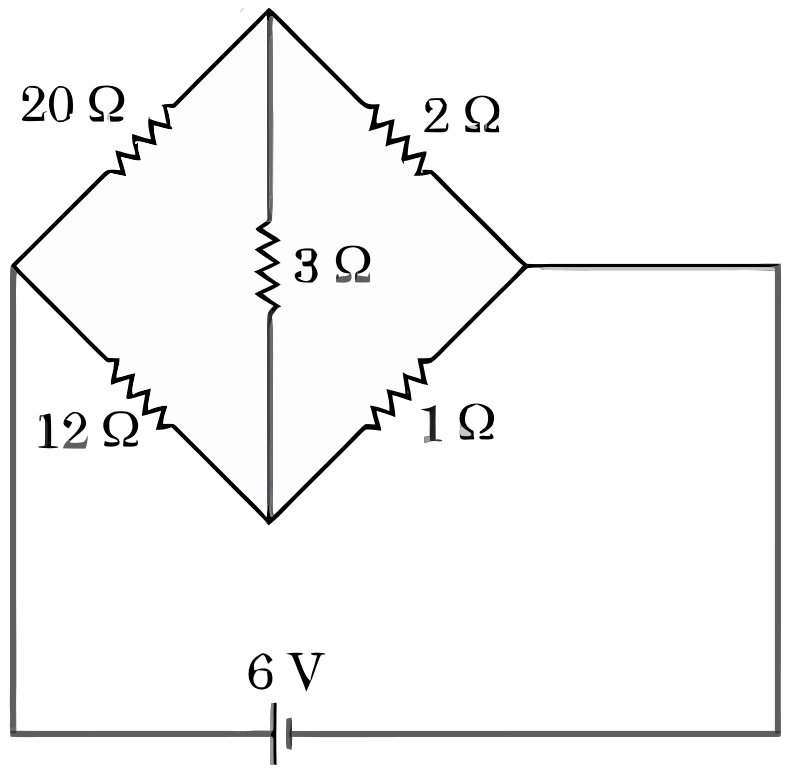
Determine the current in $\displaystyle 3 \Omega$ branch of a Wheatstone Bridge in the circuit shown in the figure.
(i)
Consider a cylindrical conductor of length $\displaystyle l$ and area of cross-section A. Current I is maintained in the conductor and electrons drift with velocity $\displaystyle \mathrm{v}_{\mathrm{d}}\left(\left|\overrightarrow{\mathrm{v}}_{\mathrm{d}}\right|=\frac{\mathrm{e}|\overrightarrow{\mathrm{E}}|}{\mathrm{m}} \tau\right)$, (where symbols have their usual meanings). Show that the conductivity $\displaystyle \sigma$ of the material of the conductor is given by $\displaystyle \sigma=\frac{\mathrm{ne}^{2}}{\mathrm{~m}} \tau$.
(ii)
The resistance of a metal wire at $\displaystyle 20^{\circ} \mathrm{C}$ is $\displaystyle 1.05 \Omega$ and at $\displaystyle 100^{\circ} \mathrm{C}$ is $\displaystyle 1.38 \Omega$. Determine the temperature coefficient of resistivity of this metal.
Marking-scheme solution
a.(i)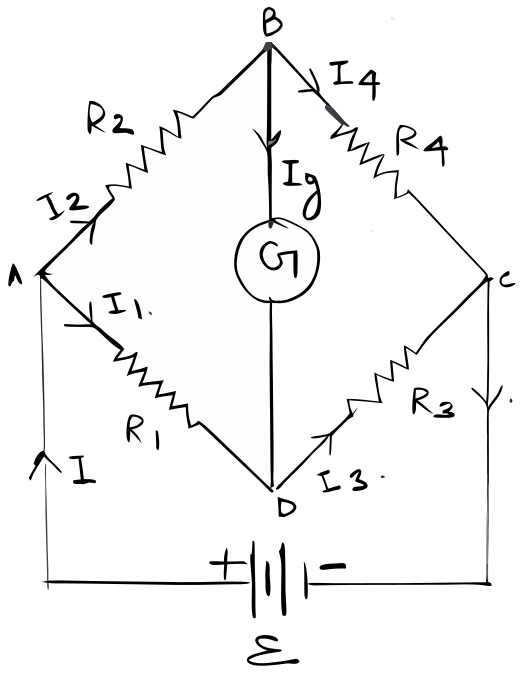 Applying Kirchoff's rule to closed loop ADBA. For balanced condition $\displaystyle \mathrm{Ig}=0$.
\[-\mathrm{I}_{1} \mathrm{R}_{1}+0+\mathrm{I}_{2} \mathrm{R}_{2}=0
\]
Applying Kirchoff's rule to closed loop CBDC using $\displaystyle \mathrm{I}_{3}=\mathrm{I}_{1}, \mathrm{I}_{4}=\mathrm{I}_{2}$
\[\mathrm{I}_{2} \mathrm{R}_{4}+0-\mathrm{I}_{1} \mathrm{R}_{3}=0 .
\]
From eq.(i).
\[\frac{\mathrm{I}_{1}}{\mathrm{I}_{2}}=\frac{\mathrm{R}_{2}}{\mathrm{R}_{1}}
\]
and from eq.(ii)
\[\frac{\mathrm{I}_{1}}{\mathrm{I}_{2}}=\frac{\mathrm{R}_{4}}{\mathrm{R}_{3}}
\]
hence $\displaystyle \frac{\mathrm{R}_{2}}{\mathrm{R}_{1}}=\frac{\mathrm{R}_{4}}{\mathrm{R}_{3}}$
Applying Kirchoff's rule to closed loop ADBA. For balanced condition $\displaystyle \mathrm{Ig}=0$.
\[-\mathrm{I}_{1} \mathrm{R}_{1}+0+\mathrm{I}_{2} \mathrm{R}_{2}=0
\]
Applying Kirchoff's rule to closed loop CBDC using $\displaystyle \mathrm{I}_{3}=\mathrm{I}_{1}, \mathrm{I}_{4}=\mathrm{I}_{2}$
\[\mathrm{I}_{2} \mathrm{R}_{4}+0-\mathrm{I}_{1} \mathrm{R}_{3}=0 .
\]
From eq.(i).
\[\frac{\mathrm{I}_{1}}{\mathrm{I}_{2}}=\frac{\mathrm{R}_{2}}{\mathrm{R}_{1}}
\]
and from eq.(ii)
\[\frac{\mathrm{I}_{1}}{\mathrm{I}_{2}}=\frac{\mathrm{R}_{4}}{\mathrm{R}_{3}}
\]
hence $\displaystyle \frac{\mathrm{R}_{2}}{\mathrm{R}_{1}}=\frac{\mathrm{R}_{4}}{\mathrm{R}_{3}}$
Applying Kirchoff's rule to closed loop ADBA. For balanced condition $\displaystyle \mathrm{Ig}=0$.
\[-\mathrm{I}_{1} \mathrm{R}_{1}+0+\mathrm{I}_{2} \mathrm{R}_{2}=0
\]
Applying Kirchoff's rule to closed loop CBDC using $\displaystyle \mathrm{I}_{3}=\mathrm{I}_{1}, \mathrm{I}_{4}=\mathrm{I}_{2}$
\[\mathrm{I}_{2} \mathrm{R}_{4}+0-\mathrm{I}_{1} \mathrm{R}_{3}=0 .
\]
From eq.(i).
\[\frac{\mathrm{I}_{1}}{\mathrm{I}_{2}}=\frac{\mathrm{R}_{2}}{\mathrm{R}_{1}}
\]
and from eq.(ii)
\[\frac{\mathrm{I}_{1}}{\mathrm{I}_{2}}=\frac{\mathrm{R}_{4}}{\mathrm{R}_{3}}
\]
hence $\displaystyle \frac{\mathrm{R}_{2}}{\mathrm{R}_{1}}=\frac{\mathrm{R}_{4}}{\mathrm{R}_{3}}$All Current Electricity questions2026 question paperNCERT solutions: Current ElectricityPractice Current Electricity →
More from Current Electricity
- A steady current flows through a metallic wire whose area of cross-section increases continuously from one end of the wire to the other. The…2023
- (i) Define mobility of electrons. Give its SI units. (ii) A steady current flows through a wire AB, as shown in the figure. What happens to the…2023
- What is the order of magnitude of drift velocity of electrons in a conductor? Deduce the relation between the current flowing through a conductor and…2026
- 'Current is a scalar quantity, although we represent current with an arrow.' Explain. Derive the balance condition of a Wheatstone Bridge.2026
- The number of electrons flowing through a conductor per second is 3 · 3 × 10^19. The current flowing through the conductor is:2023
- A student sets up the circuit as shown in the figure to find the value of unknown resistance X and records a set of readings of the voltmeter and the…2026
- Define current density and relaxation time. Derive an expression for resistivity of a conductor in terms of number density of charge carriers in the…2023
- A battery of e. m. f. 12 V and internal resistance 0.5 Ω is connected to a 9.5 Ω resistor through a key. The ratio of potential difference between…2025
CBSE Class 12 Physics past-paper question from the 2026 board exam, with the answer as CBSE’s own marking scheme gives it. Where our answers come from.