✓ Board-verified
Physics · 2025 · 4 marks
CBSE 2025 · Region 1 · Set 2 · Q30
A circuit consisting of a capacitor C, a resistor of resistance R and an ideal battery of emf V, as shown in figure is known as RC series circuit. As…
A circuit consisting of a capacitor $\displaystyle \mathrm{C}$, a resistor of resistance $\displaystyle \mathrm{R}$ and an ideal battery of emf V, as shown in figure is known as RC series circuit. $$
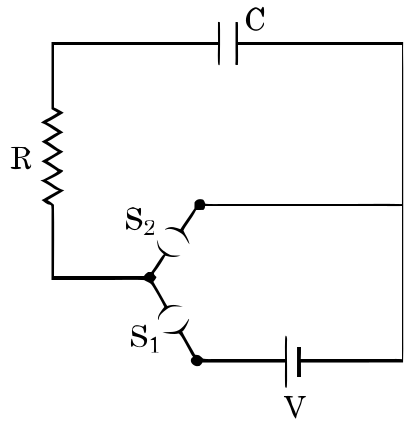
As soon as the circuit is completed by closing key $\displaystyle \mathrm{S}_{1}$ (keeping $\displaystyle \mathrm{S}_{2}$ open) charges begin to flow between the capacitor plates and the battery terminals. The charge on the capacitor increases and consequently the potential difference $\displaystyle V_{c}(=\mathrm{q} / \mathrm{C})$ across the capacitor also increases with time. When this potential difference equals the potential difference across the battery, the capacitor is fully charged $\displaystyle (Q=V \mathrm{C})$. During this process of charging, the charge $\displaystyle \mathrm{q}$ on the capacitor changes with time $\displaystyle \mathrm{t}$ as $\displaystyle \mathrm{q}=Q\left[1-\mathrm{e}^{-\mathrm{t} / \mathrm{RC}}\right]$ The charging current can be obtained by differentiating it and using $\displaystyle \frac{d}{d x}\left(\mathrm{e}^{m x}\right)=m \mathrm{e}^{m x}$. Consider the case when $\displaystyle \mathrm{R}=20 \mathrm{k} \Omega, \mathrm{C}=500 \mu \mathrm{~F}$ and $\displaystyle V=10 \mathrm{~V}$.
(i)
The final charge on the capacitor, when key $\displaystyle \mathrm{S}_{1}$ is closed and $\displaystyle \mathrm{S}_{2}$ is open, is
(A)
$\displaystyle 5 \mu \mathrm{C}$
(B)
$\displaystyle 5$ mC
(C)
$\displaystyle 25$ mC
(D)
0.$\displaystyle 1$ C
(ii)
For sufficient time the key $\displaystyle \mathrm{S}_{1}$ is closed and $\displaystyle \mathrm{S}_{2}$ is open. Now key $\displaystyle \mathrm{S}_{2}$ is closed and $\displaystyle \mathrm{S}_{1}$ is open. What is the final charge on the capacitor?
(A)
Zero
(B)
$\displaystyle 5$ mC
(C)
2.$\displaystyle 5$ mC
(D)
$\displaystyle 5 \mu \mathrm{C}$
(iii)
The dimensional formula for RC is
(A)
$\displaystyle \left[\mathrm{M} \mathrm{L}^{2} \mathrm{~T}^{-3} \mathrm{~A}^{-2}\right]$
(B)
$\displaystyle \left[\mathrm{M}^{0} \mathrm{~L}^{0} \mathrm{~T}^{-1} \mathrm{~A}^{0}\right]$
(C)
$\displaystyle \left[\mathrm{M}^{-1} \mathrm{~L}^{-2} \mathrm{~T}^{4} \mathrm{~A}^{2}\right]$
(D)
$\displaystyle \left[\mathrm{M}^{0} \mathrm{~L}^{0} T \mathrm{~A}^{0}\right]$
(iv)
The key $\displaystyle \mathrm{S}_{1}$ is closed and $\displaystyle \mathrm{S}_{2}$ is open. The value of current in the resistor after $\displaystyle 5$ seconds, is
(A)
$\displaystyle \frac{1}{2 \sqrt{\mathrm{e}}} \mathrm{~mA}$
(B)
$\displaystyle \sqrt{\mathrm{e}} \mathrm{mA}$
(C)
$\displaystyle \frac{1}{\sqrt{\mathrm{e}}} \mathrm{~mA}$
(D)
$\displaystyle \frac{1}{2 \mathrm{e}} \mathrm{~mA}$
OR
(iv)
The key $\displaystyle \mathrm{S}_{1}$ is closed and $\displaystyle \mathrm{S}_{2}$ is open. The initial value of charging current in the resistor, is
(A)
$\displaystyle 5$ mA
(B)
0.$\displaystyle 5$ mA
(C)
$\displaystyle 2$ mA
(D)
$\displaystyle 1$ mA
Marking-scheme solution
(i)(B)
$\displaystyle 5$ mC
(ii)(A)
zero
(iii)(D)
$\displaystyle \left[M^{0} L^{0} T^{0} A^{0}\right]$
(iv)
(A)
$\displaystyle \frac{1}{2 e} \mathrm{~mA}$
OR
(B)
0.$\displaystyle 5$ mA
All Current Electricity questions2025 question paperNCERT solutions: Current ElectricityPractice Current Electricity →
More from Current Electricity
- A steady current flows through a metallic wire whose area of cross-section increases continuously from one end of the wire to the other. The…2023
- (i) Define mobility of electrons. Give its SI units. (ii) A steady current flows through a wire AB, as shown in the figure. What happens to the…2023
- What is the order of magnitude of drift velocity of electrons in a conductor? Deduce the relation between the current flowing through a conductor and…2026
- 'Current is a scalar quantity, although we represent current with an arrow.' Explain. Derive the balance condition of a Wheatstone Bridge.2026
- The number of electrons flowing through a conductor per second is 3 · 3 × 10^19. The current flowing through the conductor is:2023
- A student sets up the circuit as shown in the figure to find the value of unknown resistance X and records a set of readings of the voltmeter and the…2026
- Define current density and relaxation time. Derive an expression for resistivity of a conductor in terms of number density of charge carriers in the…2023
- A battery of e. m. f. 12 V and internal resistance 0.5 Ω is connected to a 9.5 Ω resistor through a key. The ratio of potential difference between…2025
CBSE Class 12 Physics past-paper question from the 2025 board exam, with the answer as CBSE’s own marking scheme gives it. Where our answers come from.