✓ Board-verified
Physics · 2024 · 5 marks
CBSE 2024 · Region 3 · Set 1 · Q31
(a) (i) Obtain the expression for the capacitance of a parallel plate capacitor with a dielectric medium between its plates. (ii) A charge of 6 μ C…
(i)
Obtain the expression for the capacitance of a parallel plate capacitor with a dielectric medium between its plates.
(ii)
A charge of $\displaystyle 6 \mu \mathrm{C}$ is given to a hollow metallic sphere of radius $\displaystyle 0.2$ m . Find the potential at (i) the surface and (ii) the centre of the sphere.
(i)
A charge +Q is placed on a thin conducting spherical shell of radius R . Use Gauss's theorem to derive an expression for the electric field at a point lying (i) inside and (ii) outside the shell.
(ii)
Show that the electric field for same charge density ( $\displaystyle \sigma$ ) is twice in case of a conducting plate or surface than in a nonconducting sheet.
Marking-scheme solution
(i)
When a dielectric slab is inserted between the plates of capacitor, there is induced charge density $\displaystyle \sigma_P$ which opposes the original charge density ($\displaystyle \sigma$) on the plate of capacitance.
Electric field with dielectric medium is
\[E = \frac{(\sigma - \sigma_P)}{\varepsilon_0}\]
\[V = E \times d = \frac{(\sigma - \sigma_P)}{\varepsilon_0} d\]
\[(\sigma - \sigma_P) = \frac{\sigma}{K}\]
\[V = \frac{\sigma\, d}{\varepsilon_0 K} = \frac{Qd}{A\varepsilon_0 K}\]
\[C = \frac{Q}{V} = \frac{K\varepsilon_0 A}{d}\]
(ii)
Electric potential due to a point charge
\[V = \frac{1}{4\pi\varepsilon_0}\frac{q}{r}\]
(i)
At the surface
\[V = \frac{1}{4\pi\varepsilon_0}\frac{q}{r} = \frac{9\times 10^{9}\times 6\times 10^{-6}}{0.2}\]
\[V = 2.7\times 10^{5}\ \text{V}\]
(ii)
Since electric field inside the hollow sphere is zero, hence V is same as that of the surface and remains constant throughout the volume.
\[V = 2.7\times 10^{5}\ \text{V}\]
(i)
Field inside the shell
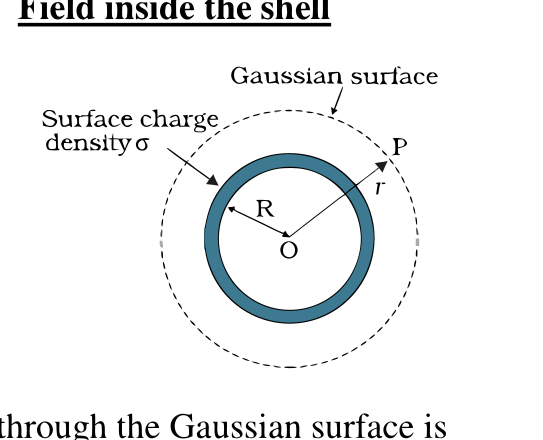
The Flux through the Gaussian surface is
\[= E \times 4\pi R^{2}\]
In this case Gaussian surface encloses no charge.
Hence $\displaystyle E \times 4\pi R^{2} = 0$
\[E = 0\](ii) Field outside the shell-
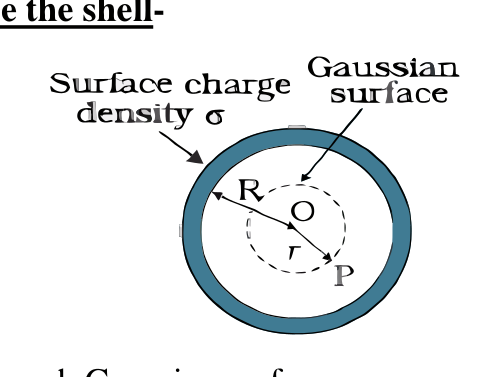
Electric flux through Gaussian surface
\[E \times 4\pi r^{2} = \frac{(\sigma\, 4\pi R^{2})}{\varepsilon_0}\]
Charge enclosed by the Gaussian surface
\[E \times 4\pi r^{2} = \frac{(\sigma\, 4\pi R^{2})}{\varepsilon_0}\]
Using Gauss's law:
\[\int \vec{E}\cdot \vec{ds} = \frac{Q}{\varepsilon_0}\]
\[E \times 4\pi r^{2} = \frac{(\sigma\, 4\pi R^{2})}{\varepsilon_0}\]
\[E = \frac{\sigma}{\varepsilon_0}\frac{R^{2}}{r^{2}} = \frac{q}{4\pi\varepsilon_0 r^{2}}\]
(ii)
For conducting sheet,
Electric field due to a conducting sheet
\[E_c = \frac{\sigma}{\varepsilon_0}\]
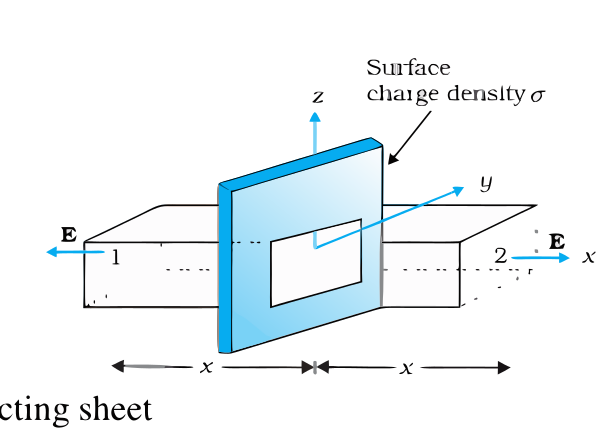
For non-conducting sheet
\[E_{nc} = \frac{\sigma}{2\varepsilon_0}\]
Since surface charge density is same.
\[2E_{nc} = E_c\]
All Electrostatic Potential and Capacitance questions2024 question paperNCERT solutions: Electrostatic Potential and CapacitancePractice Electrostatic Potential and Capacitance →
More from Electrostatic Potential and Capacitance
- (i) A parallel plate capacitor with plate area A and plate separation d has a capacitance C_0. A slab of dielectric constant K having area A and…2025
- (i) In the figure, OA and OB show the variation of electric potential V at a point due to two point charges Q_1 and Q_2 with 1/r respectively. Here r…2026
- A point charge q_0 is moving along a circular path of radius a, with a point charge -Q at the centre of the circle. The kinetic energy of q_0 is2023
- The effective capacitance of the network between points A and B shown in the figure is:2025
- Two metal spheres of radii r_1 and r_2(>r_1) having charges q_1 and q_2 respectively kept in air, are brought in contact. Which of the following…2026
- (i) Explain the following statements giving reason: (I) An equipotential surface through a point is normal to the electric field at that point. (II)…2026
- A parallel plate capacitor has plate area A and plate separation d. Half of the space between the plates is filled with a material of dielectric…2025
- A thin spherical conducting shell of radius R has a charge q. A point charge Q is placed at the centre of the shell. Find (i) the charge density on…2024
CBSE Class 12 Physics past-paper question from the 2024 board exam, with the answer as CBSE’s own marking scheme gives it. Where our answers come from.