✓ Board-verified
Physics · 2026 · 5 marks
CBSE 2026 · Region 5 · Set 1 · Q32
(a) (i) A rectangular loop of sides a and b carrying current I is placed in a magnetic field B such that its area vector A makes an angle θ with B.…
(i)
A rectangular loop of sides a and b carrying current I is placed in a magnetic field $\displaystyle \overrightarrow{\mathrm{B}}$ such that its area vector $\displaystyle \overrightarrow{\mathrm{A}}$ makes an angle $\displaystyle \theta$ with $\displaystyle \overrightarrow{\mathrm{B}}$. With the help of a suitable diagram, show that the torque $\displaystyle \vec{\tau}$ acting on the loop is given by $\displaystyle \vec{\tau}=\vec{\mathrm{m}} \times \vec{\mathrm{B}}$, where $\displaystyle \vec{\mathrm{m}}(=\mathrm{I} \vec{\mathrm{A}})$ is the magnetic dipole moment of the loop.
(ii)
A circular coil of $\displaystyle 100$ turns and radius $\displaystyle \left(\frac{10}{\sqrt{\pi}}\right) \mathrm{cm}$ carrying current of $\displaystyle 5 \cdot 0 \mathrm{~A}$ is suspended vertically in a uniform horizontal magnetic field of $\displaystyle 2.0$ T. The field makes an angle $\displaystyle 30$° with the normal to the coil. Calculate :
(I)
the magnetic dipole moment of the coil, and
(II)
the magnitude of the counter torque that must be applied to prevent the coil from turning.
(i)
Derive an expression for the force $\displaystyle \overrightarrow{\mathrm{F}}$ acting on a conductor of length L and area of cross-section A carrying current I and placed in a magnetic field $\displaystyle \overrightarrow{\mathrm{B}}$.
(ii)
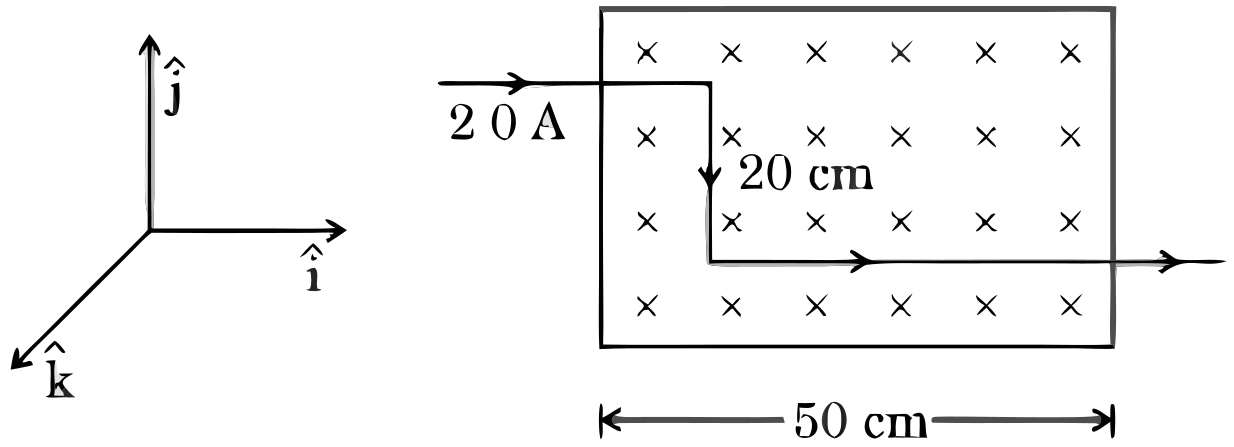
A part of a wire carrying $\displaystyle 2.0$ A current and bent at $\displaystyle 90$° at two points is placed in a region of uniform magnetic field $\displaystyle \overrightarrow{\mathrm{B}}=-(0.50 \mathrm{~T}) \hat{\mathrm{k}}$, as shown in the figure. Calculate the magnitude of the net force acting on the wire.
Marking-scheme solution
(a)(i)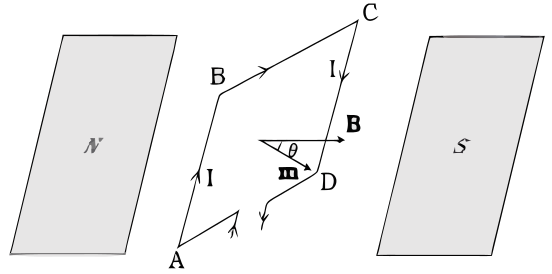

According to Right Hand Screw Rule,
Forces on BC & DA are equal and opposite in direction with same line of action, hence they cancel out each other.
Force on arm AB & CD, are also equal and opposite in direction but there is a difference in line of action so, a torque will act on it.
\[\mathrm{F}_{1}=\mathrm{F}_{2}=\mathrm{Ib} \mathrm{~B}
\]
$\displaystyle \tau=$ Force x perpendicular distance
\[\begin{aligned}
& \tau=\mathrm{F}_{1}(\mathrm{a} / 2) \sin \theta+\mathrm{F}_{2}(\mathrm{a} / 2) \sin \theta \\
&=(\mathrm{IbB}) \mathrm{a} \sin \theta \\
& \tau=\mathrm{IAB} \sin \theta \\
& \overrightarrow{\mathrm{~m}}=\mathrm{I} \overrightarrow{\mathrm{~A}} \\
& \tau=\mathrm{mB} \sin \theta \\
& \vec{\tau}=\overrightarrow{\mathrm{m}} \times \overrightarrow{\mathrm{B}}
\end{aligned}
\]
All Moving Charges and Magnetism questions2026 question paperNCERT solutions: Moving Charges and MagnetismPractice Moving Charges and Magnetism →
More from Moving Charges and Magnetism
- A 2.0 cm segment of wire, carrying 5.0 A current in positive y-direction lies along y -axis, as shown in the figure. The magnetic field at a point (3…2024
- Two thin long parallel wires A and B are separated by a distance r and carry current I each in the same direction. The force per unit length exerted…2023
- Derive an expression for the magnetic field B, due to a circular coil of N turns, each of radius r carrying current I, at a distance ' x ' from the…2026
- Assertion: A proton and an electron enter a uniform magnetic field B with the same momentum p such that p is perpendicular to B. They describe…2024
- Beams of electrons and protons move parallel to each other in the same direction. They2023
- (i) A particle of mass m and charge q is moving with a velocity v in a magnetic field B as shown in the figure. Show that it follows a helical path.…2024
- Figure shows a narrow beam of electrons entering with a velocity of 3 × 10^7 m / s, symmetrically through the space between two parallel horizontal…2026
- A particle of mass m and charge q moving with a uniform velocity v=v_0 x i+v_0 y j enters a region with a magnetic field B=B_0 j. After some time, an…2023
CBSE Class 12 Physics past-paper question from the 2026 board exam, with the answer as CBSE’s own marking scheme gives it. Where our answers come from.