✓ Board-verified
Physics · 2025 · 5 marks
CBSE 2025 · Region 1 · Set 2 · Q33
(a) (i) A proton moving with velocity V in a non-uniform magnetic field traces a path as shown in the figure. The path followed by the proton is…
(i)
A proton moving with velocity $\displaystyle \overrightarrow{\mathrm{V}}$ in a non-uniform magnetic field traces a path as shown in the figure.
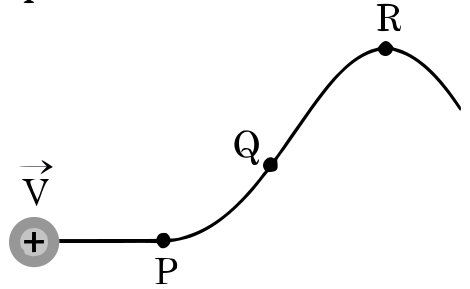
The path followed by the proton is always in the plane of the paper. What is the direction of the magnetic field in the region near points $\displaystyle \mathrm{P}, \mathrm{Q}$ and R ? What can you say about relative magnitude of magnetic fields at these points?
(ii)
A current carrying circular loop of area A produces a magnetic field B at its centre. Show that the magnetic moment of the loop is $\displaystyle \frac{2 \mathrm{BA}}{\mu_{0}} \sqrt{\frac{\mathrm{~A}}{\pi}}$.
(i)
Derive an expression for the torque acting on a rectangular current loop suspended in a uniform magnetic field.
(ii)
A charged particle is moving in a circular path with velocity $\displaystyle \vec{\mathrm{V}}$ in a uniform magnetic field $\displaystyle \overrightarrow{\mathrm{B}}$. It is made to pass through a sheet of lead and as a consequence, it looses one half of its kinetic energy without change in its direction. How will ($\displaystyle 1$) the radius of its path
(2)
its time period of revolution change ?
Marking-scheme solution
(a)
Near point P: magnetic field is acting into the plane of the paper as force is acting upwards.
Near point Q: magnetic field is into the plane of paper as force is acting upwards.
Near point R: magnetic field is acting out of the plane of the paper as force is acting downwards.
Relative magnitude of the magnetic field:
As $\displaystyle B \propto \frac{1}{r}$
Therefore, near point P, magnitude of B is small.
Near point Q, B is relatively smaller than point P.
Near point R, B is relatively larger than point P.
$\displaystyle \left(B_{Q}<B_{P}<B_{R}\right)$
(ii)
Let r be the radius of the circular coil and I the current in the coil, then:
$\displaystyle B=\frac{\mu_{0} I}{2 r}$ or $\displaystyle I=\frac{2 B r}{\mu_{0}}$
$\displaystyle A=\pi r^{2} \quad r=\sqrt{\frac{A}{\pi}}$
$\displaystyle M=I A$
$\displaystyle =\frac{2 B r}{\mu_{0}} A$
$\displaystyle =\frac{2 B A}{\mu_{0}} \sqrt{\frac{A}{\pi}}$
(b)
$\displaystyle F_{1}$ and $\displaystyle F_{2}$ are the forces acting on two arms of the rectangular coil having sides a and b.
$\displaystyle F_{1}=F_{2}=I b B$ (b = length of the arm)
Forces constitute a couple. The magnitude of torque on the loop is:
$\displaystyle \tau=F_{1} \frac{a}{2} \sin \theta+F_{2} \frac{a}{2} \sin \theta$
$\displaystyle =I a b B \sin \theta$
$\displaystyle =I A B \sin \theta$
$\displaystyle \vec{\tau}=I \vec{A} \times \vec{B}$
If the plane of the current carrying coil makes an angle $\displaystyle \alpha$ with the magnetic field:
$\displaystyle \vec{F}_{D A}=-\vec{F}_{B C}$ (cancel each other)
Force on the arm DC is into the plane of the paper, $\displaystyle F_{D C}=I b B$.
Force on the arm AB is out of the plane of the paper, $\displaystyle F_{A B}=I b B$.
Both of them form a couple and torque acting on the coil is:
$\displaystyle \tau=$ either force $\displaystyle \times$ perpendicular distance between the two forces
$\displaystyle \tau=I b B \times a \cos \alpha$
$\displaystyle =I a b B \cos \alpha$
$\displaystyle \tau=I A B \cos \alpha$
Let $\displaystyle \hat{n}=$ outward drawn normal to the plane of the coil.
$\displaystyle \theta+\alpha=90^{\circ}$
$\displaystyle \alpha=90^{\circ}-\theta$
$\displaystyle \tau=I A B \cos (90-\theta)$
$\displaystyle =I A B \sin \theta$
$\displaystyle \vec{\tau}=I \vec{A} \times \vec{B}$
(ii)(1)
$\displaystyle r=\frac{m v}{q B}=\frac{\sqrt{2 m K}}{q B}$
$\displaystyle r \propto \sqrt{K}$
$\displaystyle \frac{r^{\prime}}{r}=\sqrt{\frac{K / 2}{K}}=\frac{1}{\sqrt{2}}$
$\displaystyle r^{\prime}=\frac{r}{\sqrt{2}}$
(2)
$\displaystyle T=\frac{2 \pi m}{q B}$
Time period does not depend on kinetic energy.
$\displaystyle \therefore$ Time period will not change.
All Moving Charges and Magnetism questions2025 question paperNCERT solutions: Moving Charges and MagnetismPractice Moving Charges and Magnetism →
More from Moving Charges and Magnetism
- A 2.0 cm segment of wire, carrying 5.0 A current in positive y-direction lies along y -axis, as shown in the figure. The magnetic field at a point (3…2024
- Two thin long parallel wires A and B are separated by a distance r and carry current I each in the same direction. The force per unit length exerted…2023
- Derive an expression for the magnetic field B, due to a circular coil of N turns, each of radius r carrying current I, at a distance ' x ' from the…2026
- Assertion: A proton and an electron enter a uniform magnetic field B with the same momentum p such that p is perpendicular to B. They describe…2024
- Beams of electrons and protons move parallel to each other in the same direction. They2023
- (i) A particle of mass m and charge q is moving with a velocity v in a magnetic field B as shown in the figure. Show that it follows a helical path.…2024
- Figure shows a narrow beam of electrons entering with a velocity of 3 × 10^7 m / s, symmetrically through the space between two parallel horizontal…2026
- A particle of mass m and charge q moving with a uniform velocity v=v_0 x i+v_0 y j enters a region with a magnetic field B=B_0 j. After some time, an…2023
CBSE Class 12 Physics past-paper question from the 2025 board exam, with the answer as CBSE’s own marking scheme gives it. Where our answers come from.