✓ Board-verified
Science · 2025 · 5 marks
CBSE 2025 · Region 5 · Set 1 · Q36
(A) (a) Observe the following diagram and compare (i) speed of light and (ii) optical densities of the three media A, B and C. Also give…
(a)
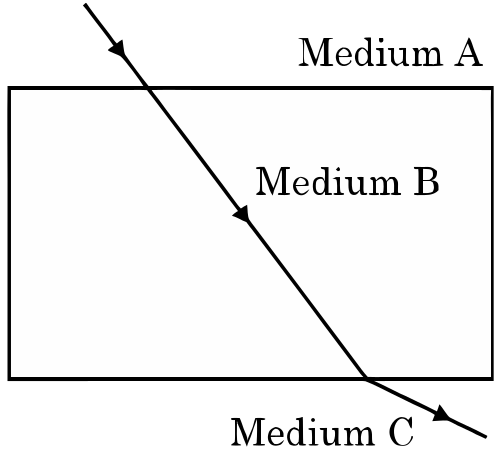
Observe the following diagram and compare (i) speed of light and (ii) optical densities of the three media A, B and C. Also give justification for your answer of any one of the two cases in terms of refractive indices of A, B and C.
(b)
Redraw the path of a ray of light through the three media, if the ray of light starting from medium A falls on the medium B
(i)
Obliquely and the optical density of medium B is made more than that of A and C.
(ii)
The ray falls normally from medium A to medium B.
Analyse the following observation table showing variation of image distance (v) with object distance (u) in case of a convex lens and answer the questions that follow without doing any calculations :
| Observation Number | Object distance (u) in cm | Image distance (v) in cm |
| $\displaystyle 1$ | -$\displaystyle 15$ | -$\displaystyle 60$ |
| $\displaystyle 2$ | -$\displaystyle 25$ | +$\displaystyle 100$ |
| $\displaystyle 3$ | -$\displaystyle 30$ | +$\displaystyle 60$ |
| $\displaystyle 4$ | -$\displaystyle 40$ | +$\displaystyle 40$ |
| $\displaystyle 5$ | -$\displaystyle 60$ | +$\displaystyle 30$ |
| $\displaystyle 6$ | -$\displaystyle 100$ | +$\displaystyle 25$ |
(a)
Determine the focal length of the lens. Give reason for your answer.
(b)
Find magnification of the image formed in Observation No. 3.
(c)
The numerical value of magnifications in cases of observation $\displaystyle 1$ and $\displaystyle 2$ is same. List two differences in the images formed in these two cases.
Marking-scheme solution
(A)(a)
(i)
Speed of light in A and B is same whereas the speed of light in C is greater than that of A and B.
(ii) Optical density of A and B is same whereas optical density of C is less than that of A and B. Since the ray of light does not bend while passing from A to B the refractive indices of A and B are same and since it bends away from the normal while passing from B to C the refractive index of C is less than that of A and B. / Refractive index of a medium is inversely proportional to the speed of light in that medium.
(b) (i) Oblique Incidence
(ii) Normal Incidence
(B) (a) \(\displaystyle 2 \mathrm{f}=40 \mathrm{~cm}\)
\[\text { ⇒ f = } 20 \text { cm }
\]
Reason: When an object is placed at 2f (- $\displaystyle 40$ cm) of a convex lens its real image formed at 2f (+ $\displaystyle 40$ cm) on the other side of the lens.
(b) \(\displaystyle \mathrm{m}=\frac{v}{u}=\frac{+60 c m}{-30 c m}=-2\)
(c) Observation No.1- image is virtual and erect Observation No. $\displaystyle 2$ - image is real and inverted
All Light - Reflection and Refraction questions2025 question paperNCERT solutions: Light - Reflection and RefractionPractice Light - Reflection and Refraction →
More from Light - Reflection and Refraction
- With the help of above given ray diagram, calculate the angle of refraction. Given that the refractive index of Medium 2 with respect to Medium 1 is…2026
- A student wants to obtain an erect image of an object using a concave mirror of 10 cm focal length. What will be the distance of the object from…2023
- An object is kept at a distance of 1m from a lens of power+2D: (i) Identify the type of lens. (ii) Calculate its focal length and distance of the…2023
- If the absolute refractive indices of two media X and Y are 6/5 and 4/3 respectively, then the refractive index of Y with respect to X will be:2025
- A student wants to project the image of a candle flame on a screen 60 cm in front of a mirror by keeping the candle at a distance of 15 cm from its…2023
- An object is placed in front of a concave mirror of focal length 12 cm. If distance of the object from the pole of the mirror is 8 cm, then use…2024
- (i) "In refraction of light through a rectangular glass slab, the emergent ray is always parallel to the direction of the incident ray." Why? Explain…2025
- The above ray diagram is to show image formation by a reflecting telescope. Reflecting telescope revolutionized our way of looking into the sky.…2026
CBSE Class 10 Science past-paper question from the 2025 board exam, with the answer as CBSE’s own marking scheme gives it. Where our answers come from.