SolveIt is under development
SolveItClass 9 · NCERT

NCERT Solutions · Class 9 Mathematics Propositions and their Converses

17 questions · 17 still being checked

Exercise Set 9.1 11–17 (part 2 of 2)

  1. Frame the converse for each of the propositions in Questions $\displaystyle 1$-12. Then, determine if each of the two statements is true or not. Justify the true statements and give a counterexample for each false statement. In Questions $\displaystyle 8$-$\displaystyle 12$, \(\displaystyle n\) is a positive integer.

    Exercise 11

    If n\displaystyle n is a product of two unequal prime numbers, then it has exactly 4\displaystyle 4 divisors.

    Not cross-checked

    This solution has not been cross-checked against the answer printed in NCERT.

    Converse: If \(\displaystyle n\) has exactly $\displaystyle 4$ divisors, then \(\displaystyle n\) is a product of two unequal primes.Proposition: True. For \(\displaystyle n = pq\) with primes \(\displaystyle p \ne q\), the divisors are \[1,\; p,\; q,\; pq \] four different numbers.Converse: False. Counterexample: \[n = 8: \quad \text{divisors } 1,\; 2,\; 4,\; 8 \] It has four divisors, but \(\displaystyle 8 = 2^3\) is not a product of two unequal primes.Answer: Converse: if \(\displaystyle n\) has exactly $\displaystyle 4$ divisors, then it is a product of two unequal primes. The proposition is true; the converse is false (\(\displaystyle n = 8\)).
  2. Exercise 12

    If n\displaystyle n and n+3\displaystyle n+3 have no factors in common, then n\displaystyle n is not a multiple of 3.

    Not cross-checked

    This solution has not been cross-checked against the answer printed in NCERT.

    Here 'no factors in common' means none other than 1.Converse: If \(\displaystyle n\) is not a multiple of $\displaystyle 3$, then \(\displaystyle n\) and \(\displaystyle n+3\) have no factors in common.Proposition: True. If \(\displaystyle n\) were a multiple of $\displaystyle 3$, they would share the factor $\displaystyle 3$: \[n = 3k, \qquad n + 3 = 3(k+1) \] So no common factor forces \(\displaystyle n\) to be a non-multiple of 3.Converse: True. Let \(\displaystyle d\) be a common factor. \[d \mid (n+3) - n = 3 \;\Rightarrow\; d = 1 \text{ or } d = 3 \] \(\displaystyle d = 3\) would make \(\displaystyle n\) a multiple of $\displaystyle 3$, which is excluded. So \(\displaystyle d = 1\).Answer: Converse: if \(\displaystyle n\) is not a multiple of $\displaystyle 3$, then \(\displaystyle n\) and \(\displaystyle n+3\) have no common factor besides 1. Both are true.
  3. Exercise 13

    There are no known 'neat' expressions that generate only primes! Find counterexamples to the following claims.
    (i)
    All numbers of the form 4n2+1\displaystyle 4 n^2+1 are prime.
    (ii)
    All numbers of the form n2+n+11\displaystyle n^2+n+11 are prime.
    (iii)
    All numbers of the form 4n+3\displaystyle 4^{\mathrm{n}}+3 are prime.

    Not cross-checked

    This solution has not been cross-checked against the answer printed in NCERT.

    (i) Take \(\displaystyle n = 4\): \[4n^2 + 1 = 4 \cdot 16 + 1 = 65 = 5 \times 13 \](ii) Take \(\displaystyle n = 10\): \[n^2 + n + 11 = 100 + 10 + 11 = 121 = 11^2 \](iii) Take \(\displaystyle n = 4\): \[4^n + 3 = 256 + 3 = 259 = 7 \times 37 \]Each is composite, so each claim is false. These are the smallest positive \(\displaystyle n\) that fail; other counterexamples exist.Answer: (i) \(\displaystyle n = 4\), $\displaystyle 65$; (ii) \(\displaystyle n = 10\), $\displaystyle 121$; (iii) \(\displaystyle n = 4\), 259.
  4. Exercise 14

    Find counterexamples to the following statements.
    (i)
    If n\displaystyle n is a prime number, then 2n−1\displaystyle 2^n-1 is a prime number.
    (ii)
    If n\displaystyle n is an even number, then 2n+1\displaystyle 2^{\mathrm{n}}+1 is a prime number.

    Not cross-checked

    This solution has not been cross-checked against the answer printed in NCERT.

    (i) Take the prime \(\displaystyle n = 11\): \[2^{11} - 1 = 2047 = 23 \times 89 \] The primes \(\displaystyle n = 2, 3, 5, 7\) give $\displaystyle 3$, $\displaystyle 7$, $\displaystyle 31$, $\displaystyle 127$, all prime, so \(\displaystyle 11\) is the first prime that fails.(ii) Take the even number \(\displaystyle n = 6\): \[2^6 + 1 = 65 = 5 \times 13 \] Here \(\displaystyle n = 2, 4\) give $\displaystyle 5$ and $\displaystyle 17$, both prime, so \(\displaystyle 6\) is the first even \(\displaystyle n\) that fails.Answer: (i) \(\displaystyle n = 11\), \(\displaystyle 2047 = 23 \times 89\); (ii) \(\displaystyle n = 6\), \(\displaystyle 65 = 5 \times 13\).
  5. Exercise 15

    Consider the statement: 'If a number is divisible by 8\displaystyle 8, then it is divisible by both 2\displaystyle 2 and 4\displaystyle 4'.
    (i)
    Justify the statement.
    (ii)
    Recall the divisibility shortcuts that we have studied for different numbers. To check whether a given number is divisible by 8\displaystyle 8, is it enough to check whether it is divisible by 2\displaystyle 2 and 4\displaystyle 4? Why or why not?

    Not cross-checked

    This solution has not been cross-checked against the answer printed in NCERT.

    (i) Let \(\displaystyle n\) be divisible by 8. \[n = 8k \] \[n = 2(4k) = 4(2k) \] So $\displaystyle 2$ and $\displaystyle 4$ both divide \(\displaystyle n\).(ii) No. Take $\displaystyle 12$: \[12 = 2 \cdot 6 = 4 \cdot 3, \qquad 12 = 8 \cdot 1 + 4 \] It passes both checks, but $\displaystyle 8$ does not divide it; \(\displaystyle 4 \mid n\) already gives \(\displaystyle 2 \mid n\). The test for $\displaystyle 8$ uses the last three digits: \[1000 = 8 \cdot 125 \] So \(\displaystyle 8 \mid n\) exactly when $\displaystyle 8$ divides the number formed by the last three digits.Answer: (i) \(\displaystyle n = 8k = 2(4k) = 4(2k)\); (ii) not enough, e.g. $\displaystyle 12$ is divisible by $\displaystyle 2$ and $\displaystyle 4$ but not by 8.
  6. Exercise 16

    Recall that a shortcut to check whether a given number is divisible by 3\displaystyle 3 is to add the digits of the number and check if the sum is a multiple of 3\displaystyle 3 . Express the relationship between 'a number is divisible by 3\displaystyle 3' and 'sum of the digits is a multiple of 3\displaystyle 3' using 'If-then' sentences.

    Not cross-checked

    This solution has not been cross-checked against the answer printed in NCERT.

    Let \(\displaystyle S\) be the sum of the digits of \(\displaystyle n\).
    If a number is divisible by $\displaystyle 3$, then the sum of its digits is a multiple of 3.
    If the sum of the digits of a number is a multiple of $\displaystyle 3$, then the number is divisible by 3.
    Both are true. Since \[10^j = 1 + 9 \times \underbrace{11\ldots1}_{j \text{ ones}} \] a number \(\displaystyle n = a_k 10^k + \cdots + a_1 \cdot 10 + a_0\) satisfies \[n = S + 9M \quad (M \text{ an integer}) \] For example, \(\displaystyle 4521 = 12 + 9 \times 501\). As \(\displaystyle 9M\) is a multiple of $\displaystyle 3$, \(\displaystyle n\) and \(\displaystyle S\) are both multiples of $\displaystyle 3$ or neither is.Answer: \(\displaystyle 3 \mid n\) if and only if \(\displaystyle 3 \mid S\); each of the two if-then sentences is true.
  7. Exercise 17

    NCERT_Question_Class9_Maths_Ch9_Ex9-1_Q17
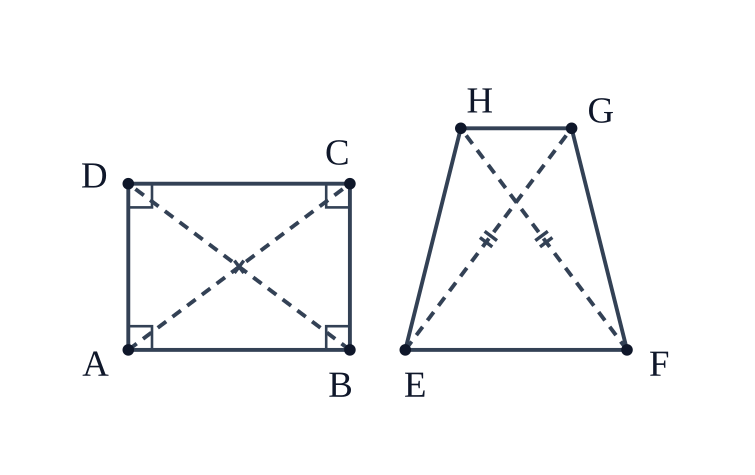
    We have identified different types of quadrilaterals-squares, rectangles, parallelograms, rhombi, kites and trapezia. One can identify more types (e.g., we could create a category of quadrilaterals that have equal-length opposite sides). Suppose we have identified a category of quadrilaterals called Q, and we have to construct a quadrilateral of this type. For this, we are to use two thin sticks, put them together as diagonals so that the quadrilateral obtained by joining their endpoints is of type Q (see the Fig. 9.2\displaystyle 9.2).
    (i)
    Suppose Q satisfies the following property. If a quadrilateral is of type Q, then it has equal-length diagonals.
    (a)
    Should the two sticks be of equal length? Why or why not?
    (b)
    Will it matter how the two sticks are put together?
    (ii)
    Instead of the property mentioned above, suppose Q satisfies the following property. If a quadrilateral has equal diagonals, then it is of type Q. What will be your answers to ( a\displaystyle a ) and (b) now?

    Not cross-checked

    This solution has not been cross-checked against the answer printed in NCERT.

    \[\text{type } Q \;\Rightarrow\; \text{equal diagonals} \] (i)(a) Yes: every quadrilateral of type \(\displaystyle Q\) has equal diagonals, so unequal sticks never give \(\displaystyle Q\). (i)(b) It can matter; equal diagonals is necessary, not sufficient. For rectangles, equal sticks crossing at their midpoints give a rectangle, while crossing off-centre can give an isosceles trapezium. NCERT_Solution_Class9_Maths_Ch9_Ex9-1_Q17 \[\text{equal diagonals} \;\Rightarrow\; \text{type } Q \] (ii)(a) Equal sticks always work, but are not forced: if \(\displaystyle Q\) = all quadrilaterals, unequal sticks work too. (ii)(b) No: equal sticks, however placed, give equal diagonals, hence type \(\displaystyle Q\).Answer: (i) equal sticks; placing can matter. (ii) equal sticks suffice; placing does not matter.