SolveIt is under development
SolveItClass 9 · NCERT

NCERT Solutions · Class 9 Mathematics Propositions and their Converses

17 questions · 17 still being checked

Exercise Set 9.1 1–10 (part 1 of 2)

  1. Frame the converse for each of the propositions in Questions $\displaystyle 1$-12. Then, determine if each of the two statements is true or not. Justify the true statements and give a counterexample for each false statement.

    Exercise 1

    If two lines are parallel, then the corresponding angles formed by a transversal are equal.

    Not cross-checked

    This solution has not been cross-checked against the answer printed in NCERT.

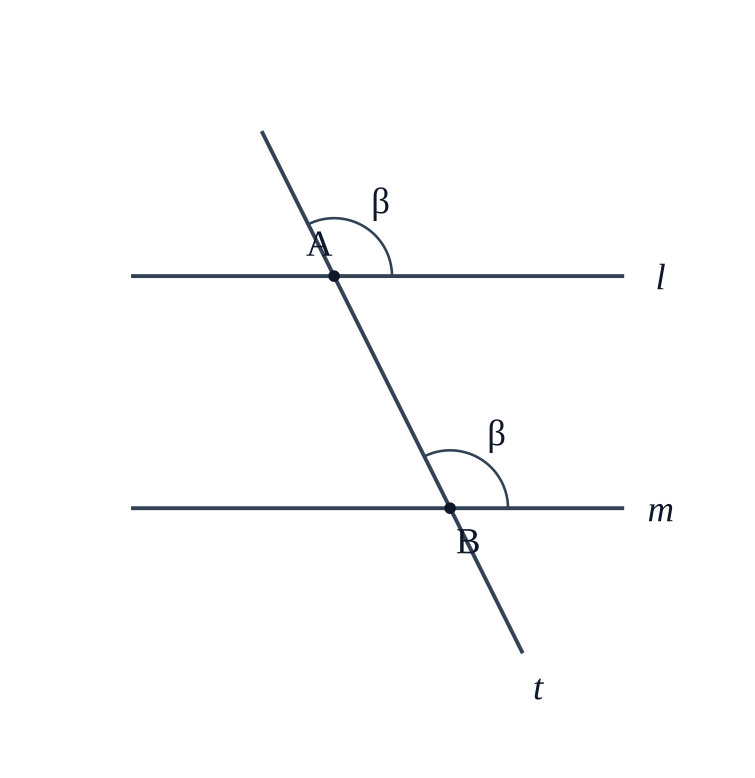
    Converse: If corresponding angles formed by a transversal are equal, then the lines are parallel. NCERT_Solution_Class9_Maths_Ch9_Ex9-1_Q1 Proposition — True. It is the basic property of parallel lines (the parallel postulate), accepted without proof: \[l \parallel m \Rightarrow \text{corresponding angles formed by } t \text{ are equal} \] Converse — True. In the figure the corresponding angles at A and B are both \(\displaystyle \beta\). Through A draw \(\displaystyle l'\parallel m\). \[\text{angle of } l' \text{ with } t \text{ at A} = \beta \quad \text{(proposition, since } l' \parallel m) \] \[\text{angle of } l \text{ with } t \text{ at A} = \beta \quad \text{(given)} \] \[l' = l \quad \text{(same angle with } t \text{, same side)} \] \[l = l' \parallel m \]Answer: Converse: if corresponding angles formed by a transversal are equal, then the lines are parallel. Both statements are true.
  2. Exercise 2

    If a quadrilateral is a square, then all its angles are equal.

    Not cross-checked

    This solution has not been cross-checked against the answer printed in NCERT.

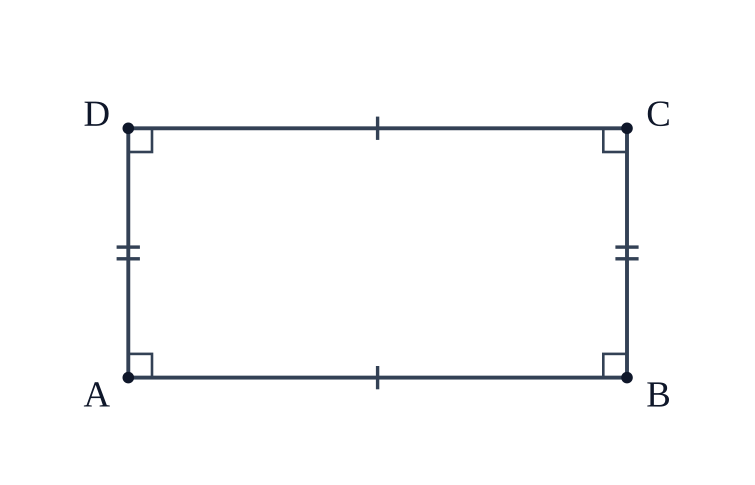
    Converse: If all angles of a quadrilateral are equal, then it is a square. Proposition — True. A square has four right angles: \[\angle A = \angle B = \angle C = \angle D = 90^\circ \] Converse — False. Take a rectangle with \(\displaystyle AB = 6\) and \(\displaystyle BC = 3\). NCERT_Solution_Class9_Maths_Ch9_Ex9-1_Q2 \[\angle A = \angle B = \angle C = \angle D = 90^\circ \] \[AB = 6 \ne 3 = BC \] All angles are equal, but the sides are not, so it is not a square.Answer: Converse: if all angles of a quadrilateral are equal, then it is a square. The proposition is true; the converse is false (a rectangle that is not a square).
  3. Exercise 3

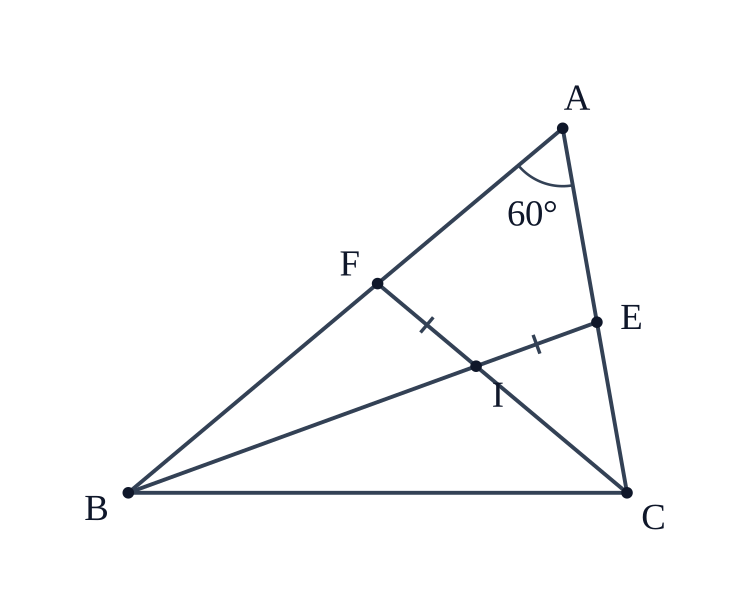
    NCERT_Question_Class9_Maths_Ch9_Ex9-1_Q3 Given any △ABC\displaystyle \triangle \mathrm{ABC}, let us bisect the angles at B and C. The bisectors meet at the incentre I of the triangle. Now extend the bisectors beyond I till they meet the opposite sides at E and F respectively, as shown. Proposition: If AB=AC\displaystyle \mathrm{AB}=\mathrm{AC}, then IE = IF.

    Not cross-checked

    This solution has not been cross-checked against the answer printed in NCERT.

    Converse: If IE = IF, then AB = AC. Proposition — True. In the given figure: \[AB = AC \Rightarrow \angle B = \angle C \quad \text{(angles opposite equal sides)} \] \[\angle IBC = \tfrac12\angle B = \tfrac12\angle C = \angle ICB \Rightarrow IB = IC \quad \text{(sides opposite equal angles)} \] \[\triangle EBC \cong \triangle FCB \quad \text{(ASA: } \angle EBC = \angle FCB,\ BC \text{ common},\ \angle ECB = \angle FBC) \] \[BE = CF \quad \text{(CPCT)} \] \[IE = BE - IB = CF - IC = IF \] Converse — False. Take \(\displaystyle \angle A = 60^\circ\), \(\displaystyle \angle B = 40^\circ\), \(\displaystyle \angle C = 80^\circ\). Then \(\displaystyle AB \ne AC\), since the angles opposite them differ. NCERT_Solution_Class9_Maths_Ch9_Ex9-1_Q3 \[\angle BIC = 180^\circ - \tfrac12(\angle B + \angle C) = 90^\circ + \tfrac12\angle A = 120^\circ \] \[\angle FIE = \angle BIC = 120^\circ \quad \text{(vertically opposite)} \] \[\angle FIE + \angle A = 180^\circ \Rightarrow AFIE \text{ is cyclic} \] \[\angle FAI = \angle IAE = 30^\circ \quad \text{(I is the incentre, so AI bisects } \angle A) \] \[IF = IE \quad \text{(equal angles in a circle stand on equal chords)} \]Answer: Converse: if IE = IF, then AB = AC. The proposition is true; the converse is false (\(\displaystyle \angle A = 60^\circ\) gives IE = IF with AB \(\displaystyle \ne\) AC).
  4. Exercise 4

    If x=y\displaystyle x=y, then a+x=a+y\displaystyle a+x=a+y, where x,y\displaystyle x, y and a\displaystyle a are any three numbers. This proposition and its converse are routinely used while solving equations.

    Not cross-checked

    This solution has not been cross-checked against the answer printed in NCERT.

    Converse: If \(\displaystyle a + x = a + y\), then \(\displaystyle x = y\). Proposition — True. \[x = y \] \[a + x = a + y \quad \text{(the same number } a \text{ added to equal numbers)} \] Converse — True. \[a + x = a + y \] \[(a + x) + (-a) = (a + y) + (-a) \quad \text{(add } -a \text{ to both sides)} \] \[x = y \]Answer: Converse: if \(\displaystyle a + x = a + y\), then \(\displaystyle x = y\). Both statements are true.
  5. Exercise 5

    If a\displaystyle a and b\displaystyle b are perfect squares, then ab\displaystyle a b is a perfect square.

    Not cross-checked

    This solution has not been cross-checked against the answer printed in NCERT.

    Converse: If \(\displaystyle ab\) is a perfect square, then \(\displaystyle a\) and \(\displaystyle b\) are perfect squares. Proposition — True. Let \(\displaystyle a = m^2\) and \(\displaystyle b = n^2\) with \(\displaystyle m, n\) integers. \[ab = m^2 n^2 = (mn)^2 \] \(\displaystyle mn\) is an integer, so \(\displaystyle ab\) is a perfect square. Converse — False. Take \(\displaystyle a = 2\), \(\displaystyle b = 8\). \[ab = 2 \times 8 = 16 = 4^2 \] But neither $\displaystyle 2$ nor $\displaystyle 8$ is a perfect square.Answer: Converse: if \(\displaystyle ab\) is a perfect square, then \(\displaystyle a\) and \(\displaystyle b\) are perfect squares. The proposition is true; the converse is false (\(\displaystyle a = 2,\ b = 8\)).
  6. Frame the converse for each of the propositions in Questions $\displaystyle 1$-12. Then, determine if each of the two statements is true or not. Justify the true statements and give a counterexample for each false statement. In Questions $\displaystyle 6$ and $\displaystyle 7$, \(\displaystyle x\) and \(\displaystyle y\) are real numbers.

    Exercise 6

    If x=y\displaystyle x=y, then x2=y2\displaystyle x^2=y^2.

    Not cross-checked

    This solution has not been cross-checked against the answer printed in NCERT.

    Converse: If \(\displaystyle x^2 = y^2\), then \(\displaystyle x = y\). Proposition — True. \[x = y \Rightarrow x \cdot x = y \cdot y \Rightarrow x^2 = y^2 \] Converse — False. Take \(\displaystyle x = 3\), \(\displaystyle y = -3\). \[x^2 = 9 = (-3)^2 = y^2 \] But \(\displaystyle x \ne y\).Answer: Converse: if \(\displaystyle x^2 = y^2\), then \(\displaystyle x = y\). The proposition is true; the converse is false (\(\displaystyle x = 3,\ y = -3\)).
  7. Exercise 7

    If x=y\displaystyle x=y, then x3=y3\displaystyle x^3=y^3.

    Not cross-checked

    This solution has not been cross-checked against the answer printed in NCERT.

    Converse: If \(\displaystyle x^3 = y^3\), then \(\displaystyle x = y\). Proposition — True. \[x = y \Rightarrow x \cdot x \cdot x = y \cdot y \cdot y \Rightarrow x^3 = y^3 \] Converse — True. Suppose \(\displaystyle x^3 = y^3\) but \(\displaystyle x \ne y\). \[x^3 - y^3 = (x - y)(x^2 + xy + y^2) = 0 \Rightarrow x^2 + xy + y^2 = 0 \] \[x^2 + xy + y^2 = \left(x + \tfrac{y}{2}\right)^2 + \tfrac34 y^2 = 0 \Rightarrow y = 0,\ x = 0 \] Then \(\displaystyle x = y\), a contradiction. So \(\displaystyle x = y\).Answer: Converse: if \(\displaystyle x^3 = y^3\), then \(\displaystyle x = y\). Both statements are true.
  8. Frame the converse for each of the propositions in Questions $\displaystyle 1$-12. Then, determine if each of the two statements is true or not. Justify the true statements and give a counterexample for each false statement. In Questions $\displaystyle 8$-$\displaystyle 12$, \(\displaystyle n\) is a positive integer.

    Exercise 8

    If n\displaystyle n is divisible by 24\displaystyle 24 , then it is divisible by both 4\displaystyle 4 and 6\displaystyle 6 .

    Not cross-checked

    This solution has not been cross-checked against the answer printed in NCERT.

    Converse: If \(\displaystyle n\) is divisible by both $\displaystyle 4$ and $\displaystyle 6$, then it is divisible by 24. Proposition — True. Let \(\displaystyle n = 24k\) with \(\displaystyle k\) an integer. \[n = 24k = 4(6k) = 6(4k) \] Converse — False. Take \(\displaystyle n = 12\). \[12 = 4 \times 3 = 6 \times 2 \] But \(\displaystyle 12 \div 24 = \tfrac12\) is not an integer.Answer: Converse: if \(\displaystyle n\) is divisible by both $\displaystyle 4$ and $\displaystyle 6$, then it is divisible by 24. The proposition is true; the converse is false (\(\displaystyle n = 12\)).
  9. Exercise 9

    If n\displaystyle n is divisible by 60\displaystyle 60 , then it is divisible by both 5\displaystyle 5 and 12\displaystyle 12 .

    Not cross-checked

    This solution has not been cross-checked against the answer printed in NCERT.

    Converse: If \(\displaystyle n\) is divisible by both $\displaystyle 5$ and $\displaystyle 12$, then it is divisible by 60.Proposition: True. \[n = 60k = 5(12k) = 12(5k) \]Converse: True. Let \(\displaystyle n = 12m\) with \(\displaystyle 5 \mid n\). \[m = 3n - 35m \] $\displaystyle 5$ divides both terms on the right, so \(\displaystyle 5 \mid m\). \[m = 5k \;\Rightarrow\; n = 12 \cdot 5k = 60k \]Answer: Converse: if $\displaystyle 5$ and $\displaystyle 12$ both divide \(\displaystyle n\), then $\displaystyle 60$ divides \(\displaystyle n\). The proposition and its converse are both true.
  10. Exercise 10

    If n\displaystyle n is the square of a prime number, then it has exactly 3\displaystyle 3 factors.

    Not cross-checked

    This solution has not been cross-checked against the answer printed in NCERT.

    Converse: If \(\displaystyle n\) has exactly $\displaystyle 3$ factors, then \(\displaystyle n\) is the square of a prime.Proposition: True. For a prime \(\displaystyle p\), the factors of \(\displaystyle p^2 = p \cdot p\) are \[1,\; p,\; p^2 \]Converse: True. Let the factors be \(\displaystyle 1, f, n\) with \(\displaystyle 1 < f < n\). The partner \(\displaystyle n/f\) is neither \(\displaystyle 1\) nor \(\displaystyle n\), so it equals \(\displaystyle f\). \[\frac{n}{f} = f \;\Rightarrow\; n = f^2 \] If \(\displaystyle f = gh\) with \(\displaystyle 1 < g < f\), then \(\displaystyle g\) would be a fourth factor of \(\displaystyle n\). So \(\displaystyle f\) is prime.Answer: Converse: if \(\displaystyle n\) has exactly $\displaystyle 3$ factors, then \(\displaystyle n\) is the square of a prime. Both are true.