Exercise 2.1
Arrange the following metals in the order in which they displace each other from the solution of their salts. Al, Cu, Fe, Mg and Zn.
Not cross-checked
This solution has not been cross-checked against the answer printed in NCERT.
A metal displaces another from its salt solution only if it is a stronger reducing agent than that metal — and the strength of a metal as a reducing agent is read directly off its standard reduction potential.The relevant half-reaction for any metal \(\displaystyle \mathrm{M} \) is
\[\mathrm{M}^{n+}(aq) + n\mathrm{e}^- \rightarrow \mathrm{M}(s), \quad E^\circ
\]
where \(\displaystyle E^\circ \) is the standard reduction potential — how much the metal "wants" to gain electrons and plate out as solid metal. A more negative \(\displaystyle E^\circ \) means the reverse process, \(\displaystyle \mathrm{M}(s) \rightarrow \mathrm{M}^{n+}(aq) + n\mathrm{e}^- \) (oxidation, losing electrons), is favoured instead — so that metal gives up electrons readily and is the stronger reducing agent.This is the step people get wrong: displacement is governed by which metal is more easily oxidised, so you rank by increasing \(\displaystyle E^\circ_{\text{red}} \) (most negative first), not by the numerical value ignoring sign.The standard reduction potentials (vs. SHE, in volts) for the five metals are:\[\begin{aligned}
\mathrm{Mg}^{2+} + 2e^- &\rightarrow \mathrm{Mg}, & E^\circ &= -2.36\ \text{V} \\
\mathrm{Al}^{3+} + 3e^- &\rightarrow \mathrm{Al}, & E^\circ &= -1.66\ \text{V} \\
\mathrm{Zn}^{2+} + 2e^- &\rightarrow \mathrm{Zn}, & E^\circ &= -0.76\ \text{V} \\
\mathrm{Fe}^{2+} + 2e^- &\rightarrow \mathrm{Fe}, & E^\circ &= -0.44\ \text{V} \\
\mathrm{Cu}^{2+} + 2e^- &\rightarrow \mathrm{Cu}, & E^\circ &= +0.34\ \text{V}
\end{aligned}
\]A metal with a more negative \(\displaystyle E^\circ \) will reduce the ion of a metal with a less negative (or positive) \(\displaystyle E^\circ \), oxidising itself in the process — that is, it displaces that metal from solution. For example, since \(\displaystyle E^\circ_{\mathrm{Mg}^{2+}/\mathrm{Mg}} = -2.36\ \text{V} \) is more negative than \(\displaystyle E^\circ_{\mathrm{Cu}^{2+}/\mathrm{Cu}} = +0.34\ \text{V} \), the spontaneous reaction is
\[\mathrm{Mg}(s) + \mathrm{Cu}^{2+}(aq) \rightarrow \mathrm{Mg}^{2+}(aq) + \mathrm{Cu}(s)
\]
so magnesium metal displaces copper from copper sulphate solution.Arranging the five values from most negative to least negative:
\[-2.36\ (\mathrm{Mg}) \;<\; -1.66\ (\mathrm{Al}) \;<\; -0.76\ (\mathrm{Zn}) \;<\; -0.44\ (\mathrm{Fe}) \;<\; +0.34\ (\mathrm{Cu})
\]This gives the order of decreasing reactivity — decreasing power to displace the others from their salt solutions:\[\mathrm{Mg} > \mathrm{Al} > \mathrm{Zn} > \mathrm{Fe} > \mathrm{Cu}
\]So magnesium can displace aluminium, zinc, iron, and copper from their salt solutions; aluminium can displace zinc, iron, and copper (but not magnesium); zinc can displace iron and copper; and iron can displace only copper. Copper, with the least negative (positive) \(\displaystyle E^\circ \), displaces none of the others.Answer: \(\displaystyle \mathrm{Mg} > \mathrm{Al} > \mathrm{Zn} > \mathrm{Fe} > \mathrm{Cu} \) — this is the order of decreasing reactivity, i.e., each metal displaces every metal listed after it from the solution of its salt.
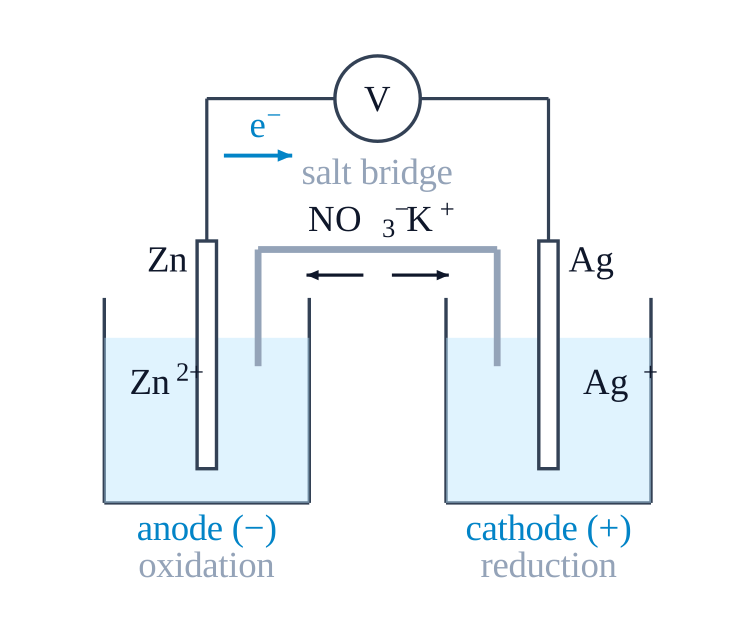 Zn(s) | Zn²⁺ ‖ Ag⁺ | Ag(s). Zn(s) → Zn²⁺(aq) + 2e⁻ at the anode, and 2Ag⁺(aq) + 2e⁻ → 2Ag(s) at the cathode. Electrons carry the current in the WIRE only; inside the cell it is carried by ions moving through the salt bridge, anions towards the anode and cations towards the cathode. Electrons piling up on the zinc are what make it the negative electrode.In a galvanic cell, split the overall reaction into its two half-reactions first — the one that loses electrons is oxidation and happens at the anode, the one that gains electrons is reduction and happens at the cathode.The overall cell reaction is
\[Zn(s) + 2Ag^{+}(aq) \rightarrow Zn^{2+}(aq) + 2Ag(s)
\]Splitting this into half-reactions:Zinc goes from the $\displaystyle 0$ oxidation state to \(\displaystyle +2\), so it loses electrons — this is oxidation, and it occurs at the anode:
\[Zn(s) \rightarrow Zn^{2+}(aq) + 2e^{-} \quad \text{(anode, oxidation)}
\]Silver ion goes from \(\displaystyle +1\) to $\displaystyle 0$, so it gains electrons — this is reduction, and it occurs at the cathode:
\[2Ag^{+}(aq) + 2e^{-} \rightarrow 2Ag(s) \quad \text{(cathode, reduction)}
\]The two electrons released by one Zn atom exactly supply the two \(\displaystyle \mathrm{Ag^{+}}\) ions that get reduced, so the half-reactions are already balanced against each other.By the IUPAC convention, a galvanic cell is written as anode | anode solution || cathode solution | cathode, so the cell is
\[Zn(s)\,|\,Zn^{2+}(aq)\,||\,Ag^{+}(aq)\,|\,Ag(s)
\](i) Which electrode is negatively charged?The zinc electrode is the anode. As each Zn atom oxidises, it leaves its two electrons behind on the metal strip before they travel through the external wire. This constant supply of electrons piling up on the zinc makes it the negative electrode. The silver electrode is the cathode, where those electrons are consumed as \(\displaystyle \mathrm{Ag^{+}}\) is reduced, so it is the positive electrode.This is the opposite of an electrolytic cell — there the anode is positive because an external battery is pulling electrons away from it. In a galvanic cell the cell itself is doing the pushing, so the anode is negative.(ii) Carriers of the current in the cellTwo different carriers are at work in two different parts of the circuit:
Zn(s) | Zn²⁺ ‖ Ag⁺ | Ag(s). Zn(s) → Zn²⁺(aq) + 2e⁻ at the anode, and 2Ag⁺(aq) + 2e⁻ → 2Ag(s) at the cathode. Electrons carry the current in the WIRE only; inside the cell it is carried by ions moving through the salt bridge, anions towards the anode and cations towards the cathode. Electrons piling up on the zinc are what make it the negative electrode.In a galvanic cell, split the overall reaction into its two half-reactions first — the one that loses electrons is oxidation and happens at the anode, the one that gains electrons is reduction and happens at the cathode.The overall cell reaction is
\[Zn(s) + 2Ag^{+}(aq) \rightarrow Zn^{2+}(aq) + 2Ag(s)
\]Splitting this into half-reactions:Zinc goes from the $\displaystyle 0$ oxidation state to \(\displaystyle +2\), so it loses electrons — this is oxidation, and it occurs at the anode:
\[Zn(s) \rightarrow Zn^{2+}(aq) + 2e^{-} \quad \text{(anode, oxidation)}
\]Silver ion goes from \(\displaystyle +1\) to $\displaystyle 0$, so it gains electrons — this is reduction, and it occurs at the cathode:
\[2Ag^{+}(aq) + 2e^{-} \rightarrow 2Ag(s) \quad \text{(cathode, reduction)}
\]The two electrons released by one Zn atom exactly supply the two \(\displaystyle \mathrm{Ag^{+}}\) ions that get reduced, so the half-reactions are already balanced against each other.By the IUPAC convention, a galvanic cell is written as anode | anode solution || cathode solution | cathode, so the cell is
\[Zn(s)\,|\,Zn^{2+}(aq)\,||\,Ag^{+}(aq)\,|\,Ag(s)
\](i) Which electrode is negatively charged?The zinc electrode is the anode. As each Zn atom oxidises, it leaves its two electrons behind on the metal strip before they travel through the external wire. This constant supply of electrons piling up on the zinc makes it the negative electrode. The silver electrode is the cathode, where those electrons are consumed as \(\displaystyle \mathrm{Ag^{+}}\) is reduced, so it is the positive electrode.This is the opposite of an electrolytic cell — there the anode is positive because an external battery is pulling electrons away from it. In a galvanic cell the cell itself is doing the pushing, so the anode is negative.(ii) Carriers of the current in the cellTwo different carriers are at work in two different parts of the circuit:
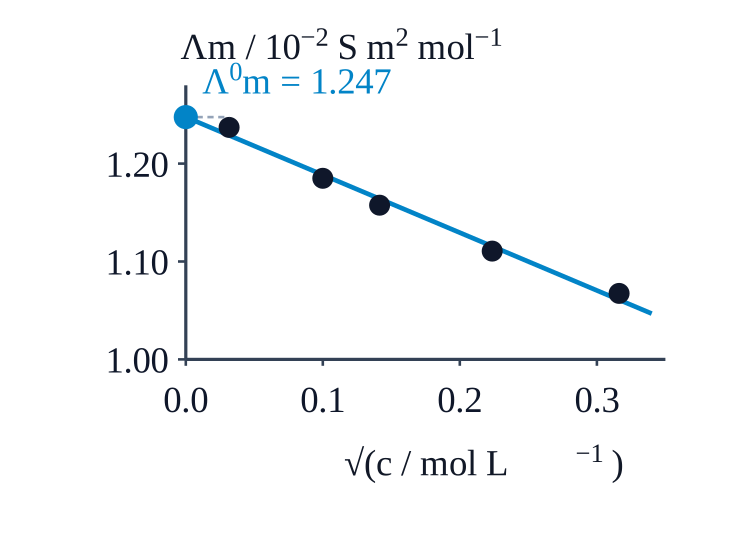 Λm against √c for NaCl. Λm falls as the solution gets stronger, because the ions crowd and hinder each other — NaCl is fully dissociated throughout, so none of this fall is incomplete dissociation. The limiting value is the intercept at √c = $\displaystyle 0$, which no measurement can reach: at zero concentration there are no ions left to carry a current.The relation \(\displaystyle Λ_m = κ/c\) only works if \(\displaystyle κ\) and \(\displaystyle c\) are in matching SI units — that's the step people trip on here, because the table gives \(\displaystyle c\) in mol L⁻¹ but \(\displaystyle κ\) in S m⁻¹.Step $\displaystyle 1$ — get the units straight, then compute \(\displaystyle Λ_m\) at each concentrationMolar conductivity is defined as
\[Λ_m = \frac{κ}{c}
\]
where \(\displaystyle κ\) is the conductivity (S m⁻¹) and \(\displaystyle c\) is the molar concentration expressed in mol m⁻³, so that \(\displaystyle Λ_m\) comes out in S m² mol⁻¹.Since \(\displaystyle 1\ \text{L} = 10^{-3}\ \text{m}^3\), a concentration of \(\displaystyle c\) mol L⁻¹ equals \(\displaystyle 1000c\) mol m⁻³. Do the first row explicitly: at \(\displaystyle c = 0.001\ \text{M}\), the table gives \(\displaystyle 10^2κ = 1.237\), so
\[κ = 1.237\times10^{-2}\ \text{S m}^{-1}, \qquad c = 0.001\times1000 = 1\ \text{mol m}^{-3}
\]
\[Λ_m = \frac{1.237\times10^{-2}}{1} = 1.237\times10^{-2}\ \text{S m}^2\ \text{mol}^{-1}
\]Repeating this division for every row:
Λm against √c for NaCl. Λm falls as the solution gets stronger, because the ions crowd and hinder each other — NaCl is fully dissociated throughout, so none of this fall is incomplete dissociation. The limiting value is the intercept at √c = $\displaystyle 0$, which no measurement can reach: at zero concentration there are no ions left to carry a current.The relation \(\displaystyle Λ_m = κ/c\) only works if \(\displaystyle κ\) and \(\displaystyle c\) are in matching SI units — that's the step people trip on here, because the table gives \(\displaystyle c\) in mol L⁻¹ but \(\displaystyle κ\) in S m⁻¹.Step $\displaystyle 1$ — get the units straight, then compute \(\displaystyle Λ_m\) at each concentrationMolar conductivity is defined as
\[Λ_m = \frac{κ}{c}
\]
where \(\displaystyle κ\) is the conductivity (S m⁻¹) and \(\displaystyle c\) is the molar concentration expressed in mol m⁻³, so that \(\displaystyle Λ_m\) comes out in S m² mol⁻¹.Since \(\displaystyle 1\ \text{L} = 10^{-3}\ \text{m}^3\), a concentration of \(\displaystyle c\) mol L⁻¹ equals \(\displaystyle 1000c\) mol m⁻³. Do the first row explicitly: at \(\displaystyle c = 0.001\ \text{M}\), the table gives \(\displaystyle 10^2κ = 1.237\), so
\[κ = 1.237\times10^{-2}\ \text{S m}^{-1}, \qquad c = 0.001\times1000 = 1\ \text{mol m}^{-3}
\]
\[Λ_m = \frac{1.237\times10^{-2}}{1} = 1.237\times10^{-2}\ \text{S m}^2\ \text{mol}^{-1}
\]Repeating this division for every row: