SolveIt is under development
SolveItNCERT · CBSE · NEET

NCERT Exemplar · Class 12 Mathematics Three Dimensional Geometry

49 questions · 49 still being checked

EXERCISE 11.3 11–20 (part 2 of 5)

  1. Exercise 11

    Find the equations of the two lines through the origin which intersect the line x−32=y−31=z1\displaystyle \frac{x-3}{2}=\frac{y-3}{1}=\frac{z}{1} at angles of π3\displaystyle \frac{\pi}{3} each.

    Matches the book, not yet reviewed

    This working reaches the answer NCERT prints. It has not yet been read through by hand.

    NCERT’s answer
    \(\displaystyle \frac{x}{1}=\frac{y}{2}=\frac{z}{-1}\) and \(\displaystyle \frac{x}{-1}=\frac{y}{1}=\frac{z}{-2}\)
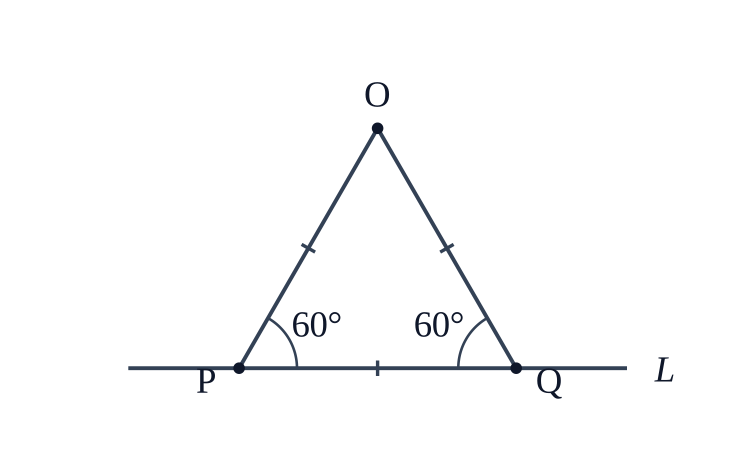
    Each required line passes through \(\displaystyle O\), meets \(\displaystyle L\) at a point \(\displaystyle R\) and makes \(\displaystyle 60^\circ\) with \(\displaystyle L\). With \(\displaystyle \mathbf d\) the direction of \(\displaystyle L\): \[R(3+2t,\ 3+t,\ t),\qquad \overrightarrow{OR}=(3+2t,\ 3+t,\ t),\qquad \mathbf d=(2,1,1) \] \[\overrightarrow{OR}\cdot\mathbf d=2(3+2t)+(3+t)+t=3(3+2t) \] \[|\overrightarrow{OR}|^2=(3+2t)^2+(3+t)^2+t^2=6(t^2+3t+3),\qquad |\mathbf d|^2=6 \] \[\cos^2 60^\circ=\frac{(\overrightarrow{OR}\cdot\mathbf d)^2}{|\overrightarrow{OR}|^2\,|\mathbf d|^2}\ \Rightarrow\ \frac14=\frac{9(3+2t)^2}{36\,(t^2+3t+3)} \] \[(3+2t)^2=t^2+3t+3 \] \[t^2+3t+2=0 \Rightarrow t=-1\ \text{or}\ t=-2 \] \[P(1,2,-1),\qquad Q(-1,1,-2) \] NCERT_Solution_Class12_Maths_Exemplar_Ch11_Ex11-3_Q11 \[OP=OQ=PQ=\sqrt6 \] The direction ratios of \(\displaystyle OP\) and \(\displaystyle OQ\) are \(\displaystyle 1,2,-1\) and \(\displaystyle -1,1,-2\): \[\frac{x}{1}=\frac{y}{2}=\frac{z}{-1}\qquad\text{and}\qquad \frac{x}{-1}=\frac{y}{1}=\frac{z}{-2} \] Answer: \(\displaystyle \dfrac{x}{1}=\dfrac{y}{2}=\dfrac{z}{-1}\) and \(\displaystyle \dfrac{x}{-1}=\dfrac{y}{1}=\dfrac{z}{-2}\)
  2. Exercise 12

    Find the angle between the lines whose direction cosines are given by the equations l+m+n=0,l2+m2−n2=0\displaystyle l+m+n=0, l^2+m^2-n^2=0.

    Matches the book, not yet reviewed

    This working reaches the answer NCERT prints. It has not yet been read through by hand.

    NCERT’s answer
    $\displaystyle 60$°
    Eliminate \(\displaystyle n\) between the two conditions: \[n=-(l+m) \] \[l^2+m^2=n^2=(l+m)^2 \] \[2lm=0 \Rightarrow l=0\ \text{or}\ m=0 \] \[l=0:\ n=-m \Rightarrow (l,m,n)\propto(0,1,-1) \] \[m=0:\ n=-l \Rightarrow (l,m,n)\propto(1,0,-1) \] Angle between the lines: \[\cos\theta=\frac{0\cdot1+1\cdot0+(-1)(-1)}{\sqrt2\cdot\sqrt2}=\frac12 \] \[\theta=\frac{\pi}{3} \] Answer: \(\displaystyle \theta=\dfrac{\pi}{3}\)
  3. Exercise 13

    If a variable line in two adjacent positions has direction cosines l,m,n\displaystyle l, m, n and l+δl,m+δm,n+δn\displaystyle l+\delta l, m+\delta m, n+\delta n, show that the small angle δθ\displaystyle \delta \theta between the two positions is given by δθ2=δl2+δm2+δn2\delta \theta^2=\delta l^2+\delta m^2+\delta n^2

    Not cross-checked

    NCERT prints no numerical answer for this exercise, so this working has not been cross-checked against the book.

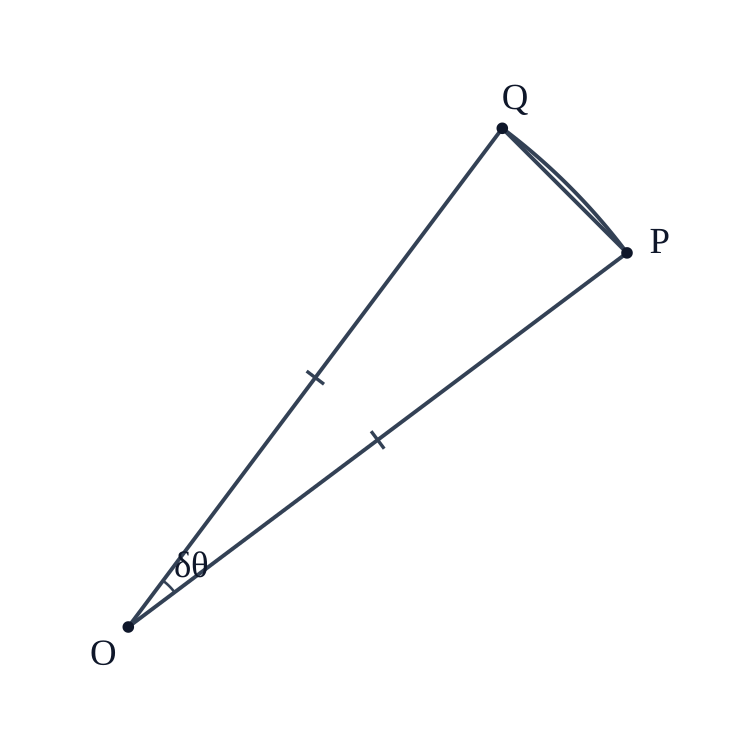
    Let \(\displaystyle P(l,m,n)\) and \(\displaystyle Q(l+\delta l,\ m+\delta m,\ n+\delta n)\); both are at distance \(\displaystyle 1\) from \(\displaystyle O\), and the angle between \(\displaystyle OP\) and \(\displaystyle OQ\) is \(\displaystyle \delta\theta\). NCERT_Solution_Class12_Maths_Exemplar_Ch11_Ex11-3_Q13 \[OP^2=l^2+m^2+n^2=1,\qquad OQ^2=(l+\delta l)^2+(m+\delta m)^2+(n+\delta n)^2=1 \] \[PQ^2=\delta l^2+\delta m^2+\delta n^2 \quad \text{(distance formula)} \] \[PQ^2=OP^2+OQ^2-2\,OP\cdot OQ\cos\delta\theta=2(1-\cos\delta\theta) \quad \text{(cosine rule)} \] \[\delta l^2+\delta m^2+\delta n^2=4\sin^2\frac{\delta\theta}{2} \] \[\sin\frac{\delta\theta}{2}\approx\frac{\delta\theta}{2}\quad (\delta\theta\ \text{small}) \] \[\delta l^2+\delta m^2+\delta n^2=\delta\theta^2 \] Answer: \(\displaystyle \delta\theta^2=\delta l^2+\delta m^2+\delta n^2\)
  4. Exercise 14

    O is the origin and A is (a,b,c)\displaystyle (a, b, c). Find the direction cosines of the line OA and the equation of plane through A at right angle to OA.

    Matches the book, not yet reviewed

    This working reaches the answer NCERT prints. It has not yet been read through by hand.

    NCERT’s answer
    ax + by + cz = \(\displaystyle a^{2}\) + \(\displaystyle b^{2}\) + \(\displaystyle c^{2}\) 14. $\displaystyle (1, 1)$
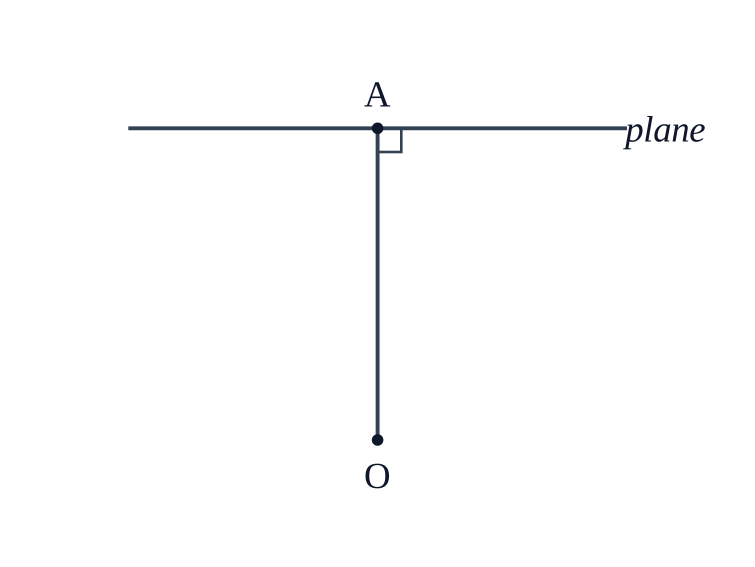
    \[OA=\sqrt{a^2+b^2+c^2} \] \[l=\frac{a}{\sqrt{a^2+b^2+c^2}},\quad m=\frac{b}{\sqrt{a^2+b^2+c^2}},\quad n=\frac{c}{\sqrt{a^2+b^2+c^2}} \] The plane is perpendicular to \(\displaystyle OA\), so \(\displaystyle \overrightarrow{OA}=(a,b,c)\) is its normal, and it passes through \(\displaystyle A\). NCERT_Solution_Class12_Maths_Exemplar_Ch11_Ex11-3_Q14 \[a(x-a)+b(y-b)+c(z-c)=0 \] \[ax+by+cz=a^2+b^2+c^2 \] Answer: d.c. of \(\displaystyle OA\): \(\displaystyle \dfrac{a}{\sqrt{a^2+b^2+c^2}},\ \dfrac{b}{\sqrt{a^2+b^2+c^2}},\ \dfrac{c}{\sqrt{a^2+b^2+c^2}}\); plane: \(\displaystyle ax+by+cz=a^2+b^2+c^2\).
  5. Exercise 15

    Two systems of rectangular axis have the same origin. If a plane cuts them at distances a,b,c\displaystyle a, b, c and a′,b′,c′\displaystyle a^{\prime}, b^{\prime}, c^{\prime}, respectively, from the origin, prove that 1a2+1b2+1c2=1a′2+1b′2+1c′2.\frac{1}{a^2}+\frac{1}{b^2}+\frac{1}{c^2}=\frac{1}{a^{\prime 2}}+\frac{1}{b^{\prime 2}}+\frac{1}{c^{\prime 2}} .

    Not cross-checked

    NCERT prints no numerical answer for this exercise, so this working has not been cross-checked against the book.

    NCERT’s answer
    $\displaystyle 15$° or $\displaystyle 75$°
    In the first system the plane is \[\frac{x}{a}+\frac{y}{b}+\frac{z}{c}=1 \]Distance of the origin from it: \[p=\frac{|0+0+0-1|}{\sqrt{\dfrac{1}{a^2}+\dfrac{1}{b^2}+\dfrac{1}{c^2}}} \] \[\frac{1}{p^2}=\frac{1}{a^2}+\frac{1}{b^2}+\frac{1}{c^2} \] In the second system the same plane is \[\frac{x'}{a'}+\frac{y'}{b'}+\frac{z'}{c'}=1 \] \[\frac{1}{p'^2}=\frac{1}{a'^2}+\frac{1}{b'^2}+\frac{1}{c'^2} \] The origin and the plane are the same, so the perpendicular distance is the same: \[p=p' \] Answer: both sums equal \(\displaystyle \dfrac{1}{p^2}\), so they are equal.
  6. Exercise 16

    Find the foot of perpendicular from the point (2,3,−8)\displaystyle (2,3,-8) to the line 4−x2=y6=1−z3\displaystyle \frac{4-x}{2}=\frac{y}{6}=\frac{1-z}{3}. Also, find the perpendicular distance from the given point to the line.

    Matches the book, not yet reviewed

    This working reaches the answer NCERT prints. It has not yet been read through by hand.

    NCERT’s answer
    ($\displaystyle 2$, $\displaystyle 6$, -$\displaystyle 2$) \(\displaystyle 3 \sqrt{5}\)
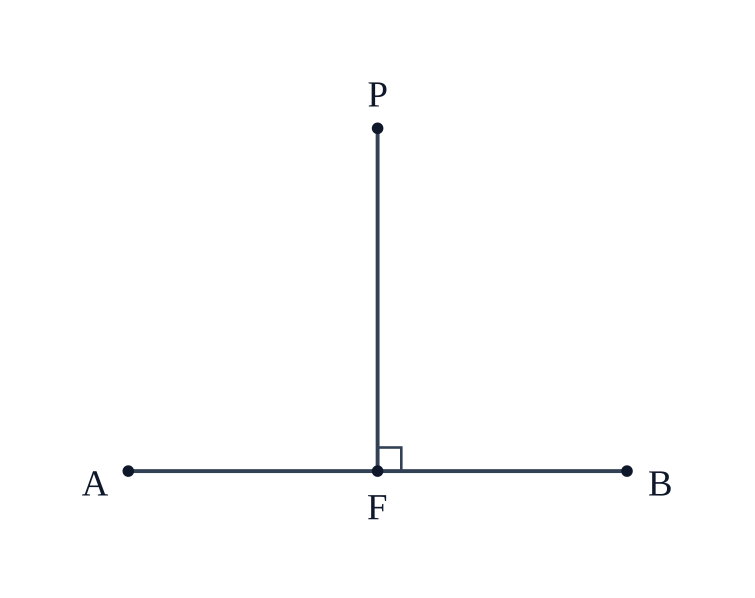
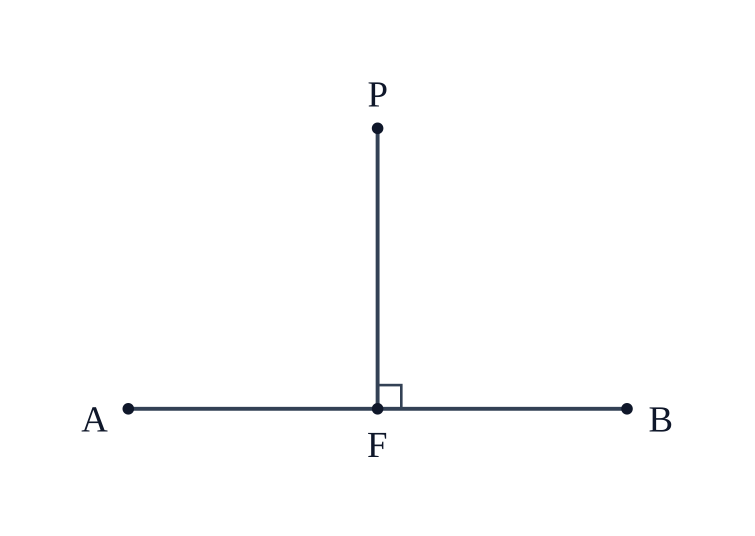
    Rewrite the line: \[\frac{x-4}{-2}=\frac{y}{6}=\frac{z-1}{-3}=\lambda \] NCERT_Solution_Class12_Maths_Exemplar_Ch11_Ex11-3_Q16 Foot \(\displaystyle F\) of the perpendicular from \(\displaystyle P(2,3,-8)\): \[F=(4-2\lambda,\ 6\lambda,\ 1-3\lambda) \] \[\overrightarrow{PF}=(2-2\lambda,\ 6\lambda-3,\ 9-3\lambda) \] \(\displaystyle PF\) is perpendicular to the direction \(\displaystyle (-2,6,-3)\): \[-2(2-2\lambda)+6(6\lambda-3)-3(9-3\lambda)=0 \] \[49\lambda-49=0 \Rightarrow \lambda=1 \] \[F=(2,6,-2) \] \[PF=\sqrt{0^2+3^2+6^2}=\sqrt{45}=3\sqrt{5} \] Answer: foot \(\displaystyle (2,6,-2)\); perpendicular distance \(\displaystyle 3\sqrt{5}\).
  7. Exercise 17

    Find the distance of a point (2,4,−1)\displaystyle (2,4,-1) from the line x+51=y+34=z−6−9\frac{x+5}{1}=\frac{y+3}{4}=\frac{z-6}{-9}

    Matches the book, not yet reviewed

    This working reaches the answer NCERT prints. It has not yet been read through by hand.

    NCERT’s answer
    $\displaystyle 7$
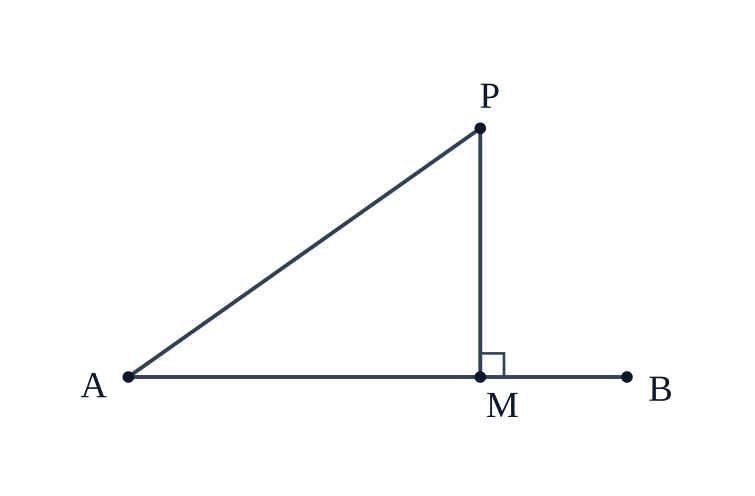
    Point on the line \(\displaystyle A(-5,-3,6)\), direction \(\displaystyle \vec d=(1,4,-9)\), and \(\displaystyle P(2,4,-1)\): \[\overrightarrow{AP}=(7,7,-7) \] NCERT_Solution_Class12_Maths_Exemplar_Ch11_Ex11-3_Q17 \[\overrightarrow{AP}\cdot\vec d=7+28+63=98 \] \[|\overrightarrow{AP}|^2=147,\qquad |\vec d|^2=1+16+81=98 \] With \(\displaystyle M\) the foot of the perpendicular from \(\displaystyle P\): \[AM=\frac{\overrightarrow{AP}\cdot\vec d}{|\vec d|}=\frac{98}{\sqrt{98}}=\sqrt{98} \] \[PM^2=AP^2-AM^2=147-98=49 \] \[PM=7 \] Answer: \(\displaystyle 7\) units.
  8. Exercise 18

    Find the length and the foot of perpendicular from the point (1,32,2)\displaystyle \left(1, \frac{3}{2}, 2\right) to the plane 2x−2y+4z+5=0\displaystyle 2 x-2 y+4 z+5=0.

    Matches the book, not yet reviewed

    This working reaches the answer NCERT prints. It has not yet been read through by hand.

    NCERT’s answer
    \(\displaystyle \sqrt{6}\)
    Length of the perpendicular from \(\displaystyle P\left(1,\tfrac32,2\right)\): \[PF=\frac{|2(1)-2\left(\tfrac32\right)+4(2)+5|}{\sqrt{2^2+(-2)^2+4^2}}=\frac{12}{2\sqrt{6}}=\sqrt{6} \] NCERT_Solution_Class12_Maths_Exemplar_Ch11_Ex11-3_Q18 \(\displaystyle PF\) runs along the normal \(\displaystyle (2,-2,4)\), so \[F=\left(1+2t,\ \tfrac32-2t,\ 2+4t\right) \] \(\displaystyle F\) lies on the plane: \[2(1+2t)-2\left(\tfrac32-2t\right)+4(2+4t)+5=0 \] \[24t+12=0 \Rightarrow t=-\tfrac12 \] \[F=\left(0,\ \tfrac52,\ 0\right) \] Answer: length \(\displaystyle \sqrt{6}\); foot \(\displaystyle \left(0,\tfrac52,0\right)\).
  9. Exercise 19

    Find the equations of the line passing through the point (3,0,1)\displaystyle (3,0,1) and parallel to the planes x+2y=0\displaystyle x+2 y=0 and 3y−z=0\displaystyle 3 y-z=0.

    Matches the book, not yet reviewed

    This working reaches the answer NCERT prints. It has not yet been read through by hand.

    NCERT’s answer
    \(\displaystyle (x-3) \hat{j}+y \hat{j}+(z-1) \hat{k}=\lambda(-2 \hat{i}+\hat{j}+3 \hat{k})\)
    The line is parallel to both planes, so it is perpendicular to both normals \(\displaystyle \vec n_1=(1,2,0)\), \(\displaystyle \vec n_2=(0,3,-1)\): \[\vec d=\vec n_1\times\vec n_2=\begin{vmatrix}\hat i&\hat j&\hat k\\1&2&0\\0&3&-1\end{vmatrix} \] \[\vec d=-2\hat i+\hat j+3\hat k \] \[\vec d\cdot\vec n_1=-2+2+0=0,\qquad \vec d\cdot\vec n_2=0+3-3=0 \] Through \(\displaystyle (3,0,1)\): \[\frac{x-3}{-2}=\frac{y}{1}=\frac{z-1}{3} \] Answer: \(\displaystyle \vec r=3\hat i+\hat k+\lambda(-2\hat i+\hat j+3\hat k)\), i.e. \(\displaystyle \dfrac{x-3}{-2}=\dfrac{y}{1}=\dfrac{z-1}{3}\).
  10. Exercise 20

    Find the equation of the plane through the points (2,1,−1)\displaystyle (2,1,-1) and (−1,3,4)\displaystyle (-1,3,4), and perpendicular to the plane x−2y+4z=10\displaystyle x-2 y+4 z=10.

    Matches the book, not yet reviewed

    This working reaches the answer NCERT prints. It has not yet been read through by hand.

    NCERT’s answer
    18x + 17y + 4z = $\displaystyle 49$
    Let \(\displaystyle A(2,1,-1)\), \(\displaystyle B(-1,3,4)\) and \(\displaystyle \vec n_0=(1,-2,4)\). The required plane contains \(\displaystyle \overrightarrow{AB}\) and is parallel to \(\displaystyle \vec n_0\), so its normal is \(\displaystyle \overrightarrow{AB}\times\vec n_0\). \[\overrightarrow{AB}=(-3,2,5) \] \[\vec n=\begin{vmatrix}\hat i&\hat j&\hat k\\-3&2&5\\1&-2&4\end{vmatrix}=(8+10)\hat i-(-12-5)\hat j+(6-2)\hat k \] \[\vec n=18\hat i+17\hat j+4\hat k \] Plane through \(\displaystyle A\): \[18(x-2)+17(y-1)+4(z+1)=0 \] \[18x+17y+4z-49=0 \] Check at \(\displaystyle B\): \[18(-1)+17(3)+4(4)-49=0 \] Answer: \(\displaystyle 18x+17y+4z=49\).