SolveIt is under development
SolveItNCERT · CBSE · NEET

NCERT Exemplar · Class 12 Mathematics Three Dimensional Geometry

49 questions · 49 still being checked

EXERCISE 11.3 1–10 (part 1 of 5)

  1. Exercise 1

    Find the position vector of a point A in space such that OA→\displaystyle \overrightarrow{\mathrm{OA}} is inclined at 60∘\displaystyle 60^{\circ} to OX and at 45∘\displaystyle 45^{\circ} to OY and ∣OA→∣=10\displaystyle |\overrightarrow{\mathrm{OA}}|=10 units.

    Matches the book, not yet reviewed

    This working reaches the answer NCERT prints. It has not yet been read through by hand.

    NCERT’s answer
    \(\displaystyle 5 \hat{i}+5 \sqrt{2} \hat{j}+5 \hat{k}\)
    Direction cosines of \(\displaystyle \overrightarrow{OA}\) from the two given angles; the third from \(\displaystyle l^2+m^2+n^2=1\).\[l=\cos60^\circ=\tfrac12,\qquad m=\cos45^\circ=\tfrac1{\sqrt2} \]\[l^2+m^2+n^2=1 \;\Rightarrow\; \tfrac14+\tfrac12+n^2=1 \]\[n^2=\tfrac14 \;\Rightarrow\; n=\pm\tfrac12 \]The angle with OZ is not given, so both signs occur.\[\overrightarrow{OA}=|\overrightarrow{OA}|\,(l\hat i+m\hat j+n\hat k)=10\left(\tfrac12\hat i+\tfrac1{\sqrt2}\hat j\pm\tfrac12\hat k\right) \]\[\overrightarrow{OA}=5\hat i+5\sqrt2\,\hat j\pm5\hat k \]\[|\overrightarrow{OA}|^2=25+50+25=100 \quad\checkmark \]Answer: \(\displaystyle \overrightarrow{OA}=5\hat i+5\sqrt2\,\hat j\pm5\hat k\), that is \(\displaystyle A=(5,\,5\sqrt2,\,\pm5)\).
  2. Exercise 2

    Find the vector equation of the line which is parallel to the vector 3i^−2j^+6k^\displaystyle 3 \hat{i}-2 \hat{j}+6 \hat{k} and which passes through the point (1,−2,3)\displaystyle (1,-2,3).

    Check this one against your book

    NCERT’s printed answer for this exercise does not match its own question. This working follows the question as printed.

    A line through the point with position vector \(\displaystyle \vec a\), parallel to \(\displaystyle \vec b\):\[\vec r=\vec a+\lambda\vec b \]\[\vec a=\hat i-2\hat j+3\hat k,\qquad \vec b=3\hat i-2\hat j+6\hat k \]\[\vec r=(\hat i-2\hat j+3\hat k)+\lambda(3\hat i-2\hat j+6\hat k) \]Answer: \(\displaystyle \vec r=(\hat i-2\hat j+3\hat k)+\lambda(3\hat i-2\hat j+6\hat k)\), \(\displaystyle \lambda\) a scalar.
  3. Exercise 3

    Show that the lines x−12=y−23=z−34 and x−45=y−12=z intersect. \begin{aligned} & \frac{x-1}{2}=\frac{y-2}{3}=\frac{z-3}{4} \\ & \text { and } \frac{x-4}{5}=\frac{y-1}{2}=z \text { intersect. } \end{aligned} Also, find their point of intersection.

    Matches the book, not yet reviewed

    This working reaches the answer NCERT prints. It has not yet been read through by hand.

    NCERT’s answer
    (-$\displaystyle 1$, - $\displaystyle 1$, - $\displaystyle 1$)
    Take a general point on each line.\[\frac{x-1}{2}=\frac{y-2}{3}=\frac{z-3}{4}=\lambda \;\Rightarrow\; (2\lambda+1,\; 3\lambda+2,\; 4\lambda+3) \]\[\frac{x-4}{5}=\frac{y-1}{2}=\frac{z}{1}=\mu \;\Rightarrow\; (5\mu+4,\; 2\mu+1,\; \mu) \]The lines meet if the two points coincide for some \(\displaystyle \lambda,\mu\).\[2\lambda+1=5\mu+4 \qquad (1) \]\[3\lambda+2=2\mu+1 \qquad (2) \]\[4\lambda+3=\mu \qquad (3) \]Put \(\displaystyle \mu=4\lambda+3\) from ($\displaystyle 3$) into ($\displaystyle 1$).\[2\lambda+1=5(4\lambda+3)+4 \;\Rightarrow\; -18\lambda=18 \;\Rightarrow\; \lambda=-1,\quad \mu=-1 \]Check in ($\displaystyle 2$).\[3(-1)+2=-1,\qquad 2(-1)+1=-1 \quad\checkmark \]All three equations hold, so the lines intersect.\[(2\lambda+1,\,3\lambda+2,\,4\lambda+3)\big|_{\lambda=-1}=(-1,\,-1,\,-1) \]\[(5\mu+4,\,2\mu+1,\,\mu)\big|_{\mu=-1}=(-1,\,-1,\,-1) \]Answer: The lines intersect at \(\displaystyle (-1,-1,-1)\).
  4. Exercise 4

    Find the angle between the lines r⃗=3i^−2j^+6k^+λ(2i^+j^+2k^) and r⃗=(2j^−5k^)+μ(6i^+3j^+2k^)\vec{r}=3 \hat{i}-2 \hat{j}+6 \hat{k}+\lambda(2 \hat{i}+\hat{j}+2 \hat{k}) \text { and } \vec{r}=(2 \hat{j}-5 \hat{k})+\mu(6 \hat{i}+3 \hat{j}+2 \hat{k})

    Matches the book, not yet reviewed

    This working reaches the answer NCERT prints. It has not yet been read through by hand.

    NCERT’s answer
    \(\displaystyle \cos ^{-1}\left(\frac{19}{21}\right)\)
    The angle between the lines is the angle between their direction vectors.\[\vec b_1=2\hat i+\hat j+2\hat k,\qquad \vec b_2=6\hat i+3\hat j+2\hat k \]\[\vec b_1\cdot\vec b_2=12+3+4=19 \]\[|\vec b_1|=\sqrt{4+1+4}=3,\qquad |\vec b_2|=\sqrt{36+9+4}=7 \]\[\cos\theta=\frac{\vec b_1\cdot\vec b_2}{|\vec b_1|\,|\vec b_2|}=\frac{19}{3\times7}=\frac{19}{21} \]Answer: \(\displaystyle \theta=\cos^{-1}\dfrac{19}{21}\).
  5. Exercise 5

    Prove that the line through A (0,−1,−1)\displaystyle (0,-1,-1) and B (4,5,1)\displaystyle (4,5,1) intersects the line through C (3,9,4)\displaystyle (3,9,4) and D (−4,4,4)\displaystyle (-4,4,4).

    Not cross-checked

    NCERT prints no numerical answer for this exercise, so this working has not been cross-checked against the book.

    Write each line in parametric form and look for a common point.\[\overrightarrow{AB}=(4,\,6,\,2)\parallel(2,\,3,\,1),\qquad \overrightarrow{CD}=(-7,\,-5,\,0)\parallel(7,\,5,\,0) \]\[AB:\ (x,y,z)=(0,-1,-1)+\lambda(2,3,1)=(2\lambda,\;3\lambda-1,\;\lambda-1) \]\[CD:\ (x,y,z)=(3,9,4)+\mu(7,5,0)=(3+7\mu,\;9+5\mu,\;4) \]Equate the \(\displaystyle z\)-coordinates, then the \(\displaystyle x\)-coordinates.\[\lambda-1=4 \;\Rightarrow\; \lambda=5 \]\[2\lambda=3+7\mu \;\Rightarrow\; 10=3+7\mu \;\Rightarrow\; \mu=1 \]Check the \(\displaystyle y\)-coordinates.\[3\lambda-1=14,\qquad 9+5\mu=14 \quad\checkmark \]The same \(\displaystyle \lambda,\mu\) satisfy all three coordinates, so the lines meet.\[(2\lambda,\,3\lambda-1,\,\lambda-1)\big|_{\lambda=5}=(10,\,14,\,4) \]Answer: AB and CD intersect at \(\displaystyle (10,14,4)\).
  6. Exercise 6

    Prove that the lines x=py+q,z=ry+s\displaystyle x=p y+q, z=r y+s and x=p′y+q′,z=r′y+s′\displaystyle x=p^{\prime} y+q^{\prime}, z=r^{\prime} y+s^{\prime} are perpendicular if pp′+rr′+1=0\displaystyle p p^{\prime}+r r^{\prime}+1=0.

    Not cross-checked

    NCERT prints no numerical answer for this exercise, so this working has not been cross-checked against the book.

    Put \(\displaystyle y=t\). Each line is then a point plus \(\displaystyle t\) times a direction.\[(x,y,z)=(pt+q,\;t,\;rt+s)=(q,0,s)+t\,(p,\,1,\,r) \]\[(x,y,z)=(p't+q',\;t,\;r't+s')=(q',0,s')+t\,(p',\,1,\,r') \]Direction ratios are \(\displaystyle (p,1,r)\) and \(\displaystyle (p',1,r')\). The lines are perpendicular when\[a_1a_2+b_1b_2+c_1c_2=0 \]\[p\,p'+1\cdot1+r\,r'=0 \]\[pp'+rr'+1=0 \]This is the given condition, so the lines are perpendicular.Answer: Direction ratios \(\displaystyle (p,1,r)\) and \(\displaystyle (p',1,r')\) are orthogonal exactly when \(\displaystyle pp'+rr'+1=0\).
  7. Exercise 7

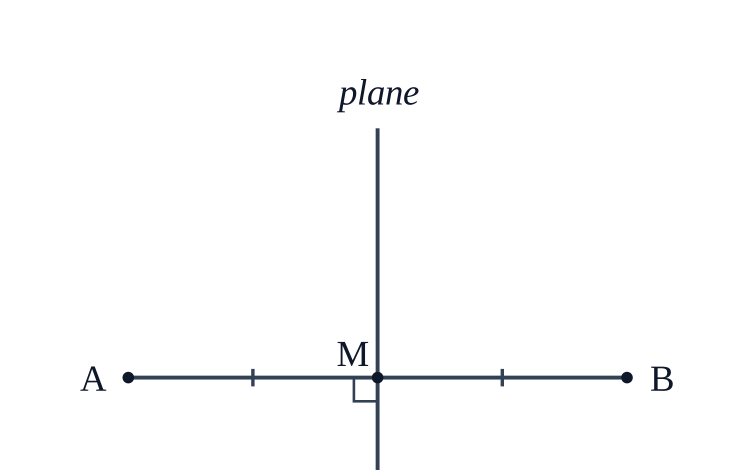
    Find the equation of a plane which bisects perpendicularly the line joining the points A(2,3,4)\displaystyle \mathrm{A}(2,3,4) and B(4,5,8)\displaystyle \mathrm{B}(4,5,8) at right angles.

    Matches the book, not yet reviewed

    This working reaches the answer NCERT prints. It has not yet been read through by hand.

    NCERT’s answer
    x + y + 2z = $\displaystyle 19$
    The plane passes through the midpoint \(\displaystyle M\) of AB, with \(\displaystyle \overrightarrow{AB}\) as its normal. NCERT_Solution_Class12_Maths_Exemplar_Ch11_Ex11-3_Q7 \[M=\left(\tfrac{2+4}{2},\ \tfrac{3+5}{2},\ \tfrac{4+8}{2}\right)=(3,4,6) \] \[\overrightarrow{AB}=(4-2,\ 5-3,\ 8-4)=(2,2,4) \] Plane through \(\displaystyle M\) with normal \(\displaystyle \overrightarrow{AB}\): \[2(x-3)+2(y-4)+4(z-6)=0 \] \[2x+2y+4z=38 \] \[x+y+2z=19 \] Answer: \(\displaystyle x+y+2z=19\).
  8. Exercise 8

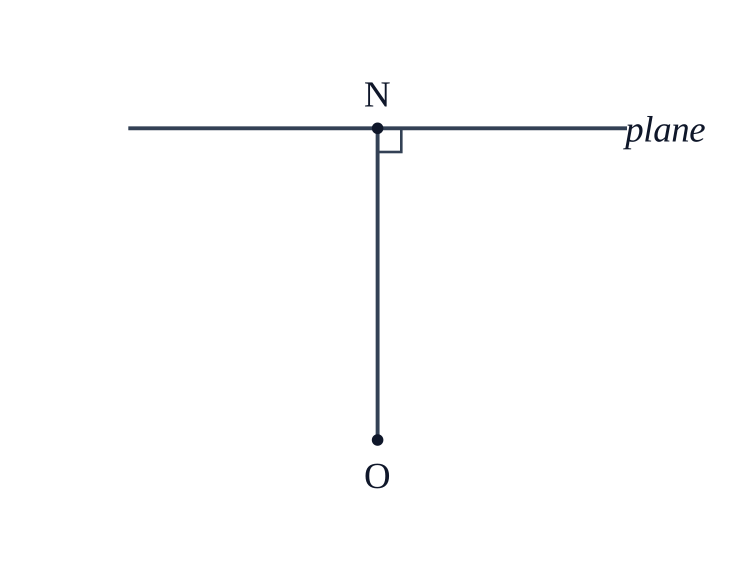
    Find the equation of a plane which is at a distance 33\displaystyle 3 \sqrt{3} units from origin and the normal to which is equally inclined to coordinate axis.

    Matches the book, not yet reviewed

    This working reaches the answer NCERT prints. It has not yet been read through by hand.

    NCERT’s answer
    x + y + z = $\displaystyle 9$
    The unit normal \(\displaystyle \hat n=(l,m,n)\) is equally inclined to the axes, so \(\displaystyle l=m=n\); the plane is at distance \(\displaystyle p=3\sqrt3\) from \(\displaystyle O\). NCERT_Solution_Class12_Maths_Exemplar_Ch11_Ex11-3_Q8 \[l^2+m^2+n^2=1 \] \[3l^2=1 \;\Rightarrow\; l=m=n=\tfrac{1}{\sqrt3} \] \[lx+my+nz=p \] \[\tfrac{1}{\sqrt3}(x+y+z)=3\sqrt3 \] \[x+y+z=9 \] The opposite normal, \(\displaystyle l=m=n=-\tfrac1{\sqrt3}\), gives the plane on the other side of \(\displaystyle O\): \[x+y+z=-9 \] Answer: \(\displaystyle x+y+z=9\) (and \(\displaystyle x+y+z=-9\) for the opposite normal).
  9. Exercise 9

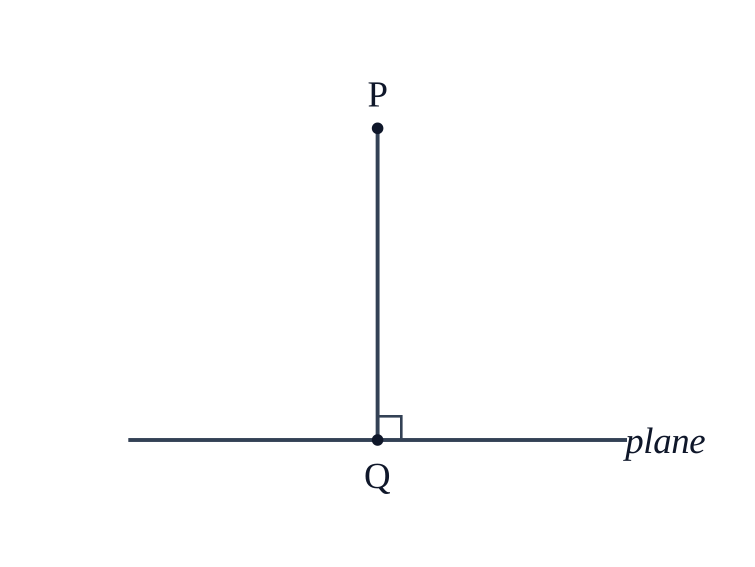
    If the line drawn from the point (−2,−1,−3)\displaystyle (-2,-1,-3) meets a plane at right angle at the point (1,−3,3)\displaystyle (1,-3,3), find the equation of the plane.

    Matches the book, not yet reviewed

    This working reaches the answer NCERT prints. It has not yet been read through by hand.

    NCERT’s answer
    3x - 2y + 6z - $\displaystyle 27$ = $\displaystyle 0$
    The line from \(\displaystyle P(-2,-1,-3)\) is perpendicular to the plane at \(\displaystyle Q(1,-3,3)\), so \(\displaystyle \overrightarrow{PQ}\) is a normal to the plane. NCERT_Solution_Class12_Maths_Exemplar_Ch11_Ex11-3_Q9 \[\overrightarrow{PQ}=(1+2,\,-3+1,\,3+3)=(3,-2,6) \] \[3(x-1)-2(y+3)+6(z-3)=0 \] \[3x-2y+6z-27=0 \] Answer: \(\displaystyle 3x-2y+6z=27\).
  10. Exercise 10

    Find the equation of the plane through the points (2,1,0),(3,−2,−2)\displaystyle (2,1,0),(3,-2,-2) and (3,1,7)\displaystyle (3,1,7).

    Matches the book, not yet reviewed

    This working reaches the answer NCERT prints. It has not yet been read through by hand.

    NCERT’s answer
    21x + 9y - 3z - $\displaystyle 51$ = $\displaystyle 0$
    Let \(\displaystyle A(2,1,0)\), \(\displaystyle B(3,-2,-2)\), \(\displaystyle C(3,1,7)\). Two vectors in the plane: \[\overrightarrow{AB}=(1,-3,-2),\qquad \overrightarrow{AC}=(1,0,7) \] A normal is their cross product: \[\overrightarrow{AB}\times\overrightarrow{AC}=\begin{vmatrix}\mathbf i&\mathbf j&\mathbf k\\ 1&-3&-2\\ 1&0&7\end{vmatrix}=-21\,\mathbf i-9\,\mathbf j+3\,\mathbf k \] \[\mathbf n\parallel(7,3,-1) \] Plane through \(\displaystyle A\): \[7(x-2)+3(y-1)-(z-0)=0 \] \[7x+3y-z=17 \] Check at \(\displaystyle B\) and \(\displaystyle C\): \[7(3)+3(-2)-(-2)=17,\qquad 7(3)+3(1)-7=17 \] Answer: \(\displaystyle 7x+3y-z=17\)