SolveIt is under development
SolveItNCERT · CBSE · NEET

NCERT Exemplar · Class 12 Mathematics Differential Equations

77 questions · 77 still being checked

EXERCISE 9.3 31–40 (part 4 of 8)

  1. Exercise 31

    Find the equation of a curve passing through origin if the slope of the tangent to the curve at any point (x,y)\displaystyle (x, y) is equal to the square of the difference of the abcissa and ordinate of the point.

    Matches the book, not yet reviewed

    This working reaches the answer NCERT prints. It has not yet been read through by hand.

    NCERT’s answer
    \(\displaystyle k e^{2 x}(1-x+y)=1+x-y\)
    Slope of the tangent: \[\frac{dy}{dx} = (x-y)^2 \] Put \(\displaystyle z = x - y\): \[\frac{dz}{dx} = 1 - \frac{dy}{dx} = 1 - z^2 \] \[\frac{dz}{1-z^2} = dx \] \[\frac12\log\left|\frac{1+z}{1-z}\right| = x + c \] Through \(\displaystyle (0,0)\), \(\displaystyle z = 0\): \[c = 0 \] \[\frac{1+z}{1-z} = e^{2x} \] \[z = \frac{e^{2x}-1}{e^{2x}+1} \] Answer: \(\displaystyle x - y = \dfrac{e^{2x}-1}{e^{2x}+1} \), i.e. \(\displaystyle y = x - \tanh x \)
  2. Exercise 32

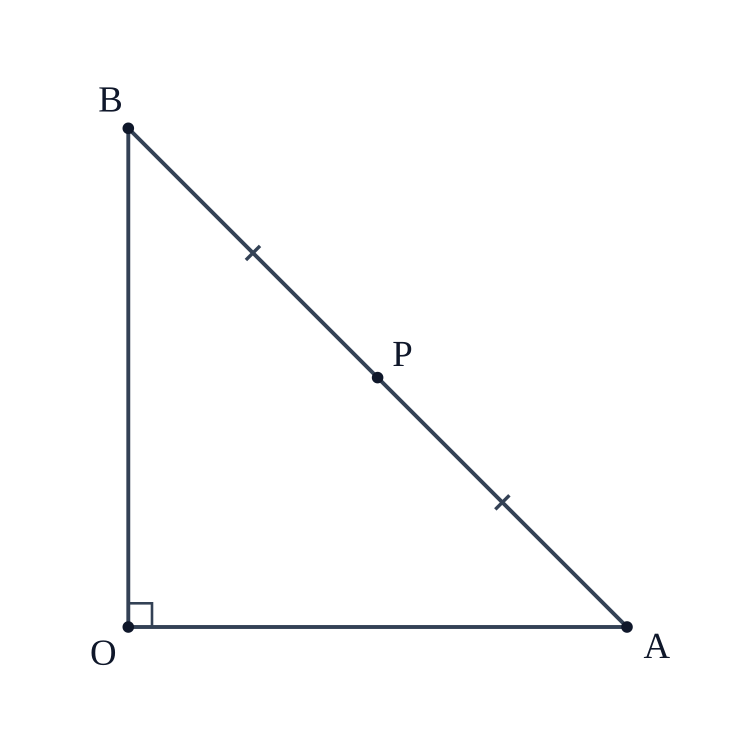
    Find the equation of a curve passing through the point (1,1)\displaystyle (1,1). If the tangent drawn at any point P(x,y)\displaystyle \mathrm{P}(x, y) on the curve meets the co-ordinate axes at A and B such that P is the mid-point of AB.

    Matches the book, not yet reviewed

    This working reaches the answer NCERT prints. It has not yet been read through by hand.

    NCERT’s answer
    \(\displaystyle x y=1\)
    \(\displaystyle P(x,y)\) is the mid-point of \(\displaystyle AB\), with \(\displaystyle A\) on the \(\displaystyle x\)-axis and \(\displaystyle B\) on the \(\displaystyle y\)-axis: \[A = (2x,\,0), \qquad B = (0,\,2y) \] NCERT_Solution_Class12_Maths_Exemplar_Ch9_Ex9-3_Q32 The tangent is the line \(\displaystyle AB\): \[\frac{dy}{dx} = \frac{2y - 0}{0 - 2x} = -\frac{y}{x} \] \[\frac{dy}{y} = -\frac{dx}{x} \] \[\log y = -\log x + \log C \] \[xy = C \] Through \(\displaystyle (1,1)\): \[C = 1 \] Answer: \(\displaystyle xy = 1 \)
  3. Exercise 33

    Solve : xdydx=y(log⁡y−log⁡x+1)\displaystyle x \frac{d y}{d x}=y(\log y-\log x+1)

    Matches the book, not yet reviewed

    This working reaches the answer NCERT prints. It has not yet been read through by hand.

    NCERT’s answer
    \(\displaystyle \log \left(\frac{x}{y}\right)=c x\)
    Homogeneous equation; put \(\displaystyle y = vx\).\[x\frac{dy}{dx} = y\left(\log\frac{y}{x} + 1\right) \]\[\frac{dy}{dx} = v + x\frac{dv}{dx} \]\[v + x\frac{dv}{dx} = v(\log v + 1) \]\[x\frac{dv}{dx} = v\log v \]\[\int \frac{dv}{v\log v} = \int \frac{dx}{x} \]\[\log|\log v| = \log|x| + \log|C| \]\[\log v = Cx \]\[\frac{y}{x} = e^{Cx} \]Answer: \(\displaystyle y = x\,e^{Cx}\), \(\displaystyle C\) an arbitrary constant.
  4. Choose the correct answer from the given four options in each of the Exercises from $\displaystyle 34$ to $\displaystyle 75$ (M.C.Q)

    Exercise 34

    The degree of the differential equation (d2ydx2)2+(dydx)2=xsin⁡(dydx)\displaystyle \left(\frac{d^2 y}{d x^2}\right)^2+\left(\frac{d y}{d x}\right)^2=x \sin \left(\frac{d y}{d x}\right) is:
    (A)
    1\displaystyle 1 (B) 2\displaystyle 2 (C) 3\displaystyle 3 (D) not defined

    Matches the book, not yet reviewed

    This working reaches the answer NCERT prints. It has not yet been read through by hand.

    NCERT’s answer
    D
    (D) not defined. The right side contains \(\displaystyle \sin\left(\frac{dy}{dx}\right)\), which is not a polynomial in \(\displaystyle \frac{dy}{dx}\):\[\sin\left(\frac{dy}{dx}\right) = \frac{dy}{dx} - \frac{1}{3!}\left(\frac{dy}{dx}\right)^3 + \frac{1}{5!}\left(\frac{dy}{dx}\right)^5 - \cdots \]so the equation is not polynomial in its derivatives and has no degree.
  5. Exercise 35

    The degree of the differential equation [1+(dydx)2]32=d2ydx2\displaystyle \left[1+\left(\frac{d y}{d x}\right)^2\right]^{\frac{3}{2}}=\frac{d^2 y}{d x^2} is
    (A)
    4\displaystyle 4 (B) 32\displaystyle \frac{3}{2}
    (C)
    not defined

    Matches the book, not yet reviewed

    This working reaches the answer NCERT prints. It has not yet been read through by hand.

    NCERT’s answer
    C
    (C) not defined. The derivative \(\displaystyle \frac{dy}{dx}\) sits inside a fractional power, so the equation is not a polynomial in its derivatives:\[\left[1+\left(\frac{dy}{dx}\right)^2\right]^{\frac{3}{2}} \Rightarrow \text{degree not defined} \]
  6. Exercise 36

    The order and degree of the differential equation d2ydx2+(dydx)14+x15=0\displaystyle \frac{d^2 y}{d x^2}+\left(\frac{d y}{d x}\right)^{\frac{1}{4}}+x^{\frac{1}{5}}=0, respectively, are
    (A)
    2\displaystyle 2 and not defined
    (B)
    2\displaystyle 2 and 2\displaystyle 2
    (C)
    2\displaystyle 2 and 3\displaystyle 3
    (D)
    3\displaystyle 3 and 3\displaystyle 3

    Matches the book, not yet reviewed

    This working reaches the answer NCERT prints. It has not yet been read through by hand.

    NCERT’s answer
    A
    (A) \(\displaystyle 2\) and not defined. The order comes from the highest derivative:\[\frac{d^2y}{dx^2} \Rightarrow \text{order} = 2 \]The derivative \(\displaystyle \frac{dy}{dx}\) carries a fractional power, so the equation is not a polynomial in its derivatives:\[\left(\frac{dy}{dx}\right)^{\frac{1}{4}} \Rightarrow \text{degree not defined} \]
  7. Exercise 37

    If y=e−x(Acos⁡x+Bsin⁡x)\displaystyle y=e^{-x}(\operatorname{Acos} x+\operatorname{Bsin} x), then y\displaystyle y is a solution of
    (A)
    d2ydx2+2dydx=0\displaystyle \frac{d^2 y}{d x^2}+2 \frac{d y}{d x}=0
    (B)
    d2ydx2−2dydx+2y=0\displaystyle \frac{d^2 y}{d x^2}-2 \frac{d y}{d x}+2 y=0
    (C)
    d2ydx2+2dydx+2y=0\displaystyle \frac{d^2 y}{d x^2}+2 \frac{d y}{d x}+2 y=0
    (D)
    d2ydx2+2y=0\displaystyle \frac{d^2 y}{d x^2}+2 y=0

    Matches the book, not yet reviewed

    This working reaches the answer NCERT prints. It has not yet been read through by hand.

    NCERT’s answer
    C
    (C) \(\displaystyle \frac{d^2y}{dx^2}+2\frac{dy}{dx}+2y=0\).\[y = e^{-x}u, \quad u = A\cos x + B\sin x, \quad u'' = -u \]\[y' = e^{-x}(u' - u) \]\[y'' = e^{-x}(u'' - 2u' + u) = -2e^{-x}u' \]\[y'' + 2y' + 2y = e^{-x}\left(-2u' + 2u' - 2u + 2u\right) = 0 \]
  8. Exercise 38

    The differential equation for y=Acos⁡αx+Bsin⁡αx\displaystyle y=\mathrm{A} \cos \alpha x+\mathrm{B} \sin \alpha x, where A and B are arbitrary constants is
    (A)
    d2ydx2−α2y=0\displaystyle \frac{d^2 y}{d x^2}-\alpha^2 y=0
    (B)
    d2ydx2+α2y=0\displaystyle \frac{d^2 y}{d x^2}+\alpha^2 y=0
    (C)
    d2ydx2+αy=0\displaystyle \frac{d^2 y}{d x^2}+\alpha y=0
    (D)
    d2ydx2−αy=0\displaystyle \frac{d^2 y}{d x^2}-\alpha y=0

    Matches the book, not yet reviewed

    This working reaches the answer NCERT prints. It has not yet been read through by hand.

    NCERT’s answer
    B
    (B) \(\displaystyle \frac{d^2y}{dx^2}+\alpha^2 y=0\).\[\frac{dy}{dx} = -A\alpha\sin\alpha x + B\alpha\cos\alpha x \]\[\frac{d^2y}{dx^2} = -\alpha^2\left(A\cos\alpha x + B\sin\alpha x\right) = -\alpha^2 y \]\[\frac{d^2y}{dx^2} + \alpha^2 y = 0 \]
  9. Exercise 39

    Solution of differential equation xdy−ydx=0\displaystyle x d y-y d x=0 represents :
    (A)
    a rectangular hyperbola
    (B)
    parabola whose vertex is at origin
    (C)
    straight line passing through origin
    (D)
    a circle whose centre is at origin

    Matches the book, not yet reviewed

    This working reaches the answer NCERT prints. It has not yet been read through by hand.

    NCERT’s answer
    C
    (C) straight line passing through origin.\[x\,dy - y\,dx = 0 \Rightarrow \frac{dy}{y} = \frac{dx}{x} \]\[\log|y| = \log|x| + \log|c| \]\[y = cx \]This is a line through the origin with slope \(\displaystyle c\).
  10. Exercise 40

    Integrating factor of the differential equation cos⁡xdydx+ysin⁡x=1\displaystyle \cos x \frac{d y}{d x}+y \sin x=1 is :
    (A)
    cos⁡x\displaystyle \cos x
    (B)
    tan⁡x\displaystyle \tan x
    (C)
    sec⁡x\displaystyle \sec x
    (D)
    sin⁡x\displaystyle \sin x

    Matches the book, not yet reviewed

    This working reaches the answer NCERT prints. It has not yet been read through by hand.

    NCERT’s answer
    C
    (C) \(\displaystyle \sec x\). Divide by \(\displaystyle \cos x\) to reach \(\displaystyle \frac{dy}{dx} + Py = Q\):\[\frac{dy}{dx} + y\tan x = \sec x \]\[\text{I.F.} = e^{\int \tan x\,dx} = e^{\log|\sec x|} = \sec x \]