SolveIt is under development
SolveItNCERT · CBSE · NEET

NCERT Exemplar · Class 12 Mathematics Differential Equations

77 questions · 77 still being checked

EXERCISE 9.3 21–30 (part 3 of 8)

  1. Exercise 21

    Solve the differential equation dy=cos⁡x(2−ycosec⁡x)dx\displaystyle d y=\cos x(2-y \operatorname{cosec} x) d x given that y=2\displaystyle y=2 when x=π2.x=\frac{\pi}{2} .

    Matches the book, not yet reviewed

    This working reaches the answer NCERT prints. It has not yet been read through by hand.

    NCERT’s answer
    \(\displaystyle y \sin x=\frac{-\cos 2 x}{2}+\frac{3}{2}\)
    Rewrite as a linear equation: \[\frac{dy}{dx}=2\cos x-y\cot x \] \[\frac{dy}{dx}+y\cot x=2\cos x \] \[\text{I.F.}=e^{\int\cot x\,dx}=\sin x \] \[y\sin x=\int2\sin x\cos x\,dx=\sin^2x+C \] Use \(\displaystyle y=2\) at \(\displaystyle x=\frac{\pi}{2}\): \[2\cdot1=1+C\;\Rightarrow\;C=1 \] \[y\sin x=\sin^2x+1 \] Answer: \(\displaystyle y=\sin x+\operatorname{cosec}x\)
  2. Exercise 22

    Form the differential equation by eliminating A and B in Ax2+By2=1\displaystyle \mathrm{A} x^2+\mathrm{B} y^2=1.

    Check this one against your book

    NCERT’s printed answer for this exercise does not match its own question. This working follows the question as printed.

    Differentiate the relation twice with respect to \(\displaystyle x\): \[Ax^2+By^2=1 \] \[Ax+By\,y'=0 \] \[A+B\left(y'^2+y\,y''\right)=0 \] From the first derivative \(\displaystyle A=-\dfrac{By\,y'}{x}\); substitute in the second: \[-\frac{By\,y'}{x}+B\left(y'^2+y\,y''\right)=0 \] \[xy\,y''+x\,y'^2-y\,y'=0 \] Answer: \(\displaystyle xy\dfrac{d^2y}{dx^2}+x\left(\dfrac{dy}{dx}\right)^2-y\dfrac{dy}{dx}=0\)
  3. Exercise 23

    Solve the differential equation (1+y2)tan⁡−1xdx+2y(1+x2)dy=0\displaystyle \left(1+y^2\right) \tan ^{-1} x d x+2 y\left(1+x^2\right) d y=0.

    Matches the book, not yet reviewed

    This working reaches the answer NCERT prints. It has not yet been read through by hand.

    NCERT’s answer
    \(\displaystyle \frac{1}{2}\left(\tan ^{-1} x\right)^2+\log \left(1+y^2\right)=c\)
    Divide by \(\displaystyle (1+x^2)(1+y^2)\): \[\frac{\tan^{-1}x}{1+x^2}\,dx+\frac{2y}{1+y^2}\,dy=0 \] \[\int\frac{\tan^{-1}x}{1+x^2}\,dx+\int\frac{2y}{1+y^2}\,dy=C_1 \] \[\frac{(\tan^{-1}x)^2}{2}+\log(1+y^2)=C_1 \] Answer: \(\displaystyle (\tan^{-1}x)^2+2\log(1+y^2)=C\)
  4. Exercise 24

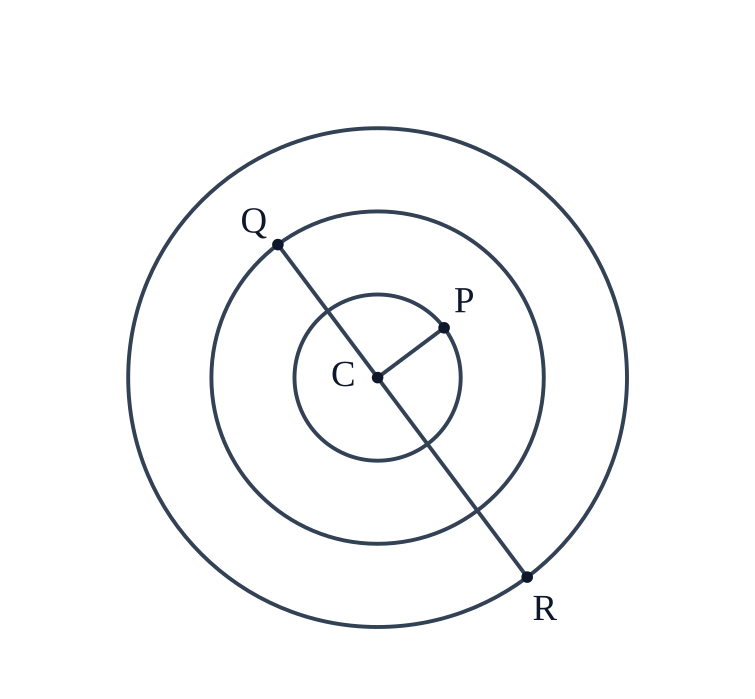
    Find the differential equation of system of concentric circles with centre (1,2)\displaystyle (1,2).

    Matches the book, not yet reviewed

    This working reaches the answer NCERT prints. It has not yet been read through by hand.

    NCERT’s answer
    \(\displaystyle (x-1)+(y-2) \frac{d y}{d x}=0\)
    NCERT_Solution_Class12_Maths_Exemplar_Ch9_Ex9-3_Q24 Circles with centre \(\displaystyle (1,2)\) and radius \(\displaystyle r\): \[(x-1)^2+(y-2)^2=r^2 \] Differentiate to eliminate \(\displaystyle r\): \[2(x-1)+2(y-2)\frac{dy}{dx}=0 \] \[(x-1)+(y-2)\frac{dy}{dx}=0 \] Answer: \(\displaystyle (x-1)+(y-2)\dfrac{dy}{dx}=0\)
  5. Exercise 25

    Solve : y+ddx(xy)=x(sin⁡x+log⁡x)\displaystyle y+\frac{d}{d x}(x y)=x(\sin x+\log x)

    Matches the book, not yet reviewed

    This working reaches the answer NCERT prints. It has not yet been read through by hand.

    NCERT’s answer
    \(\displaystyle y=-\cos x+\frac{2 \sin x}{x}+\frac{2 \cos x}{x^2}+\frac{x \log x}{3}-\frac{x}{9}+c x^{-2}\)
    Expand the product: \[y + y + x\frac{dy}{dx} = x(\sin x + \log x) \] \[\frac{dy}{dx} + \frac{2}{x}\,y = \sin x + \log x \] Linear in \(\displaystyle y\): \[\text{I.F.} = e^{\int \frac{2}{x}\,dx} = x^2 \] \[\frac{d}{dx}\left(x^2 y\right) = x^2\sin x + x^2\log x \] By parts: \[\int x^2\sin x\,dx = -x^2\cos x + 2\int x\cos x\,dx = -x^2\cos x + 2x\sin x + 2\cos x \] \[\int x^2\log x\,dx = \frac{x^3}{3}\log x - \int\frac{x^2}{3}\,dx = \frac{x^3}{3}\log x - \frac{x^3}{9} \] \[x^2 y = -x^2\cos x + 2x\sin x + 2\cos x + \frac{x^3}{3}\log x - \frac{x^3}{9} + C \] Answer: \(\displaystyle y = -\cos x + \dfrac{2\sin x}{x} + \dfrac{2\cos x}{x^2} + \dfrac{x}{3}\log x - \dfrac{x}{9} + \dfrac{C}{x^2} \)
  6. Exercise 26

    Find the general solution of (1+tan⁡y)(dx−dy)+2xdy=0\displaystyle (1+\tan y)(d x-d y)+2 x d y=0.

    Matches the book, not yet reviewed

    This working reaches the answer NCERT prints. It has not yet been read through by hand.

    NCERT’s answer
    \(\displaystyle x(\sin y+\cos y)=\sin y+c e^{-y}\)
    Take \(\displaystyle x\) as the dependent variable: \[(1+\tan y)\,dx + (2x - 1 - \tan y)\,dy = 0 \] \[\frac{dx}{dy} + \frac{2}{1+\tan y}\,x = 1 \] \[\frac{2}{1+\tan y} = \frac{2\cos y}{\cos y+\sin y} = 1 + \frac{\cos y - \sin y}{\cos y + \sin y} \] \[\int\frac{2}{1+\tan y}\,dy = y + \log(\sin y + \cos y) \] \[\text{I.F.} = e^{y}(\sin y + \cos y) \] \[x\,e^{y}(\sin y + \cos y) = \int e^{y}(\sin y + \cos y)\,dy \] Since \[\frac{d}{dy}\left(e^{y}\sin y\right) = e^{y}(\sin y + \cos y) \] \[x\,e^{y}(\sin y + \cos y) = e^{y}\sin y + C \] Answer: \(\displaystyle x(\sin y + \cos y) = \sin y + Ce^{-y} \)
  7. Exercise 27

    Solve : dydx=cos⁡(x+y)+sin⁡(x+y)\displaystyle \frac{d y}{d x}=\cos (x+y)+\sin (x+y).[Hint: Substitute x+y=z\displaystyle x+y=z ]

    Matches the book, not yet reviewed

    This working reaches the answer NCERT prints. It has not yet been read through by hand.

    NCERT’s answer
    \(\displaystyle \log \left|1+\tan \left(\frac{x+y}{2}\right)\right|=x+c\)
    Put \(\displaystyle z = x + y\): \[\frac{dz}{dx} = 1 + \cos z + \sin z \] \[1 + \cos z + \sin z = 2\cos^2\frac z2 + 2\sin\frac z2\cos\frac z2 = 2\cos^2\frac z2\left(1 + \tan\frac z2\right) \] \[\frac{\tfrac12\sec^2\frac z2\,dz}{1 + \tan\frac z2} = dx \] \[\log\left|1 + \tan\frac z2\right| = x + c \] \[1 + \tan\frac{x+y}{2} = Ce^{x} \] Answer: \(\displaystyle \tan\dfrac{x+y}{2} = Ce^{x} - 1 \)
  8. Exercise 28

    Find the general solution of dydx−3y=sin⁡2x\displaystyle \frac{d y}{d x}-3 y=\sin 2 x.

    Matches the book, not yet reviewed

    This working reaches the answer NCERT prints. It has not yet been read through by hand.

    NCERT’s answer
    \(\displaystyle y=-\left[\frac{3 \sin 2 x+2 \cos 2 x}{13}\right]+c e^{3 x}\)
    Linear in \(\displaystyle y\): \[\text{I.F.} = e^{\int -3\,dx} = e^{-3x} \] \[\frac{d}{dx}\left(y\,e^{-3x}\right) = e^{-3x}\sin 2x \] \[\int e^{ax}\sin bx\,dx = \frac{e^{ax}(a\sin bx - b\cos bx)}{a^2+b^2} \] With \(\displaystyle a=-3,\ b=2\): \[y\,e^{-3x} = \frac{e^{-3x}\left(-3\sin 2x - 2\cos 2x\right)}{13} + C \] Answer: \(\displaystyle y = -\dfrac{3\sin 2x + 2\cos 2x}{13} + Ce^{3x} \)
  9. Exercise 29

    Find the equation of a curve passing through (2,1)\displaystyle (2,1) if the slope of the tangent to the curve at any point (x,y)\displaystyle (x, y) is x2+y22xy\displaystyle \frac{x^2+y^2}{2 x y}.

    Matches the book, not yet reviewed

    This working reaches the answer NCERT prints. It has not yet been read through by hand.

    NCERT’s answer
    \(\displaystyle 2\left(x^2-y^2\right)=3 x\)
    Slope of the tangent: \[\frac{dy}{dx} = \frac{x^2+y^2}{2xy} \] Homogeneous; put \(\displaystyle y = vx\): \[v + x\frac{dv}{dx} = \frac{1+v^2}{2v} \] \[x\frac{dv}{dx} = \frac{1-v^2}{2v} \] \[\frac{2v\,dv}{1-v^2} = \frac{dx}{x} \] \[-\log|1-v^2| = \log|x| + \log|c| \] \[x(1-v^2) = C \] \[x^2 - y^2 = Cx \] Through \(\displaystyle (2,1)\): \[4 - 1 = 2C \Rightarrow C = \frac32 \] Answer: \(\displaystyle x^2 - y^2 = \dfrac32 x \), i.e. \(\displaystyle 2x^2 - 2y^2 = 3x \)
  10. Exercise 30

    Find the equation of the curve through the point (1,0)\displaystyle (1,0) if the slope of the tangent to the curve at any point (x,y)\displaystyle (x, y) is y−1x2+x\displaystyle \frac{y-1}{x^2+x}.

    Matches the book, not yet reviewed

    This working reaches the answer NCERT prints. It has not yet been read through by hand.

    NCERT’s answer
    \(\displaystyle (y-1)(x+1)+2 x=0\)
    Slope of the tangent: \[\frac{dy}{dx} = \frac{y-1}{x^2+x} \] \[\frac{dy}{y-1} = \frac{dx}{x(x+1)} = \left(\frac1x - \frac1{x+1}\right)dx \] \[\log|y-1| = \log\left|\frac{x}{x+1}\right| + \log|C| \] \[y - 1 = \frac{Cx}{x+1} \] Through \(\displaystyle (1,0)\): \[-1 = \frac{C}{2} \Rightarrow C = -2 \] \[y = 1 - \frac{2x}{x+1} = \frac{1-x}{1+x} \] Answer: \(\displaystyle y = \dfrac{1-x}{1+x} \), i.e. \(\displaystyle xy + x + y - 1 = 0 \)