SolveIt is under development
SolveItNCERT · CBSE · NEET

NCERT Exemplar · Class 12 Mathematics Determinants

58 questions · 58 still being checked

EXERCISE 4.3 21–30 (part 3 of 6)

  1. Exercise 21

    If a+b+c≠0\displaystyle a+b+c \neq 0 and ∣abcbcacab∣=0\displaystyle \left|\begin{array}{lll}a & b & c \\ b & c & a \\ c & a & b\end{array}\right|=0, then prove that a=b=c\displaystyle a=b=c.

    Not cross-checked

    NCERT prints no numerical answer for this exercise, so this working has not been cross-checked against the book.

    Let \(\displaystyle \Delta\) be the determinant. Apply \(\displaystyle R_1\to R_1+R_2+R_3\), then \(\displaystyle C_2\to C_2-C_1,\ C_3\to C_3-C_1\). \[\Delta=(a+b+c)\begin{vmatrix}1&1&1\\b&c&a\\c&a&b\end{vmatrix}=(a+b+c)\begin{vmatrix}1&0&0\\b&c-b&a-b\\c&a-c&b-c\end{vmatrix} \] \[\Delta=(a+b+c)\left[(c-b)(b-c)-(a-b)(a-c)\right] \] \[\Delta=-(a+b+c)(a^2+b^2+c^2-ab-bc-ca) \] \[\Delta=-\tfrac12(a+b+c)\left[(a-b)^2+(b-c)^2+(c-a)^2\right] \] Since \(\displaystyle \Delta=0\) and \(\displaystyle a+b+c\neq0\): \[(a-b)^2+(b-c)^2+(c-a)^2=0 \] Squares of real numbers are non-negative, so each is zero. \[a-b=0,\quad b-c=0,\quad c-a=0 \] Answer: \(\displaystyle a=b=c\).
  2. Exercise 22

    Prove that ∣bc−a2ca−b2ab−c2ca−b2ab−c2bc−a2ab−c2bc−a2ca−b2∣\displaystyle \left|\begin{array}{lll}b c-a^2 & c a-b^2 & a b-c^2 \\ c a-b^2 & a b-c^2 & b c-a^2 \\ a b-c^2 & b c-a^2 & c a-b^2\end{array}\right| is divisible by a+b+c\displaystyle a+b+c and find the quotient.

    Not cross-checked

    NCERT prints no numerical answer for this exercise, so this working has not been cross-checked against the book.

    Put \(\displaystyle p=bc-a^2,\ q=ca-b^2,\ r=ab-c^2\) and \(\displaystyle S=a^2+b^2+c^2-ab-bc-ca\). The determinant is \(\displaystyle D\). \[D=\begin{vmatrix}p&q&r\\q&r&p\\r&p&q\end{vmatrix} \] Apply \(\displaystyle R_1\to R_1+R_2+R_3\), then \(\displaystyle C_2\to C_2-C_1,\ C_3\to C_3-C_1\). \[D=(p+q+r)\begin{vmatrix}1&0&0\\q&r-q&p-q\\r&p-r&q-r\end{vmatrix} \] \[D=(p+q+r)\left[(r-q)(q-r)-(p-q)(p-r)\right]=-(p+q+r)(p^2+q^2+r^2-pq-qr-rp) \] Now express in \(\displaystyle a,b,c\). \[p+q+r=-S \] \[p-q=(b-a)(a+b+c),\quad q-r=(c-b)(a+b+c),\quad r-p=(a-c)(a+b+c) \] \[p^2+q^2+r^2-pq-qr-rp=\tfrac12\left[(p-q)^2+(q-r)^2+(r-p)^2\right]=(a+b+c)^2S \] \[D=-(-S)(a+b+c)^2S=(a+b+c)^2S^2 \] \[\frac{D}{a+b+c}=(a+b+c)\,S^2 \] So \(\displaystyle D\) is divisible by \(\displaystyle a+b+c\).Answer: quotient \(\displaystyle =(a+b+c)(a^2+b^2+c^2-ab-bc-ca)^2\).
  3. Exercise 23

    If x+y+z=0\displaystyle x+y+z=0, prove that ∣xaybzcyczaxbzbxcya∣=xyz∣abccabbca∣\displaystyle \left|\begin{array}{ccc}x a & y b & z c \\ y c & z a & x b \\ z b & x c & y a\end{array}\right|=x y z\left|\begin{array}{ccc}a & b & c \\ c & a & b \\ b & c & a\end{array}\right|

    Not cross-checked

    NCERT prints no numerical answer for this exercise, so this working has not been cross-checked against the book.

    Expand the left side along the first row. \[\text{LHS}=xa\,(yz\,a^2-x^2bc)-yb\,(y^2ac-xz\,b^2)+zc\,(xy\,c^2-z^2ab) \] \[\text{LHS}=xyz\,(a^3+b^3+c^3)-abc\,(x^3+y^3+z^3) \] Use \(\displaystyle x+y+z=0\). \[x^3+y^3+z^3-3xyz=(x+y+z)(x^2+y^2+z^2-xy-yz-zx)=0 \] \[x^3+y^3+z^3=3xyz \] \[\text{LHS}=xyz\,(a^3+b^3+c^3)-3xyz\,abc=xyz\,(a^3+b^3+c^3-3abc) \] Expand the determinant on the right. \[\begin{vmatrix}a&b&c\\c&a&b\\b&c&a\end{vmatrix}=a(a^2-bc)-b(ca-b^2)+c(c^2-ab)=a^3+b^3+c^3-3abc \] \[\text{LHS}=xyz\begin{vmatrix}a&b&c\\c&a&b\\b&c&a\end{vmatrix}=\text{RHS} \] Answer: the identity holds when \(\displaystyle x+y+z=0\).
  4. Choose the correct answer from given four options in each of the Exercises from $\displaystyle 24$ to 37.

    Exercise 24

    If ∣2x58x∣=∣6−273∣\displaystyle \left|\begin{array}{cc}2 x & 5 \\ 8 & x\end{array}\right|=\left|\begin{array}{cc}6 & -2 \\ 7 & 3\end{array}\right|, then value of x\displaystyle x is
    (A)
    3\displaystyle 3 (B) ±3\displaystyle \pm 3
    (C)
    ±6\displaystyle \pm 6

    Matches the book, not yet reviewed

    This working reaches the answer NCERT prints. It has not yet been read through by hand.

    NCERT’s answer
    C
    (C) \(\displaystyle \pm 6\)Expand both sides. \[2x^2-40=18+14 \] \[x^2=36 \] \[x=\pm 6 \]
  5. Exercise 25

    The value of determinant ∣a−bb+cab−ac+abc−aa+bc∣\displaystyle \left|\begin{array}{lll}a-b & b+c & a \\ b-a & c+a & b \\ c-a & a+b & c\end{array}\right|
    (A)
    a3+b3+c3\displaystyle a^3+b^3+c^3
    (B)
    3bc\displaystyle 3 b c
    (C)
    a3+b3+c3−3abc\displaystyle a^3+b^3+c^3-3 a b c
    (D)
    none of these

    Check this one against your book

    NCERT’s printed answer for this exercise does not match its own question. This working follows the question as printed.

    (D) none of these\(\displaystyle C_2 \to C_2 + C_3\) makes every entry of \(\displaystyle C_2\) equal to \(\displaystyle a+b+c\); then \(\displaystyle R_2 \to R_2 - R_1,\; R_3 \to R_3 - R_1\).\[D = (a+b+c)\begin{vmatrix} a-b & 1 & a \\ b-a & 1 & b \\ c-a & 1 & c \end{vmatrix} \]\[D = (a+b+c)\begin{vmatrix} a-b & 1 & a \\ 2(b-a) & 0 & b-a \\ c+b-2a & 0 & c-a \end{vmatrix} \]Expand along \(\displaystyle C_2\):\[D = -(a+b+c)\left[\,2(b-a)(c-a) - (b-a)(c+b-2a)\,\right] \]\[D = -(a+b+c)(b-a)(c-b) = (a+b+c)(a-b)(c-b) \]At \(\displaystyle a=1,\ b=2,\ c=3\): \(\displaystyle D=-6\), while (A), (B), (C) give \(\displaystyle 36,\ 18,\ 18\).
  6. Exercise 26

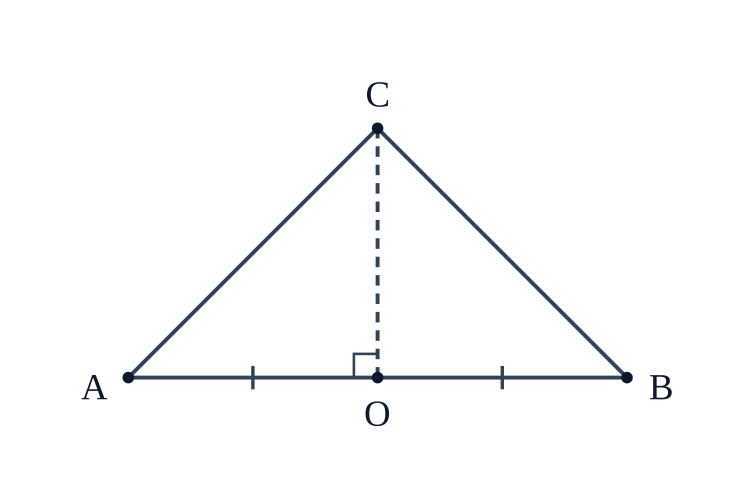
    The area of a triangle with vertices (−3,0),(3,0)\displaystyle (-3,0),(3,0) and (0,k)\displaystyle (0, k) is 9\displaystyle 9 sq. units. The value of k\displaystyle k will be
    (A)
    9\displaystyle 9 (B) 3\displaystyle 3 (C) −9\displaystyle -9 (D) 6\displaystyle 6

    Matches the book, not yet reviewed

    This working reaches the answer NCERT prints. It has not yet been read through by hand.

    NCERT’s answer
    B
    (B) \(\displaystyle 3\)Let \(\displaystyle A(-3,0),\ B(3,0),\ C(0,k)\).NCERT_Solution_Class12_Maths_Exemplar_Ch4_Ex4-3_Q26\[\Delta = \frac{1}{2}\begin{vmatrix} -3 & 0 & 1 \\ 3 & 0 & 1 \\ 0 & k & 1 \end{vmatrix} \]Expand along \(\displaystyle C_2\):\[\Delta = \frac{1}{2}\left|\,-k\,(-3-3)\,\right| = \frac{1}{2}\,|6k| = 3|k| \]\[3|k| = 9 \;\Rightarrow\; |k| = 3 \]\(\displaystyle k=\pm 3\); only \(\displaystyle 3\) is among the options.
  7. Exercise 27

    The determinant ∣b2−abb−cbc−acab−a2a−bb2−abbc−acc−aab−a2∣\displaystyle \left|\begin{array}{lll}b^2-a b & b-c & b c-a c \\ a b-a^2 & a-b & b^2-a b \\ b c-a c & c-a & a b-a^2\end{array}\right| equals
    (A)
    abc(b−c)(c−a)(a−b)\displaystyle a b c(b-c)(c-a)(a-b)
    (B)
    (b−c)(c−a)(a−b)\displaystyle (b-c)(c-a)(a-b)
    (C)
    (a+b+c)(b−c)(c−a)(a−b)\displaystyle (a+b+c)(b-c)(c-a)(a-b)
    (D)
    None of these

    Matches the book, not yet reviewed

    This working reaches the answer NCERT prints. It has not yet been read through by hand.

    NCERT’s answer
    D
    (D) None of theseTake \(\displaystyle (b-a)\) out of \(\displaystyle C_1\) and out of \(\displaystyle C_3\):\[D = (b-a)^2\begin{vmatrix} b & b-c & c \\ a & a-b & b \\ c & c-a & a \end{vmatrix} \]\(\displaystyle C_2 \to C_2 - C_1 + C_3\):\[\big(b-c-b+c,\; a-b-a+b,\; c-a-c+a\big) = (0,\,0,\,0) \]\[D = 0 \](A), (B), (C) are not zero in general; at \(\displaystyle a=1,\ b=2,\ c=3\) they give \(\displaystyle 12,\ 2,\ 12\).
  8. Exercise 28

    The number of distinct real roots of ∣sin⁡xcos⁡xcos⁡xcos⁡xsin⁡xcos⁡xcos⁡xcos⁡xsin⁡x∣=0\displaystyle \left|\begin{array}{ccc}\sin x & \cos x & \cos x \\ \cos x & \sin x & \cos x \\ \cos x & \cos x & \sin x\end{array}\right|=0 in the interval −π4≤x≤π4\displaystyle -\frac{\pi}{4} \leq x \leq \frac{\pi}{4} is
    (A)
    0\displaystyle 0 (B) 2\displaystyle 2 (C) 1\displaystyle 1 (D) 3\displaystyle 3

    Matches the book, not yet reviewed

    This working reaches the answer NCERT prints. It has not yet been read through by hand.

    NCERT’s answer
    C
    (C) \(\displaystyle 1\)\(\displaystyle C_1 \to C_1 + C_2 + C_3\) gives the factor \(\displaystyle \sin x + 2\cos x\); then \(\displaystyle R_2 \to R_2 - R_1,\; R_3 \to R_3 - R_1\).\[\Delta = (\sin x + 2\cos x)\begin{vmatrix} 1 & \cos x & \cos x \\ 1 & \sin x & \cos x \\ 1 & \cos x & \sin x \end{vmatrix} \]\[\Delta = (\sin x + 2\cos x)\begin{vmatrix} 1 & \cos x & \cos x \\ 0 & \sin x - \cos x & 0 \\ 0 & 0 & \sin x - \cos x \end{vmatrix} \]\[\Delta = (\sin x + 2\cos x)(\sin x - \cos x)^2 = 0 \]\[\tan x = -2 \quad\text{or}\quad \tan x = 1 \]On \(\displaystyle \left[-\frac{\pi}{4}, \frac{\pi}{4}\right]\), \(\displaystyle |\tan x| \le 1\), so \(\displaystyle \tan x=-2\) is rejected; only \(\displaystyle x=\frac{\pi}{4}\) remains.
  9. Exercise 29

    If A,B\displaystyle \mathrm{A}, \mathrm{B} and C are angles of a triangle, then the determinant ∣−1cos⁡Ccos⁡Bcos⁡C−1cos⁡Acos⁡Bcos⁡A−1∣ is equal to \left|\begin{array}{ccc} -1 & \cos \mathrm{C} & \cos \mathrm{B} \\ \cos \mathrm{C} & -1 & \cos \mathrm{A} \\ \cos \mathrm{B} & \cos \mathrm{A} & -1 \end{array}\right| \text { is equal to }
    (A)
    0\displaystyle 0 (B) −1\displaystyle -1 (C) 1\displaystyle 1 (D) None of these

    Matches the book, not yet reviewed

    This working reaches the answer NCERT prints. It has not yet been read through by hand.

    NCERT’s answer
    A
    (A) \(\displaystyle 0\)Expand along \(\displaystyle R_1\):\[\Delta = -(1-\cos^2 A) - \cos C(-\cos C - \cos A\cos B) + \cos B(\cos A\cos C + \cos B) \]\[\Delta = \cos^2 A + \cos^2 B + \cos^2 C + 2\cos A\cos B\cos C - 1 \]Since \(\displaystyle C = \pi - (A+B)\):\[\cos C = \sin A\sin B - \cos A\cos B \]\[\cos^2 C + 2\cos A\cos B\cos C = \cos C(\cos C + 2\cos A\cos B) = \sin^2 A\sin^2 B - \cos^2 A\cos^2 B \]\[\cos^2 A + \cos^2 B + \sin^2 A\sin^2 B - \cos^2 A\cos^2 B = \cos^2 A\sin^2 B + \sin^2 A\sin^2 B + \cos^2 B = 1 \]\[\Delta = 1 - 1 = 0 \]
  10. Exercise 30

    Let f(t)=∣cos⁡tt12sin⁡tt2tsin⁡ttt∣\displaystyle f(t)=\left|\begin{array}{ccc}\cos t & t & 1 \\ 2 \sin t & t & 2 t \\ \sin t & t & t\end{array}\right|, then lim⁡t→0f(t)t2\displaystyle \lim _{t \rightarrow 0} \frac{f(t)}{t^2} is equal to
    (A)
    0\displaystyle 0 (B) - 1\displaystyle 1 (C) 2\displaystyle 2 (D) 3\displaystyle 3

    Matches the book, not yet reviewed

    This working reaches the answer NCERT prints. It has not yet been read through by hand.

    NCERT’s answer
    A
    (A) \(\displaystyle 0\)Expand along \(\displaystyle R_1\):\[f(t) = \cos t\,(t^2 - 2t^2) - t\,(2t\sin t - 2t\sin t) + 1\cdot(2t\sin t - t\sin t) \]\[f(t) = t\sin t - t^2\cos t \]\[\frac{f(t)}{t^2} = \frac{\sin t}{t} - \cos t \]\[\lim_{t\to 0}\frac{f(t)}{t^2} = 1 - 1 = 0 \]