SolveIt is under development
SolveItNCERT · CBSE · NEET

NCERT Exemplar · Class 12 Mathematics Determinants

58 questions · 58 still being checked

EXERCISE 4.3 11–20 (part 2 of 6)

  1. Exercise 11

    If the co-ordinates of the vertices of an equilateral triangle with sides of length ‘a\displaystyle a’ are (x1,y1),(x2,y2),(x3,y3)\displaystyle \left(x_1, y_1\right),\left(x_2, y_2\right),\left(x_3, y_3\right), then ∣x1y11x2y21x3y31∣2=3a44\displaystyle \left|\begin{array}{lll}x_1 & y_1 & 1 \\ x_2 & y_2 & 1 \\ x_3 & y_3 & 1\end{array}\right|^2=\frac{3 a^4}{4}.

    Not cross-checked

    NCERT prints no numerical answer for this exercise, so this working has not been cross-checked against the book.
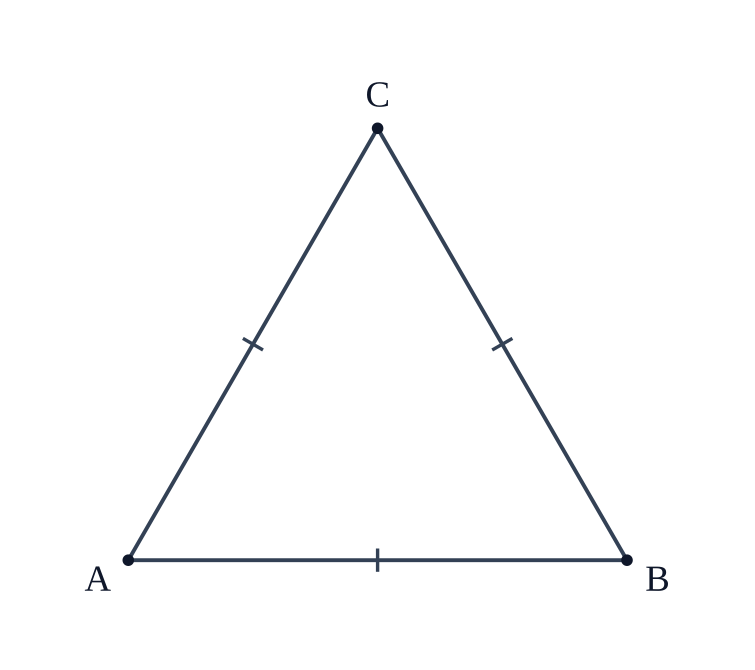
    NCERT_Solution_Class12_Maths_Exemplar_Ch4_Ex4-3_Q11 Let \(\displaystyle \Delta\) be the determinant and take \(\displaystyle A(x_1,y_1)\), \(\displaystyle B(x_2,y_2)\), \(\displaystyle C(x_3,y_3)\). \[\text{Area}(\triangle ABC)=\frac12\left|\Delta\right| \] \[\text{Area}(\triangle ABC)=\frac{\sqrt3}{4}a^2 \quad \text{(equilateral, side } a\text{)} \] \[\frac12|\Delta|=\frac{\sqrt3}{4}a^2 \] \[|\Delta|=\frac{\sqrt3}{2}a^2 \] \[\Delta^2=\frac{3}{4}a^4 \] Answer: \(\displaystyle \Delta^2=\dfrac{3a^4}{4}\)
  2. Exercise 12

    Find the value of θ\displaystyle \theta satisfying [11sin⁡3θ−43cos⁡2θ7−7−2]=0\displaystyle \left[\begin{array}{ccc}1 & 1 & \sin 3 \theta \\ -4 & 3 & \cos 2 \theta \\ 7 & -7 & -2\end{array}\right]=0.

    Matches the book, not yet reviewed

    This working reaches the answer NCERT prints. It has not yet been read through by hand.

    NCERT’s answer
    \(\displaystyle \theta=n \pi\) or \(\displaystyle n \pi+(-1)^n\left(\frac{\pi}{6}\right)\)
    Expand along \(\displaystyle R_1\): \[\Delta=(-6+7\cos2\theta)-(8-7\cos2\theta)+\sin3\theta\,(28-21) \] \[\Delta=14\cos2\theta+7\sin3\theta-14=0 \] \[2\cos2\theta+\sin3\theta-2=0 \] With \(\displaystyle \cos2\theta=1-2\sin^2\theta\) and \(\displaystyle \sin3\theta=3\sin\theta-4\sin^3\theta\): \[-4\sin^2\theta+3\sin\theta-4\sin^3\theta=0 \] \[\sin\theta\,(2\sin\theta-1)(2\sin\theta+3)=0 \] \(\displaystyle \sin\theta=-\tfrac32\) is impossible, so \[\sin\theta=0 \;\Rightarrow\; \theta=n\pi \] \[\sin\theta=\tfrac12 \;\Rightarrow\; \theta=n\pi+(-1)^n\frac{\pi}{6} \] Answer: \(\displaystyle \theta=n\pi\) or \(\displaystyle \theta=n\pi+(-1)^n\dfrac{\pi}{6}\), \(\displaystyle n\in\mathbb Z\)
  3. Exercise 13

    If [4−x4+x4+x4+x4−x4+x4+x4+x4−x]=0\displaystyle \left[\begin{array}{lll}4-x & 4+x & 4+x \\ 4+x & 4-x & 4+x \\ 4+x & 4+x & 4-x\end{array}\right]=0, then find values of x\displaystyle x.

    Matches the book, not yet reviewed

    This working reaches the answer NCERT prints. It has not yet been read through by hand.

    NCERT’s answer
    \(\displaystyle x=0,-12\)
    Apply \(\displaystyle C_1\to C_1+C_2+C_3\) (every row sums to \(\displaystyle 12+x\)): \[\Delta=(12+x)\begin{vmatrix}1&4+x&4+x\\1&4-x&4+x\\1&4+x&4-x\end{vmatrix} \] Apply \(\displaystyle R_2\to R_2-R_1\), \(\displaystyle R_3\to R_3-R_1\): \[\Delta=(12+x)\begin{vmatrix}1&4+x&4+x\\0&-2x&0\\0&0&-2x\end{vmatrix} \] \[\Delta=(12+x)(-2x)(-2x)=4x^2(12+x)=0 \] Answer: \(\displaystyle x=0\) or \(\displaystyle x=-12\)
  4. Exercise 14

    If a1,a2,a3,…,ar\displaystyle a_1, a_2, a_3, \ldots, a_r are in G.P., then prove that the determinant ∣ar+1ar+5ar+9ar+7ar+11ar+15ar+11ar+17ar+21∣\displaystyle \left|\begin{array}{ccc}a_{r+1} & a_{r+5} & a_{r+9} \\ a_{r+7} & a_{r+11} & a_{r+15} \\ a_{r+11} & a_{r+17} & a_{r+21}\end{array}\right| is independent of r\displaystyle r.

    Not cross-checked

    NCERT prints no numerical answer for this exercise, so this working has not been cross-checked against the book.

    Let the common ratio be \(\displaystyle k\), so \(\displaystyle a_n=a_1k^{\,n-1}\). \[\Delta=\begin{vmatrix} a_1k^{r} & a_1k^{r+4} & a_1k^{r+8}\\ a_1k^{r+6} & a_1k^{r+10} & a_1k^{r+14}\\ a_1k^{r+10} & a_1k^{r+16} & a_1k^{r+20}\end{vmatrix} \] Compare the first two rows: \[R_2=k^6R_1 \] Two proportional rows give \[\Delta=0 \] Answer: \(\displaystyle \Delta=0\) for every \(\displaystyle r\), so it is independent of \(\displaystyle r\).
  5. Exercise 15

    Show that the points (a+5,a−4),(a−2,a+3)\displaystyle (a+5, a-4),(a-2, a+3) and (a,a)\displaystyle (a, a) do not lie on a straight line for any value of a\displaystyle a.

    Not cross-checked

    NCERT prints no numerical answer for this exercise, so this working has not been cross-checked against the book.

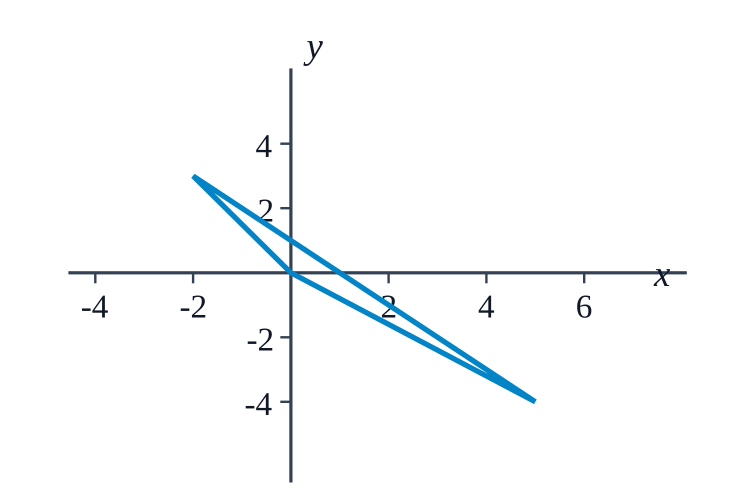
    NCERT_Solution_Class12_Maths_Exemplar_Ch4_Ex4-3_Q15 Three points are collinear only if the triangle they form has zero area. \[\Delta=\begin{vmatrix}a+5&a-4&1\\a-2&a+3&1\\a&a&1\end{vmatrix} \] Apply \(\displaystyle R_1\to R_1-R_2\), \(\displaystyle R_2\to R_2-R_3\): \[\Delta=\begin{vmatrix}7&-7&0\\-2&3&0\\a&a&1\end{vmatrix} \] \[\Delta=7\cdot3-(-7)(-2)=7 \] \[\text{Area}=\frac12|\Delta|=\frac72\neq0 \] Answer: The area is \(\displaystyle \tfrac72\) whatever \(\displaystyle a\) is, so the points are never collinear.
  6. Exercise 16

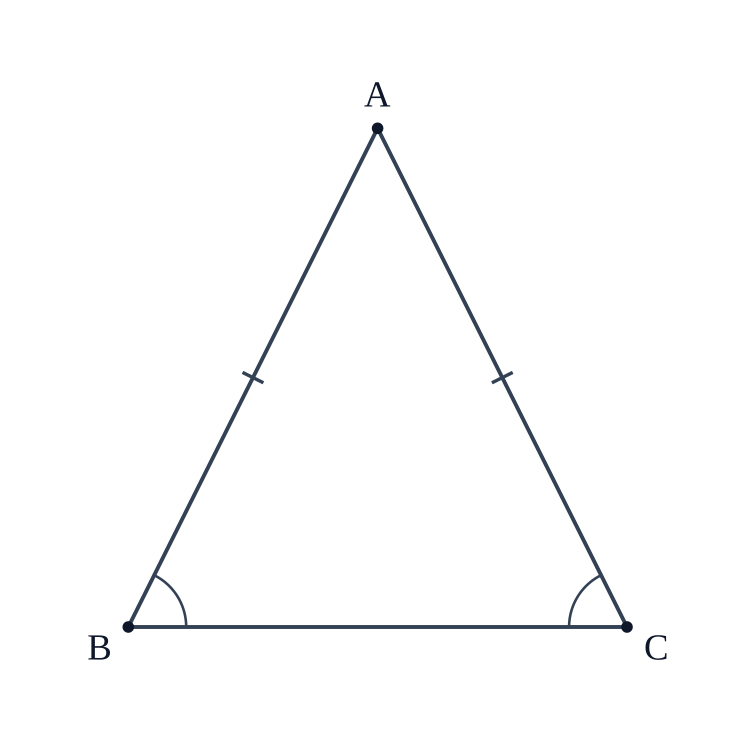
    Show that the ΔABC\displaystyle \Delta \mathrm{ABC} is an isosceles triangle if the determinant Δ=[1111+cos⁡A1+cos⁡B1+cos⁡Ccos⁡2A+cos⁡Acos⁡2B+cos⁡Bcos⁡2C+cos⁡C]=0.\Delta=\left[\begin{array}{ccc} 1 & 1 & 1 \\ 1+\cos \mathrm{A} & 1+\cos \mathrm{B} & 1+\cos \mathrm{C} \\ \cos ^2 \mathrm{A}+\cos \mathrm{A} & \cos ^2 \mathrm{B}+\cos \mathrm{B} & \cos ^2 \mathrm{C}+\cos \mathrm{C} \end{array}\right]=0 .

    Not cross-checked

    NCERT prints no numerical answer for this exercise, so this working has not been cross-checked against the book.

    Put \(\displaystyle x=\cos A\), \(\displaystyle y=\cos B\), \(\displaystyle z=\cos C\). Apply \(\displaystyle R_2\to R_2-R_1\), then \(\displaystyle R_3\to R_3-R_2\): \[\Delta=\begin{vmatrix}1&1&1\\x&y&z\\x^2&y^2&z^2\end{vmatrix} \] Apply \(\displaystyle C_1\to C_1-C_2\), \(\displaystyle C_2\to C_2-C_3\): \[\Delta=\begin{vmatrix}0&0&1\\x-y&y-z&z\\x^2-y^2&y^2-z^2&z^2\end{vmatrix} \] \[\Delta=(x-y)(y-z)\begin{vmatrix}0&0&1\\1&1&z\\x+y&y+z&z^2\end{vmatrix} \] \[\Delta=(x-y)(y-z)(z-x)=0 \] \[\cos A=\cos B \ \text{ or } \ \cos B=\cos C \ \text{ or } \ \cos C=\cos A \] Cosine is one-one on \(\displaystyle (0,\pi)\), so two angles are equal, say \[B=C \;\Rightarrow\; AB=AC \quad \text{(sides opposite equal angles)} \] NCERT_Solution_Class12_Maths_Exemplar_Ch4_Ex4-3_Q16 Answer: Two angles of \(\displaystyle \triangle ABC\) are equal, so it is isosceles.
  7. Exercise 17

    Find A−1\displaystyle A^{-1} if A=[011101110]\displaystyle A=\left[\begin{array}{lll}0 & 1 & 1 \\ 1 & 0 & 1 \\ 1 & 1 & 0\end{array}\right] and show that A−1=A2−3I2\displaystyle A^{-1}=\frac{A^2-3 I}{2}.

    Not cross-checked

    NCERT prints no numerical answer for this exercise, so this working has not been cross-checked against the book.

    \[|A| = 0(0-1)-1(0-1)+1(1-0) = 2 \neq 0 \] Cofactors: diagonal ones are \(\displaystyle -1\), all others are \(\displaystyle 1\). \[\operatorname{adj}A=\begin{bmatrix}-1&1&1\\1&-1&1\\1&1&-1\end{bmatrix} \] \[A^{-1}=\frac{\operatorname{adj}A}{|A|}=\frac12\begin{bmatrix}-1&1&1\\1&-1&1\\1&1&-1\end{bmatrix} \] Now square \(\displaystyle A\). \[A^2=\begin{bmatrix}0&1&1\\1&0&1\\1&1&0\end{bmatrix}\begin{bmatrix}0&1&1\\1&0&1\\1&1&0\end{bmatrix}=\begin{bmatrix}2&1&1\\1&2&1\\1&1&2\end{bmatrix} \] \[A^2-3I=\begin{bmatrix}-1&1&1\\1&-1&1\\1&1&-1\end{bmatrix}=2A^{-1} \] \[A^{-1}=\frac{A^2-3I}{2} \] Answer: \(\displaystyle A^{-1}=\dfrac12\begin{bmatrix}-1&1&1\\1&-1&1\\1&1&-1\end{bmatrix}\), and it equals \(\displaystyle \dfrac{A^2-3I}{2}\).
  8. Exercise 18

    If A=[120−2−1−20−11]\displaystyle \mathrm{A}=\left[\begin{array}{ccc}1 & 2 & 0 \\ -2 & -1 & -2 \\ 0 & -1 & 1\end{array}\right], find A−1\displaystyle \mathrm{A}^{-1}. Using A−1\displaystyle A^{-1}, solve the system of linear equations x−2y=10,2x−y−z=8,−2y+z=7\displaystyle x-2 y=10,2 x-y-z=8,-2 y+z=7.

    Matches the book, not yet reviewed

    This working reaches the answer NCERT prints. It has not yet been read through by hand.

    NCERT’s answer
    \(\displaystyle x=0, y=-5, z=-3\)
    \[|A| = 1(-1-2)-2(-2-0)+0 = 1 \] Cofactors: \[A_{11}=-3,\ A_{12}=2,\ A_{13}=2,\ A_{21}=-2,\ A_{22}=1,\ A_{23}=1,\ A_{31}=-4,\ A_{32}=2,\ A_{33}=3 \] \[A^{-1}=\frac{\operatorname{adj}A}{1}=\begin{bmatrix}-3&-2&-4\\2&1&2\\2&1&3\end{bmatrix} \] The coefficient matrix of the system is \(\displaystyle A^{T}\). \[\begin{bmatrix}1&-2&0\\2&-1&-1\\0&-2&1\end{bmatrix}\begin{bmatrix}x\\y\\z\end{bmatrix}=\begin{bmatrix}10\\8\\7\end{bmatrix} \] \[X=(A^{T})^{-1}B=(A^{-1})^{T}B=\begin{bmatrix}-3&2&2\\-2&1&1\\-4&2&3\end{bmatrix}\begin{bmatrix}10\\8\\7\end{bmatrix} \] \[X=\begin{bmatrix}-30+16+14\\-20+8+7\\-40+16+21\end{bmatrix}=\begin{bmatrix}0\\-5\\-3\end{bmatrix} \] Answer: \(\displaystyle A^{-1}=\begin{bmatrix}-3&-2&-4\\2&1&2\\2&1&3\end{bmatrix}\); \(\displaystyle x=0,\ y=-5,\ z=-3\).
  9. Exercise 19

    Using matrix method, solve the system of equations 3x+2y−2z=3,x+2y+3z=6,2x−y+z=2\displaystyle 3 x+2 y-2 z=3, x+2 y+3 z=6,2 x-y+z=2.

    Matches the book, not yet reviewed

    This working reaches the answer NCERT prints. It has not yet been read through by hand.

    NCERT’s answer
    \(\displaystyle x=1, y=1, z=1\)
    \[\begin{bmatrix}3&2&-2\\1&2&3\\2&-1&1\end{bmatrix}\begin{bmatrix}x\\y\\z\end{bmatrix}=\begin{bmatrix}3\\6\\2\end{bmatrix},\qquad AX=B \] \[|A|=3(2+3)-2(1-6)-2(-1-4)=15+10+10=35 \] Cofactors: \[A_{11}=5,\ A_{12}=5,\ A_{13}=-5,\ A_{21}=0,\ A_{22}=7,\ A_{23}=7,\ A_{31}=10,\ A_{32}=-11,\ A_{33}=4 \] \[\operatorname{adj}A=\begin{bmatrix}5&0&10\\5&7&-11\\-5&7&4\end{bmatrix} \] \[X=A^{-1}B=\frac1{35}\begin{bmatrix}5&0&10\\5&7&-11\\-5&7&4\end{bmatrix}\begin{bmatrix}3\\6\\2\end{bmatrix} \] \[X=\frac1{35}\begin{bmatrix}15+0+20\\15+42-22\\-15+42+8\end{bmatrix}=\frac1{35}\begin{bmatrix}35\\35\\35\end{bmatrix} \] Answer: \(\displaystyle x=1,\ y=1,\ z=1\).
  10. Exercise 20

    Given A=[22−4−42−42−15],B=[1−10234012]\displaystyle \mathrm{A}=\left[\begin{array}{ccc}2 & 2 & -4 \\ -4 & 2 & -4 \\ 2 & -1 & 5\end{array}\right], \mathrm{B}=\left[\begin{array}{ccc}1 & -1 & 0 \\ 2 & 3 & 4 \\ 0 & 1 & 2\end{array}\right], find BA and use this to solve the system of equations y+2z=7,x−y=3,2x+3y+4z=17\displaystyle y+2 z=7, x-y=3,2 x+3 y+4 z=17.

    Matches the book, not yet reviewed

    This working reaches the answer NCERT prints. It has not yet been read through by hand.

    NCERT’s answer
    \(\displaystyle x=2, y=-1, z=4\)
    \[BA=\begin{bmatrix}1&-1&0\\2&3&4\\0&1&2\end{bmatrix}\begin{bmatrix}2&2&-4\\-4&2&-4\\2&-1&5\end{bmatrix} \] \[BA=\begin{bmatrix}2+4+0&2-2+0&-4+4+0\\4-12+8&4+6-4&-8-12+20\\0-4+4&0+2-2&0-4+10\end{bmatrix}=\begin{bmatrix}6&0&0\\0&6&0\\0&0&6\end{bmatrix}=6I \] \[B^{-1}=\frac{A}{6} \] Write the system in the order \(\displaystyle x-y=3,\ 2x+3y+4z=17,\ y+2z=7\). \[\begin{bmatrix}1&-1&0\\2&3&4\\0&1&2\end{bmatrix}\begin{bmatrix}x\\y\\z\end{bmatrix}=\begin{bmatrix}3\\17\\7\end{bmatrix},\qquad BX=C \] \[X=B^{-1}C=\frac16\begin{bmatrix}2&2&-4\\-4&2&-4\\2&-1&5\end{bmatrix}\begin{bmatrix}3\\17\\7\end{bmatrix} \] \[X=\frac16\begin{bmatrix}6+34-28\\-12+34-28\\6-17+35\end{bmatrix}=\frac16\begin{bmatrix}12\\-6\\24\end{bmatrix} \] Answer: \(\displaystyle BA=6I\); \(\displaystyle x=2,\ y=-1,\ z=4\).