SolveIt is under development
SolveItNCERT · CBSE · NEET

NCERT Exemplar · Class 12 Mathematics Continuity and Differentiability

106 questions · 106 still being checked

EXERCISE 5.3 21–30 (part 3 of 11)

  1. Examine the differentiability of \(\displaystyle f\), where \(\displaystyle f\) is defined by

    Exercise 21

    f(x)={x2sin⁡1x, if x≠00, if x=0\displaystyle f(x)= \begin{cases}x^2 \sin \frac{1}{x} & , \text { if } x \neq 0 \\ 0 & , \text { if } x=0\end{cases} at x=0\displaystyle x=0.

    Matches the book, not yet reviewed

    This working reaches the answer NCERT prints. It has not yet been read through by hand.

    NCERT’s answer
    Differentiable at \(\displaystyle x=0\)
    \[f'(0) = \lim_{h\to0}\frac{f(h) - f(0)}{h} = \lim_{h\to0}\frac{h^2\sin\dfrac{1}{h} - 0}{h} = \lim_{h\to0} h\sin\frac{1}{h} \] \[-|h| \le h\sin\frac{1}{h} \le |h| \quad \left(\left|\sin\tfrac{1}{h}\right| \le 1\right) \] \[\lim_{h\to0}|h| = 0 \;\Rightarrow\; \lim_{h\to0} h\sin\frac{1}{h} = 0 \quad \text{(squeeze)} \]Answer: \(\displaystyle f\) is differentiable at \(\displaystyle x = 0\), with \(\displaystyle f'(0) = 0\).
  2. Exercise 22

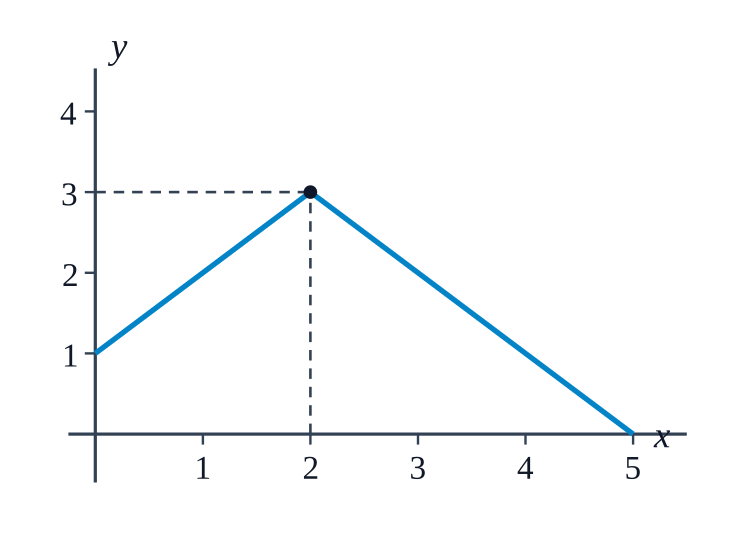
    f(x)={1+x, if x≤25−x, if x>2\displaystyle f(x)=\left\{\begin{array}{lll}1+x & , \text { if } & x \leq 2 \\ 5-x & , \text { if } & x>2\end{array}\right. at x=2\displaystyle x=2.

    Matches the book, not yet reviewed

    This working reaches the answer NCERT prints. It has not yet been read through by hand.

    NCERT’s answer
    Not differentiable at \(\displaystyle x=2\)
    \[f(2) = 1 + 2 = 3 \] \[Lf'(2) = \lim_{h\to0^-}\frac{f(2+h) - f(2)}{h} = \lim_{h\to0^-}\frac{(1 + 2 + h) - 3}{h} = 1 \] \[Rf'(2) = \lim_{h\to0^+}\frac{f(2+h) - f(2)}{h} = \lim_{h\to0^+}\frac{(5 - 2 - h) - 3}{h} = -1 \] \[Lf'(2) = 1 \neq -1 = Rf'(2) \] NCERT_Solution_Class12_Maths_Exemplar_Ch5_Ex5-3_Q22Answer: \(\displaystyle f\) is not differentiable at \(\displaystyle x = 2\).
  3. Exercise 23

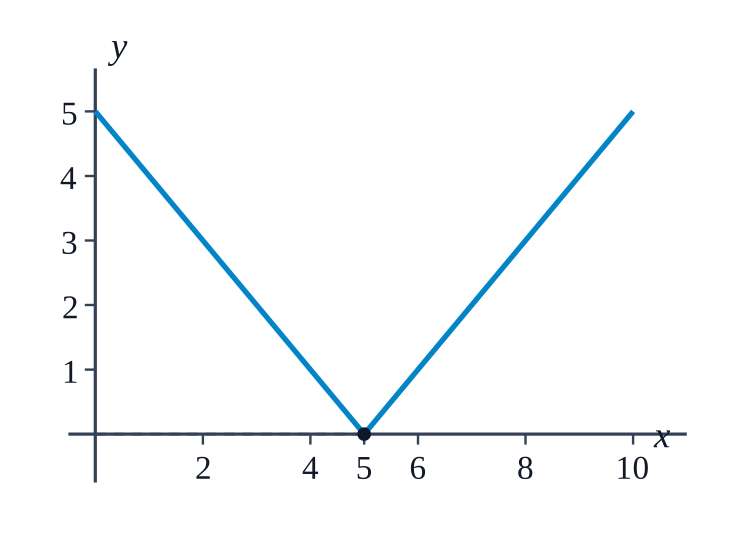
    Show that f(x)=∣x−5∣\displaystyle f(x)=|x-5| is continuous but not differentiable at x=5\displaystyle x=5.

    Not cross-checked

    NCERT prints no numerical answer for this exercise, so this working has not been cross-checked against the book.

    \[f(x) = |x-5| = \begin{cases} x - 5, & x \ge 5 \\ 5 - x, & x < 5 \end{cases} \qquad f(5) = 0 \] \[\lim_{x\to5^-}(5 - x) = 0 = \lim_{x\to5^+}(x - 5) = f(5) \] So \(\displaystyle f\) is continuous at \(\displaystyle x = 5\). \[Lf'(5) = \lim_{h\to0^-}\frac{|h| - 0}{h} = \lim_{h\to0^-}\frac{-h}{h} = -1 \] \[Rf'(5) = \lim_{h\to0^+}\frac{|h| - 0}{h} = \lim_{h\to0^+}\frac{h}{h} = 1 \] \[Lf'(5) \neq Rf'(5) \] NCERT_Solution_Class12_Maths_Exemplar_Ch5_Ex5-3_Q23Answer: \(\displaystyle f\) is continuous at \(\displaystyle x = 5\) but not differentiable there.
  4. Exercise 24

    A function f:R→R\displaystyle f: \mathbf{R} \rightarrow \mathbf{R} satisfies the equation f(x+y)=f(x)f(y)\displaystyle f(x+y)=f(x) f(y) for all x,y∈R\displaystyle x, y \in \mathbf{R}, f(x)≠0\displaystyle f(x) \neq 0. Suppose that the function is differentiable at x=0\displaystyle x=0 and f′(0)=2\displaystyle f^{\prime}(0)=2. Prove that f′(x)=2f(x)\displaystyle f^{\prime}(x)=2 f(x).

    Not cross-checked

    NCERT prints no numerical answer for this exercise, so this working has not been cross-checked against the book.

    Put \(\displaystyle x = y = 0\) in the given equation: \[f(0) = f(0)\,f(0) \] \[f(0) \neq 0 \;\Rightarrow\; f(0) = 1 \] \[f'(x) = \lim_{h\to0}\frac{f(x+h) - f(x)}{h} \] \[= \lim_{h\to0}\frac{f(x)f(h) - f(x)}{h} \quad \bigl(f(x+h) = f(x)f(h)\bigr) \] \[= f(x)\lim_{h\to0}\frac{f(h) - f(0)}{h} \quad \bigl(f(0) = 1\bigr) \] \[= f(x)\,f'(0) = 2f(x) \]Answer: \(\displaystyle f'(x) = 2f(x)\).
  5. Differentiate each of the following w.r.t. \(\displaystyle x\) (Exercises $\displaystyle 25$ to $\displaystyle 43$) :

    Exercise 25

    2cos⁡2x\displaystyle 2^{\cos ^2 x}

    Matches the book, not yet reviewed

    This working reaches the answer NCERT prints. It has not yet been read through by hand.

    NCERT’s answer
    \(\displaystyle -(\log 2) \cdot \sin 2 x \cdot 2^{\cos ^2 x}\)
    \[y = 2^{\cos^2 x} \] \[\frac{dy}{dx} = 2^{\cos^2 x}\,\ln 2 \cdot \frac{d}{dx}\left(\cos^2 x\right) \quad \text{(chain rule)} \] \[\frac{d}{dx}\left(\cos^2 x\right) = 2\cos x\,(-\sin x) = -\sin 2x \] \[\frac{dy}{dx} = -\ln 2\,\sin 2x\;2^{\cos^2 x} \] Answer: \(\displaystyle -\ln 2\,\sin 2x\;2^{\cos^2 x} \)
  6. Exercise 26

    8xx8\displaystyle \frac{8^x}{x^8}

    Matches the book, not yet reviewed

    This working reaches the answer NCERT prints. It has not yet been read through by hand.

    NCERT’s answer
    \(\displaystyle \frac{8^x}{x^8}\left[\log 8-\frac{8}{x}\right]\)
    \[y = \frac{8^x}{x^8} \] \[\frac{dy}{dx} = \frac{x^8\cdot 8^x\ln 8 - 8^x\cdot 8x^7}{\left(x^8\right)^2} \quad \text{(quotient rule)} \] \[\frac{dy}{dx} = \frac{8^x\,x^7\,(x\ln 8 - 8)}{x^{16}} = \frac{8^x\,(x\ln 8 - 8)}{x^9} \] Answer: \(\displaystyle \dfrac{8^x\,(x\ln 8 - 8)}{x^9} \)
  7. Exercise 27

    log⁡(x+x2+a)\displaystyle \log \left(x+\sqrt{x^2+a}\right)

    Matches the book, not yet reviewed

    This working reaches the answer NCERT prints. It has not yet been read through by hand.

    NCERT’s answer
    \(\displaystyle \frac{1}{\sqrt{x^2+a}}\)
    \[y = \log\left(x+\sqrt{x^2+a}\right) \] \[\frac{d}{dx}\sqrt{x^2+a} = \frac{2x}{2\sqrt{x^2+a}} = \frac{x}{\sqrt{x^2+a}} \] \[\frac{dy}{dx} = \frac{1}{x+\sqrt{x^2+a}}\left(1+\frac{x}{\sqrt{x^2+a}}\right) \] \[\frac{dy}{dx} = \frac{1}{x+\sqrt{x^2+a}}\cdot\frac{\sqrt{x^2+a}+x}{\sqrt{x^2+a}} = \frac{1}{\sqrt{x^2+a}} \] Answer: \(\displaystyle \dfrac{1}{\sqrt{x^2+a}} \)
  8. Exercise 28

    log⁡[log⁡(log⁡x5)]\displaystyle \log \left[\log \left(\log x^5\right)\right]

    Matches the book, not yet reviewed

    This working reaches the answer NCERT prints. It has not yet been read through by hand.

    NCERT’s answer
    \(\displaystyle \frac{5}{x \log \left(x^5\right) \log \left(\log x^5\right)}\)
    \[y = \log\left[\log\left(\log x^5\right)\right] \] \[\frac{dy}{dx} = \frac{1}{\log\left(\log x^5\right)}\cdot\frac{d}{dx}\log\left(\log x^5\right) \] \[\frac{d}{dx}\log\left(\log x^5\right) = \frac{1}{\log x^5}\cdot\frac{d}{dx}\log x^5 \] \[\frac{d}{dx}\log x^5 = \frac{1}{x^5}\cdot 5x^4 = \frac{5}{x} \] \[\frac{dy}{dx} = \frac{5}{x\,\log x^5\,\log\left(\log x^5\right)} \] Since \(\displaystyle \log x^5 = 5\log x \): \[\frac{dy}{dx} = \frac{1}{x\,\log x\,\log\left(\log x^5\right)} \] Answer: \(\displaystyle \dfrac{1}{x\,\log x\,\log\left(\log x^5\right)} \)
  9. Exercise 29

    sin⁡x+cos⁡2x\displaystyle \sin \sqrt{x}+\cos ^2 \sqrt{x}

    Matches the book, not yet reviewed

    This working reaches the answer NCERT prints. It has not yet been read through by hand.

    NCERT’s answer
    \(\displaystyle \frac{\cos \sqrt{x}}{2 \sqrt{x}}-\frac{\sin 2 \sqrt{x}}{2 \sqrt{x}}\)
    \[y = \sin\sqrt{x} + \cos^2\sqrt{x} \] \[\frac{d}{dx}\sin\sqrt{x} = \cos\sqrt{x}\cdot\frac{1}{2\sqrt{x}} \] \[\frac{d}{dx}\cos^2\sqrt{x} = 2\cos\sqrt{x}\left(-\sin\sqrt{x}\right)\frac{1}{2\sqrt{x}} = -\frac{\sin 2\sqrt{x}}{2\sqrt{x}} \] \[\frac{dy}{dx} = \frac{\cos\sqrt{x} - \sin 2\sqrt{x}}{2\sqrt{x}} \] Answer: \(\displaystyle \dfrac{\cos\sqrt{x} - \sin 2\sqrt{x}}{2\sqrt{x}} \)
  10. Exercise 30

    sin⁡n(ax2+bx+c)\displaystyle \sin ^n\left(a x^2+b x+c\right)

    Matches the book, not yet reviewed

    This working reaches the answer NCERT prints. It has not yet been read through by hand.

    NCERT’s answer
    \(\displaystyle n(2 a x+b) \sin ^{n-1}\left(a x^2+b x+c\right) \cos \left(a x^2+b x+c\right)\)
    \[y = \sin^n\left(ax^2+bx+c\right) \] \[\frac{dy}{dx} = n\sin^{n-1}\left(ax^2+bx+c\right)\cdot\frac{d}{dx}\sin\left(ax^2+bx+c\right) \] \[\frac{d}{dx}\sin\left(ax^2+bx+c\right) = \cos\left(ax^2+bx+c\right)\cdot(2ax+b) \] \[\frac{dy}{dx} = n\,(2ax+b)\sin^{n-1}\left(ax^2+bx+c\right)\cos\left(ax^2+bx+c\right) \] Answer: \(\displaystyle n\,(2ax+b)\sin^{n-1}\left(ax^2+bx+c\right)\cos\left(ax^2+bx+c\right) \)