SolveIt is under development
SolveItNCERT · CBSE · NEET

NCERT Exemplar · Class 11 Mathematics Relations and Functions

42 questions · 42 still being checked

EXERCISE 2.3 11–20 (part 2 of 4)

  1. Exercise 11

    If f\displaystyle f and g\displaystyle g are real functions defined by f(x)=x2+7\displaystyle f(x)=x^2+7 and g(x)=3x+5\displaystyle g(x)=3 x+5, find each of the following
    (a)
    f(3)+g(−5)\displaystyle f(3)+g(-5)
    (b)
    f(12)×g(14)\displaystyle f\left(\frac{1}{2}\right) \times g(14)
    (c)
    f(−2)+g(−1)\displaystyle f(-2)+g(-1)
    (d)
    f(t)−f(−2)\displaystyle f(t)-f(-2)
    (e)
    f(t)−f(5)t−5\displaystyle \frac{f(t)-f(5)}{t-5}, if t≠5\displaystyle t \neq 5

    Check this one against your book

    NCERT’s printed answer for this exercise does not match its own question. This working follows the question as printed.

    \[f(x)=x^2+7,\qquad g(x)=3x+5 \](a) \[f(3)=9+7=16,\qquad g(-5)=-15+5=-10 \] \[f(3)+g(-5)=16-10=6 \](b) \[f\left(\tfrac12\right)=\tfrac14+7=\tfrac{29}{4},\qquad g(14)=42+5=47 \] \[f\left(\tfrac12\right)\times g(14)=\tfrac{29}{4}\times 47=\tfrac{1363}{4} \](c) \[f(-2)=4+7=11,\qquad g(-1)=-3+5=2 \] \[f(-2)+g(-1)=13 \](d) \[f(t)-f(-2)=(t^2+7)-11=t^2-4 \](e) \[\frac{f(t)-f(5)}{t-5}=\frac{(t^2+7)-32}{t-5}=\frac{t^2-25}{t-5}=\frac{(t-5)(t+5)}{t-5}=t+5 \quad (t\ne 5) \]Answer: (a) \(\displaystyle 6\); (b) \(\displaystyle \frac{1363}{4}\); (c) \(\displaystyle 13\); (d) \(\displaystyle t^2-4\); (e) \(\displaystyle t+5\)
  2. Exercise 12

    Let f\displaystyle f and g\displaystyle g be real functions defined by f(x)=2x+1\displaystyle f(x)=2 x+1 and g(x)=4x−7\displaystyle g(x)=4 x-7.
    (a)
    For what real numbers x,f(x)=g(x)\displaystyle x, f(x)=g(x) ?
    (b)
    For what real numbers x,f(x)<g(x)\displaystyle x, f(x)<g(x) ?

    Matches the book, not yet reviewed

    This working reaches the answer NCERT prints. It has not yet been read through by hand.

    NCERT’s answer
    (a)
    \(\displaystyle x=4\)
    (b)
    \(\displaystyle x>4\)
    (a) \[f(x)=g(x) \Rightarrow 2x+1=4x-7 \] \[8=2x \Rightarrow x=4 \](b) \[f(x)<g(x) \Rightarrow 2x+1<4x-7 \] \[8<2x \Rightarrow x>4 \]Answer: (a) \(\displaystyle x=4\); (b) all real \(\displaystyle x>4\), i.e. \(\displaystyle x\in(4,\infty)\)
  3. Exercise 13

    If f\displaystyle f and g\displaystyle g are two real valued functions defined as f(x)=2x+1,g(x)=x2+1\displaystyle f(x)=2 x+1, g(x)=x^2+1, then find.
    (i)
    f+g\displaystyle f+g
    (ii)
    f−g\displaystyle f-g
    (iii)
    fg\displaystyle f g
    (iv)
    fg\displaystyle \frac{f}{g}

    Check this one against your book

    NCERT’s printed answer for this exercise does not match its own question. This working follows the question as printed.

    \[f(x)=2x+1,\qquad g(x)=x^2+1 \](i) \[(f+g)(x)=(2x+1)+(x^2+1)=x^2+2x+2 \](ii) \[(f-g)(x)=(2x+1)-(x^2+1)=2x-x^2 \](iii) \[(fg)(x)=(2x+1)(x^2+1)=2x^3+x^2+2x+1 \](iv) \[\left(\frac{f}{g}\right)(x)=\frac{2x+1}{x^2+1} \] \[x^2+1\ge 1>0 \Rightarrow \text{defined for all real } x \]Answer: (i) \(\displaystyle x^2+2x+2\); (ii) \(\displaystyle 2x-x^2\); (iii) \(\displaystyle 2x^3+x^2+2x+1\); (iv) \(\displaystyle \dfrac{2x+1}{x^2+1}\), all \(\displaystyle x\in\mathbb{R}\)
  4. Exercise 14

    Express the following functions as set of ordered pairs and determine their range. f:X→R,f(x)=x3+1\displaystyle f: \mathrm{X} \rightarrow \mathbf{R}, f(x)=x^3+1, where X={−1,0,3,9,7}\displaystyle \mathrm{X}=\{-1,0,3,9,7\}

    Matches the book, not yet reviewed

    This working reaches the answer NCERT prints. It has not yet been read through by hand.

    NCERT’s answer
    (i)
    \(\displaystyle f=\{(-1,0),(0,1),(3,28),(7,344),(9,730)\}\)
    \[f(x)=x^3+1 \]\[f(-1)=-1+1=0 \] \[f(0)=0+1=1 \] \[f(3)=27+1=28 \] \[f(9)=729+1=730 \] \[f(7)=343+1=344 \]\[f=\{(-1,0),(0,1),(3,28),(9,730),(7,344)\} \]Answer: \(\displaystyle f=\{(-1,0),(0,1),(3,28),(9,730),(7,344)\}\); Range \(\displaystyle =\{0,1,28,344,730\}\)
  5. Exercise 15

    Find the values of x\displaystyle x for which the functions f(x)=3x2−1\displaystyle f(x)=3 x^2-1 and g(x)=3+x\displaystyle g(x)=3+x are equal

    Matches the book, not yet reviewed

    This working reaches the answer NCERT prints. It has not yet been read through by hand.

    NCERT’s answer
    \(\displaystyle x=-1, \frac{4}{3}\)
    Set the two functions equal. \[3x^2 - 1 = 3 + x \] \[3x^2 - x - 4 = 0 \] \[(3x-4)(x+1) = 0 \] \[x = \tfrac{4}{3} \quad \text{or} \quad x = -1 \] \[f(-1) = 2 = g(-1) \] \[f\!\left(\tfrac43\right) = \tfrac{16}{3} - 1 = \tfrac{13}{3} = g\!\left(\tfrac43\right) \] Answer: \(\displaystyle x = -1\) or \(\displaystyle x = \tfrac{4}{3}\).
  6. Exercise 16

    Is g={(1,1),(2,3),(3,5),(4,7)}\displaystyle g=\{(1,1),(2,3),(3,5),(4,7)\} a function? Justify. If this is described by the relation, g(x)=αx+β\displaystyle g(x)=\alpha x+\beta, then what values should be assigned to α\displaystyle \alpha and β\displaystyle \beta ?

    Matches the book, not yet reviewed

    This working reaches the answer NCERT prints. It has not yet been read through by hand.

    NCERT’s answer
    Yes, \(\displaystyle \alpha=2, \beta=-1\)
    Yes, \(\displaystyle g\) is a function: each of \(\displaystyle 1, 2, 3, 4\) appears once as a first element, so each has exactly one image. \[g(1) = \alpha + \beta = 1 \] \[g(2) = 2\alpha + \beta = 3 \] \[\alpha = 2, \qquad \beta = 1 - 2 = -1 \] \[g(3) = 2(3) - 1 = 5, \qquad g(4) = 2(4) - 1 = 7 \] Answer: \(\displaystyle g\) is a function; \(\displaystyle \alpha = 2\), \(\displaystyle \beta = -1\).
  7. Exercise 17

    Find the domain of each of the following functions given by
    (i)
    f(x)=11−cos⁡x\displaystyle f(x)=\frac{1}{\sqrt{1-\cos x}}
    (ii)
    f(x)=1x+∣x∣\displaystyle f(x)=\frac{1}{\sqrt{x+|x|}}
    (iii)
    f(x)=x∣x∣\displaystyle f(x)=x|x|
    (iv)
    f(x)=x3−x+3x2−1\displaystyle f(x)=\frac{x^3-x+3}{x^2-1}
    (v)
    f(x)=3x2x−8\displaystyle f(x)=\frac{3 x}{2 x-8}

    Matches the book, not yet reviewed

    This working reaches the answer NCERT prints. It has not yet been read through by hand.

    NCERT’s answer
    (i)
    \(\displaystyle \mathrm{R}-\{2 n \pi: n \in \mathrm{Z}\}\)
    (ii)
    \(\displaystyle \mathrm{R}^{+}\)
    (iii)
    R
    (iv)
    \(\displaystyle \mathrm{R}-\{-1,1\}\)
    (v)
    \(\displaystyle \mathrm{R}-\{4\}\)
    (i) The root needs a positive quantity under it. \[1 - \cos x > 0 \iff \cos x \neq 1 \iff x \neq 2n\pi, \; n \in \mathbb{Z} \] \[D = \mathbb{R} - \{2n\pi : n \in \mathbb{Z}\} \] (ii) \[x > 0: \; x + |x| = 2x > 0 \] \[x \le 0: \; x + |x| = 0 \] \[D = (0, \infty) \] (iii) No restriction on \(\displaystyle x\). \[D = \mathbb{R} \] (iv) \[x^2 - 1 \neq 0 \Rightarrow x \neq \pm 1 \] \[D = \mathbb{R} - \{-1, 1\} \] (v) \[2x - 8 \neq 0 \Rightarrow x \neq 4 \] \[D = \mathbb{R} - \{4\} \] Answer: (i) \(\displaystyle \mathbb{R} - \{2n\pi\}\); (ii) \(\displaystyle (0, \infty)\); (iii) \(\displaystyle \mathbb{R}\); (iv) \(\displaystyle \mathbb{R} - \{-1, 1\}\); (v) \(\displaystyle \mathbb{R} - \{4\}\).
  8. Exercise 18

    Find the range of the following functions given by
    (i)
    f(x)=32−x2\displaystyle f(x)=\frac{3}{2-x^2}
    (ii)
    f(x)=1−∣x−2∣\displaystyle f(x)=1-|x-2|
    (iii)
    f(x)=∣x−3∣\displaystyle f(x)=|x-3|
    (iv)
    f(x)=1+3cos⁡2x\displaystyle f(x)=1+3 \cos 2 x
    (Hint : −1≤cos⁡2x≤1⇒−3≤3cos⁡2x≤3⇒−2≤1+3cos⁡2x≤4\displaystyle -1 \leq \cos 2 x \leq 1 \Rightarrow-3 \leq 3 \cos 2 x \leq 3 \Rightarrow-2 \leq 1+3 \cos 2 x \leq 4 )

    Check this one against your book

    NCERT’s printed answer for this exercise does not match its own question. This working follows the question as printed.

    (i) Put \(\displaystyle y = \dfrac{3}{2 - x^2}\) and solve for \(\displaystyle x^2\). \[x^2 = 2 - \frac{3}{y} = \frac{2y - 3}{y} \] \[x^2 \ge 0 \Rightarrow \frac{2y-3}{y} \ge 0 \Rightarrow y < 0 \;\text{ or }\; y \ge \tfrac{3}{2} \] \[\text{Range} = (-\infty, 0) \cup \left[\tfrac{3}{2}, \infty\right) \] (ii) \[|x - 2| \ge 0 \Rightarrow 1 - |x-2| \le 1 \] \[\text{Range} = (-\infty, 1] \] (iii) \[|x - 3| \ge 0 \Rightarrow \text{Range} = [0, \infty) \] (iv) \[-1 \le \cos 2x \le 1 \Rightarrow -3 \le 3\cos 2x \le 3 \Rightarrow -2 \le 1 + 3\cos 2x \le 4 \] \[\text{Range} = [-2, 4] \] Answer: (i) \(\displaystyle (-\infty, 0) \cup [\tfrac32, \infty)\); (ii) \(\displaystyle (-\infty, 1]\); (iii) \(\displaystyle [0, \infty)\); (iv) \(\displaystyle [-2, 4]\).
  9. Exercise 19

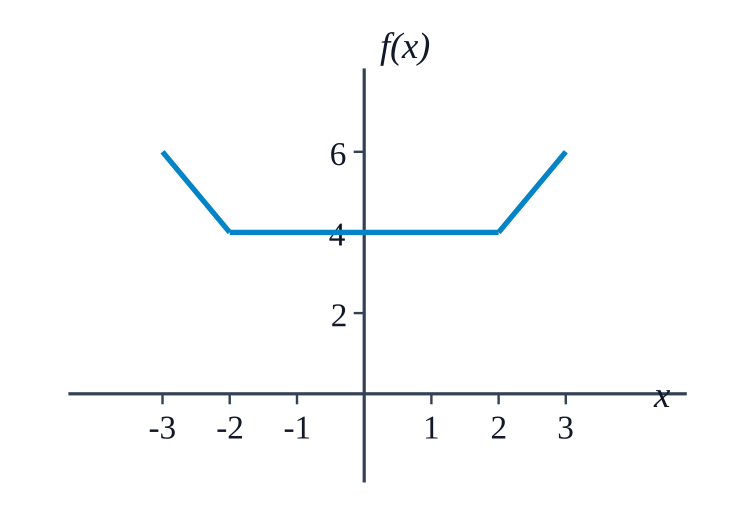
    Redefine the function f(x)=∣x−2∣+∣2+x∣,−3≤x≤3\displaystyle f(x)=|x-2|+|2+x|, \quad-3 \leq x \leq 3

    Check this one against your book

    NCERT’s printed answer for this exercise does not match its own question. This working follows the question as printed.

    Each modulus changes sign at \(\displaystyle x = \pm 2\), so split the interval there. \[-3 \le x < -2: \quad f(x) = -(x-2) - (x+2) = -2x \] \[-2 \le x \le 2: \quad f(x) = (2-x) + (x+2) = 4 \] \[2 < x \le 3: \quad f(x) = (x-2) + (x+2) = 2x \] NCERT_Solution_Class11_Maths_Exemplar_Ch2_Ex2-3_Q19 Answer: \[f(x) = \begin{cases} -2x, & -3 \le x < -2 \\ 4, & -2 \le x \le 2 \\ 2x, & 2 < x \le 3 \end{cases} \]
  10. Exercise 20

    If f(x)=x−1x+1\displaystyle f(x)=\frac{x-1}{x+1}, then show that
    (i)
    f(1x)=−f(x)\displaystyle f\left(\frac{1}{x}\right)=-f(x)
    (ii)
    f(−1x)=−1f(x)\displaystyle f\left(-\frac{1}{x}\right)=\frac{-1}{f(x)}

    Not cross-checked

    NCERT prints no numerical answer for this exercise, so this working has not been cross-checked against the book.

    (i) Multiply numerator and denominator by \(\displaystyle x\). \[f\!\left(\tfrac{1}{x}\right) = \frac{\dfrac{1}{x} - 1}{\dfrac{1}{x} + 1} = \frac{1 - x}{1 + x} \] \[= -\frac{x - 1}{x + 1} = -f(x) \] (ii) \[f\!\left(-\tfrac{1}{x}\right) = \frac{-\dfrac{1}{x} - 1}{-\dfrac{1}{x} + 1} = \frac{-(1 + x)}{x - 1} \] \[= -\frac{x + 1}{x - 1} = \frac{-1}{\dfrac{x - 1}{x + 1}} = \frac{-1}{f(x)} \]