SolveIt is under development
SolveItNCERT · CBSE · NEET

NCERT Exemplar · Class 11 Mathematics Relations and Functions

42 questions · 42 still being checked

EXERCISE 2.3 1–10 (part 1 of 4)

  1. Exercise 1

    Let A={−1,2,3}\displaystyle \mathrm{A}=\{-1,2,3\} and B={1,3}\displaystyle \mathrm{B}=\{1,3\}. Determine
    (i)
    A×B\displaystyle \mathrm{A} \times \mathrm{B}
    (ii)
    B×A\displaystyle \mathrm{B} \times \mathrm{A}
    (iii)
    B×B\displaystyle \mathrm{B} \times \mathrm{B}
    (iv)
    A×A\displaystyle \mathrm{A} \times \mathrm{A}

    Matches the book, not yet reviewed

    This working reaches the answer NCERT prints. It has not yet been read through by hand.

    NCERT’s answer
    (i)
    \(\displaystyle \{(-1, 1), (-1, 3), (2, 1), (2, 3), (3, 1), (3, 3)\}\)
    (ii)
    \(\displaystyle \{(1,-1),(1,2),(1,3),(3,-1),(3,2),(3,3)\}\)
    (iii)
    \(\displaystyle \{(1,1),(1,3),(3,1),(3,3)\}\)
    (iv)
    \(\displaystyle \{(-1, -1), (-1, 2), (-1, 3), (2, -1), (2, 2), (2, 3), (3, -1), (3, 2), (3, 3)\}\)
    Pair each element of the first set with each element of the second.\[n(A\times B)=3\cdot 2=6,\quad n(B\times B)=2\cdot 2=4,\quad n(A\times A)=3\cdot 3=9 \] \[A\times B=\{(-1,1),(-1,3),(2,1),(2,3),(3,1),(3,3)\} \] \[B\times A=\{(1,-1),(1,2),(1,3),(3,-1),(3,2),(3,3)\} \] \[B\times B=\{(1,1),(1,3),(3,1),(3,3)\} \] \[A\times A=\{(-1,-1),(-1,2),(-1,3),(2,-1),(2,2),(2,3),(3,-1),(3,2),(3,3)\} \]Answer: the four products are the sets of $\displaystyle 6$, $\displaystyle 6$, $\displaystyle 4$ and $\displaystyle 9$ ordered pairs listed above.
  2. Exercise 2

    If P={x:x<3,x∈N},Q={x:x≤2,x∈W}\displaystyle \mathrm{P}=\{x: x<3, x \in \mathbf{N}\}, \mathrm{Q}=\{x: x \leq 2, x \in \mathbf{W}\}. Find (P∪Q)×(P∩Q)\displaystyle (\mathrm{P} \cup \mathrm{Q}) \times(\mathrm{P} \cap \mathrm{Q}), where W\displaystyle \mathbf{W} is the set of whole numbers.

    Matches the book, not yet reviewed

    This working reaches the answer NCERT prints. It has not yet been read through by hand.

    NCERT’s answer
    \(\displaystyle \{(0, 1), (0, 2), (1, 1), (1, 2), (2, 1), (2, 2)\}\)
    \(\displaystyle \mathbf N\) starts at $\displaystyle 1$ and \(\displaystyle \mathbf W\) starts at 0.\[P=\{1,2\},\qquad Q=\{0,1,2\} \] \[P\cup Q=\{0,1,2\},\qquad P\cap Q=\{1,2\} \] \[(P\cup Q)\times(P\cap Q)=\{(0,1),(0,2),(1,1),(1,2),(2,1),(2,2)\} \] \[n=3\cdot 2=6 \]Answer: \(\displaystyle \{(0,1),(0,2),(1,1),(1,2),(2,1),(2,2)\}\)
  3. Exercise 3

    If A={x:x∈W,x<2}B={x:x∈N,1<x<5}C={3,5}\displaystyle \mathrm{A}=\{x: x \in \mathbf{W}, x<2\} \quad \mathrm{B}=\{x: x \in \mathbf{N}, 1<x<5\} \quad \mathrm{C}=\{3,5\} find
    (i)
    A×(B∩C)\displaystyle \mathrm{A} \times(\mathrm{B} \cap \mathrm{C})
    (ii)
    A×(B∪C)\displaystyle \mathrm{A} \times(\mathrm{B} \cup \mathrm{C})

    Matches the book, not yet reviewed

    This working reaches the answer NCERT prints. It has not yet been read through by hand.

    NCERT’s answer
    (i)
    \(\displaystyle \{(0, 3), (1, 3)\}\)
    (ii)
    \(\displaystyle \{(0, 2), (0, 3), (0, 4), (0, 5), (1, 2), (1, 3), (1, 4), (1,5)\}\)
    \[A=\{0,1\},\qquad B=\{2,3,4\},\qquad C=\{3,5\} \]
    \[B\cap C=\{3\},\qquad B\cup C=\{2,3,4,5\} \]
    (i)
    \[A\times(B\cap C)=\{(0,3),(1,3)\} \]
    (ii)
    \[A\times(B\cup C)=\{(0,2),(0,3),(0,4),(0,5),(1,2),(1,3),(1,4),(1,5)\} \]
    \[n=2\cdot 4=8 \]
    Answer: (i) \(\displaystyle \{(0,3),(1,3)\}\); (ii) the $\displaystyle 8$ pairs \(\displaystyle (a,b)\) with \(\displaystyle a\in\{0,1\}\), \(\displaystyle b\in\{2,3,4,5\}\).
  4. Exercise 4

    In each of the following cases, find a\displaystyle a and b\displaystyle b.
    (i)
    (2a+b,a−b)=(8,3)\displaystyle (2 a+b, a-b)=(8,3)
    (ii)
    (a4,a−2b)=(0,6+b)\displaystyle \left(\frac{a}{4}, a-2 b\right)=(0,6+b)

    Matches the book, not yet reviewed

    This working reaches the answer NCERT prints. It has not yet been read through by hand.

    NCERT’s answer
    (i)
    \(\displaystyle a=\frac{11}{3}\) and \(\displaystyle b=\frac{2}{3}\)
    (ii)
    \(\displaystyle a=0\) and \(\displaystyle b=-2\)
    Equal ordered pairs have equal components.
    (i)
    \[2a+b=8,\qquad a-b=3 \]
    \[3a=11\ \Rightarrow\ a=\tfrac{11}{3} \]
    \[b=a-3=\tfrac{2}{3} \]
    \[2\cdot\tfrac{11}{3}+\tfrac{2}{3}=8 \]
    (ii)
    \[\tfrac{a}{4}=0\ \Rightarrow\ a=0 \]
    \[a-2b=6+b\ \Rightarrow\ -2b=6+b \]
    \[-3b=6\ \Rightarrow\ b=-2 \]
    \[a-2b=4=6+b \]
    Answer: (i) \(\displaystyle a=\tfrac{11}{3},\ b=\tfrac{2}{3}\); (ii) \(\displaystyle a=0,\ b=-2\).
  5. Exercise 5

    Given A={1,2,3,4,5},S={(x,y):x∈ A,y∈ A}\displaystyle \mathrm{A}=\{1,2,3,4,5\}, \mathrm{S}=\{(x, \mathrm{y}): x \in \mathrm{~A}, y \in \mathrm{~A}\}. Find the ordered pairs which satisfy the conditions given below:
    (i)
    x+y=5\displaystyle x+y=5
    (ii)
    x+y<5\displaystyle x+y<5
    (iii)
    x+y>8\displaystyle x+y>8

    Matches the book, not yet reviewed

    This working reaches the answer NCERT prints. It has not yet been read through by hand.

    NCERT’s answer
    (i)
    \(\displaystyle \{(1,4),(2,3),(3,2),(4,1)\}\)
    (ii)
    \(\displaystyle \{(1,1),(1,2),(1,3),(2,1),(2,2),(3,1)\}\)
    (iii)
    \(\displaystyle \{(4,5),(5,4),(5,5)\}\)
    Pairs \(\displaystyle (x,y)\) of \(\displaystyle A\times A\) by their sum, \(\displaystyle 2\le x+y\le 10\).
    (i)
    \[x+y=5:\quad \{(1,4),(2,3),(3,2),(4,1)\} \]
    (ii)
    \[x+y<5\ \Rightarrow\ x+y\in\{2,3,4\} \]
    \[\{(1,1),(1,2),(1,3),(2,1),(2,2),(3,1)\} \]
    (iii)
    \[x+y>8\ \Rightarrow\ x+y\in\{9,10\} \]
    \[\{(4,5),(5,4),(5,5)\} \]
    Answer: (i) $\displaystyle 4$ pairs; (ii) $\displaystyle 6$ pairs; (iii) $\displaystyle 3$ pairs, as listed above.
  6. Exercise 6

    Given R={(x,y):x,y∈W,x2+y2=25}\displaystyle \mathrm{R}=\left\{(x, y): x, y \in \mathbf{W}, x^2+y^2=25\right\}. Find the domain and Range of R.

    Matches the book, not yet reviewed

    This working reaches the answer NCERT prints. It has not yet been read through by hand.

    NCERT’s answer
    Domain of \(\displaystyle \mathrm{R}=\{0,3,4,5\}=\) Range of R
    Whole numbers, so \(\displaystyle x^2\le 25\) forces \(\displaystyle x\in\{0,1,2,3,4,5\}\); test each.\[x=0:\ y^2=25\Rightarrow y=5 \] \[x=1:\ y^2=24,\qquad x=2:\ y^2=21 \quad(\text{not squares}) \] \[x=3:\ y^2=16\Rightarrow y=4 \] \[x=4:\ y^2=9\Rightarrow y=3 \] \[x=5:\ y^2=0\Rightarrow y=0 \] \[R=\{(0,5),(3,4),(4,3),(5,0)\} \] \[\text{Domain}=\{0,3,4,5\},\qquad \text{Range}=\{5,4,3,0\} \]Answer: Domain \(\displaystyle =\{0,3,4,5\}\), Range \(\displaystyle =\{0,3,4,5\}\).
  7. Exercise 7

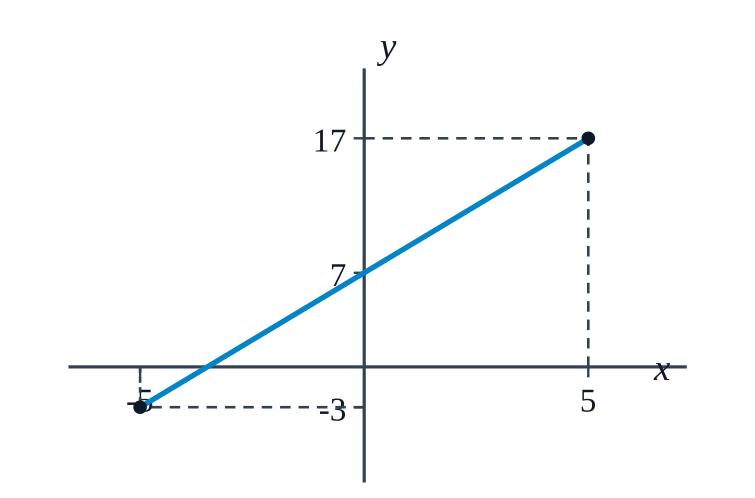
    If R1={(x,y)∣y=2x+7\displaystyle \mathrm{R}_1=\{(x, y) \mid y=2 x+7, where x∈R\displaystyle x \in \mathbf{R} and −5≤x≤5}\displaystyle -5 \leq x \leq 5\} is a relation. Then find the domain and Range of R1\displaystyle \mathrm{R}_1.

    Matches the book, not yet reviewed

    This working reaches the answer NCERT prints. It has not yet been read through by hand.

    NCERT’s answer
    Domain of \(\displaystyle \mathrm{R}_1=[-5,5]\) and Range of \(\displaystyle \mathrm{R}_1=[-3,17]\)
    \[-5\le x\le 5 \ \Rightarrow\ \text{Domain}=[-5,5] \] \[-10\le 2x\le 10 \] \[-3\le 2x+7\le 17 \] \[x=-5\Rightarrow y=-3,\qquad x=5\Rightarrow y=17 \]The line is continuous, so \(\displaystyle y\) takes every value between these ends.NCERT_Solution_Class11_Maths_Exemplar_Ch2_Ex2-3_Q7Answer: Domain \(\displaystyle =[-5,5]\), Range \(\displaystyle =[-3,17]\).
  8. Exercise 8

    If R2={(x,y)∣x\displaystyle \mathrm{R}_2=\left\{(x, y) \mid x\right. and y\displaystyle y are integers and x2+y2=64}\displaystyle \left.x^2+y^2=64\right\} is a relation. Then find R2\displaystyle \mathrm{R}_2.

    Matches the book, not yet reviewed

    This working reaches the answer NCERT prints. It has not yet been read through by hand.

    NCERT’s answer
    \(\displaystyle \mathrm{R}_2=\{(0,8),(8,0)(0,-8),(-8,0)\}\)
    Since \(\displaystyle y^2 \ge 0\), \(\displaystyle x^2 \le 64\), so \(\displaystyle x\) is an integer with \(\displaystyle |x|\le 8\).\[x=0:\ y^2=64 \Rightarrow y=\pm 8 \] \[x=\pm 8:\ y^2=0 \Rightarrow y=0 \] \[x=\pm1,\pm2,\dots,\pm7:\ y^2=64-x^2 = 63,\,60,\,55,\,48,\,39,\,28,\,15 \]None of these is a perfect square, so no other integer pair works.Answer: \(\displaystyle R_2=\{(0,8),(0,-8),(8,0),(-8,0)\}\)
  9. Exercise 9

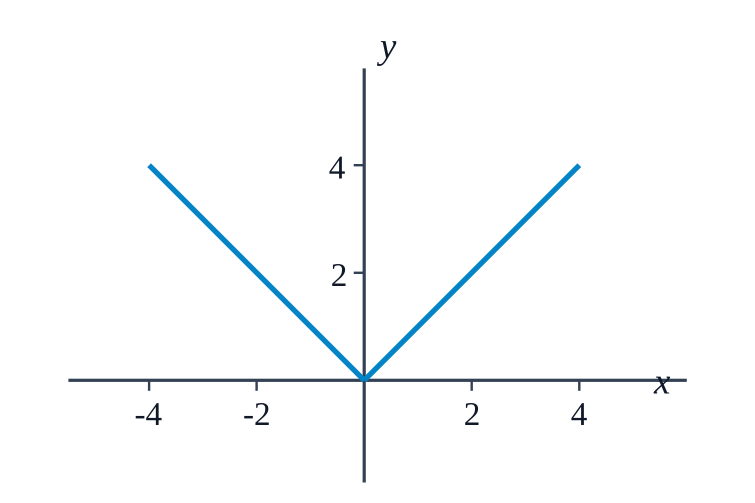
    If R3={(x,∣x∣)∣x\displaystyle \mathrm{R}_3=\{(x,|x|) \mid x is a real number }\displaystyle \} is a relation. Then find domain and range of R3\displaystyle \mathrm{R}_3.

    Matches the book, not yet reviewed

    This working reaches the answer NCERT prints. It has not yet been read through by hand.

    NCERT’s answer
    Domain of \(\displaystyle \mathrm{R}_3=\mathbf{R}\) and range of \(\displaystyle \mathrm{R}_3=\mathbf{R}^{+} \cup\{0\}\)
    \(\displaystyle |x|\) is defined for every real \(\displaystyle x\):\[\text{Domain}=\mathbb{R} \]\(\displaystyle |x|\ge 0\), and every \(\displaystyle a\ge 0\) is attained since\[(a,|a|)=(a,a)\in R_3 \quad (a\ge 0) \]\[\text{Range}=\{y\in\mathbb{R} : y\ge 0\}=[0,\infty) \]NCERT_Solution_Class11_Maths_Exemplar_Ch2_Ex2-3_Q9Answer: Domain \(\displaystyle =\mathbb{R}\); Range \(\displaystyle =[0,\infty)\)
  10. Exercise 10

    Is the given relation a function? Give reasons for your answer.
    (i)
    h={(4,6),(3,9),(−11,6),(3,11)}\displaystyle h=\{(4,6),(3,9),(-11,6),(3,11)\}
    (ii)
    f={(x,x)∣x\displaystyle f=\{(x, x) \mid x is a real number }\displaystyle \}
    (iii)
    g={(n,1n)∣ n\displaystyle g=\left\{\left.\left(n, \frac{1}{n}\right) \right\rvert\, n\right. is a positive integer }\displaystyle \}
    (iv)
    s={(n,n2)∣n\displaystyle s=\left\{\left(n, n^2\right) \mid n\right. is a positive integer }\displaystyle \}
    (v)
    t={(x,3)∣x\displaystyle t=\{(x, 3) \mid x is a real number.

    Matches the book, not yet reviewed

    This working reaches the answer NCERT prints. It has not yet been read through by hand.

    NCERT’s answer
    (i)
    \(\displaystyle h\) is not a function
    (ii)
    \(\displaystyle f\) is a function
    (iii)
    \(\displaystyle g\) is a function
    (iv)
    \(\displaystyle s\) is a function
    (v)
    \(\displaystyle t\) is a constant function
    (i) Not a function: \(\displaystyle 3\) has two images. \[h(3)=9 \quad\text{and}\quad h(3)=11 \](ii) Function: each real \(\displaystyle x\) has exactly one image. \[f(x)=x \](iii) Function: each positive integer \(\displaystyle n\) has exactly one image. \[g(n)=\frac{1}{n} \](iv) Function: each positive integer \(\displaystyle n\) has exactly one image. \[s(n)=n^2 \](v) Function (constant): each real \(\displaystyle x\) has exactly one image. \[t(x)=3 \]Answer: (i) not a function; (ii), (iii), (iv), (v) are functions.