SolveIt is under development
SolveItNCERT · CBSE · NEET

NCERT Exemplar · Class 10 Science Sources of Energy

29 questions · 29 still being checked

Multiple Choice Questions 11–15 (part 2 of 4)

  1. Exercise 11

    The power generated in a windmill
    (a)
    is more in rainy season since damp air would mean more air mass hitting the blades
    (b)
    depends on the height of the tower
    (c)
    depends on wind velocity
    (d)
    can be increased by planting tall trees close to the tower

    Matches the book, not yet reviewed

    This working reaches the answer NCERT prints. It has not yet been read through by hand.

    NCERT’s answer
    (c)
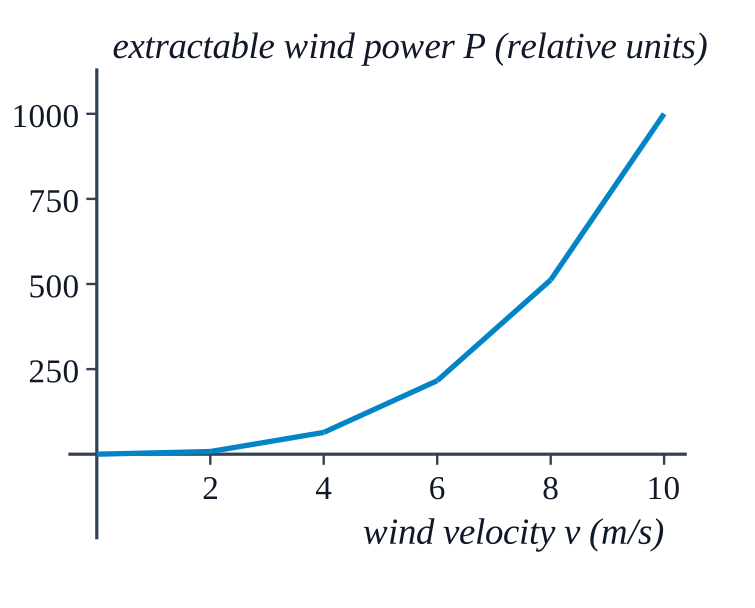
    (c) Depends on wind velocity. NCERT_Solution_Class10_Science_Exemplar_Ch14_Q11 The kinetic energy carried by moving air, and hence the power a windmill can extract, rises steeply with speed: \[P \propto v^{3} \] Tower height and rainfall do not enter this relation.
  2. Exercise 12

    Choose the correct statement
    (a)
    Sun can be taken as an inexhaustible source of energy
    (b)
    There is infinite storage of fossil fuel inside the earth
    (c)
    Hydro and wind energy plants are non polluting sources of energy
    (d)
    Waste from a nuclear power plant can be easily disposed off

    Matches the book, not yet reviewed

    This working reaches the answer NCERT prints. It has not yet been read through by hand.

    NCERT’s answer
    (a)
    (a) The Sun will radiate for billions of years, effectively inexhaustible on human timescales. Fossil fuel is finite, dams and rotting vegetation harm the environment, and nuclear waste needs prolonged safe storage, not easy disposal.
  3. Exercise 13

    In a hydroelectric power plant more electrical power can be generated if water falls from a greater height because
    (a)
    its temperature increases
    (b)
    larger amount of potential energy is converted into kinetic energy
    (c)
    the electricity content of water increases with height
    (d)
    more water molecules dissociate into ions

    Matches the book, not yet reviewed

    This working reaches the answer NCERT prints. It has not yet been read through by hand.

    NCERT’s answer
    (b)
    (b) Larger PE converts to KE. \[PE = mgh \] \[PE \to KE = \tfrac{1}{2}mv^{2} \] A greater head \(\displaystyle h\) gives a greater fall speed \(\displaystyle v\) at the turbine, hence more electrical power generated.
  4. Exercise 14

    Choose the incorrect statement regarding wind power
    (a)
    It is expected to harness wind power to minimum in open space
    (b)
    The potential energy content of wind blowing at high altitudes is the source of wind power
    (c)
    Wind hitting at the blades of a windmill causes them to rotate The rotation thus achieved can be utilised further
    (d)
    One possible method of utilising the energy of rotational motion of the blades of a windmill is to run the turbine of an electric generator

    Matches the book, not yet reviewed

    This working reaches the answer NCERT prints. It has not yet been read through by hand.

    NCERT’s answer
    (b)
    (b) Wind's usable energy is kinetic, from moving air, \[KE = \tfrac{1}{2}mv^{2} \] not potential energy "at high altitude" — height alone stores no wind power; blade rotation driving a generator turbine, as in (c) and (d), is correctly described.
  5. Exercise 15

    Choose the incorrect statement
    (a)
    We are encouraged to plant more trees so as to ensure clean environment and also provide bio-mass fuel
    (b)
    Gobar-gas is produced when crops, vegetable wastes etc., decompose in the absence of oxygen
    (c)
    The main ingredient of bio-gas is ethane and it gives a lot of smoke and also produces a lot of residual ash
    (d)
    Bio-mass is a renewable source of energy

    Matches the book, not yet reviewed

    This working reaches the answer NCERT prints. It has not yet been read through by hand.

    NCERT’s answer
    (c)
    (c) Biogas's main ingredient is methane, not ethane; it burns with a clean flame — no smoke, no residual ash — unlike solid biomass fuels; (a), (b), (d) are each true.