SolveIt is under development
SolveItNCERT · CBSE · NEET

NCERT Exemplar · Class 10 Science Magnetic Effects of Electric Current

32 questions · 32 still being checked

Short Answer Questions 13–24 (part 2 of 3)

  1. Exercise 13

    A magnetic compass needle is placed in the plane of paper near point A as shown in Figure 13.6. In which plane should a straight current carrying conductor be placed so that it passes through A and there is no change in the deflection of the compass? Under what condition is the deflection maximum and why? NCERT_Question_Class10_Science_Exemplar_Ch13_Q13

    Matches the book, not yet reviewed

    This working reaches the answer NCERT prints. It has not yet been read through by hand.

    NCERT’s answer
    In the plane of the paper itself. The axis of the compass is vertical and the field due to the conductor is also vertical. It could result in a dip of compass needle which is not possible in this case (dips result only if axis of compass is horizontal). The deflection is maximum when the conductor through A is perpendicular to the plane of paper and the field due to it is maximum in the plane of the paper.
    A wire lying in the page gives, at every point of the page, a field normal to the page; the needle swings only in the page.\[\text{wire in the page} \Rightarrow \vec B \perp \text{page} \Rightarrow \text{no turning force} \] \[\text{wire} \perp \text{page} \Rightarrow \vec B \text{ in the page} \Rightarrow \text{maximum turning force} \] Answer: a wire through A in the plane of the paper leaves the deflection unchanged; a wire through A perpendicular to the paper gives the maximum, since its field then lies in the needle's plane of swing.
  2. Exercise 14

    Under what conditions permanent electromagnet is obtained if a current carrying solenoid is used? Support your answer with the help of a labelled circuit diagram.

    Matches the book, not yet reviewed

    This working reaches the answer NCERT prints. It has not yet been read through by hand.

    NCERT’s answer
    Hint— (i) The current through the solenoid should be direct current.
    (ii)
    The rod inside is made of a magnetic material such as steel.
    NCERT_Solution_Class10_Science_Exemplar_Ch13_Q14_ncert
    Two conditions: the current must be direct, from a cell (alternating current reverses the field every half-cycle, so no steady poles form); and the core must be steel, whose high retentivity keeps its magnetism (soft iron loses it).Switch the current off only after the steel bar is magnetised; it then stays a permanent magnet. Answer: pass direct current through the solenoid, with a steel core.
  3. Exercise 15

    AB is a current carrying conductor in the plane of the paper as shown in Figure 13.7. What are the directions of magnetic fields produced by it at points P\displaystyle P and Q\displaystyle Q? Given r1>r2\displaystyle r_1>r_2, where will the strength of the magnetic field be larger? NCERT_Question_Class10_Science_Exemplar_Ch13_Q15

    Matches the book, not yet reviewed

    This working reaches the answer NCERT prints. It has not yet been read through by hand.

    NCERT’s answer
    Into the plane of paper at P and out of it at Q. The strength of the magnetic field is larger at the point located closer i.e. at Q.
    Curl the right hand around AB with the thumb along \(\displaystyle I\) (upward): at P, to the right of the wire, the fingers point into the page; at Q, to the left, they point out of the page.\[B = \dfrac{\mu_0 I}{2\pi r} \ \Rightarrow\ B \propto \dfrac{1}{r} \] \[r_2 < r_1 \ \Rightarrow\ B_Q > B_P \] Answer: into the page at P, out of the page at Q; the field is stronger at Q, the closer point.
  4. Exercise 16

    A magnetic compass shows a deflection when placed near a current carrying wire. How will the deflection of the compass get affected if the current in the wire is increased? Support your answer with a reason.

    Matches the book, not yet reviewed

    This working reaches the answer NCERT prints. It has not yet been read through by hand.

    NCERT’s answer
    The deflection increases. The strength of magnetic field is directly proportional to the magnitude of current passing through the straight conductor.
    \[B_{\text{wire}}=\dfrac{\mu_0 I}{2\pi r}\ \Rightarrow\ B_{\text{wire}}\propto I\quad (r\ \text{fixed}) \] \[I\uparrow \Rightarrow B_{\text{wire}}\uparrow \Rightarrow \text{deflection}\uparrow \] The needle points along the resultant of the wire's field and Earth's field; a stronger wire field turns that resultant further from north. Answer: the deflection increases, because the wire's magnetic field grows with the current.
  5. Exercise 17

    It is established that an electric current through a metallic conductor produces a magnetic field around it. Is there a similar magnetic field produced around a thin beam of moving (i) alpha particles, (ii) neutrons? Justify your answer.

    Matches the book, not yet reviewed

    This working reaches the answer NCERT prints. It has not yet been read through by hand.

    NCERT’s answer
    Hint— (i) Yes, Alpha particles being positively charged constitutes a current in the direction of motion.
    (ii)
    No. The neutrons being electrically neutral constitute no current.
    A magnetic field needs moving charge, i.e. a current, not moving mass alone.
    (i)
    \(\displaystyle \alpha\)-particles carry charge \(\displaystyle +2e\): the beam is a current along its direction of motion, so \(\displaystyle \text{current} \Rightarrow \vec B\) around the beam.
    (ii)
    Neutrons are uncharged: \(\displaystyle q = 0 \Rightarrow \text{no current} \Rightarrow \text{no field}\).
    Answer: (i) yes -- a beam of alpha particles is a current; (ii) no -- neutrons carry no charge.
  6. Exercise 18

    What does the direction of thumb indicate in the right-hand thumb rule. In what way this rule is different from Fleming's left-hand rule?

    Matches the book, not yet reviewed

    This working reaches the answer NCERT prints. It has not yet been read through by hand.

    NCERT’s answer
    The thumb indicates the direction of current in the straight conductor held by curled fingers, whereas the Fleming's left-hand rule gives the direction of force experienced by current carrying conductor placed in an external magnetic field.
    In the right-hand thumb rule the thumb points along the current \(\displaystyle I\); the curled fingers give the field \(\displaystyle \vec B\) circling the wire.Fleming's left-hand rule instead gives the force \(\displaystyle \vec F\) on a current in a field: forefinger \(\displaystyle = \vec B\), middle finger \(\displaystyle = I\), thumb \(\displaystyle = \vec F\). Answer: the thumb shows the current; the right-hand rule gives the field a current makes, Fleming's left-hand rule the force on a current in a field.
  7. Exercise 19

    Meena draws magnetic field lines of field close to the axis of a current carrying circular loop. As she moves away from the centre of the circular loop she observes that the lines keep on diverging. How will you explain her observation.

    Matches the book, not yet reviewed

    This working reaches the answer NCERT prints. It has not yet been read through by hand.

    NCERT’s answer
    Strength of the magnetic field falls as distance increases. This is indicated by the decrease in degree of closeness of the lines of field.
    Near the centre of the loop the axial lines are close together and nearly straight: the field is strongest there. \[\text{distance from centre}\uparrow \Rightarrow B\downarrow \Rightarrow \text{lines spread apart} \]Answer: The field of the loop weakens as one moves away from its centre, so the lines diverge.
  8. Exercise 20

    What does the divergence of magnetic field lines near the ends of a current carrying straight solenoid indicate?

    Matches the book, not yet reviewed

    This working reaches the answer NCERT prints. It has not yet been read through by hand.

    NCERT’s answer
    The divergence, that is, the falling degree of closeness of magnetic field lines indicates the fall in strength of magnetic field near and beyond the ends of the solenoid.
    Field-line density represents field strength. Inside the solenoid the lines run parallel and closely spaced: the field is strong and nearly uniform. Near the ends the lines diverge: \[\text{density}\downarrow \Rightarrow B\downarrow \]Answer: The magnetic field becomes weaker near and beyond the ends of the solenoid.
  9. Exercise 21

    Name four appliances wherein an electric motor, a rotating device that converts electrical energy to mechanical energy, is used as an important component. In what respect motors are different from generators?

    Matches the book, not yet reviewed

    This working reaches the answer NCERT prints. It has not yet been read through by hand.

    NCERT’s answer
    Electric fans, mixers, washing machines, computer drives, etc. Motors convert electrical energy into mechanical energy whereas generators convert mechanical energy into electrical energy.
    \[\text{Motor: } I\ (\text{in } B) \xrightarrow{\text{force}} \text{rotation}\quad (\text{electrical}\to\text{mechanical}) \] \[\text{Generator: rotation}\ (\text{in } B) \xrightarrow{\text{induction}} I\quad (\text{mechanical}\to\text{electrical}) \] Answer: Fan, washing machine, mixer-grinder, water pump. A motor converts electrical energy into mechanical energy; a generator converts mechanical energy into electrical energy.
  10. Exercise 22

    What is the role of the two conducting stationary brushes in a simple electric motor?

    Matches the book, not yet reviewed

    This working reaches the answer NCERT prints. It has not yet been read through by hand.

    NCERT’s answer
    The brushes are connected to the battery and touch the outer side of two halves of the split ring whose inner sides are insulated and attached to the axle.
    Brushes X and Y press on split-ring halves P and Q and feed battery current into the coil as it rotates. \[X\to P\to A\to B\to C\to D\to Q\to Y \] Half a turn later the halves have swapped brushes: \[X\to Q\to D\to C\to B\to A\to P\to Y \] The current in the coil reverses, so the torque keeps the same sense. Answer: They connect the fixed battery circuit to the rotating coil through the split ring, without the wires twisting.
  11. Exercise 23

    What is the difference between a direct current and an alternating current? How many times does AC used in India change direction in one second?

    Matches the book, not yet reviewed

    This working reaches the answer NCERT prints. It has not yet been read through by hand.

    NCERT’s answer
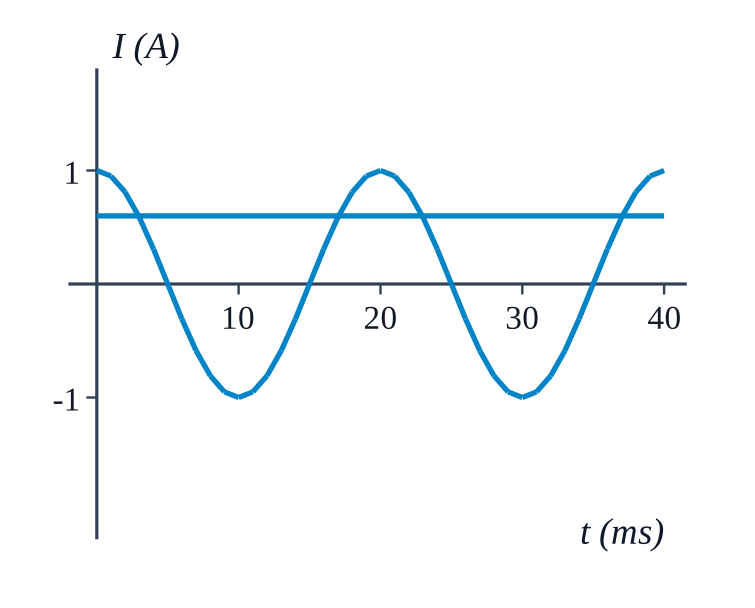
    Direct current always flows in one direction but the alternating current reverses its direction periodically. The frequency of AC in India is $\displaystyle 50$ Hz and in each cycle it alters direction twice. Therefore AC changes direction \(\displaystyle 2 \times 50=100\) times in one second.
    DC flows in one direction only; AC reverses its direction periodically. NCERT_Solution_Class10_Science_Exemplar_Ch13_Q23 Indian mains: \(\displaystyle f = 50\ \text{Hz}\), and each cycle has two reversals: \[2f = 2\times 50\ \text{Hz} = 100\ \text{s}^{-1} \] Answer: DC flows one way only, AC reverses periodically. AC in India changes direction $\displaystyle 100$ times per second.
  12. Exercise 24

    What is the role of fuse, used in series with any electrical appliance? Why should a fuse with defined rating not be replaced by one with a larger rating?

    Matches the book, not yet reviewed

    This working reaches the answer NCERT prints. It has not yet been read through by hand.

    NCERT’s answer
    Fuse is used for protecting appliances due to short-circuiting or overloading. The fuse is rated for a certain maximum current and blows off when a current more than the rated value flows through it. If a fuse is replaced by one with larger ratings, the appliances may get damaged while the protecting fuse does not burn off. This practice of using fuse of improper rating should always be avoided.
    A fuse is a thin, low-melting-point wire in series with the appliance, so the whole circuit current passes through it. \[I > I_{\text{rated}} \Rightarrow H = I^2 R t\uparrow \Rightarrow \text{wire melts, circuit breaks} \] This protects wiring and appliance from overload or short circuit. Answer: The fuse melts and breaks the circuit when current exceeds its rating. A larger-rated fuse would let unsafe current flow instead of blowing in time.