SolveIt is under development
SolveItNCERT · CBSE · NEET

NCERT Exemplar · Class 10 Science Electricity

35 questions · 35 still being checked

Multiple Choice Questions 11–18 (part 2 of 4)

  1. Exercise 11

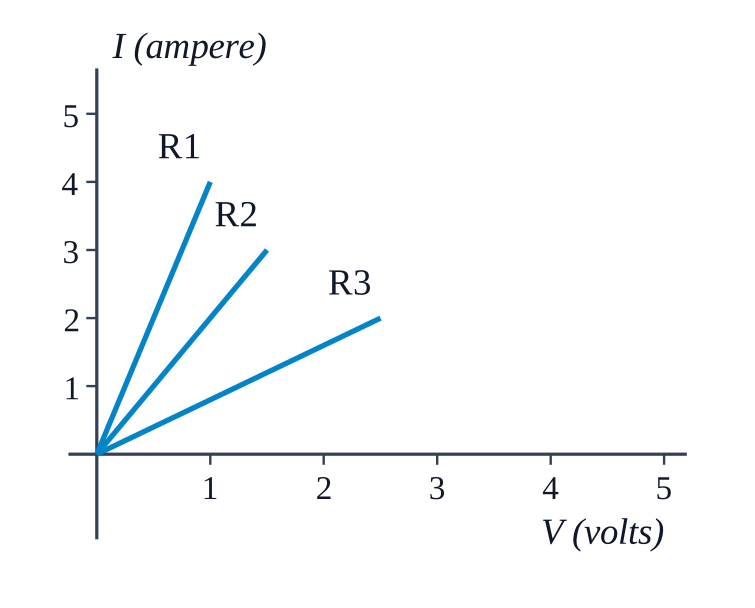
    A student carries out an experiment and plots the V-I graph of three samples of nichrome wire with resistances R1,R2\displaystyle R_1, R_2 and R3\displaystyle R_3 respectively (Figure.12.5). Which of the following is true?
    (a)
    R1=R2=R3\displaystyle R_1=R_2=R_3
    (b)
    R1>R2>R3\displaystyle R_1>R_2>R_3
    (c)
    R3>R2>R1\displaystyle R_3>R_2>R_1
    (d)
    R2>R3>R1\displaystyle R_2>R_3>R_1
    NCERT_Question_Class10_Science_Exemplar_Ch12_Q11

    Matches the book, not yet reviewed

    This working reaches the answer NCERT prints. It has not yet been read through by hand.

    NCERT’s answer
    (c)
    (c) \(\displaystyle R_3>R_2>R_1\) — the slope of an I\(\displaystyle -\)V line is \(\displaystyle 1/R\); the steeper line has the smaller resistance. NCERT_Solution_Class10_Science_Exemplar_Ch12_Q11 \[V=IR\ \Rightarrow\ I=\frac{1}{R}\,V \] \[\text{slope}(R_1)>\text{slope}(R_2)>\text{slope}(R_3) \] \[\frac{1}{R_1}>\frac{1}{R_2}>\frac{1}{R_3}\ \Rightarrow\ R_3>R_2>R_1 \]
  2. Exercise 12

    If the current I\displaystyle I through a resistor is increased by 100\displaystyle 100% (assume that temperature remains unchanged), the increase in power dissipated will be
    (a)
    100\displaystyle 100 %
    (b)
    200\displaystyle 200 %
    (c)
    300\displaystyle 300 %
    (d)
    400\displaystyle 400 %

    Matches the book, not yet reviewed

    This working reaches the answer NCERT prints. It has not yet been read through by hand.

    NCERT’s answer
    (c)
    (c) $\displaystyle 300$% — power varies as the square of current, so doubling \(\displaystyle I\) makes power four times as large, a rise of \(\displaystyle 3P\). \[P=I^2R \] \[P'=(2I)^2R=4I^2R=4P \] \[\Delta P=P'-P=4P-P=3P \] \[\frac{\Delta P}{P}\times100\%=300\% \]
  3. Exercise 13

    The resistivity does not change if
    (a)
    the material is changed
    (b)
    the temperature is changed
    (c)
    the shape of the resistor is changed
    (d)
    both material and temperature are changed

    Matches the book, not yet reviewed

    This working reaches the answer NCERT prints. It has not yet been read through by hand.

    NCERT’s answer
    (c)
    (c) The shape of the resistor is changed. \[\rho = \dfrac{RA}{L} \] Resistivity \(\displaystyle \rho\) is fixed by material and temperature; length \(\displaystyle L\) and area \(\displaystyle A\) cancel out of the ratio, so changing the shape leaves \(\displaystyle \rho\) unchanged.
  4. Exercise 14

    In an electrical circuit three incandescent bulbs A,B\displaystyle \mathrm{A}, \mathrm{B} and C of rating 40\displaystyle 40 W, 60\displaystyle 60 W and 100\displaystyle 100 W respectively are connected in parallel to an electric source. Which of the following is likely to happen regarding their brightness?
    (a)
    Brightness of all the bulbs will be the same
    (b)
    Brightness of bulb A will be the maximum
    (c)
    Brightness of bulb B will be more than that of A
    (d)
    Brightness of bulb C will be less than that of B

    Matches the book, not yet reviewed

    This working reaches the answer NCERT prints. It has not yet been read through by hand.

    NCERT’s answer
    (c)
    (c) Brightness of bulb B will be more than that of A. \[P = \dfrac{V^2}{R} \] In parallel every bulb sees the same \(\displaystyle V\), so power (brightness) tracks the rated wattage directly: \(\displaystyle P_C(100\,\mathrm{W}) > P_B(60\,\mathrm{W}) > P_A(40\,\mathrm{W})\).
  5. Exercise 15

    In an electrical circuit two resistors of 2Ω\displaystyle 2 \Omega and 4Ω\displaystyle 4 \Omega respectively are connected in series to a 6\displaystyle 6 V battery. The heat dissipated by the 4Ω\displaystyle 4 \Omega resistor in 5\displaystyle 5 s will be
    (a)
    5\displaystyle 5 J
    (b)
    10\displaystyle 10 J
    (c)
    20\displaystyle 20 J
    (d)
    30\displaystyle 30 J

    Matches the book, not yet reviewed

    This working reaches the answer NCERT prints. It has not yet been read through by hand.

    NCERT’s answer
    (c)
    (c) $\displaystyle 20$ J. \[I = \dfrac{V}{R_1+R_2} = \dfrac{6\,\mathrm{V}}{2\,\Omega+4\,\Omega} = 1\,\mathrm{A} \] \[H = I^2 R_2 t = (1\,\mathrm{A})^2 \times 4\,\Omega \times 5\,\mathrm{s} = 20\,\mathrm{J} \]
  6. Exercise 16

    An electric kettle consumes 1\displaystyle 1 kW of electric power when operated at 220\displaystyle 220 V. A fuse wire of what rating must be used for it?
    (a)
    1\displaystyle 1 A
    (b)
    2\displaystyle 2 A
    (c)
    4\displaystyle 4 A
    (d)
    5\displaystyle 5 A

    Matches the book, not yet reviewed

    This working reaches the answer NCERT prints. It has not yet been read through by hand.

    NCERT’s answer
    (d)
    (d) $\displaystyle 5$ A. \[I = \dfrac{P}{V} = \dfrac{1000\,\mathrm{W}}{220\,\mathrm{V}} \approx 4.55\,\mathrm{A} \] A fuse must carry the normal operating current without blowing, so its rating is the next standard value above \(\displaystyle 4.55\,\mathrm{A}\).
  7. Exercise 17

    Two resistors of resistance 2Ω\displaystyle 2 \Omega and 4Ω\displaystyle 4 \Omega when connected to a battery will have
    (a)
    same current flowing through them when connected in parallel
    (b)
    same current flowing through them when connected in series
    (c)
    same potential difference across them when connected in series
    (d)
    different potential difference across them when connected in parallel

    Matches the book, not yet reviewed

    This working reaches the answer NCERT prints. It has not yet been read through by hand.

    NCERT’s answer
    (b)
    (b) Same current flowing through them when connected in series. \[I = \dfrac{V}{R_1+R_2} \] A series loop carries one common \(\displaystyle I\) through both resistors; in parallel \(\displaystyle V\) is common instead, giving \(\displaystyle I_1=V/R_1 \neq I_2=V/R_2\) since \(\displaystyle R_1\neq R_2\).
  8. Exercise 18

    Unit of electric power may also be expressed as
    (a)
    volt ampere
    (b)
    kilowatt hour
    (c)
    watt second
    (d)
    joule second

    Matches the book, not yet reviewed

    This working reaches the answer NCERT prints. It has not yet been read through by hand.

    NCERT’s answer
    (a)
    (a) Volt ampere. \[P = VI \] \[\mathrm{V}\times\mathrm{A} = \dfrac{\mathrm{J}}{\mathrm{C}}\times\dfrac{\mathrm{C}}{\mathrm{s}} = \mathrm{J\,s^{-1}} = \mathrm{W} \] Kilowatt hour and watt second are units of energy; joule second is energy \(\displaystyle \times\) time.