Exercise 11
If , then prove that .
Not cross-checked
NCERT prints no numerical answer for this exercise, so this working has not been cross-checked against the book.
\[a\sin\theta+b\cos\theta=c \]
\[(a\sin\theta+b\cos\theta)^2+(a\cos\theta-b\sin\theta)^2=a^2(\sin^2\theta+\cos^2\theta)+b^2(\cos^2\theta+\sin^2\theta)=a^2+b^2 \]
\[c^2+(a\cos\theta-b\sin\theta)^2=a^2+b^2 \]
\[(a\cos\theta-b\sin\theta)^2=a^2+b^2-c^2 \]
Taking the positive root:
\[a\cos\theta-b\sin\theta=\sqrt{a^2+b^2-c^2} \]
Answer: \(\displaystyle a\cos\theta-b\sin\theta=\sqrt{a^2+b^2-c^2}\)
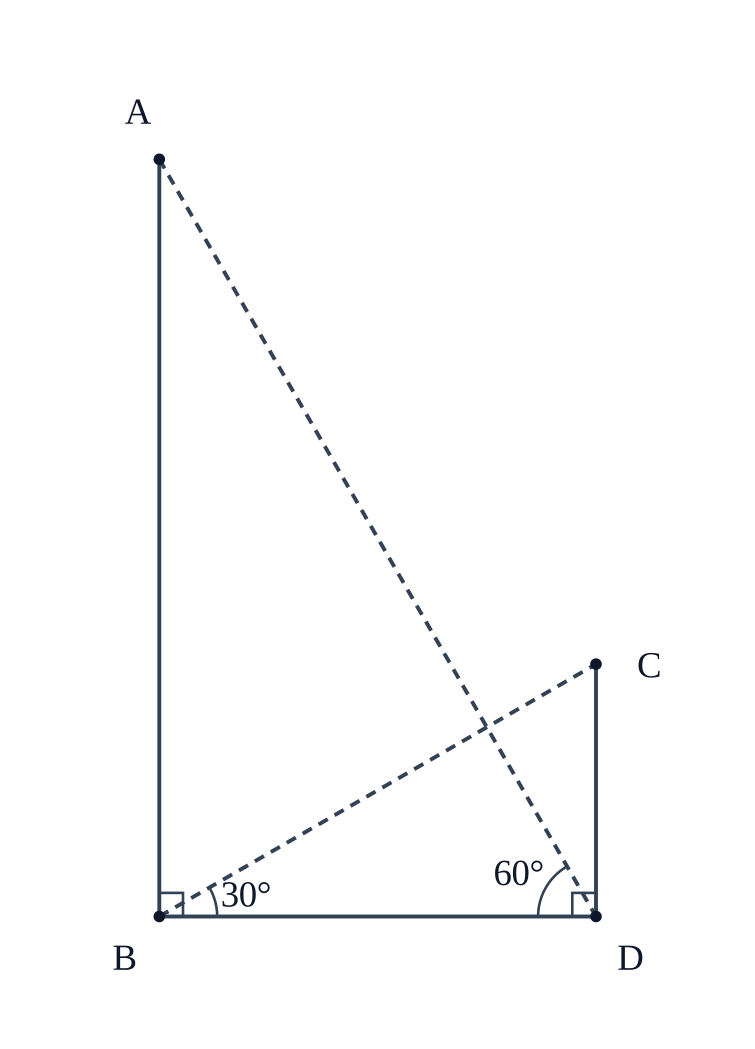 \[\tan 60^\circ = \frac{AB}{BD} \]
\[x = \frac{30}{\sqrt3} = 10\sqrt3 \]
\[\tan 30^\circ = \frac{CD}{BD} \]
\[CD = 10\sqrt3 \times \frac{1}{\sqrt3} = 10 \]
Answer: distance between the towers \(\displaystyle 10\sqrt3\approx17.3\) m; height of the other tower \(\displaystyle 10\) m.
\[\tan 60^\circ = \frac{AB}{BD} \]
\[x = \frac{30}{\sqrt3} = 10\sqrt3 \]
\[\tan 30^\circ = \frac{CD}{BD} \]
\[CD = 10\sqrt3 \times \frac{1}{\sqrt3} = 10 \]
Answer: distance between the towers \(\displaystyle 10\sqrt3\approx17.3\) m; height of the other tower \(\displaystyle 10\) m.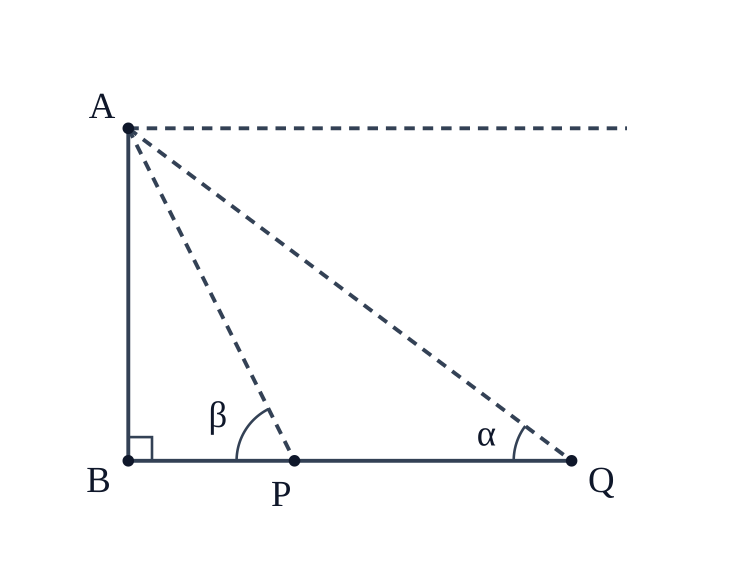 \[\angle APB=\beta,\quad \angle AQB=\alpha \quad \text{(alternate angles)} \]
\[\tan\beta = \frac{h}{BP} \implies BP = h\cot\beta \]
\[\tan\alpha = \frac{h}{BQ} \implies BQ = h\cot\alpha \]
\[PQ = BQ - BP = h(\cot\alpha-\cot\beta) \]
Answer: \(\displaystyle PQ=h(\cot\alpha-\cot\beta)\) m.
\[\angle APB=\beta,\quad \angle AQB=\alpha \quad \text{(alternate angles)} \]
\[\tan\beta = \frac{h}{BP} \implies BP = h\cot\beta \]
\[\tan\alpha = \frac{h}{BQ} \implies BQ = h\cot\alpha \]
\[PQ = BQ - BP = h(\cot\alpha-\cot\beta) \]
Answer: \(\displaystyle PQ=h(\cot\alpha-\cot\beta)\) m.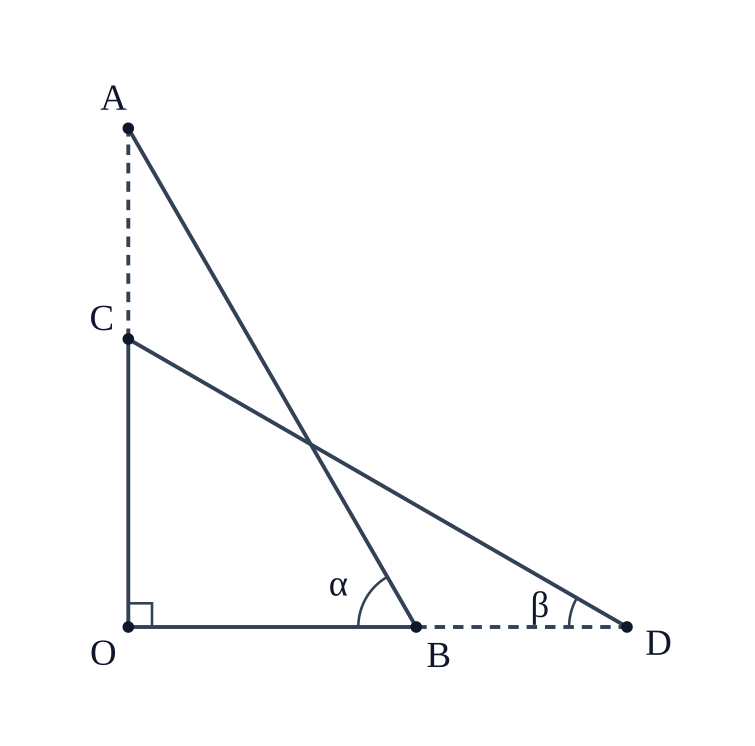 \[\triangle AOB:\quad OB=L\cos\alpha,\quad OA=L\sin\alpha \]
\[\triangle COD:\quad OD=L\cos\beta,\quad OC=L\sin\beta \]
\[p = BD = OD-OB = L(\cos\beta-\cos\alpha) \]
\[q = AC = OA-OC = L(\sin\alpha-\sin\beta) \]
\[\frac{p}{q} = \frac{L(\cos\beta-\cos\alpha)}{L(\sin\alpha-\sin\beta)} = \frac{\cos\beta-\cos\alpha}{\sin\alpha-\sin\beta} \]
Answer: \(\displaystyle \dfrac{p}{q}=\dfrac{\cos\beta-\cos\alpha}{\sin\alpha-\sin\beta}\)
\[\triangle AOB:\quad OB=L\cos\alpha,\quad OA=L\sin\alpha \]
\[\triangle COD:\quad OD=L\cos\beta,\quad OC=L\sin\beta \]
\[p = BD = OD-OB = L(\cos\beta-\cos\alpha) \]
\[q = AC = OA-OC = L(\sin\alpha-\sin\beta) \]
\[\frac{p}{q} = \frac{L(\cos\beta-\cos\alpha)}{L(\sin\alpha-\sin\beta)} = \frac{\cos\beta-\cos\alpha}{\sin\alpha-\sin\beta} \]
Answer: \(\displaystyle \dfrac{p}{q}=\dfrac{\cos\beta-\cos\alpha}{\sin\alpha-\sin\beta}\)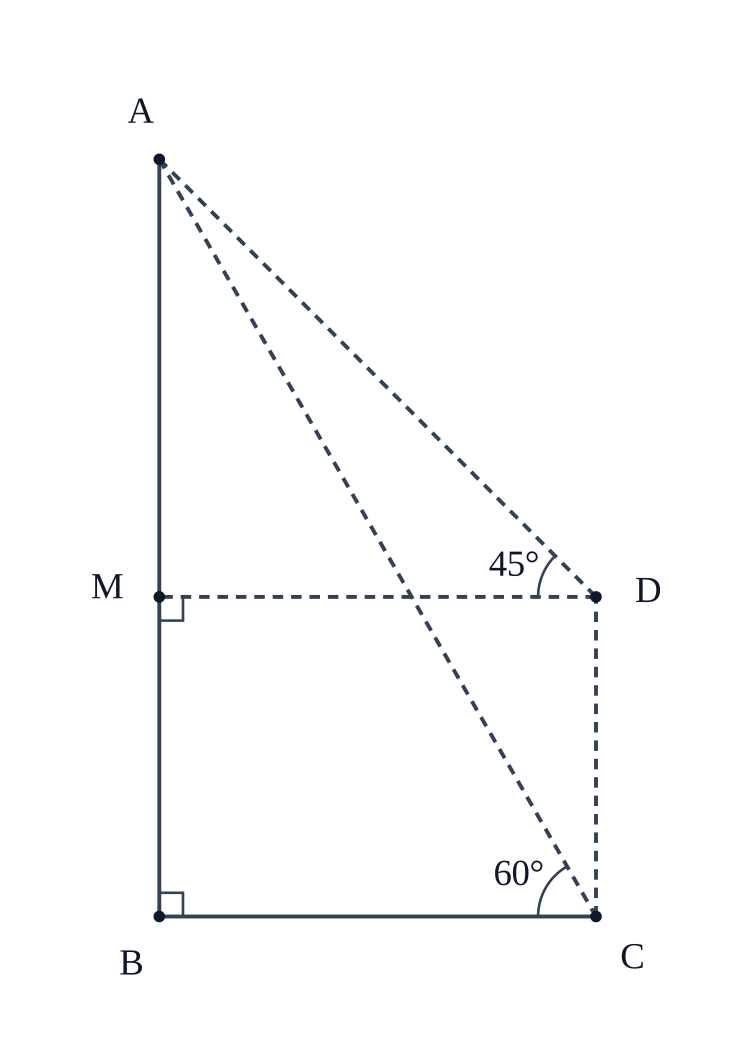 \[\tan 60^\circ = \frac{h}{BC} \implies BC=\frac{h}{\sqrt3} \]
\[\tan 45^\circ = \frac{h-10}{BC} \implies h-10=\frac{h}{\sqrt3} \]
\[h\left(1-\frac{1}{\sqrt3}\right)=10 \implies h=\frac{10\sqrt3}{\sqrt3-1} \]
\[h=\frac{10\sqrt3(\sqrt3+1)}{(\sqrt3-1)(\sqrt3+1)}=\frac{10(3+\sqrt3)}{2}=5(3+\sqrt3) \]
Answer: \(\displaystyle h=5(3+\sqrt3)\) m \(\displaystyle \approx23.66\) m.
\[\tan 60^\circ = \frac{h}{BC} \implies BC=\frac{h}{\sqrt3} \]
\[\tan 45^\circ = \frac{h-10}{BC} \implies h-10=\frac{h}{\sqrt3} \]
\[h\left(1-\frac{1}{\sqrt3}\right)=10 \implies h=\frac{10\sqrt3}{\sqrt3-1} \]
\[h=\frac{10\sqrt3(\sqrt3+1)}{(\sqrt3-1)(\sqrt3+1)}=\frac{10(3+\sqrt3)}{2}=5(3+\sqrt3) \]
Answer: \(\displaystyle h=5(3+\sqrt3)\) m \(\displaystyle \approx23.66\) m.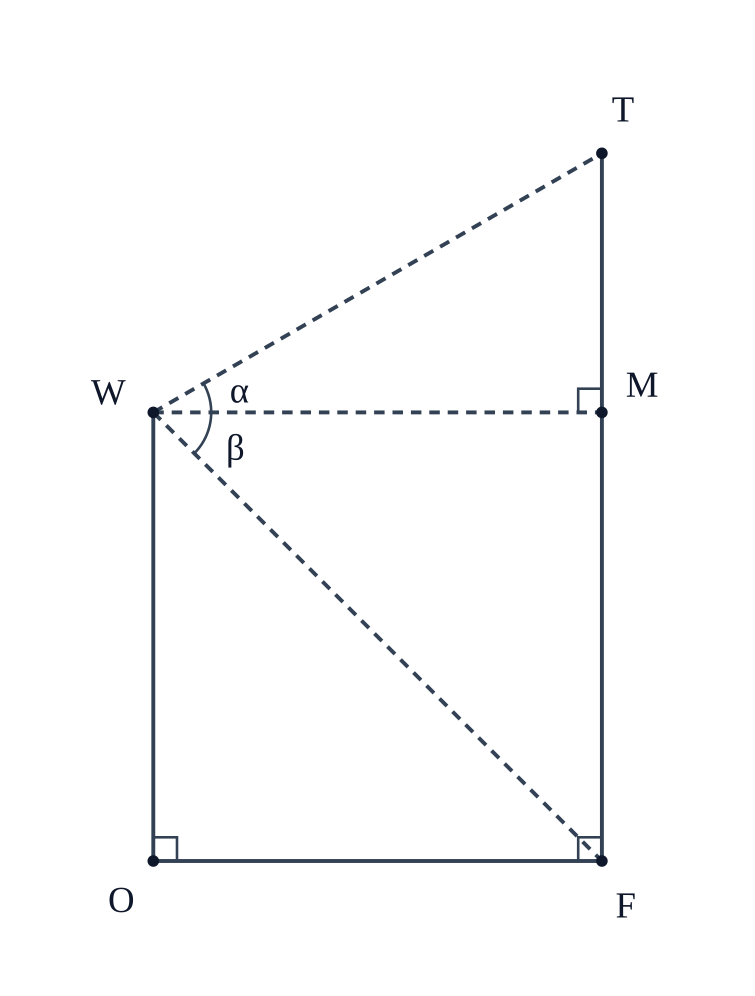 \[\tan\beta=\frac{MF}{WM}=\frac{h}{d} \implies d=h\cot\beta \]
\[\tan\alpha=\frac{MT}{WM}=\frac{H-h}{d} \]
\[H-h = d\tan\alpha = h\cot\beta\tan\alpha \]
\[H = h(1+\tan\alpha\cot\beta) \]
Answer: \(\displaystyle H=h(1+\tan\alpha\cot\beta)\) m.
\[\tan\beta=\frac{MF}{WM}=\frac{h}{d} \implies d=h\cot\beta \]
\[\tan\alpha=\frac{MT}{WM}=\frac{H-h}{d} \]
\[H-h = d\tan\alpha = h\cot\beta\tan\alpha \]
\[H = h(1+\tan\alpha\cot\beta) \]
Answer: \(\displaystyle H=h(1+\tan\alpha\cot\beta)\) m.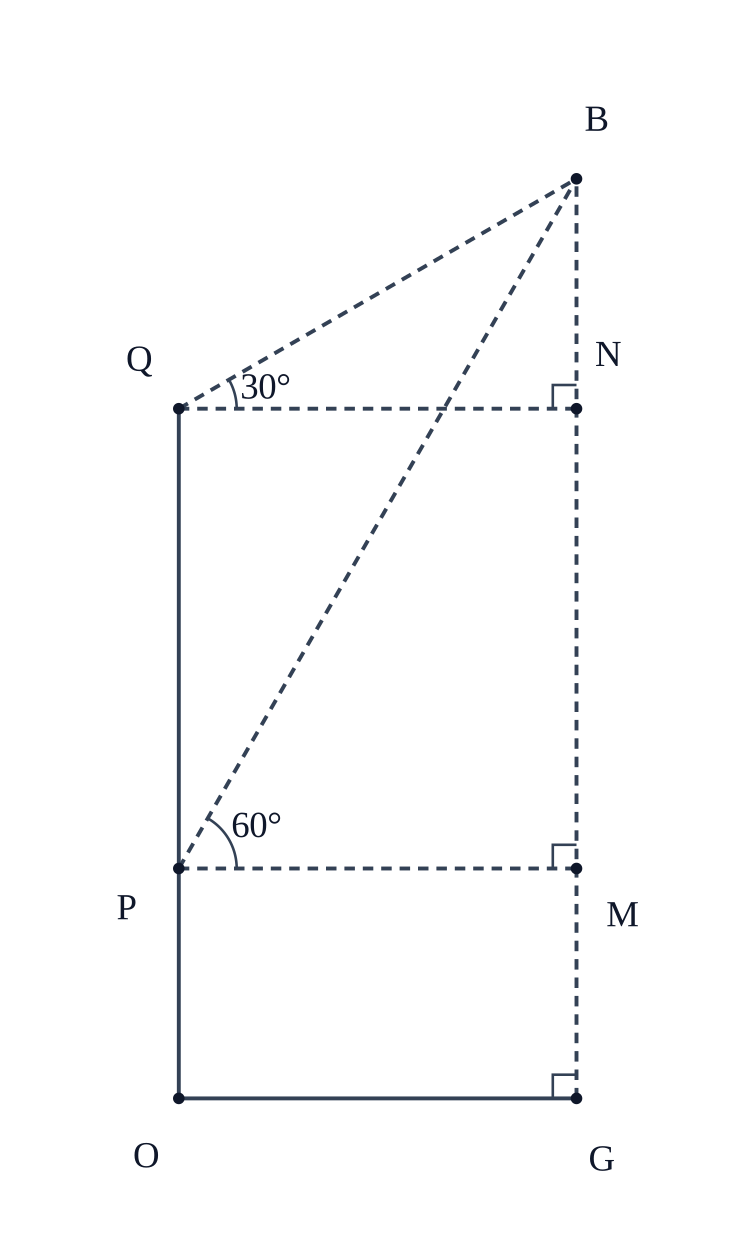 \[\tan 60^\circ = \frac{BM}{PM}=\frac{H-2}{d} \implies d=\frac{H-2}{\sqrt3} \]
\[\tan 30^\circ = \frac{BN}{QN}=\frac{H-6}{d} \implies d=\sqrt3(H-6) \]
\[\frac{H-2}{\sqrt3} = \sqrt3(H-6) \implies H-2=3(H-6) \]
\[2H=16 \implies H=8 \]
Answer: the balloon is \(\displaystyle 8\) m above the ground.
\[\tan 60^\circ = \frac{BM}{PM}=\frac{H-2}{d} \implies d=\frac{H-2}{\sqrt3} \]
\[\tan 30^\circ = \frac{BN}{QN}=\frac{H-6}{d} \implies d=\sqrt3(H-6) \]
\[\frac{H-2}{\sqrt3} = \sqrt3(H-6) \implies H-2=3(H-6) \]
\[2H=16 \implies H=8 \]
Answer: the balloon is \(\displaystyle 8\) m above the ground.