SolveIt is under development
SolveItNCERT · CBSE · NEET

NCERT Exemplar · Class 10 Mathematics Introduction to Trigonometry and its Applications

60 questions · 60 still being checked

EXERCISE 8.4 1–10 (part 6 of 7)

  1. Exercise 1

    If cosec⁡θ+cot⁡θ=p\displaystyle \operatorname{cosec} \theta+\cot \theta=p, then prove that cos⁡θ=p2−1p2+1\displaystyle \cos \theta=\frac{p^2-1}{p^2+1}.

    Not cross-checked

    NCERT prints no numerical answer for this exercise, so this working has not been cross-checked against the book.

    \[\operatorname{cosec}\theta+\cot\theta=p \] \[(\operatorname{cosec}\theta+\cot\theta)(\operatorname{cosec}\theta-\cot\theta)=\operatorname{cosec}^2\theta-\cot^2\theta=1 \] \[\operatorname{cosec}\theta-\cot\theta=\frac{1}{p} \] Adding: \[2\operatorname{cosec}\theta=p+\frac{1}{p}=\frac{p^2+1}{p} \] Subtracting: \[2\cot\theta=p-\frac{1}{p}=\frac{p^2-1}{p} \] \[\cos\theta=\frac{\cot\theta}{\operatorname{cosec}\theta}=\frac{p^2-1}{p^2+1} \] Answer: \(\displaystyle \cos\theta=\dfrac{p^2-1}{p^2+1}\)
  2. Exercise 2

    Prove that sec⁡2θ+cosec⁡2θ=tan⁡θ+cot⁡θ\displaystyle \sqrt{\sec ^2 \theta+\operatorname{cosec}^2 \theta}=\tan \theta+\cot \theta

    Not cross-checked

    NCERT prints no numerical answer for this exercise, so this working has not been cross-checked against the book.

    \[\sec^2\theta+\operatorname{cosec}^2\theta=\frac{1}{\cos^2\theta}+\frac{1}{\sin^2\theta}=\frac{\sin^2\theta+\cos^2\theta}{\sin^2\theta\cos^2\theta}=\frac{1}{\sin^2\theta\cos^2\theta} \] \[\sqrt{\sec^2\theta+\operatorname{cosec}^2\theta}=\frac{1}{\sin\theta\cos\theta} \] \[\tan\theta+\cot\theta=\frac{\sin\theta}{\cos\theta}+\frac{\cos\theta}{\sin\theta}=\frac{\sin^2\theta+\cos^2\theta}{\sin\theta\cos\theta}=\frac{1}{\sin\theta\cos\theta} \] Answer: \(\displaystyle \sqrt{\sec^2\theta+\operatorname{cosec}^2\theta}=\tan\theta+\cot\theta=\dfrac{1}{\sin\theta\cos\theta}\)
  3. Exercise 3

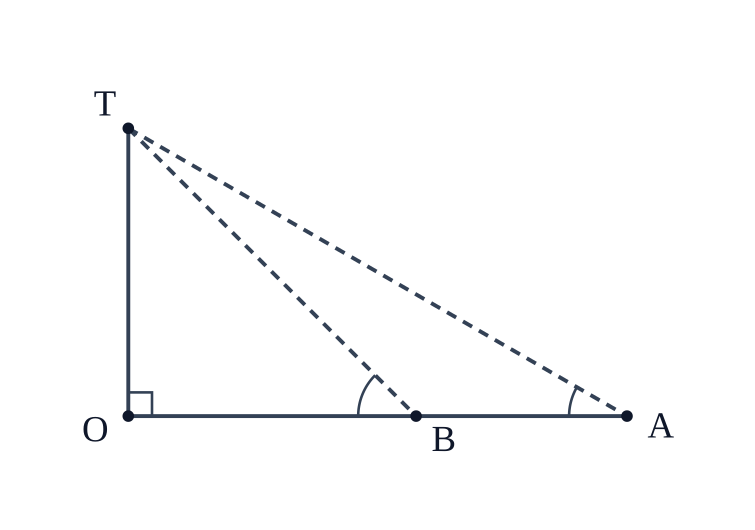
    The angle of elevation of the top of a tower from certain point is 30\displaystyle 30°. If the observer moves 20\displaystyle 20 metres towards the tower, the angle of elevation of the top increases by 15\displaystyle 15°. Find the height of the tower.

    Matches the book, not yet reviewed

    This working reaches the answer NCERT prints. It has not yet been read through by hand.

    NCERT’s answer
    \(\displaystyle 10(\sqrt{3}+1) \mathrm{~m}\)
    Let the tower be \(\displaystyle OT=h\). The far point \(\displaystyle A\) has elevation \(\displaystyle 30^\circ\); after moving \(\displaystyle 20\) m to \(\displaystyle B\) it is \(\displaystyle 30^\circ+15^\circ=45^\circ\), so \(\displaystyle AB=20\). NCERT_Solution_Class10_Maths_Exemplar_Ch8_Ex8-4_Q3 \[\tan 30^\circ=\frac{h}{OA} \quad\Rightarrow\quad OA=h\sqrt3 \] \[\tan 45^\circ=\frac{h}{OB} \quad\Rightarrow\quad OB=h \] \[OA-OB=AB \quad\Rightarrow\quad h\sqrt3-h=20 \] \[h=\frac{20}{\sqrt3-1}=\frac{20(\sqrt3+1)}{2}=10(\sqrt3+1) \] Answer: \(\displaystyle 10(\sqrt3+1)\) m
  4. Exercise 4

    If 1+sin⁡2θ=3sin⁡θcos⁡θ\displaystyle 1+\sin ^2 \theta=3 \sin \theta \cos \theta, then prove that tan⁡θ=1\displaystyle \tan \theta=1 or 12\displaystyle \frac{1}{2}.

    Not cross-checked

    NCERT prints no numerical answer for this exercise, so this working has not been cross-checked against the book.

    \[1+\sin^2\theta=3\sin\theta\cos\theta \] Divide by \(\displaystyle \cos^2\theta\): \[\sec^2\theta+\tan^2\theta=3\tan\theta \] \[(1+\tan^2\theta)+\tan^2\theta=3\tan\theta \] \[2\tan^2\theta-3\tan\theta+1=0 \] \[\tan\theta=\frac{3\pm\sqrt{9-8}}{4}=\frac{3\pm1}{4} \] \[\tan\theta=1 \quad\text{or}\quad \tan\theta=\frac12 \] Answer: \(\displaystyle \tan\theta=1\) or \(\displaystyle \tan\theta=\tfrac12\)
  5. Exercise 5

    Given that sin⁡θ+2cos⁡θ=1\displaystyle \sin \theta+2 \cos \theta=1, then prove that 2sin⁡θ−cos⁡θ=2\displaystyle 2 \sin \theta-\cos \theta=2.

    Not cross-checked

    NCERT prints no numerical answer for this exercise, so this working has not been cross-checked against the book.

    \[\sin\theta+2\cos\theta=1 \quad\Rightarrow\quad \sin\theta=1-2\cos\theta \] \[\sin^2\theta=1-4\cos\theta+4\cos^2\theta \] Use \(\displaystyle \sin^2\theta=1-\cos^2\theta\): \[1-\cos^2\theta=1-4\cos\theta+4\cos^2\theta \] \[5\cos^2\theta-4\cos\theta=0 \quad\Rightarrow\quad \cos\theta(5\cos\theta-4)=0 \] \[\cos\theta=0 \quad\text{or}\quad \cos\theta=\frac45 \] For \(\displaystyle \cos\theta=\frac45\): \(\displaystyle \sin\theta=1-\frac85=-\frac35\), impossible for \(\displaystyle \theta\in[0^\circ,90^\circ]\). So \(\displaystyle \cos\theta=0,\ \sin\theta=1\). \[2\sin\theta-\cos\theta=2(1)-0=2 \] Answer: \(\displaystyle 2\sin\theta-\cos\theta=2\)
  6. Exercise 6

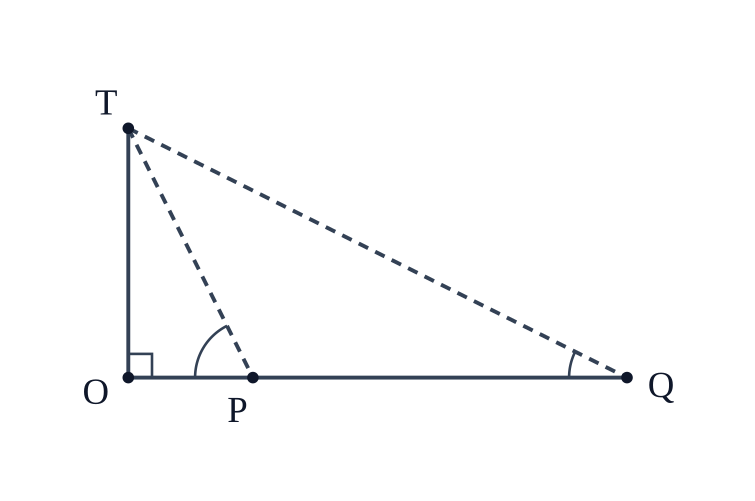
    The angle of elevation of the top of a tower from two points distant s\displaystyle s and t\displaystyle t from its foot are complementary. Prove that the height of the tower is st\displaystyle \sqrt{s t}.

    Not cross-checked

    NCERT prints no numerical answer for this exercise, so this working has not been cross-checked against the book.

    Let the tower be \(\displaystyle OT=h\), with \(\displaystyle OP=s\) and \(\displaystyle OQ=t\). If the elevation at \(\displaystyle P\) is \(\displaystyle \alpha\), the elevation at \(\displaystyle Q\) is \(\displaystyle 90^\circ-\alpha\). NCERT_Solution_Class10_Maths_Exemplar_Ch8_Ex8-4_Q6 \[\tan\alpha=\frac{h}{s} \] \[\tan(90^\circ-\alpha)=\cot\alpha=\frac{h}{t} \] \[\tan\alpha\cdot\cot\alpha=1 \quad\Rightarrow\quad \frac{h}{s}\cdot\frac{h}{t}=1 \] \[h^2=st \quad\Rightarrow\quad h=\sqrt{st} \] Answer: \(\displaystyle h=\sqrt{st}\)
  7. Exercise 7

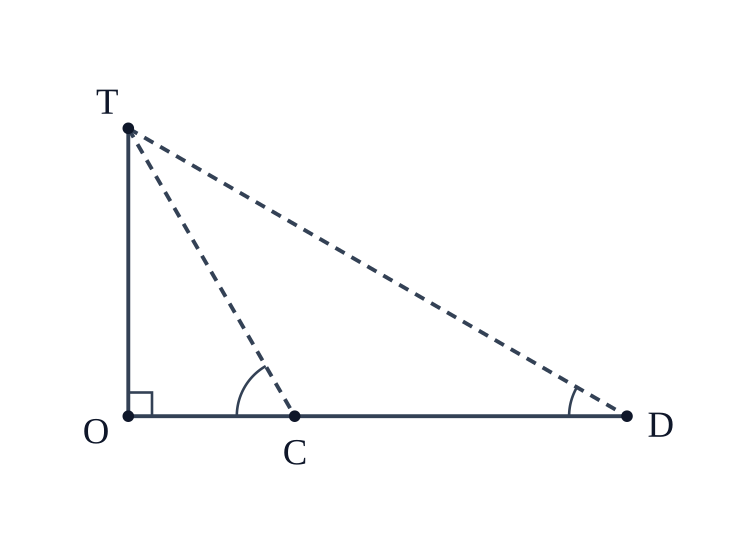
    The shadow of a tower standing on a level plane is found to be 50\displaystyle 50 m longer when Sun's elevation is 30∘\displaystyle 30^{\circ} than when it is 60∘\displaystyle 60^{\circ}. Find the height of the tower.

    Matches the book, not yet reviewed

    This working reaches the answer NCERT prints. It has not yet been read through by hand.

    NCERT’s answer
    \(\displaystyle 25 \sqrt{3} \mathrm{~m}\)
    Let the tower be \(\displaystyle OT=h\); the near point is \(\displaystyle C\) (elevation \(\displaystyle 60^\circ\)) and the far point \(\displaystyle D\) (elevation \(\displaystyle 30^\circ\)), \(\displaystyle CD=50\). NCERT_Solution_Class10_Maths_Exemplar_Ch8_Ex8-4_Q7 \[\tan 60^\circ=\frac{h}{OC} \quad\Rightarrow\quad OC=\frac{h}{\sqrt3} \] \[\tan 30^\circ=\frac{h}{OD} \quad\Rightarrow\quad OD=h\sqrt3 \] \[OD-OC=CD \quad\Rightarrow\quad h\sqrt3-\frac{h}{\sqrt3}=50 \] \[\frac{3h-h}{\sqrt3}=50 \quad\Rightarrow\quad \frac{2h}{\sqrt3}=50 \] \[h=25\sqrt3 \] Answer: \(\displaystyle 25\sqrt3\) m
  8. Exercise 8

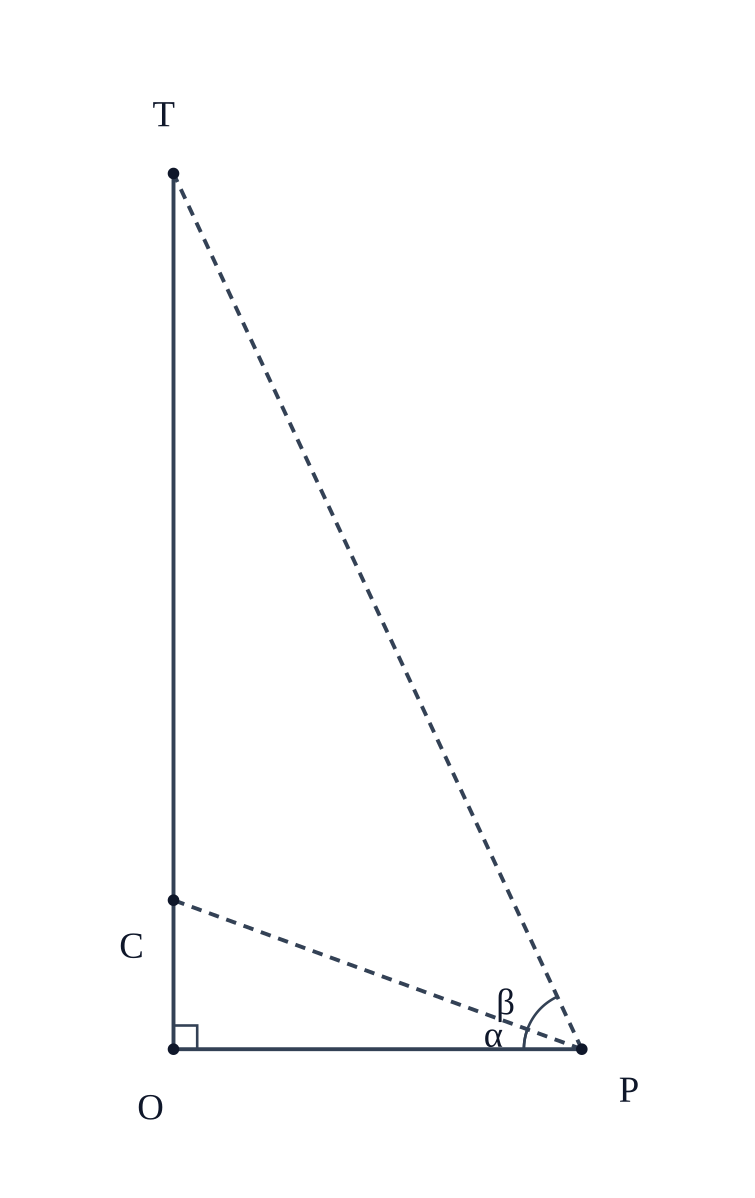
    A vertical tower stands on a horizontal plane and is surmounted by a vertical flag staff of height h\displaystyle h. At a point on the plane, the angles of elevation of the bottom and the top of the flag staff are α\displaystyle \alpha and β\displaystyle \beta, respectively. Prove that the height of the tower is (htan⁡αtan⁡β−tan⁡α)\displaystyle \left(\frac{h \tan \alpha}{\tan \beta-\tan \alpha}\right).

    Not cross-checked

    NCERT prints no numerical answer for this exercise, so this working has not been cross-checked against the book.

    Let the tower be \(\displaystyle OC=H\) and the flagstaff \(\displaystyle CT=h\); from \(\displaystyle P\) on the plane, \(\displaystyle \angle CPO=\alpha\), \(\displaystyle \angle TPO=\beta\), \(\displaystyle OP=d\). NCERT_Solution_Class10_Maths_Exemplar_Ch8_Ex8-4_Q8 \[\tan\alpha=\frac{H}{d} \quad\Rightarrow\quad d=H\cot\alpha \] \[\tan\beta=\frac{H+h}{d} \quad\Rightarrow\quad d=(H+h)\cot\beta \] \[H\cot\alpha=(H+h)\cot\beta \] \[H(\cot\alpha-\cot\beta)=h\cot\beta \] \[H=\frac{h\cot\beta}{\cot\alpha-\cot\beta}=\frac{h\cot\beta\cdot\tan\alpha\tan\beta}{(\cot\alpha-\cot\beta)\tan\alpha\tan\beta}=\frac{h\tan\alpha}{\tan\beta-\tan\alpha} \] Answer: \(\displaystyle H=\dfrac{h\tan\alpha}{\tan\beta-\tan\alpha}\)
  9. Exercise 9

    If tan⁡θ+sec⁡θ=l\displaystyle \tan \theta+\sec \theta=l, then prove that sec⁡θ=l2+12l\displaystyle \sec \theta=\frac{l^2+1}{2 l}.

    Not cross-checked

    NCERT prints no numerical answer for this exercise, so this working has not been cross-checked against the book.

    \[\tan\theta+\sec\theta=l \] \[\sec^2\theta-\tan^2\theta=1 \quad\Rightarrow\quad (\sec\theta-\tan\theta)(\sec\theta+\tan\theta)=1 \] \[\sec\theta-\tan\theta=\frac1l \] Adding: \[2\sec\theta=l+\frac1l=\frac{l^2+1}{l} \] \[\sec\theta=\frac{l^2+1}{2l} \] Answer: \(\displaystyle \sec\theta=\dfrac{l^2+1}{2l}\)
  10. Exercise 10

    If sin⁡θ+cos⁡θ=p\displaystyle \sin \theta+\cos \theta=p and sec⁡θ+cosec⁡θ=q\displaystyle \sec \theta+\operatorname{cosec} \theta=q, then prove that q(p2−1)=2p\displaystyle q\left(p^2-1\right)=2 p.

    Not cross-checked

    NCERT prints no numerical answer for this exercise, so this working has not been cross-checked against the book.

    \[p^2=(\sin\theta+\cos\theta)^2=1+2\sin\theta\cos\theta \quad\Rightarrow\quad p^2-1=2\sin\theta\cos\theta \] \[q=\sec\theta+\operatorname{cosec}\theta=\frac{1}{\cos\theta}+\frac{1}{\sin\theta}=\frac{\sin\theta+\cos\theta}{\sin\theta\cos\theta}=\frac{p}{\sin\theta\cos\theta} \] \[q(p^2-1)=\frac{p}{\sin\theta\cos\theta}\cdot2\sin\theta\cos\theta=2p \] Answer: \(\displaystyle q(p^2-1)=2p\)