SolveIt is under development
SolveItNCERT · CBSE · NEET

NCERT Exemplar · Class 10 Mathematics Introduction to Trigonometry and its Applications

60 questions · 60 still being checked

EXERCISE 8.2 1–12 (part 3 of 7)

  1. Write 'True' or 'False' and justify your answer in each of the following:

    Exercise 1

    tan⁡47∘cot⁡43∘=1\displaystyle \frac{\tan 47^{\circ}}{\cot 43^{\circ}}=1

    Matches the book, not yet reviewed

    This working reaches the answer NCERT prints. It has not yet been read through by hand.

    NCERT’s answer
    True
    True, since \(\displaystyle \cot 43^{\circ}\) is the co-function of \(\displaystyle \tan 47^{\circ}\). \[\cot 43^{\circ} = \tan(90^{\circ}-43^{\circ}) = \tan 47^{\circ} \] \[\frac{\tan 47^{\circ}}{\cot 43^{\circ}} = \frac{\tan 47^{\circ}}{\tan 47^{\circ}} = 1 \]
  2. Exercise 2

    The value of the expression (cos⁡223∘−sin⁡267∘)\displaystyle \left(\cos ^2 23^{\circ}-\sin ^2 67^{\circ}\right) is positive.

    Matches the book, not yet reviewed

    This working reaches the answer NCERT prints. It has not yet been read through by hand.

    NCERT’s answer
    False
    False, the co-function identity makes the expression zero, not positive. \[\sin 67^{\circ} = \cos(90^{\circ}-67^{\circ}) = \cos 23^{\circ} \] \[\cos^2 23^{\circ} - \sin^2 67^{\circ} = \cos^2 23^{\circ} - \cos^2 23^{\circ} = 0 \]
  3. Exercise 3

    The value of the expression (sin⁡80∘−cos⁡80∘)\displaystyle \left(\sin 80^{\circ}-\cos 80^{\circ}\right) is negative.

    Matches the book, not yet reviewed

    This working reaches the answer NCERT prints. It has not yet been read through by hand.

    NCERT’s answer
    False [\(\displaystyle \sin 80^{\circ}-\sin 10^{\circ}=\) positive : as \(\displaystyle \theta\) increases, value of \(\displaystyle \sin \theta\) increases ]
    False. \(\displaystyle \sin\theta\) increases and \(\displaystyle \cos\theta\) decreases on \(\displaystyle 0^{\circ}\) to \(\displaystyle 90^{\circ}\), equal only at \(\displaystyle 45^{\circ}\), so for \(\displaystyle 80^{\circ}>45^{\circ}\): \[\sin 80^{\circ} > \cos 80^{\circ} \] \[\sin 80^{\circ} - \cos 80^{\circ} > 0 \]
  4. Exercise 4

    (1−cos⁡2θ)sec⁡2θ=tan⁡θ\displaystyle \sqrt{\left(1-\cos ^2 \theta\right) \sec ^2 \theta}=\tan \theta

    Matches the book, not yet reviewed

    This working reaches the answer NCERT prints. It has not yet been read through by hand.

    NCERT’s answer
    True
    True, for an angle of a right triangle \(\displaystyle 0^{\circ}\le\theta<90^{\circ}\), where \(\displaystyle \tan\theta\ge 0\). \[(1-\cos^2\theta)\sec^2\theta = \sin^2\theta\sec^2\theta = \tan^2\theta \] \[\sqrt{\tan^2\theta} = \tan\theta \quad (\tan\theta \ge 0) \]
  5. Exercise 5

    If cos⁡A+cos⁡2A=1\displaystyle \cos \mathrm{A}+\cos ^2 \mathrm{A}=1, then sin⁡2A+sin⁡4A=1\displaystyle \sin ^2 \mathrm{A}+\sin ^4 \mathrm{A}=1.

    Matches the book, not yet reviewed

    This working reaches the answer NCERT prints. It has not yet been read through by hand.

    NCERT’s answer
    True
    True. \[\cos A + \cos^2 A = 1 \implies \cos A = 1-\cos^2 A = \sin^2 A \] \[\sin^2 A + \sin^4 A = \cos A + \cos^2 A = 1 \]
  6. Exercise 6

    (tan⁡θ+2)(2tan⁡θ+1)=5tan⁡θ+sec⁡2θ\displaystyle (\tan \theta+2)(2 \tan \theta+1)=5 \tan \theta+\sec ^2 \theta.

    Matches the book, not yet reviewed

    This working reaches the answer NCERT prints. It has not yet been read through by hand.

    NCERT’s answer
    False
    False, the two sides differ by \(\displaystyle \tan^2\theta+1\). \[(\tan\theta+2)(2\tan\theta+1) = 2\tan^2\theta+5\tan\theta+2 \] \[5\tan\theta+\sec^2\theta = 5\tan\theta+1+\tan^2\theta = \tan^2\theta+5\tan\theta+1 \] \[2\tan^2\theta+5\tan\theta+2 \;\neq\; \tan^2\theta+5\tan\theta+1 \]
  7. Exercise 7

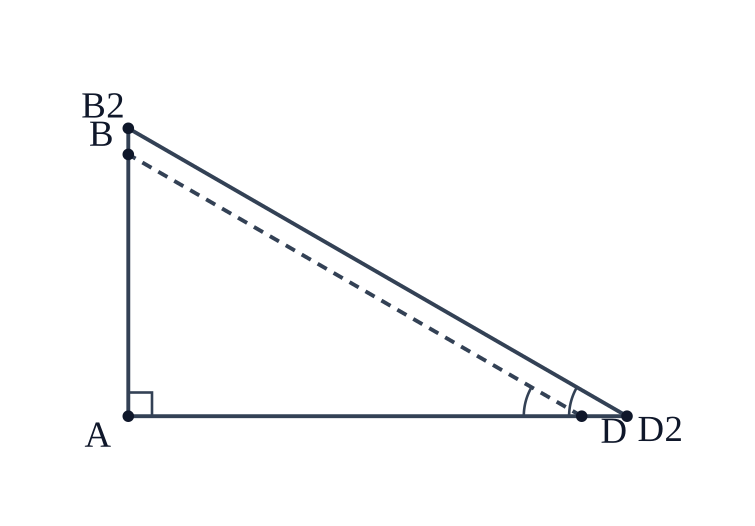
    If the length of the shadow of a tower is increasing, then the angle of elevation of the sun is also increasing.

    Matches the book, not yet reviewed

    This working reaches the answer NCERT prints. It has not yet been read through by hand.

    NCERT’s answer
    False
    False. NCERT_Solution_Class10_Maths_Exemplar_Ch8_Ex8-2_Q7 \[\tan\theta = \frac{h}{s} \] Height \(\displaystyle h\) is fixed; as shadow length \(\displaystyle s\) grows, \(\displaystyle \tan\theta\) falls, so \(\displaystyle \theta\) falls too.
  8. Exercise 8

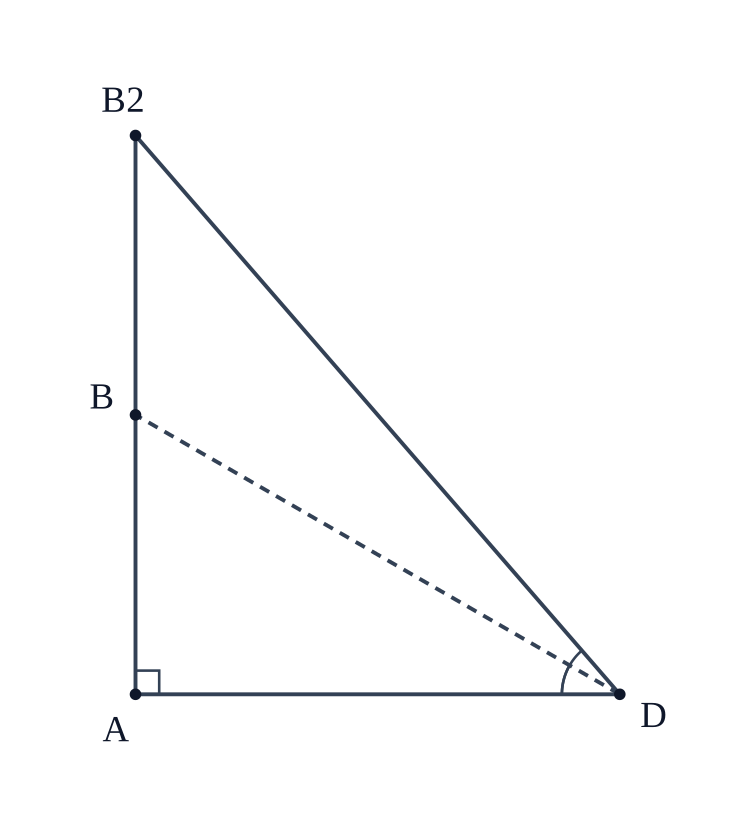
    If a man standing on a platform 3\displaystyle 3 metres above the surface of a lake observes a cloud and its reflection in the lake, then the angle of elevation of the cloud is equal to the angle of depression of its reflection.

    Matches the book, not yet reviewed

    This working reaches the answer NCERT prints. It has not yet been read through by hand.

    NCERT’s answer
    False
    False. NCERT_Solution_Class10_Maths_Exemplar_Ch8_Ex8-2_Q8 Let the cloud \(\displaystyle C\) be \(\displaystyle h\) above the lake and \(\displaystyle d\) away horizontally. The reflection \(\displaystyle C'\) is as far below the lake as \(\displaystyle C\) is above it. \[\tan(\text{elevation}) = \frac{h-3}{d} \] \[\tan(\text{depression}) = \frac{h+3}{d} \] \[h+3 > h-3 \implies \text{depression} > \text{elevation} \]
  9. Exercise 9

    The value of 2sin⁡θ\displaystyle 2 \sin \theta can be a+1a\displaystyle a+\frac{1}{a} \quad, where a\displaystyle a is a positive number, and a≠1\displaystyle a \neq 1.

    Matches the book, not yet reviewed

    This working reaches the answer NCERT prints. It has not yet been read through by hand.

    NCERT’s answer
    False
    False. \[a+\frac{1}{a} \ge 2 \quad \text{(AM–GM, equality iff } a=1\text{)} \] Since \(\displaystyle a\neq 1\), \(\displaystyle a+\frac{1}{a}>2\), while \(\displaystyle 2\sin\theta\le 2\) always, so equality is impossible.
  10. Exercise 10

    cos⁡θ=a2+b22ab\displaystyle \cos \theta=\frac{a^2+b^2}{2 a b}, where a\displaystyle a and b\displaystyle b are two distinct numbers such that ab>0\displaystyle a b>0.

    Matches the book, not yet reviewed

    This working reaches the answer NCERT prints. It has not yet been read through by hand.

    NCERT’s answer
    False
    False. \[(a-b)^2>0 \implies a^2+b^2>2ab \] Since \(\displaystyle ab>0\), dividing by \(\displaystyle 2ab\) gives \[\frac{a^2+b^2}{2ab}>1 \] but \(\displaystyle \cos\theta\le 1\) always, so equality is impossible.
  11. Exercise 11

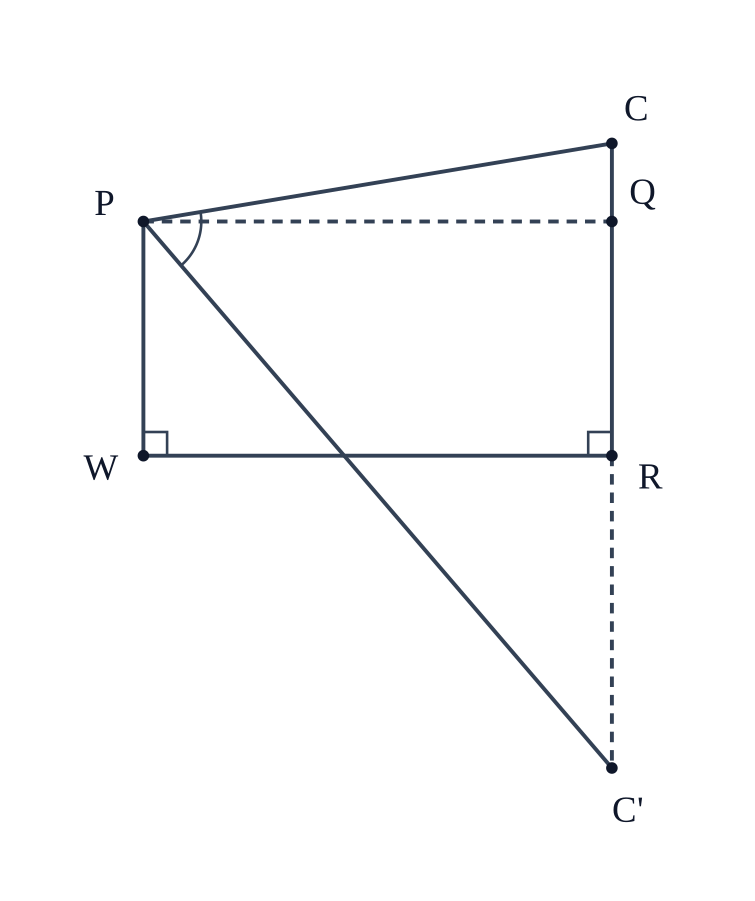
    The angle of elevation of the top of a tower is 30\displaystyle 30°. If the height of the tower is doubled, then the angle of elevation of its top will also be doubled.

    Matches the book, not yet reviewed

    This working reaches the answer NCERT prints. It has not yet been read through by hand.

    NCERT’s answer
    False
    False. NCERT_Solution_Class10_Maths_Exemplar_Ch8_Ex8-2_Q11 \[\tan\theta=\frac{h}{d}, \qquad \tan\theta'=\frac{2h}{d}=2\tan\theta \] Tangent is not linear, so \(\displaystyle \theta'\ne 2\theta\); doubling \(\displaystyle h\) takes \(\displaystyle 30^\circ\) to about \(\displaystyle 49^\circ\), not \(\displaystyle 60^\circ\).
  12. Exercise 12

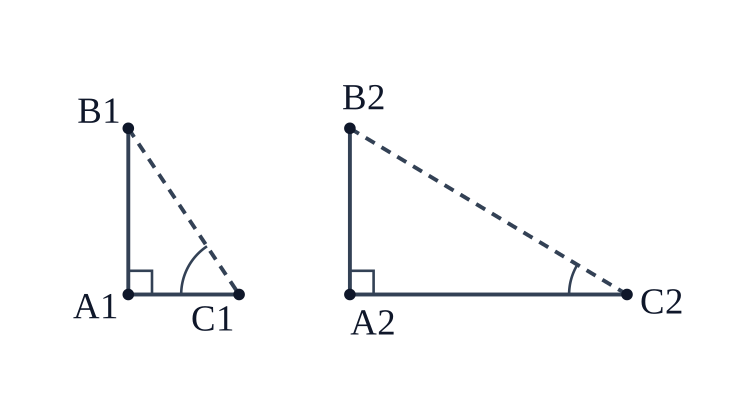
    If the height of a tower and the distance of the point of observation from its foot, both, are increased by 10\displaystyle 10%, then the angle of elevation of its top remains unchanged.

    Matches the book, not yet reviewed

    This working reaches the answer NCERT prints. It has not yet been read through by hand.

    NCERT’s answer
    True
    True. NCERT_Solution_Class10_Maths_Exemplar_Ch8_Ex8-2_Q12 \[\tan\theta=\frac{h}{d} = \frac{1.1h}{1.1d} = \tan\theta' \] Scaling both \(\displaystyle h\) and \(\displaystyle d\) by the same factor leaves their ratio, hence the angle, unchanged.