✓ Board-verified
Physics · 2025 · 4 marks
Dual Nature of Radiation and MatterEinstein’s Photoelectric Equation: Energy Quantum of Radiation4 marksApplycase study
CBSE 2025 · Region 2 · Set 1 · Q30
When a photon of suitable frequency is incident on a metal surface, photoelectron is emitted from it. If the frequency is below a threshold frequency…
When a photon of suitable frequency is incident on a metal surface, photoelectron is emitted from it. If the frequency is below a threshold frequency $\displaystyle \left(v_{\mathrm{o}}\right)$ for the surface, no photoelectron is emitted. For a photon of frequency $\displaystyle v\left(v>v_{\mathrm{o}}\right)$, the kinetic energy of the emitted photoelectrons is $\displaystyle \mathrm{h}\left(v-v_{\mathrm{o}}\right)$. The photocurrent can be stopped by applying a potential $\displaystyle \mathrm{V}_{\mathrm{o}}$ called 'stopping potential' on the anode. Thus maximum kinetic energy of photoelectrons $\displaystyle \mathrm{K}_{\mathrm{m}}=\mathrm{e} \mathrm{V}_{\mathrm{o}}=\mathrm{h}\left(v-v_{\mathrm{o}}\right)$. The experimental graph between $\displaystyle \mathrm{V}_{\mathrm{o}}$ and $\displaystyle v$ for a metal is shown in figure. This is a straight line of slope $\displaystyle \mathrm{m} . \quad$
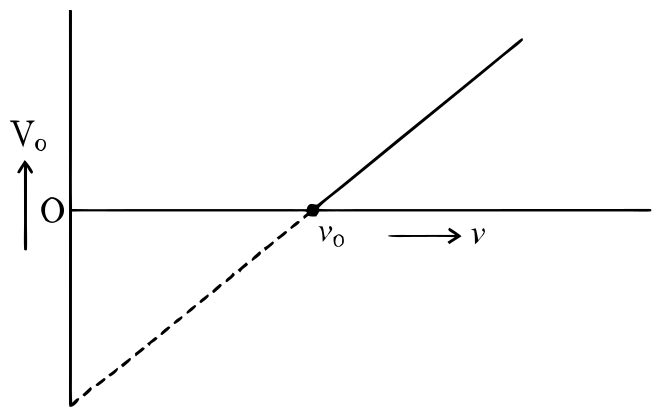
(i)
The straight line graphs obtained for two metals
(A)
coincide each other.
(B)
are parallel to each other.
(C)
are not parallel to each other and cross at a point on $\displaystyle v$-axis.
(D)
are not parallel to each other and do not cross at a point on $\displaystyle v$-axis.
(ii)
The value of Planck's constant for this metal is
(A)
$\displaystyle \frac{\mathrm{e}}{\mathrm{m}}$
(B)
$\displaystyle \frac{1}{\mathrm{me}}$
(C)
me
(D)
$\displaystyle \frac{\mathrm{m}}{\mathrm{e}}$
The intercepts on $\displaystyle v$-axis and $\displaystyle \mathrm{V}_{\mathrm{o}}$-axis of the graph are respectively :
(A)
$\displaystyle v_{\mathrm{o}}, \frac{\mathrm{h} v_{\mathrm{o}}}{\mathrm{e}}$
(B)
$\displaystyle v_{\mathrm{o}}, \mathrm{~h} v_{\mathrm{o}}$
(C)
$\displaystyle \frac{\mathrm{h} v_{\mathrm{o}}}{\mathrm{e}}, v_{\mathrm{o}}$
(D)
$\displaystyle \mathrm{h} v_{\mathrm{o}}, v_{\mathrm{o}}$
When the wavelength of a photon is doubled, how many times its wave number and frequency become, respectively?
(A)
$\displaystyle 2, \frac{1}{2}$
(B)
$\displaystyle \frac{1}{2}, \frac{1}{2}$
(C)
$\displaystyle \frac{1}{2}, 2$
(D)
$\displaystyle 2,2$
(iv)
The momentum of a photon is $\displaystyle 5.0 \times 10^{-29} \mathrm{~kg} . \mathrm{m} / \mathrm{s}$. Ignoring relativistic effects (if any), the wavelength of the photon is
(A)
$\displaystyle 1.33 \mu \mathrm{~m}$
(B)
$\displaystyle 3.3 \mu \mathrm{~m}$
(C)
$\displaystyle 16.6 \mu \mathrm{~m}$
(D)
$\displaystyle 13.3 \mu \mathrm{~m}$
Marking-scheme solution
(i)(B)
are parallel to each other.
(ii)(C)
me
(iv)(D)
$\displaystyle 13.3 \mu \mathrm{m}$
All Dual Nature of Radiation and Matter questions2025 question paperNCERT solutions: Dual Nature of Radiation and MatterPractice Dual Nature of Radiation and Matter →
More from Dual Nature of Radiation and Matter
- The de-Broglie wavelength associated with an electron is 0.30 nm. Calculate: the speed, and the kinetic energy (in eV), of the electron.2022
- In a photoelectric experiment, the emitter plate is irradiated with radiation of 200 nm. The photocurrent becomes zero when the collector plate…2026
- Draw a plot of frequency v of incident radiations as a function of stopping potential V_0 for a given photo emissive material. What information can…2025
- A particle is associated with a de Broglie wave of wavelength 1.2 nm. The kinetic energy of the particle is made four times. Calculate the new value…2023
- de Broglie wavelength λ as a function of 1/(√ K), for two particles of masses m_1 and m_2 are shown in the figure. Here, K is the energy of the…2024
- The energy of a photon of wavelength 663 nm is2023
- Consider a neutron (mass m ) of kinetic energy E and a photon of the same energy. Let λ_n and λ_p be the de Broglie wavelength of neutron and the…2024
- Mention any three features of results of experiment on photoelectric effect which cannot be explained using the wave theory of light. In his…2025
CBSE Class 12 Physics past-paper question from the 2025 board exam, with the answer as CBSE’s own marking scheme gives it. Where our answers come from.