✓ Board-verified
Physics · 2023 · 5 marks
CBSE 2023 · Region 1 · Set 1 · Q31
(a) (i) State Coulomb's law in electrostatics and write it in vector form, for two charges. (ii) 'Gauss's law is based on the inverse-square…
(i)
State Coulomb's law in electrostatics and write it in vector form, for two charges.
(ii)
'Gauss's law is based on the inverse-square dependence on distance contained in the Coulomb's law.' Explain.
(iii)
Two charges A (charge q ) and B (charge $\displaystyle 2$ q ) are located at points $\displaystyle (0,0)$ and $\displaystyle (a, a)$ respectively. Let $\displaystyle \hat{\mathrm{i}}$ and $\displaystyle \hat{\mathrm{j}}$ be the unit vectors along x -axis and y -axis respectively. Find the force exerted by A on B , in terms of $\displaystyle \hat{\mathrm{i}}$ and $\displaystyle \hat{\mathrm{j}}$.
(i)
Derive an expression for the electric field at a point on the equatorial plane of an electric dipole consisting of charges q and -q separated by a distance 2a.
(ii)
The distance of a far off point on the equatorial plane of an electric dipole is halved. How will the electric field be affected for the dipole?
(iii)
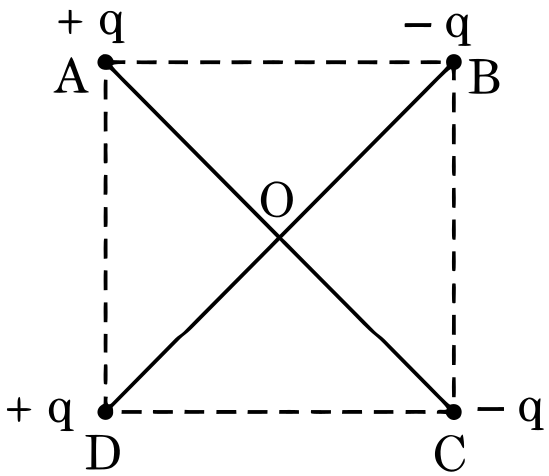
Two identical electric dipoles are placed along the diagonals of a square ABCD of side $\displaystyle \sqrt{2} \mathrm{~m}$ as shown in the figure. Obtain the magnitude and direction of the net electric field at the centre (O) of the square.
Marking-scheme solution
i) Force between two point charges varies inversely with the square of distance between the charges and is directly proportional to the product of magnitude of the two charges and acts along the line joining the two charges.
\[\overrightarrow{F_{12}}=\frac{1}{4 \pi \epsilon_{0}} \frac{\mathrm{q}_{1} \mathrm{q}_{2}}{\mathrm{r}_{12}{ }^{2}} \widehat{\mathrm{r}_{12}}
\]
Alternatively
\(\displaystyle \overrightarrow{F_{12}}=\frac{1}{4 \pi \epsilon_{o}} \frac{\mathrm{q}_{1} \mathrm{q}_{2}}{\mathrm{r}_{12}{ }^{3}} \overrightarrow{\mathrm{r}_{12}}\)
Where \(\displaystyle \overrightarrow{\mathrm{r}_{12}}\) is a vector from charge \(\displaystyle \mathrm{q}_{2}\) to charge \(\displaystyle \mathrm{q}_{1}\).ii) In derivation of Gauss's law, flux is calculated using Coulomb's law and surface area. Here coulomb's law involves \(\displaystyle \frac{1}{\mathrm{r}^{2}}\) factor and surface area involves \(\displaystyle \mathrm{r}^{2}\) factor. When product is taken, the two factors cancel out and flux becomes independent of r.
iii) 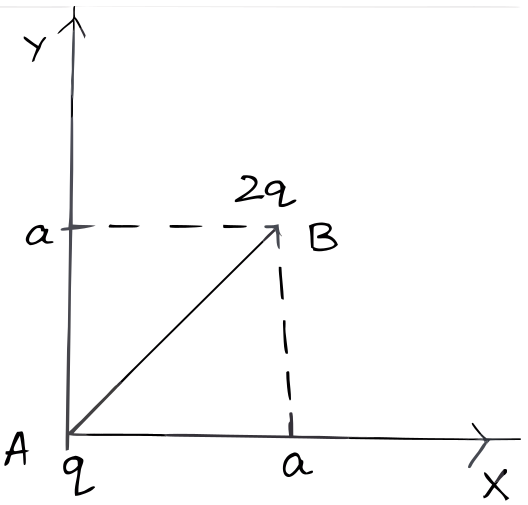
\(\displaystyle \vec{\mathrm{r}}=\overrightarrow{A B}=a \hat{\mathrm{i}}+a \hat{\mathrm{j}}\)
\(\displaystyle \mathrm{r}=|\overrightarrow{A B}|=\sqrt{a^{2}+a^{2}}=\sqrt{2} a\)
\(\displaystyle \vec{F}=\frac{1}{4 \pi \epsilon_{o}} \frac{\mathrm{q}_{1} \mathrm{q}_{2}}{\mathrm{r}^{2}} \hat{\mathrm{r}}\)
All Electric Charges and Fields questions2023 question paperNCERT solutions: Electric Charges and FieldsPractice Electric Charges and Fields →
More from Electric Charges and Fields
- (i) Two point charges +q and -q are held at (a, 0) and ( -a, 0 ) in x-y plane. Obtain an expression for the net electric field due to the charges at…2025
- An electric dipole of dipole moment 1.0 × 10^-12 Cm lies along x -axis. An electric field of magnitude 2.0 × 10^4 NC^-1 is switched on at an instant…2025
- An electric dipole consists of two point charges q and -q separated by a distance 2a. Derive an expression for the electric field E due to this…2026
- Depict the orientation of an electric dipole in stable and unstable equilibrium in an external uniform electric field. Write the potential energy of…2023
- (i) Define electric flux and write its SI unit. (ii) Use Gauss' law to obtain the expression for the electric field due to a uniformly charged…2023
- Two small solid metal balls A and B of radii R and 2 R having charge densities 2 σ and 3 σ respectively are kept far apart. Find the charge densities…2025
- Define the term 'electric flux' and write its dimensions. A plane surface, in shape of a square of side 1 cm is placed in an electric field E=(100…2024
- Three small charged spheres X, Y and Z carrying charges +q,-q and +q respectively are placed equidistant from each other, as shown in the figure. The…2024
CBSE Class 12 Physics past-paper question from the 2023 board exam, with the answer as CBSE’s own marking scheme gives it. Where our answers come from.